
The Song of the Hoe: Anuna, Human Labor, and Nisaba’s Records
A source-backed reading of CDLI P248356 and Q000778, where the Anuna, human formation, labor tools, Enki, Nisaba, and recordkeeping converge.

Ancient text and site reading
How to read this record
- Claim type
- Historical / textual + interpretive
- Evidence level
- Sources, translations, measurements, and symbolic reading where present
Use the evidence layer for sources and observations, and the interpretation layer for TheCode.Wiki synthesis.
Today I chose The Song of the Hoe, CDLI Literary 000778 / Q000778, because the corpus needed a tighter bridge between human labor, tools, recordkeeping, and explicit Anuna language. The strongest anchor is CDLI P248356, a real Old Babylonian witness whose obverse column 1 preserves the selected cluster.

Why This Source
Recent corpus entries have already covered human creation, sustenance, kingship, the me, and law. The remaining gap is more practical: how divine authority touches work, tools, city-building, and records. The Song of the Hoe is valuable because it uses the hoe as the divine instrument by which human emergence and organized labor become possible.
The physical witness discipline matters. P248356 directly preserves the early sequence from the human model and the Anuna through Enki’s praise of the hoe and Nisaba’s responsibility for decisions. The wider composite also says the Anuna rejoice and that the hoe and basket are tools for city-building, but those later lines are used here as context rather than the primary physical-witness claim.

Published Translation And Working Reading
ETCSL’s published translation says that Enlil made the human seed of the Land come forth, set the hoe to work at the place where flesh came forth, placed the first model of mankind in the brick mould, and then the Anuna gods stepped forward to him. It continues with the Anuna calming Enlil in prayer, asking for the black-headed people, and the recruitment of important people to provide for the gods.
My cautious working reading is narrower but important: the tablet does not prove extraterrestrial engineering. It does show that one Sumerian composition can put human formation, divine service, the Anuna, Enki’s approval, Nisaba’s records, and labor tools into one connected theological chain. That is a strong source-backed data point for Tony’s organized-divine-order and human-labor strand.
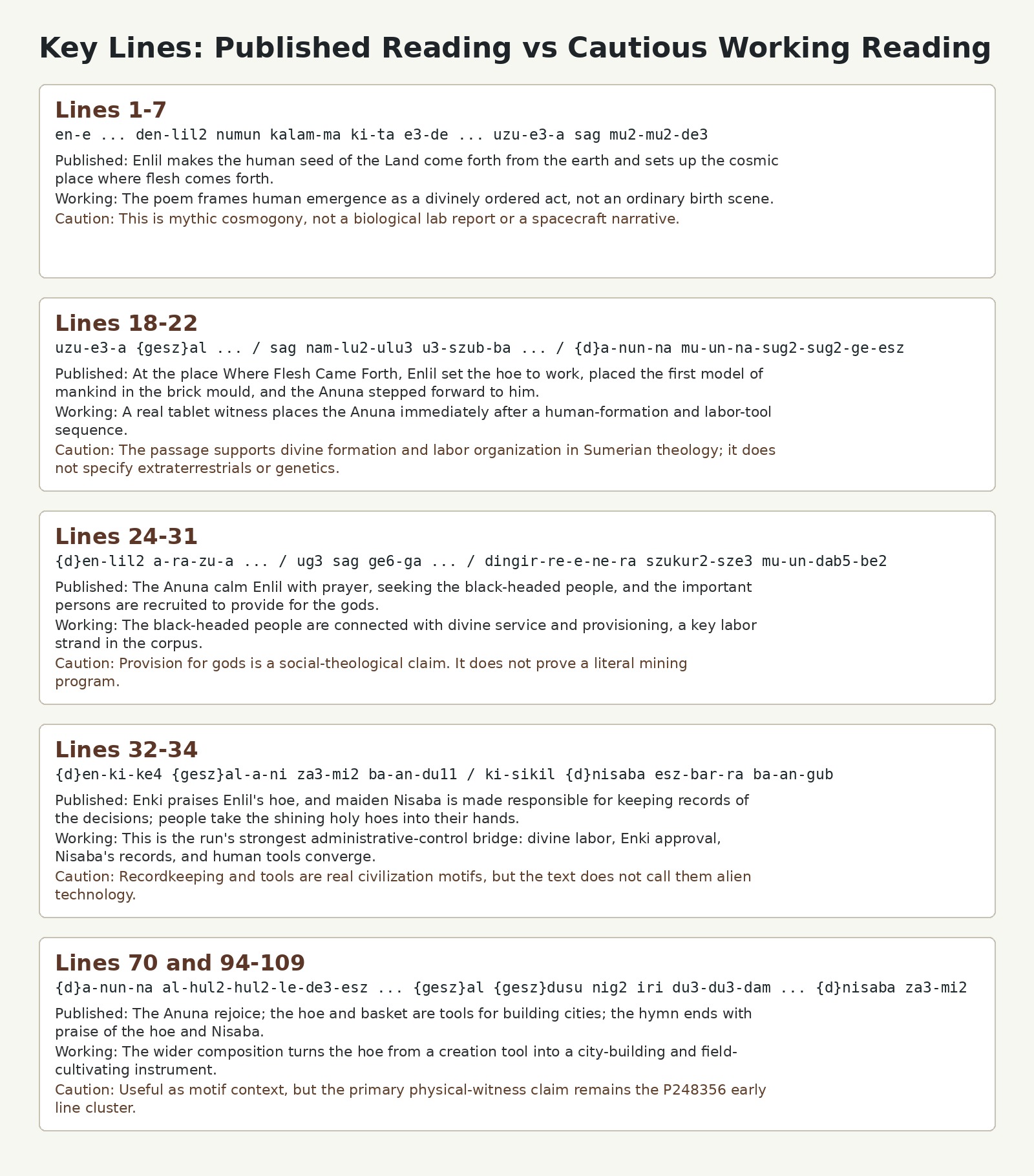
Line Notes
| Lines | Transliteration | Published sense | Cautious working reading | Limit |
|---|---|---|---|---|
| 1-7 | en-e ... den-lil2 numun kalam-ma ki-ta e3-de ... uzu-e3-a sag mu2-mu2-de3 | Enlil makes the human seed of the Land come forth from the earth and sets up the cosmic place where flesh comes forth. | The poem frames human emergence as a divinely ordered act, not an ordinary birth scene. | This is mythic cosmogony, not a biological lab report or a spacecraft narrative. |
| 18-22 | uzu-e3-a {gesz}al ... / sag nam-lu2-ulu3 u3-szub-ba ... / {d}a-nun-na mu-un-na-sug2-sug2-ge-esz | At the place Where Flesh Came Forth, Enlil set the hoe to work, placed the first model of mankind in the brick mould, and the Anuna stepped forward to him. | A real tablet witness places the Anuna immediately after a human-formation and labor-tool sequence. | The passage supports divine formation and labor organization in Sumerian theology; it does not specify extraterrestrials or genetics. |
| 24-31 | {d}en-lil2 a-ra-zu-a ... / ug3 sag ge6-ga ... / dingir-re-e-ne-ra szukur2-sze3 mu-un-dab5-be2 | The Anuna calm Enlil with prayer, seeking the black-headed people, and the important persons are recruited to provide for the gods. | The black-headed people are connected with divine service and provisioning, a key labor strand in the corpus. | Provision for gods is a social-theological claim. It does not prove a literal mining program. |
| 32-34 | {d}en-ki-ke4 {gesz}al-a-ni za3-mi2 ba-an-du11 / ki-sikil {d}nisaba esz-bar-ra ba-an-gub | Enki praises Enlil's hoe, and maiden Nisaba is made responsible for keeping records of the decisions; people take the shining holy hoes into their hands. | This is the run's strongest administrative-control bridge: divine labor, Enki approval, Nisaba's records, and human tools converge. | Recordkeeping and tools are real civilization motifs, but the text does not call them alien technology. |
| 70 and 94-109 | {d}a-nun-na al-hul2-hul2-le-de3-esz ... {gesz}al {gesz}dusu nig2 iri du3-du3-dam ... {d}nisaba za3-mi2 | The Anuna rejoice; the hoe and basket are tools for building cities; the hymn ends with praise of the hoe and Nisaba. | The wider composition turns the hoe from a creation tool into a city-building and field-cultivating instrument. | Useful as motif context, but the primary physical-witness claim remains the P248356 early line cluster. |
Corpus Relevance
- Evidence value: very strong for human labor, tools, and administrative recordkeeping because P248356 joins the human model, Anuna, black-headed people, Enki, Nisaba, and holy hoes in one physical witness.
- Sitchin relevance: high for the claim that Sumerian tradition remembers humans and labor order as arising within an organized divine system. This supports service-to-the-gods and civilization-order strands, while staying below an alien-technology claim.
- Limit: the source does not state extraterrestrial identity, Nibiru, spacecraft, genetic engineering, literal mining, metal machines, or a recoverable technology package.
- Witness discipline: P248356 anchors lines 18-34; composite lines 70 and 94-109 provide wider context for Anuna rejoicing and city-building but are not treated as fully visible on the same tablet.

Source Links
- CDLI artifact P248356 – HMA 9-02857, Old Babylonian literary tablet witness to Song of the Hoe; CDLI ATF preserves the Anuna, Enki, Nisaba, and human-labor sequence on obverse column 1.
- CDLI photo asset for P248356 – Photo-backed physical witness used for the annotated tablet overview.
- CDLI line art for P248356 – Published line art used to orient the selected obverse column 1 passage.
- CDLI composite P478966 / Q000778 – Composite artifact entry for CDLI Literary 000778, Song of the Hoe.
- CDLI composite score Q000778 – Composite score tying P248356 to early Song of the Hoe lines, including the Anuna, Enki, and Nisaba sequence.
- ETCSL translation, Song of the Hoe – Published English translation for lines 1-34, 70, and 94-109.
- ETCSL transliteration, Song of the Hoe – Critical transliteration and cuneiform-source list for ETCSL 5.5.4.
- ORACC AMGG Anunna page – Terminology bridge for Anuna/Anunna/Anunnaki as a divine group.
- ORACC AMGG Nidaba page – Control source for Nisaba/Nidaba as a goddess of writing, grain, and scribal arts.
- ePSD2 Anuna entry – Lexical check for a-nun-na / Anuna as the divine group name.
- ePSD2 namlulu entry – Lexical check for nam-lu2-ulu3 / namlulu, humanity, matching the human-seed and human-model language.
Download the working report: Song of the Hoe, Anuna, human labor, and Nisaba records PDF report.
Bottom line: this source advances the corpus more than another isolated Anuna mention would. It gives a source-backed chain from human formation to labor service, with Enki and Nisaba linking tool use and recorded decisions to the divine order. The honest limit is equally clear: the text remains mythic theology, not direct proof of spacecraft, Nibiru, genetics, or machines.
Share this:

One considered email each week
TheCode Weekly Evidence Brief
Receive the week’s strongest tablet decode, source audit or research update, plus one carefully chosen archive read. Routine posts stay on the site; the Brief is the curated signal.
Free. Usually sent on Sunday. No daily post flood. Unsubscribe at any time. See what the Brief includes.


