
Hammurapi Laws: Anunnaku, Justice, and Royal Decree
A source-backed reading of CDLI P464358 / RIME 4.03.06.add21, where Anunnaku language frames justice, royal decree, public law, and final divine sanction.

Ancient text and site reading
How to read this record
- Claim type
- Historical / textual + interpretive
- Evidence level
- Sources, translations, measurements, and symbolic reading where present
Use the evidence layer for sources and observations, and the interpretation layer for TheCode.Wiki synthesis.
Today I chose the Laws of Hammurapi because the corpus needed a direct legal and decree source, not another creation or temple-praise text. CDLI P464358 / Q006387 preserves an Akkadian royal-legal composition whose prologue calls Anu king of the Anunnaku and whose epilogue invokes all the Anunnaku as part of the final sanctioning curse.
Download the working report: Hammurapi Laws Anunnaku justice PDF report.

The source basis
The primary text control is CDLI inscription 2268595, RIME 4.03.06.add21, the Laws of Hammurapi composite. CDLI P464358 identifies the artifact record as an Old Babylonian official or display composite tied to Babylon, and its JSON witness data includes the Louvre stele Sb 00008 along with later tablet witnesses.
For the visual witness, I used the Louvre object record for SB 8 and a reusable Wikimedia Commons photograph by Sailko under CC BY 2.5. The visual panels are annotated for orientation only. The exact readings in this article come from CDLI's composite text and witness controls, not a new collation from the photograph.

The Anunnaku frame
The opening lines matter. The prologue begins with Anu as king of the Anunnaku and Enlil as lord of heaven and earth who determines the destinies of the land. That is not a loose mythic aside; it is the divine frame for kingship and public justice in one of Mesopotamia's most famous legal monuments.
Hammurapi is then described as the ruler called to make justice prevail in the land, destroy wickedness, and prevent the strong from oppressing the weak. For Tony's thesis test, this is high-value evidence for organized divine authority shaping law and public order. It is not evidence for spacecraft, Nibiru, or machines.

From decree to public legal procedure
The body of the text turns the divine mandate into a public legal program. The transition says truth and justice were established in the land; the first laws treat accusation, river ordeal, witnesses, judge misconduct, and temple/palace property. This is the corpus bridge that was still missing: Anunnaku language framing a legal institution and not only a mythic or temple scene.
The epilogue closes the loop. It invokes the great gods of heaven and earth, all the Anunnaku in their totality, to curse whoever alters or erases the inscription, and then appeals to Enlil's command that cannot be countermanded. The Anunnaku therefore appear at both ends of the legal monument: authority at the opening, sanction at the close.
Line notes
| Line | ATF / line control | Published control | Cautious working reading | Confidence | Limit |
|---|---|---|---|---|---|
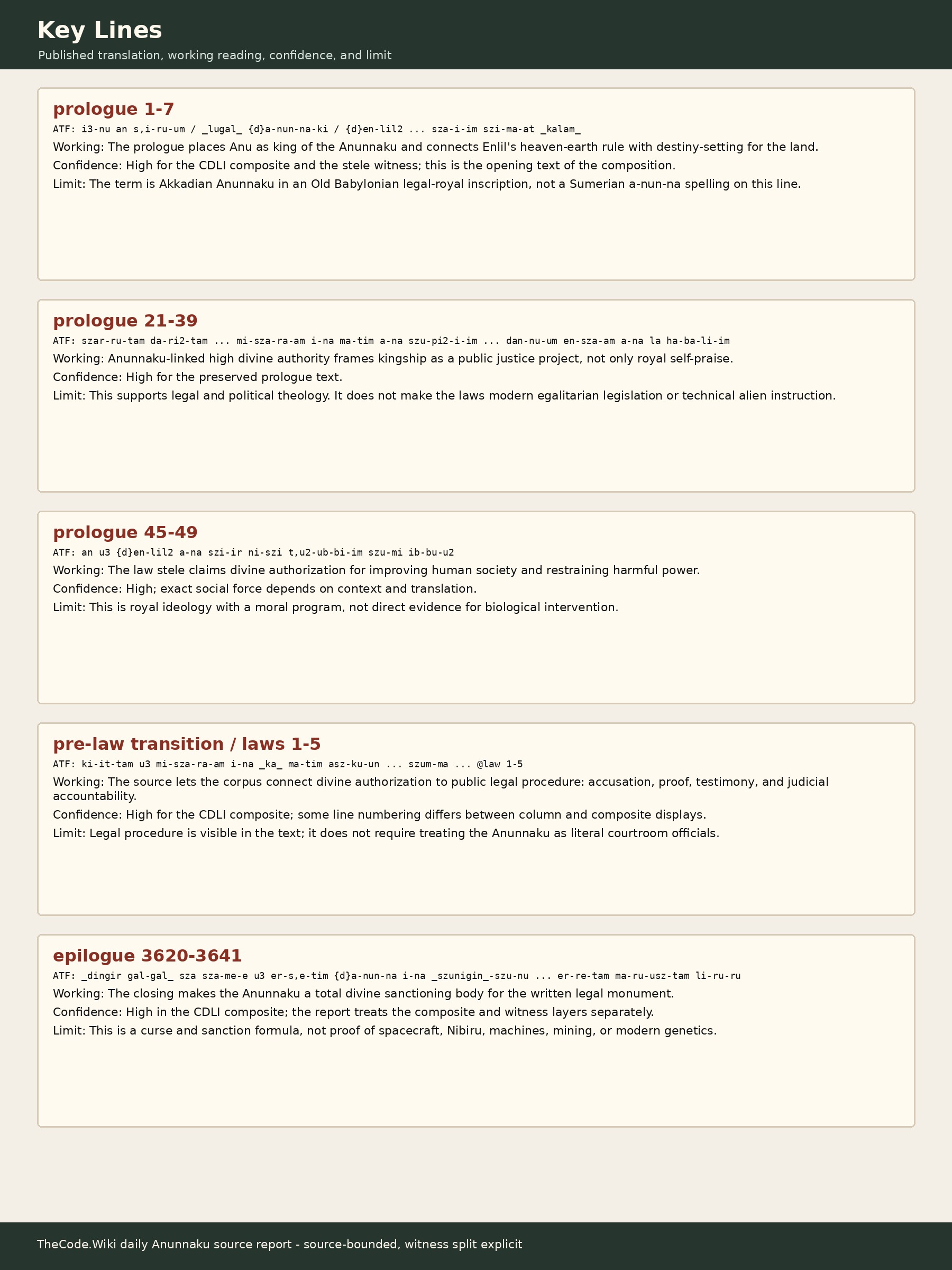
| prologue 1-7 | i3-nu an s,i-ru-um / _lugal_ {d}a-nun-na-ki / {d}en-lil2 ... sza-i-im szi-ma-at _kalam_ | When august Anu, king of the Anunnaku, and Enlil, lord of heaven and earth, who determines the destinies of the land… | The prologue places Anu as king of the Anunnaku and connects Enlil's heaven-earth rule with destiny-setting for the land. | High for the CDLI composite and the stele witness; this is the opening text of the composition. | The term is Akkadian Anunnaku in an Old Babylonian legal-royal inscription, not a Sumerian a-nun-na spelling on this line. |
| prologue 21-39 | szar-ru-tam da-ri2-tam ... mi-sza-ra-am i-na ma-tim a-na szu-pi2-i-im ... dan-nu-um en-sza-am a-na la ha-ba-li-im | Eternal kingship is established; Hammurapi is named to make justice prevail in the land so the strong will not oppress the weak. | Anunnaku-linked high divine authority frames kingship as a public justice project, not only royal self-praise. | High for the preserved prologue text. | This supports legal and political theology. It does not make the laws modern egalitarian legislation or technical alien instruction. |
| prologue 45-49 | an u3 {d}en-lil2 a-na szi-ir ni-szi t,u2-ub-bi-im szu-mi ib-bu-u2 | Anu and Enlil named Hammurapi to improve the flesh/condition of the people. | The law stele claims divine authorization for improving human society and restraining harmful power. | High; exact social force depends on context and translation. | This is royal ideology with a moral program, not direct evidence for biological intervention. |
| pre-law transition / laws 1-5 | ki-it-tam u3 mi-sza-ra-am i-na _ka_ ma-tim asz-ku-un ... szum-ma ... @law 1-5 | Hammurapi says he established truth and justice in the mouth of the land; the first laws handle accusation, ordeal, witness, and judge misconduct. | The source lets the corpus connect divine authorization to public legal procedure: accusation, proof, testimony, and judicial accountability. | High for the CDLI composite; some line numbering differs between column and composite displays. | Legal procedure is visible in the text; it does not require treating the Anunnaku as literal courtroom officials. |
| epilogue 3620-3641 | _dingir gal-gal_ sza sza-me-e u3 er-s,e-tim {d}a-nun-na i-na _szunigin_-szu-nu ... er-re-tam ma-ru-usz-tam li-ru-ru | May the great gods of heaven and earth, all the Anunnaku in their totality, curse the offender with a terrible curse; Enlil's command cannot be countermanded. | The closing makes the Anunnaku a total divine sanctioning body for the written legal monument. | High in the CDLI composite; the report treats the composite and witness layers separately. | This is a curse and sanction formula, not proof of spacecraft, Nibiru, machines, mining, or modern genetics. |
What this does and does not prove
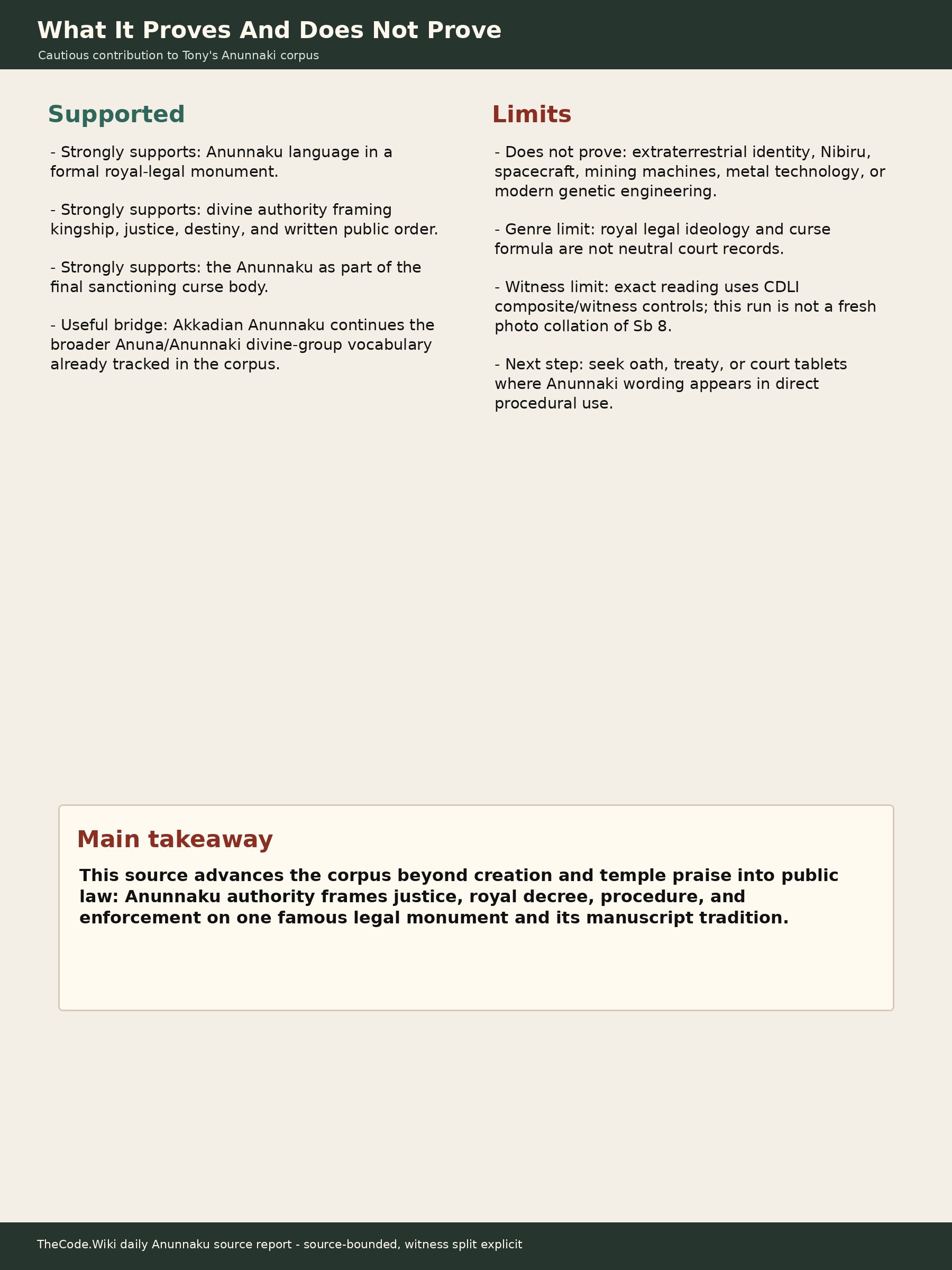
This source strongly supports the legal/decree strand of the corpus: the Anunnaku can appear in a royal legal monument that claims divine authorization for justice, public order, procedure, and enforcement. It also strengthens the Anuna/Anunnaki continuity strand because the Akkadian Anunnaku wording belongs to the same broader divine-group vocabulary tracked in earlier Sumerian and bilingual entries.
The limits are equally important. This is Old Babylonian Akkadian royal ideology and law, not a Sumerian creation myth, a laboratory record, a spaceflight account, or a modern technical manual. It does not state extraterrestrial identity, Nibiru, genetic engineering, literal mining, spacecraft, or metal machines.
Source links
- CDLI artifact P464358 / RIME 4.03.06.add21 – Primary CDLI artifact page for the Laws of Hammurapi composite, with Old Babylonian period metadata, composite text, and witness list.
- CDLI composite text, inscription 2268595 – Line-by-line CDLI text for RIME 4.03.06.add21, including the prologue Anunnaku line, justice frame, laws, and final Anunnaku curse.
- CDLI P464358 JSON metadata and witnesses – Machine-readable metadata and witness data, including the stele witness Sb 00008 and tablet copies of the composition.
- Louvre object record for Code de Hammurabi / SB 8 – Museum record for the Louvre stele, with SB 8 / AS 6064 identifiers, Susa discovery, date range, and display status.
- Wikimedia Commons file page: Codice di hammurabi 03.JPG – Reusable visual source for the annotated stele image; file metadata identifies the photograph as Sailko's own work under CC BY 2.5.
- Wikimedia direct image used for annotations – Image file used to create the annotated overview and detail crop panels.
- ORACC AMGG Anunna page – Terminology context for Sumerian Anunna and Akkadian Anunnaku / Anunnaki usage.
- ePSD2 Anuna lexical entry – Lexical control for the Sumerian divine-group name a-nun-na, useful for the Anuna-to-Anunnaku bridge.
Share this:

One considered email each week
TheCode Weekly Evidence Brief
Receive the week’s strongest tablet decode, source audit or research update, plus one carefully chosen archive read. Routine posts stay on the site; the Brief is the curated signal.
Free. Usually sent on Sunday. No daily post flood. Unsubscribe at any time. See what the Brief includes.


