
Esarhaddon’s Anunnakū Tablet: Divine Order, Ea-like Knowledge, and Human Craft
Exact-image reading of P394681 / Esarhaddon 48: Aššur rules the Anunnakū, while Ea-like knowledge, divination, and named human craftsmen structure cult restoration.

Ancient text and site reading
How to read this record
- Claim type
- Historical / textual + interpretive
- Evidence level
- Sources, translations, measurements, and symbolic reading where present
Use the evidence layer for sources and observations, and the interpretation layer for TheCode.Wiki synthesis.
Today’s exact selected artifact is British Museum K 2801 + K 3053 + K 18057 + DT 252, catalogued by CDLI as P394681 and edited as Esarhaddon 48 / Q003277. Its photograph-visible opening calls Aššur “king of the Igīgū and Anunnakū gods.” The same inscription then supplies an unusually concrete craft dossier: Ea-like knowledge is granted to selected craftsmen, divination validates the workshop, and named human specialists execute the work.

Why this source advances the corpus
The corpus already contains creation-for-labor texts, divine assembly, fate-setting, kingship, law, and building inscriptions. Esarhaddon 48 advances the craft, knowledge, and validation proof gap because it places Anunnakū hierarchy, Ea’s wisdom, taught specialist knowledge, divination, workshops, materials, tools, and human construction procedure in one exact-object dossier.
That connection must be stated carefully. The Anunnakū are named in the divine hierarchy; the craftsmen and work crews—not the Anunnakū—perform the described technical labor. The evidence supports a theology of authorized knowledge transfer, not a claim that non-human engineers physically built the temples.
Exact-object identity and inspection
CDLI P394681 lists accession K 02801 + K 03053 + K 18057 + DT 252, the British Museum collection, and composite Q003277. eBL independently assigns P394681 to K.2801, K.3053, and DT.252 and records the four-part join as checked. ORACC/RINAP Sources identifies the same exact exemplar and begins its transcription at obverse line 1.
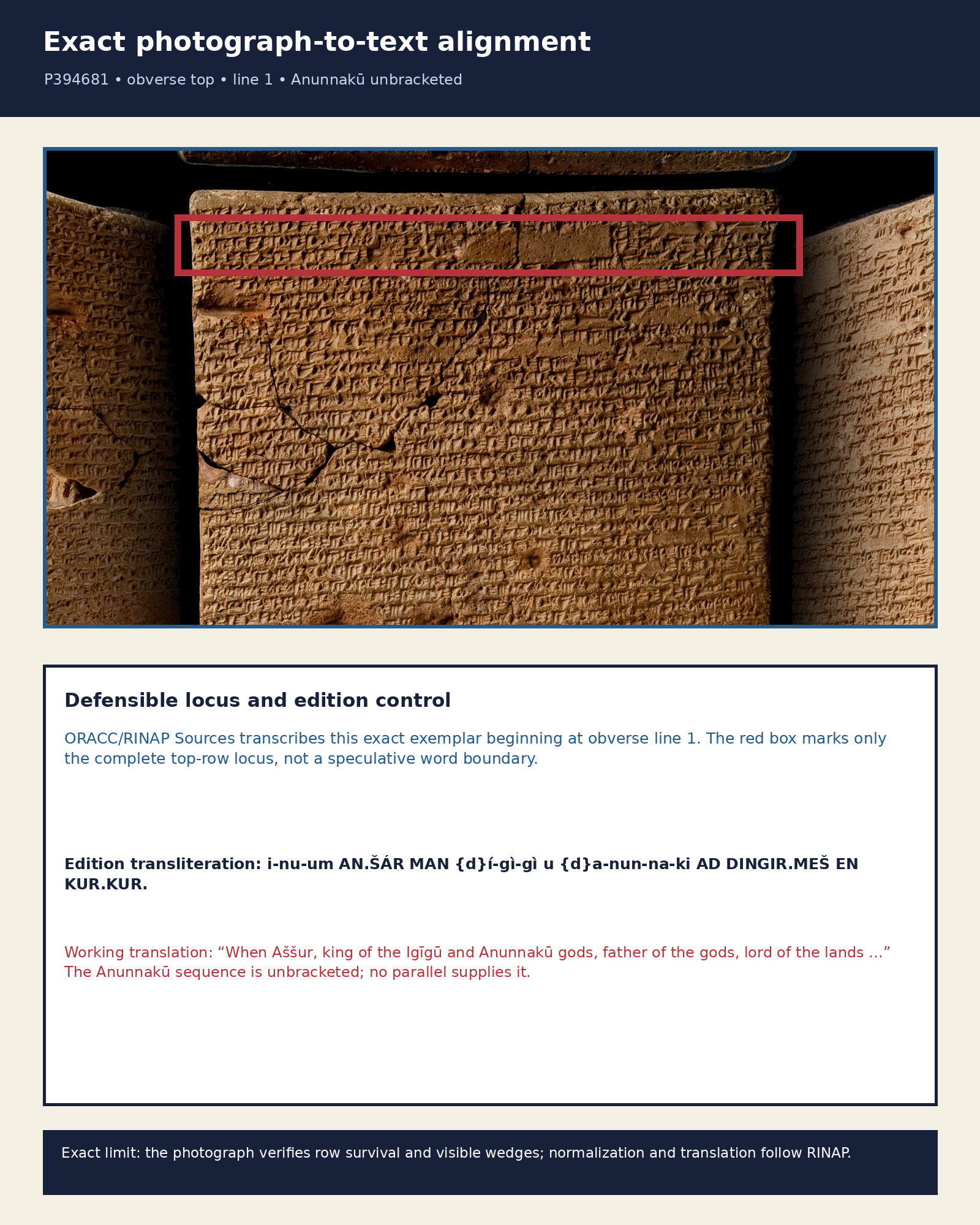
The 3,364×5,618 exact photograph was opened and inspected. It presents faces and edges of the joined tablet, visible K and DT labels, dense horizontal writing, join cracks, abrasion, and missing surface. These observations apply only to P394681.
Core line: obverse 1
Edition transliteration: i-nu-um AN.ŠÁR MAN {d}í-gì-gì u {d}a-nun-na-ki AD DINGIR.MEŠ EN KUR.KUR.
Published RINAP sense: “When Aššur, king of the Igīgū and Anunnakū gods, father of the gods, lord of the lands …”
Cautious working translation: “When Aššur—king over the Igīgū and Anunnakū gods, father of the gods, lord of the lands—…” The phrase supports a ranked divine collective beneath Aššur. It does not define biological origin, planet, vehicle, or technology.
Image-to-text epigraphic gate

The exact source transcription starts with line o 1, and the photographed obverse begins with a complete top row. The row and its wedge field are photograph-visible; the Anunnakū spelling is unbracketed and not supplied from a parallel. The result is independently photograph-verifiable at whole-row survival level and edition-guided for sign values, normalization, and translation.
Later line o 9 also names the Anunnakū under Nabû’s direction, but its opening divine name is restored. It is useful comparative context, not the main image-decoding claim.
The divine catalogue: differentiated authority
Lines o 1–13 assign distinct roles: Aššur rules Igīgū and Anunnakū; Anu’s command is unalterable; Enlil decrees fates and secures dwellings; Ea is lord of wisdom and fashioner of creation; Sîn determines decisions and reveals signs; Šamaš judges; Adad brings rain and sustains life; Marduk can depopulate and resettle; and Nabû directs Igīgū and Anunnakū. The text therefore presents structure, not an undifferentiated crowd of gods.
How knowledge reaches the workshop

In reverse lines 61–70, Esarhaddon asks the gods to grant the selected craftsmen sublime knowledge “like Ea,” their creator, and to teach them the necessary skills. Lines 72–79 describe extispicy: the workshop location and personnel are tested, the omens agree, and diviners deliver a firm affirmative answer.
Lines 79–90 name the human experts—carpenters, jewelers, copper smiths, seal cutters, and skilled craftsmen who know secrets—and deliver red gold and precious stones into their hands. Lines 96–100 then shift to mass construction: human workmen take up hoe and basket, make bricks in elaborate molds, mix mortar with oil, honey, ghee, wines, and beer, and lay temple foundations.
Published translation versus working inference
Published translation layer: RINAP supplies the official lineation, normalized Akkadian, and translation. It explicitly assigns learned skill to craftsmen and hoe, basket, bricks, mortar, and foundation work to Esarhaddon’s workmen.
Cautious inference layer: the inscription treats specialist knowledge as divinely authorized, taught, and validated. That is relevant to the corpus’s knowledge-transfer question. It is not evidence that the techniques exceed ancient human capabilities, and it does not make the Anunnakū the grammatical agents of the craft.
Corpus relevance and limits
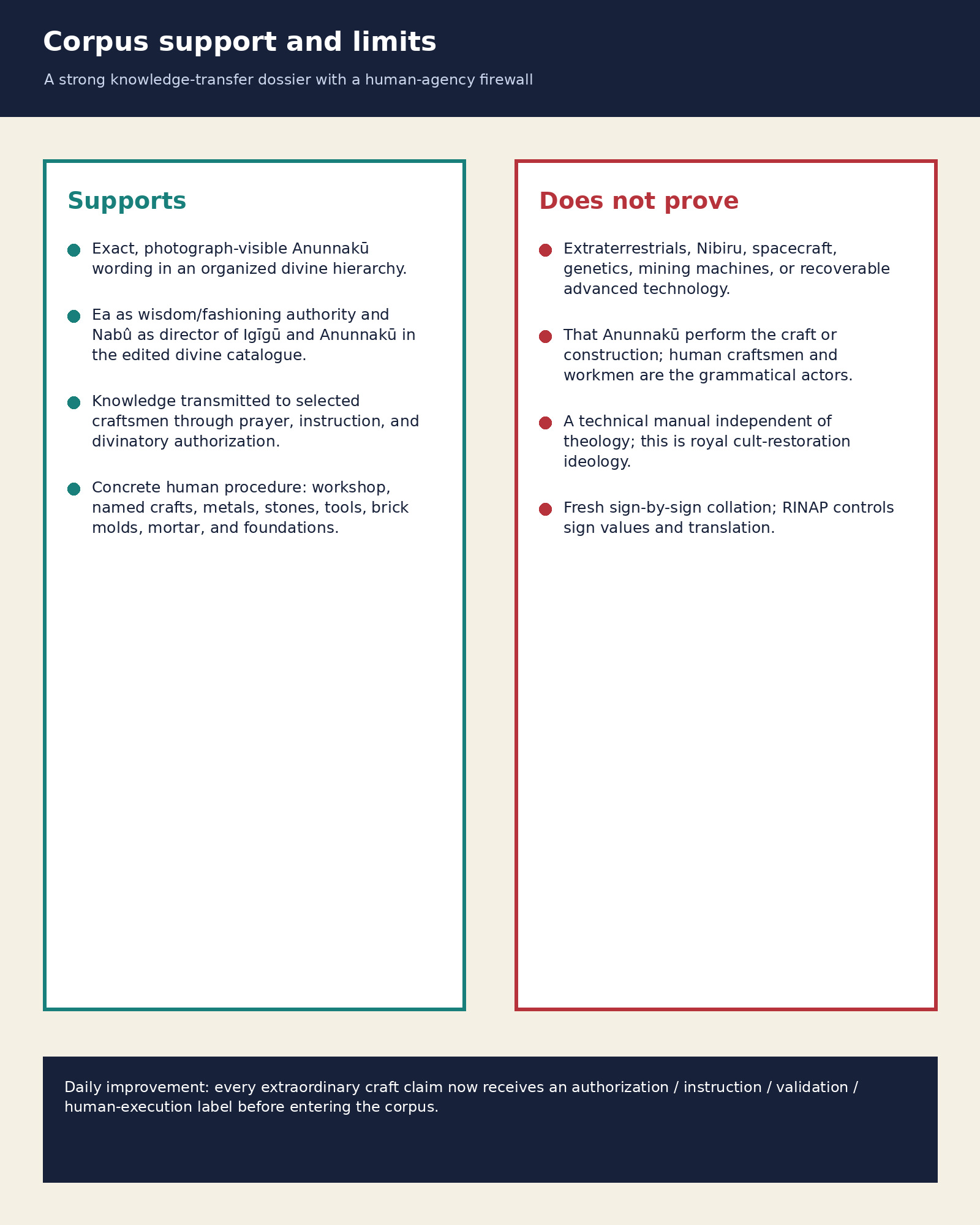
This source strongly supports two smaller claims in Tony’s working thesis: Anunnakū belong to an organized divine hierarchy, and Mesopotamian royal theology could describe skilled knowledge as transmitted under divine authority. It also supplies unusually concrete procedural evidence for workshop selection, named crafts, raw materials, tools, brick production, mortar, and foundations.
It does not support extraterrestrials, Nibiru, spacecraft, genetics, literal mining machinery, or recoverable advanced technology. The stated builders are human craftsmen and workmen. The honest result is a strong divine-authority-and-knowledge dossier with a strict human-agency firewall.
Sources and credits
- CDLI P394681 — exact photograph, identifiers, joins, collection, and composite linkage.
- ORACC/RINAP Q003277, Esarhaddon 48 — composite transliteration and published English translation.
- RINAP Sources P394681 — exact-exemplar transcription beginning with photograph-visible obverse line 1.
- eBL K.2801 — independent P394681 identifier and checked join metadata.
Daily capability improvement: craft claims now use a four-layer agency chain—divine authorization, taught instruction, divinatory validation, and named human execution—so theological framing cannot silently become a false technical-agency claim.
Download the evidence report: P394681, Esarhaddon 48, Anunnakū hierarchy, and human craft PDF report.
Share this:

One considered email each week
TheCode Weekly Evidence Brief
Receive the week’s strongest tablet decode, source audit or research update, plus one carefully chosen archive read. Routine posts stay on the site; the Brief is the curated signal.
Free. Usually sent on Sunday. No daily post flood. Unsubscribe at any time. See what the Brief includes.


