
The Anunna Serve Gibil: Exact Tablet P269689 and the Fire-Cult Limit
Exact P269689 report: the Anunna serve and rejoice with Gibil, but the grammar does not make the group smiths, builders, or technical operators.

Ancient text and site reading
How to read this record
- Claim type
- Historical / textual + interpretive
- Evidence level
- Sources, translations, measurements, and symbolic reading where present
Use the evidence layer for sources and observations, and the interpretation layer for TheCode.Wiki synthesis.
Source-controlled result: the exact photographed Nippur tablet CDLI P269689 / CBS 15133 + N 6885 + N 6887 + N 6897 preserves a Sumerian hymn to Gibil in which the Anunna are plural actors: they serve him and rejoice with him. This is a real collective-action result in a fire-god cultic setting, but the grammar does not make the Anunna smiths, builders, inventors, or operators of technology.

Why this tablet matters
The cumulative corpus is testing small propositions rather than forcing a modern theory onto ancient sources. P269689 advances one of those propositions: the Anuna/Anunna can be a coordinated grammatical collective, not merely decorative names in a divine list. Lines 16 and 18 assign them plural actions around Gibil, the Sumerian fire god.
The same proximity creates a useful methodological test. Gibil’s fire and the “oven of Enlil” are real textual context. They cannot be reassigned to the Anunna as technical agency unless a verb actually makes the group forge, build, measure, mine, or operate something. This witness does not do so.

Artifact and source identity
- CDLI artifact: P269689.
- Museum numbers: CBS 15133 + N 6885 + N 6887 + N 6897, Penn Museum.
- Standard designation: Studia Mesopotamica 1 (2014), pp. 302–311.
- Provenience: Nippur (modern Nuffar).
- Object: clay tablet reconstructed from four joined fragments.
- Exact-image control: the CDLI page binds all identifiers to the artifact; the photograph visibly carries the painted number 15133.
Published translation and cautious working translation
“The Anunna serve him … the Anunna rejoice with him.”
CDLI edition, obverse 16 and 18
Edition transliteration: line 16 [{d}a]-nun-na mu-na-sug₂-sug₂-ge-[eš]; line 18 [{d}]a-nun-na mu-un-da-hul₂-hul₂#-[le-eš].
Cautious working translation: “The Anunna render service to him; the Anunna rejoice together with him.” The central proposition is moderately secure, while the divine determinatives and verbal endings are partly restored and hul₂ in line 18 is damaged-readable/uncertain.
Image-to-text hard gate

The exact 2563 × 4838 Penn Museum photograph was opened and inspected at original resolution. It shows the joined tablet from several views, including the written obverse, breaks, edges, and the painted CBS number. The lower-obverse rows survive, but fractures and wear make autonomous sign-by-sign reading irresponsible.
The result is therefore photograph-visible at conservative whole-row level and edition-guided for sign values and translation. The image verifies artifact identity, preservation, alignment, and row survival. CDLI’s artifact-specific edition controls the reading. Most of a-nun-na and the central verbal chains lie outside editorial brackets, while determinatives and endings are partly restored. No restored sign is presented as independently decoded from pixels.
Line notes

Obverse 13 appears to gather Gibil with Suen “in high heaven,” but the line is uncertain and Gibil remains its subject. Obverse 16 gives the Anunna a service action. Obverse 17 returns to Gibil and the oven of Enlil. Obverse 18 gives the Anunna a second collective response, rejoicing with him. The broken reverse mentions lapis lazuli, Zabalam, and Inanna, but those fragments are comparative context rather than the core daily claim.
Agency firewall: fire is context, not transferred technology

The strongest source-backed statement is narrow: an organized divine collective serves and rejoices with a named deity. It is tempting to expand a fire-god hymn into metallurgy or advanced craft, but the text supplies no Anunna forging verb, workshop, tool, design, measurement, transport, vehicle, mining operation, biological procedure, or machine. The Anunna are direct actors, yet their actions here are ritual and emotional.
Corpus relevance and limits
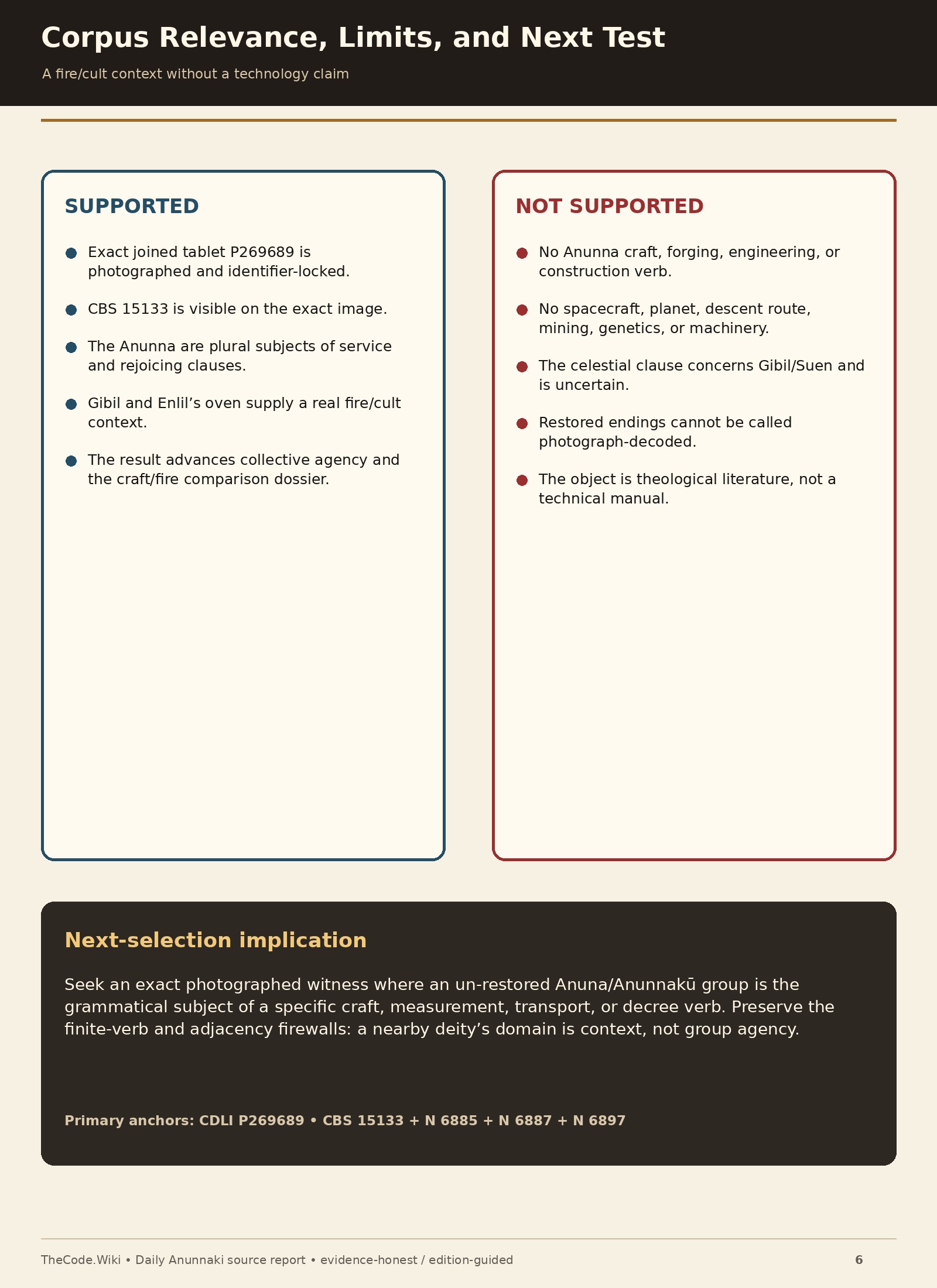
What this supports: the Anunna can act as a coordinated plural group; their service and rejoicing occur in a coherent divine hierarchy; the exact artifact anchors those clauses inside a real Gibil hymn; and the fire/oven setting gives the corpus a disciplined comparison point for future craft texts.
What this does not support: extraterrestrial identity, Nibiru, spacecraft, descent from another planet, genetic engineering, mining, metallurgy performed by the Anunna, or recoverable advanced technology. The composition is theological literature, not a technical manual or eyewitness engineering log.
Next test: seek an exact photographed witness where an un-restored Anuna/Anunnakū noun is itself the subject of a specific craft, measurement, transport, or decree verb. Keep the finite-verb and adjacency firewalls: a nearby god’s domain is context until grammar assigns the action to the group.
Primary sources
- CDLI P269689 artifact record, identifiers, exact photo, and transliteration
- CDLI exact-image reader for P269689
- Studia Mesopotamica 1, 302–311 publication record
Share this:

One considered email each week
TheCode Weekly Evidence Brief
Receive the week’s strongest tablet decode, source audit or research update, plus one carefully chosen archive read. Routine posts stay on the site; the Brief is the curated signal.
Free. Usually sent on Sunday. No daily post flood. Unsubscribe at any time. See what the Brief includes.


