
P144821: The Anuna in an Ur III Material Account
Exact-photo audit of YBC 1078 / CDLI P144821, a dated Ur III Umma ledger that measures gypsum and bitumen and names Šara and the Anuna, with strict lexical and agency limits.

Ancient text and site reading
How to read this record
- Claim type
- Historical / textual + interpretive
- Evidence level
- Sources, translations, measurements, and symbolic reading where present
Use the evidence layer for sources and observations, and the interpretation layer for TheCode.Wiki synthesis.
Today’s object is not a mythological composite or a royal monument. It is a small, dated Ur III administrative tablet from Umma: SAT 3, 1621, Yale Babylonian Collection YBC 1078, CDLI P144821. Its five-line obverse measures white gypsum and bitumen, then names Šara and the Anuna inside the material-application clause. The reverse records the human source, sealing official, month, and regnal year.

Result in one sentence
P144821 supplies rare non-literary evidence that Anuna language entered a measured, dated, sealed Umma material account; it supports institutional cult administration, but it does not make the Anuna builders, miners, engineers, or extraterrestrial technicians.
Why this tablet matters
Most entries in this project’s Anuna/Anunnakū corpus are literary compositions, prayers, hymns, myths, or royal inscriptions. Those genres are essential, but they can make every claim look theological or ideological. P144821 is a useful control because it belongs to routine administration. Its structure is recognizably bureaucratic: commodity, quantity, divine referents, action, source, seal, calendar month, and regnal year.
The CDLI artifact record identifies the object as an administrative tablet from Umma, dated to the Ur III period and specifically to Šū-Suen year 5. It links YBC 01078, YPM BC 015819, BDTNS 049804, and eBL YBC.1078. The exact photograph is credited to the Yale Babylonian Collection. The eBL identifier page independently supplies the same Yale/CDLI crosswalk.
Exact-object image gate
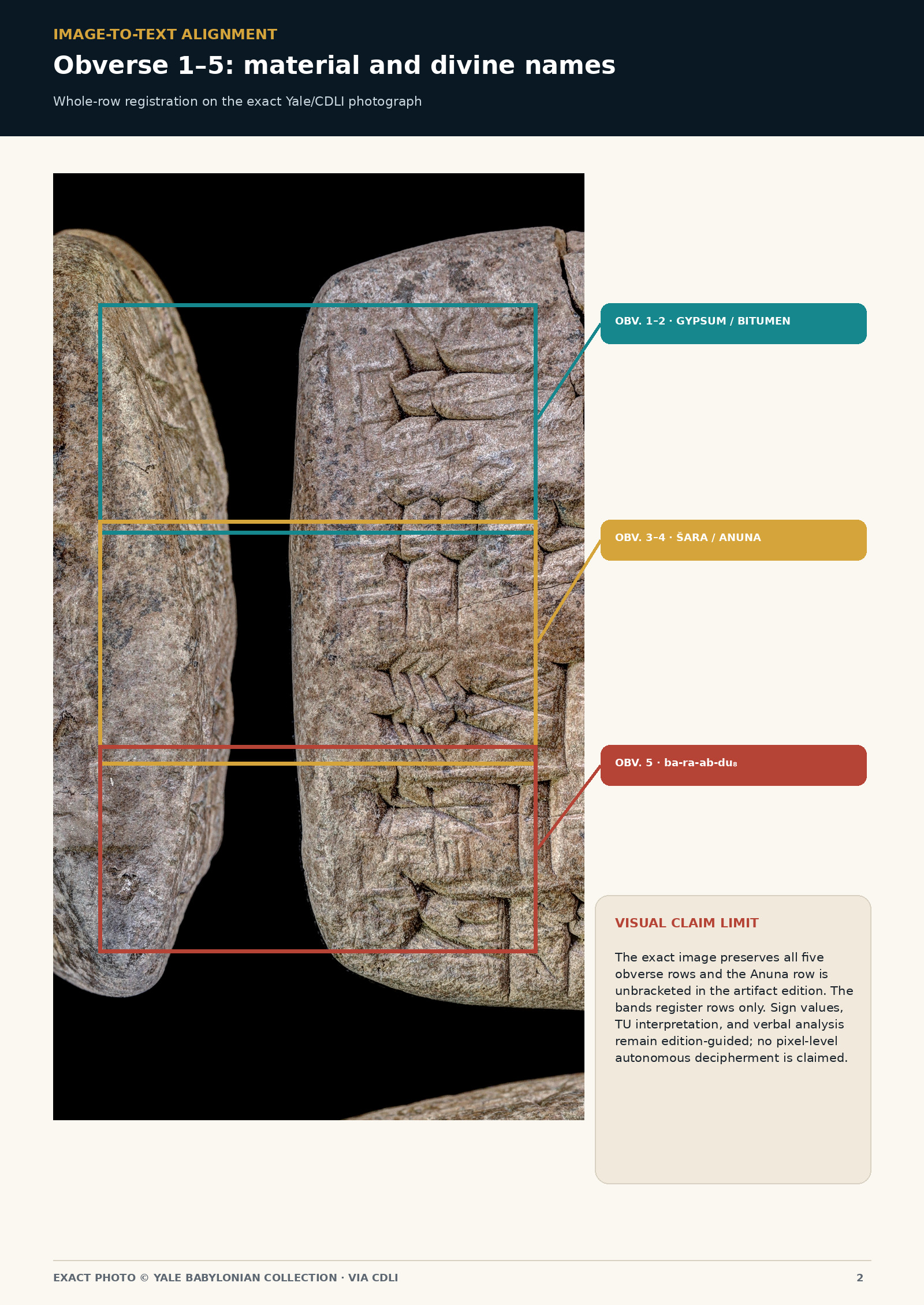
The downloaded exact photograph is a 5009×7321 multi-view montage. It was opened at original resolution before report generation. The montage visibly labels “YBC 1078 (YPM BC 015819)” and includes obverse, reverse, top, bottom, and side views with a one-centimeter scale. Surface cracks, worn areas, row survival, and the five-line obverse are visible. Its SHA-256 is recorded in the source manifest.
This establishes the physical artifact. It does not, by itself, establish a fresh sign-by-sign decipherment. The image-to-text claim below is therefore conservative: the exact photograph verifies the survival and placement of complete rows; the approved artifact edition controls sign values and grammar.
Published transliteration and cautious working translation
The approved CDLI/ePSD2 artifact lineation gives:
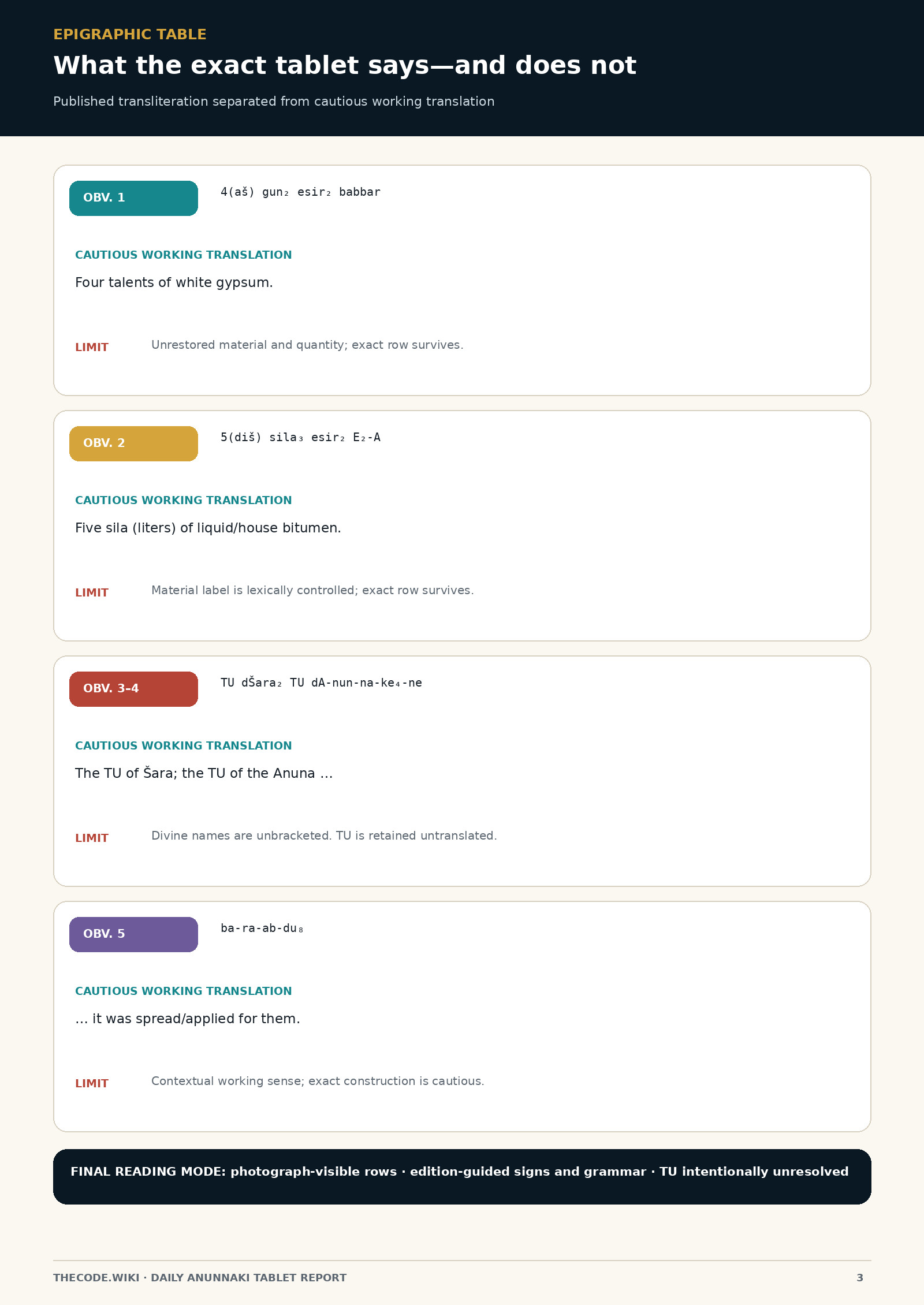
obv. 1  4(aš) gun₂ esir₂ babbar
obv. 2  5(diš) sila₃ esir₂ E₂-A
obv. 3–4  TU dŠara₂ TU dA-nun-na-ke₄-ne
obv. 5  ba-ra-ab-du₈
A cautious working translation is:
“Four talents of white gypsum; five sila of liquid/house bitumen; the TU of Šara, the TU of the Anuna; it was spread/applied for them.”
Two controls matter. First, the quantities, commodity terms, Šara, Anuna, and the verbal form are not supplied in square brackets. Second, TU is retained untranslated. Its presence is secure; its precise sense here is not. The gypsum/bitumen context supports a cautious application or spreading sense for du₈, but the evidence does not justify silently turning TU into a shrine, dais, platform, machine, or named architectural installation.
TU signs are kept separate.The reverse: human administration around the divine names
The reverse reads:
ki Ur-dDumu-zi-da-ta
kišib₃ Lu₂-dNin-šubur
iti nesag
mu us₂-sa dŠu-dSuen lugal bad₃ mar-tu mu-du₃
The record therefore names Ur-Dumuzida in the source/receipt relationship, the seal of Lu-Ninšubur, the month nesag, and the year after Šū-Suen built the Amorite Wall. The impressed seal identifies Lu-Ninšubur as a scribe and šabra, an administrator of Šara. This is exactly why the tablet is valuable: the Anuna occur inside a document whose human chain of custody and institutional setting are explicit.
The actors must remain separate. The document does not say that the Anuna quarried gypsum, produced bitumen, transported material, kept accounts, or pressed the seal. Human officials administer the transaction. The divine names identify the institutional or cultic referents inside that transaction.

What this adds to the Anuna corpus
The ORACC Ancient Mesopotamian Gods and Goddesses overview of the Anunna notes that Ur III administrative attestations require reconsidering an older idea that Anuna references belonged only to literary texts. The evidence remains sparse, which makes exact objects like P144821 especially important.
This tablet advances the corpus in three ways:
- Genre control: it is an administrative record rather than a narrative, hymn, prayer, or royal self-presentation.
- Institutional control: Šara, the Anuna, a Šara administrator, measured materials, and a dated seal chain occur on one exact object.
- Material control: the commodities are ordinary gypsum and bitumen. The source therefore tests cult administration without importing an exotic technology story.
For the Sitchin hypothesis, the result is limited but useful. It moderately supports the smaller proposition that the Anuna were treated as an organized divine category embedded in real human institutions. It does not support extraterrestrial identity, Nibiru, spacecraft, genetics, laboratories, gold mining, or advanced machinery. The strongest conclusion is documentary and institutional, not technological.

Daily decoding capability improvement
This run adds an administrative-divine-name gate. For every future administrative candidate, record commodity, quantity, recipient or referent, operative verb, human source, sealing official, institution, date, restoration state, and unresolved signs as separate fields. An exact photograph may verify row survival and artifact identity; it may not complete an unresolved lexical sign or transfer a human administrative action to a divine collective.
The same gate also changes selection priorities. A second photographed Ur III administrative Anuna record should be sought next, so commodities, verbs, offices, and institutional settings can be compared before a general claim is made from one account.
Sources
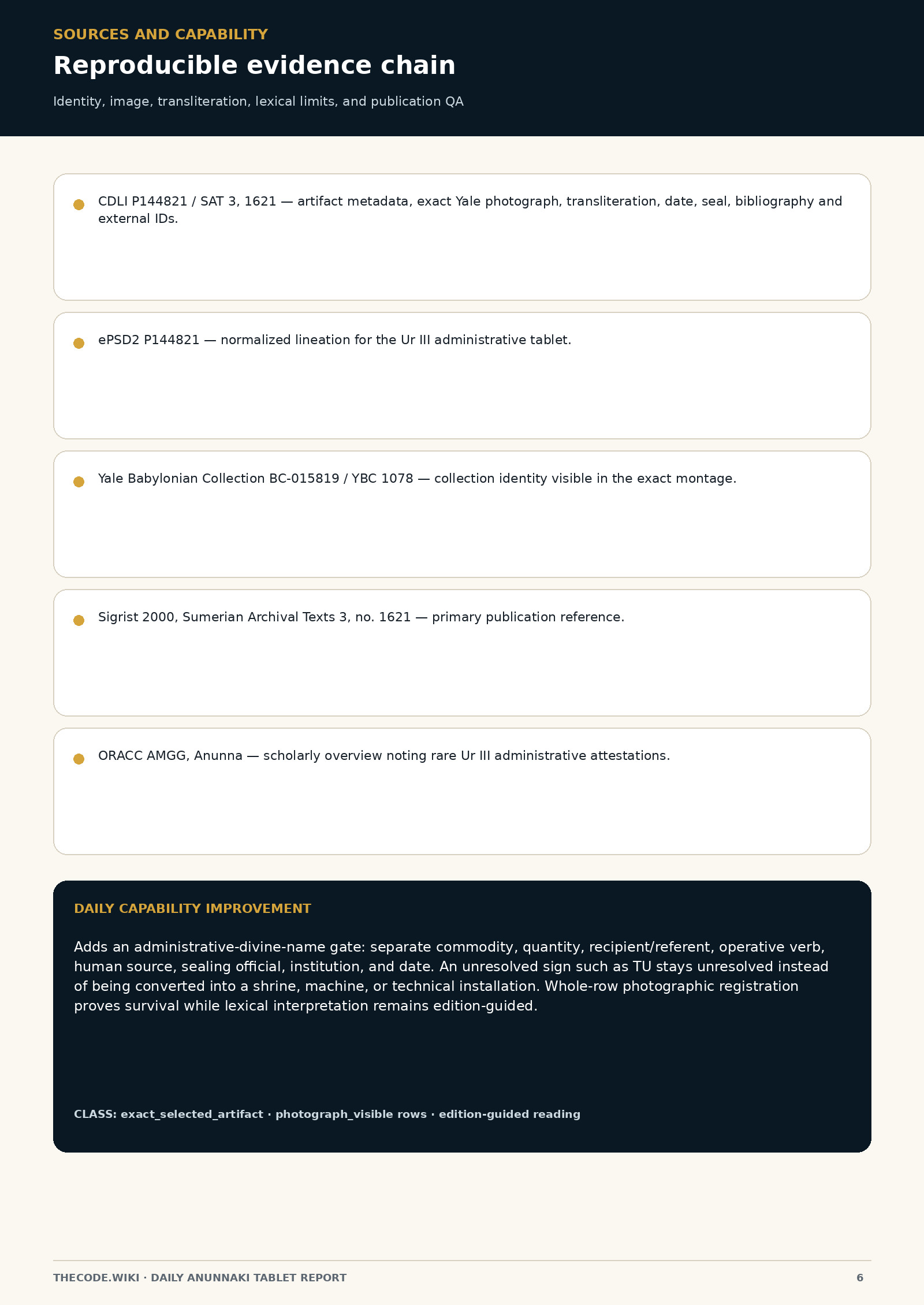
- CDLI P144821 / SAT 3, 1621 — artifact metadata, exact photograph, transliteration, date, seal, bibliography, and external identifiers.
- ePSD2 P144821 — normalized Ur III administrative lineation.
- eBL YBC.1078 — independent collection/CDLI identifier control.
- ORACC AMGG: Anunna — scholarly overview and administrative-attestation context.
- Marcel Sigrist, Texts from the Yale Babylonian Collections, Part 2: Sumerian Archival Texts 3 (2000), no. 1621 — primary publication reference.
Share this:

One considered email each week
TheCode Weekly Evidence Brief
Receive the week’s strongest tablet decode, source audit or research update, plus one carefully chosen archive read. Routine posts stay on the site; the Brief is the curated signal.
Free. Usually sent on Sunday. No daily post flood. Unsubscribe at any time. See what the Brief includes.


