
K 2860: Anuna, Anunnakū, and the Language-Order Limit
Exact-photo audit of British Museum K 2860 / CDLI P394721: Sumerian Anuna and Akkadian Anunnakū align as collective viewers, while the addressed deity owns the following language-order verb.

Ancient text and site reading
How to read this record
- Claim type
- Historical / textual + interpretive
- Evidence level
- Sources, translations, measurements, and symbolic reading where present
Use the evidence layer for sources and observations, and the interpretation layer for TheCode.Wiki synthesis.
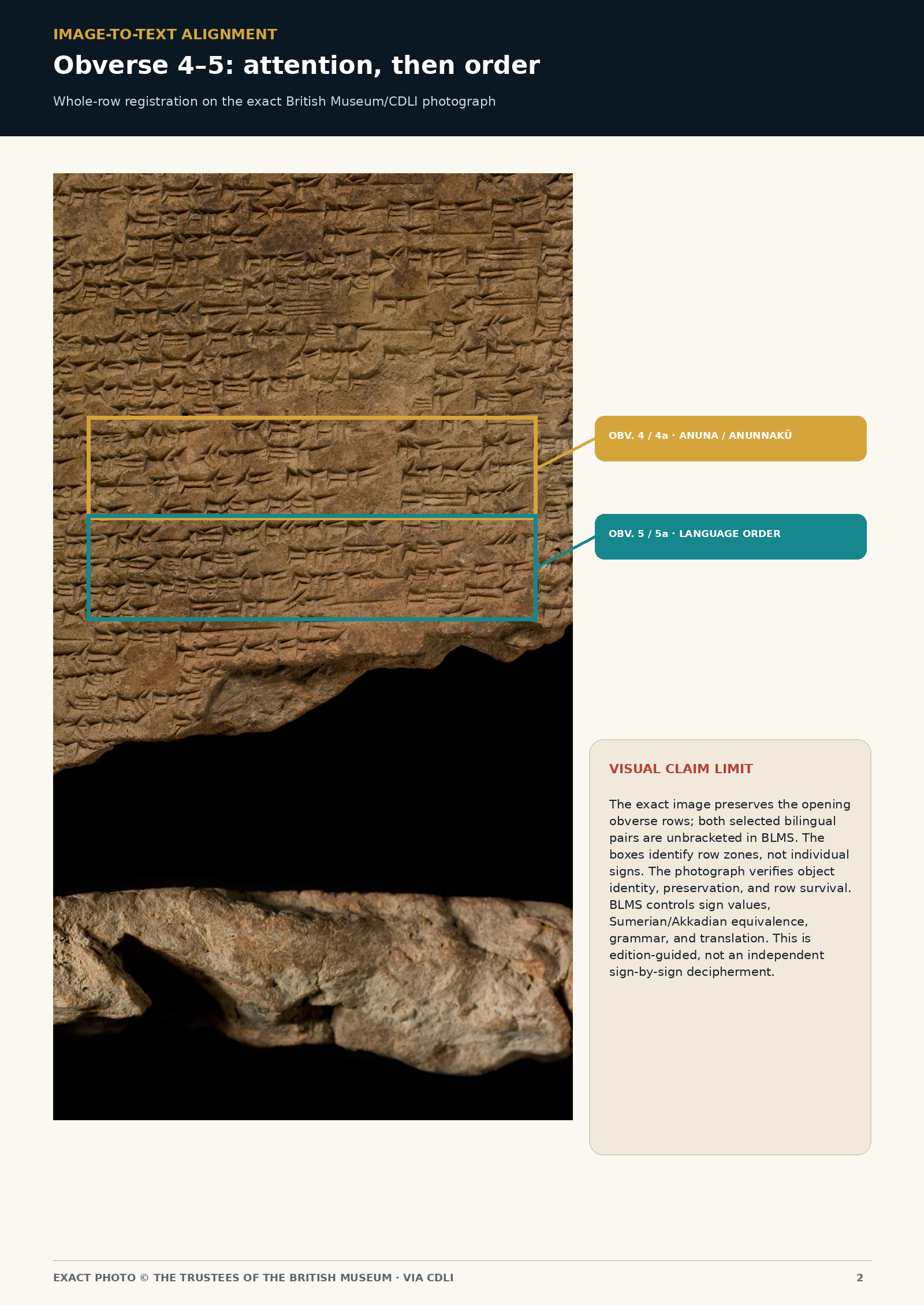
Today’s exact object is a bilingual learned tablet from Neo-Assyrian Nineveh. British Museum K 02860 (K.2860), CDLI P394721, places Sumerian and Akkadian versions line by line. In obverse 4/4a, Sumerian Anuna corresponds directly to Akkadian Anunnakū, and the collective is the plural subject of looking toward the addressed deity. In the next pair, the addressed deity—not the collective—puts mixed language into order.

Result in one sentence
K 2860 gives a clean bilingual bridge from Sumerian Anuna to Akkadian Anunnakū and assigns the group direct collective attention, but the following language-ordering verb belongs to the addressed divine lord and cannot be transferred to the Anunnakū.
Why this tablet matters
The cumulative corpus has many Anuna/Anunnakū passages, but the historical relationship between the Sumerian and Akkadian forms is often explained rather than displayed on one artifact. K 2860 is valuable because the scribal layout does the comparison for us. A Sumerian row is followed by its Akkadian counterpart. The two group names occupy corresponding positions, and both versions present a plural act of looking or attention toward the divine addressee.
The CDLI artifact record identifies P394721 as K 02860, a Neo-Assyrian tablet from Nineveh in the British Museum, and designates it “Shamash 03.” CDLI also links the object to BLMS P394721, eBL K.2860, and the British Museum collection record.
Exact-object image gate
The downloaded exact photograph is a 2090×3644 multi-view montage. It was opened at original resolution before report generation. The montage visibly carries “K.2860” and shows the inscribed obverse, reverse, edges, scale, and the broken lower-right part of the tablet. Its SHA-256 and licensing record are preserved in the source manifest.
This establishes physical identity and row survival. It does not create an independent sign-by-sign reading. The image-to-text claim is therefore conservative: the exact photograph registers the selected whole rows; the artifact-specific BLMS edition controls sign values, bilingual equivalence, grammar, and translation.
Published edition and cautious working translation
The artifact-specific ORACC BLMS edition gives the key bilingual pair:
obv. 4   {d}a-nun-na-ke₄-e-ne gi-bar-ra saŋ-zu mu-un-i-duḫ
obv. 4a  {d}A.NUN.NA.KI gi-mir-šu₂-nu i-na-aṭ-ṭa-lu pa-ni-ka
A cautious working translation is:
“The Anuna look toward your head/face (the Sumerian wording is uncertain); all the Anunnakū look at your face.”
The minimum is unusually firm. The Sumerian and Akkadian group names are not bracketed. In the Akkadian line, gimiršunu (“all of them”), the plural verb inaṭṭalū (“they look”), and pānīka (“your face”) are also un-restored. BLMS flags the exact Sumerian idiom as uncertain, so the Akkadian counterpart is the stronger grammatical control.
The next line: language is ordered, but by whom?
Obverse 5/5a follows immediately:
obv. 5   eme ḫa-mun dili-gin₇ si mu-ni-ib₂-si-sa₂-e
obv. 5a  li-ša₂-nu mit-ḫur-ti ki-ma iš-ten šu-me tuš-te-šer₃
The cautious sense is that the addressed divine figure puts mixed or conflated language into a single ordered line. The Akkadian verb is second person: “you put in order.” That actor distinction is the central control for this report. The Anuna/Anunnakū are the collective viewers in 4/4a. The addressee owns the ordering action in 5/5a.
This means the tablet places an explicit Anuna/Anunnakū collective next to a knowledge-and-language-order motif, but it does not say that the group invented language, unified languages, taught humans a universal language, or operated a translation technology.

Who is the addressed god?
The identification should remain cautious. CDLI’s catalog designation is “Shamash 03,” and the text repeatedly uses light, darkness, seeing, and solar language. Yet row 6 names Uta’ulu, which BLMS notes is “usually Ninurta,” while its Akkadian counterpart refers to the light of Šamaš. The artifact is a learned bilingual composition, and the preserved evidence does not justify silently flattening these editorial signals into one certain divine name.
The report therefore uses “addressed divine lord” when discussing the grammar. This preserves what the text securely shows: the Anuna/Anunnakū look toward him; he is the second-person actor who orders the mixed language.

What this adds to the Anuna corpus
K 2860 advances the corpus in three tightly bounded ways:
- Lexical continuity: Sumerian Anuna and Akkadian Anunnakū are directly aligned in corresponding rows of one exact witness.
- Collective agency: the group is not decorative. It is the plural subject of looking or attending toward the addressee.
- Knowledge-order control: language ordering occurs beside the group reference, but the grammar explicitly assigns that operation to the addressee.
For the Sitchin hypothesis, this is moderate support for the limited proposition that Mesopotamian learned tradition remembered an organized non-human/divine collective across Sumerian and Akkadian terminology. It is also a contradiction control: adjacency to language order cannot be promoted into Anunnakū authorship. The tablet does not establish extraterrestrial identity, Nibiru, spacecraft, genetics, laboratories, universal translation devices, mining, or advanced machinery.

Daily decoding capability improvement
This run adds a bilingual agency-separation gate. For every bilingual candidate, record the Sumerian subject, Akkadian equivalent, finite verb, totalizer, addressee, adjacent knowledge/order predicate, restoration state, and image-reading mode as separate fields. Corresponding bilingual rows can establish lexical continuity without transferring the next clause’s predicate to the divine collective.
The next high-value selection remains stricter: seek a photographed bilingual or administrative witness where an un-restored Anuna/Anunnakū noun itself governs a creation, measurement, transport, knowledge, or decree verb.

Sources
- CDLI P394721 / K 02860 — artifact identity, exact photograph, period, provenance, collection, license, and external identifiers.
- ORACC BLMS P394721 — artifact-specific bilingual lineation, translations, grammatical analysis, and uncertainty markers.
- British Museum K 2860 — institutional collection record cross-linked by CDLI.
- eBL K.2860 — independent fragment identifier cross-linked by CDLI.
- Bezold, Catalogue of the Cuneiform Tablets in the Kouyunjik Collection, K.2860 — early catalog description of the interlinear Sumero-Akkadian incantation tablet.
Share this:

One considered email each week
TheCode Weekly Evidence Brief
Receive the week’s strongest tablet decode, source audit or research update, plus one carefully chosen archive read. Routine posts stay on the site; the Brief is the curated signal.
Free. Usually sent on Sunday. No daily post flood. Unsubscribe at any time. See what the Brief includes.


