
Water and Golden Thrones: VAT 9729’s Anunnaki in Ishtar’s Descent
Exact VAT 9729 line art maps water-sharing rhetoric and a command-execution pair seating the netherworld Anunnaki on golden thrones.

Primary-text evidence study
How to read this record
- Claim type
- Historical textual analysis
- Evidence level
- Exact KAR 1 line art for VAT 9729 / P368996 and current eBL Ishtar Descent edition
- Status
- Edition-guided; checked join and grammatical roles separated
The witness links the Anunnaki to water-sharing rhetoric and golden thrones; it does not prove extraterrestrials or advanced technology.
Reading classification: edition-guided; exact_line_art_or_squeeze_visible. Exact line art verifies identity and row survival; current edition controls reading.
Download the complete illustrated PDF report
The exact witness and the question
VAT 9729, joined with VAT 11245 and VAT 11247, is a Neo-Assyrian clay-tablet witness from Assur to the Akkadian Descent of Ishtar. The current eBL object record links it to CDLI P368996 and KAR 1 and marks the joins checked. This is an Akkadian literary tablet, not a Sumerian-language administrative record; Anunnaki is the conventional normalized form used here for the Akkadian divine collective.
This study asks a narrow source question: what roles does this exact witness give the Anunnaki in its netherworld sequence? The answer is institutional and grammatical. Ereshkigal imagines drinking water with them, later orders Namtar to bring them out and seat them on golden thrones, and Namtar executes that order. The object does not present the Anunnaki as builders, engineers, healers, or operators of resurrection technology.

Why exact line art is used
The exact-object visual gate was not satisfied by a photograph because no documented public photograph is exposed. eBL records hasPhoto=false, and the documented CDLI P368996 photo URL returned HTTP 404. CDLI does expose an exact 1180×7742 line-art source tied to P368996, reproducing the KAR 1 copy. Under the runbook, exact-object line art is the allowed fallback only after the photograph path is shown unavailable.
The source image was opened at original resolution. Its principal obverse and reverse copies preserve numbered line anchors. The annotations below mark complete rows only. They do not claim that a modern reader independently recognized each wedge, and they do not draw a word-sized box around the divine name. Sign values, word division, normalization, restoration marks, and translation remain controlled by the current eBL edition.
Obverse 33′: water with the netherworld Anunnaki
In the immediate context, Ereshkigal hears of Ishtar’s arrival, turns pale, and protests what the encounter will mean. VAT 9729 obverse 33′ maps to composition line 32 and is un-restored in the current witness ATF: an-nu-u₂ a-na-ku it-ti {d}a-nun-na-ki A-MEŠ a-šat-ti.
The published translation is: “Here now, shall I drink water with the (netherworld) Anunna-gods,”. A cautious working translation is: “Now then: am I to drink water together with the netherworld Anunnaki?” The next line contrasts bread with clay and beer with dirty water. This is rhetoric about netherworld condition and association, not a technical description of a water system or a claim that the Anunnaki produce the water.

Reverse 29′ and 33′: command and execution
Composition lines 109–118 form a tightly controlled procedure. Ereshkigal speaks to Namtar, orders him to knock at the Egalgina and decorate its thresholds, then commands: “Bring out and seat the (netherworld) Anunna-gods on thrones of gold.” The same sequence orders Namtar to sprinkle Ishtar with the water of life and remove her from Ereshkigal’s presence.
VAT 9729 reverse 29′ preserves the command without restoration brackets: {d}a-nun-na-ki šu-ṣa-ma i+na {giš}GU.ZA KU₃.GI šu-šib. Reverse 33′ preserves Namtar’s execution: {d#}a-nun-na-ki u₂-še-ṣa-ma i+na {giš}GU.ZA# KU₃#.GI u₂-še-šib. The # marks identify damaged-but-readable signs, not supplied text. The parallel syntax makes the roles explicit: Ereshkigal commands, Namtar acts, and the Anunnaki are the collective brought out and enthroned.
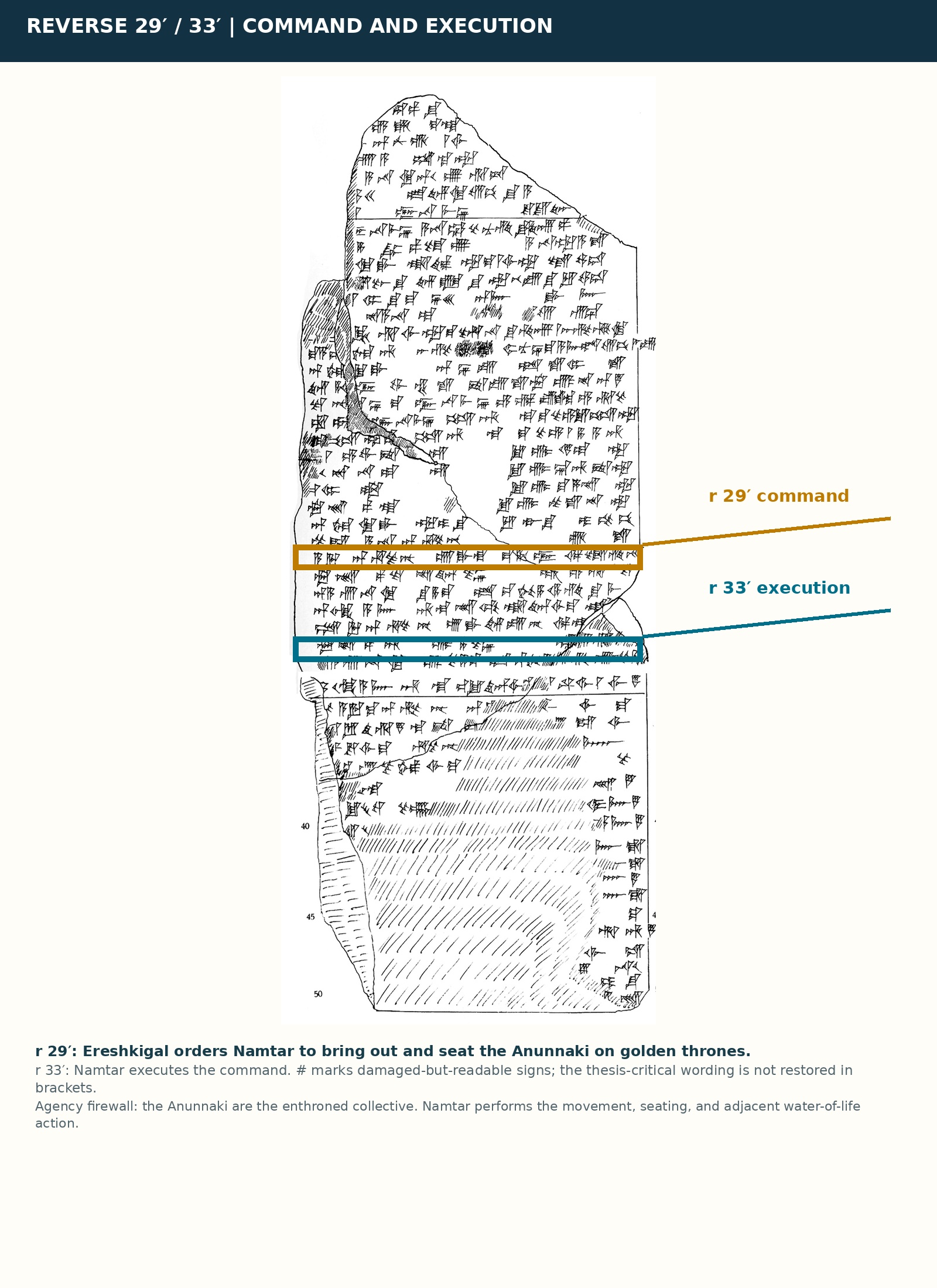
Image-to-text evidence table
The hard gate separates exact-object survival from edition-controlled reading. Each thesis-critical line has a face, witness line, composition line, whole-row visual locus, restoration classification, cautious translation, confidence statement, and a limit on what the image can prove.
Image-to-text record 1
- Exact image location
- Exact VAT 9729 line art, obverse 33′; composition line 32; conservative whole-row gold box.
- Edition transliteration / control
- an-nu-u₂ a-na-ku it-ti {d}a-nun-na-ki A-MEŠ a-šat-ti
- Published translation
- “Here now, shall I drink water with the (netherworld) Anunna-gods,”
- Cautious working translation
- “Now then: am I to drink water together with the netherworld Anunnaki?”
- Photograph-visible signs
- No photograph is used. The exact KAR 1 copy preserves the complete numbered row; eBL controls the signs.
- Exact-copy-visible / unbracketed sequence
- The full VAT 9729 witness line is un-restored in current eBL ATF, including the Anunnaki name and water/drink wording.
- Damaged signs
- No square-bracket restoration occurs in this witness line.
- Restored, composite, or parallel-supplied signs
- None in the selected witness line. Normalization, grammar, and translation remain edition-controlled.
- Confidence
- High for identity, row mapping, and un-restored status; edition-guided for sign values and translation.
- Limit of visual claim
- Whole-row survival only. No word/sign box, fresh wedge collation, or claim that the Anunnaki create or control water.
- Textual evidence class
- exact_line_art_or_squeeze_visible
Image-to-text record 2
- Exact image location
- Exact VAT 9729 line art, reverse 29′; composition line 113; conservative whole-row gold box.
- Edition transliteration / control
- {d}a-nun-na-ki šu-ṣa-ma i+na {giš}GU.ZA KU₃.GI šu-šib
- Published translation
- “Bring out and seat the (netherworld) Anunna-gods on thrones of gold,”
- Cautious working translation
- “Bring out the netherworld Anunnaki and seat them on golden thrones.”
- Photograph-visible signs
- No photograph is used. The exact KAR 1 copy preserves the complete numbered command row; eBL controls the signs.
- Exact-copy-visible / unbracketed sequence
- Anunnaki, the bring-out command, throne/gold phrase, and seat command are all un-restored in this witness.
- Damaged signs
- No square-bracket restoration occurs in this witness line.
- Restored, composite, or parallel-supplied signs
- None in the selected VAT 9729 command line.
- Confidence
- High for identity, row mapping, un-restored command, and command-giver/addressee context; edition-guided for signs and translation.
- Limit of visual claim
- Whole-row survival only. The grammar makes Ereshkigal command giver and Namtar addressee; the Anunnaki are the group to be seated.
- Textual evidence class
- exact_line_art_or_squeeze_visible
Image-to-text record 3
- Exact image location
- Exact VAT 9729 line art, reverse 33′; composition line 117; conservative whole-row blue box.
- Edition transliteration / control
- {d#}a-nun-na-ki u₂-še-ṣa-ma i+na {giš}GU.ZA# KU₃#.GI u₂-še-šib
- Published translation
- “He brought out and seated the (netherworld) Anunna-gods on thrones of gold,”
- Cautious working translation
- “He brought out the netherworld Anunnaki and seated them on golden thrones.”
- Photograph-visible signs
- No photograph is used. The exact KAR 1 copy preserves the numbered execution row; eBL controls damaged-readable signs.
- Exact-copy-visible / unbracketed sequence
- The complete execution clause is un-restored. # flags mark damaged-but-readable signs rather than supplied text.
- Damaged signs
- The divine determinative and several throne/gold signs carry # damage/readability flags.
- Restored, composite, or parallel-supplied signs
- No thesis-critical word is restored in square brackets in VAT 9729 r33′.
- Confidence
- High for command/execution correspondence and row mapping; medium-high for the damaged-readable signs; edition-guided for sign values and translation.
- Limit of visual claim
- Whole-row survival only. Namtar is the executor; no movement, seating, or water-of-life verb is transferred to the Anunnaki.
- Textual evidence class
- exact_line_art_or_squeeze_visible
Published translation and cautious working translation
Published translation, line 32: “Here now, shall I drink water with the (netherworld) Anunna-gods,”. Working translation: “Now then: am I to drink water together with the netherworld Anunnaki?” The working version makes the rhetorical question explicit but does not change the social association.
Published translation, line 113: “Bring out and seat the (netherworld) Anunna-gods on thrones of gold,”. Working translation: “Bring out the netherworld Anunnaki and seat them on golden thrones.” Published translation, line 117: “He brought out and seated the (netherworld) Anunna-gods on thrones of gold,”. Working translation: “He brought out the netherworld Anunnaki and seated them on golden thrones.”
The composition’s English ‘Anunna-gods’ is a scholarly rendering of the divine group. Popular writing often says Anunnaki. Neither spelling by itself carries an extraterrestrial meaning. The controlled claim is that this Mesopotamian witness presents an organized netherworld collective within a formal court-and-ritual procedure.
Agency firewall: the water of life is not Anunnaki technology
The sequence is useful precisely because it prevents role inflation. The Anunnaki are named as those brought out and seated. Namtar is the grammatical executor of movement and seating, and Namtar also sprinkles Ishtar with the water of life. The text does not say that the Anunnaki manufacture, control, or apply that water.
Golden thrones indicate rank and formal seating; they are not evidence of machines. Water of life is a literary-ritual motif in this descent-and-return narrative; it is not a laboratory protocol. The tablet therefore supports hierarchy, assembly, delegated command, and ritual procedure. It does not establish extraterrestrials, Nibiru, spacecraft, genetics, mining, laboratories, resurrection devices, or advanced technology.
Corpus relevance and what this adds
The corpus already contains K.162, a Nineveh witness to the same late command–execution pair. VAT 9729 is not being used to pretend that the composition itself is new. Its contribution is exact-witness control: this Assur copy preserves the water-with-Anunnaki line as well as both sides of the enthronement instruction. The article title and evidence record therefore identify the new physical witness and the distinct water-plus-throne angle.
For Tony’s working Sitchin thesis, the source moderately supports the smaller claim that Mesopotamian tradition imagined the Anunnaki as an organized, ranked collective in a consequential non-human/divine institution. It does not support the stronger ancient-astronaut, genetic-engineering, mining, or high-technology claims. The next most useful source would give the Anunnaki an unambiguous finite action in a less literary and more procedural setting, with the action and group name visible on one exact object.
Daily capability improvement: Command–Execution–Beneficiary Matrix
This run adds a Command–Execution–Beneficiary Matrix. For paired procedural clauses, record the command giver, addressee, executor, moved or enthroned group, ritual beneficiary, and adjacent instrument or substance separately. A repeated noun does not inherit every nearby verb.
Applied here: Ereshkigal is command giver, Namtar is addressee and executor, the Anunnaki are the enthroned collective, Ishtar is the water-of-life beneficiary, and the water is the adjacent ritual substance. This blocks a common interpretive error: turning proximity to a remarkable motif into false technical agency.
Sources and reproducible controls
All source links below were checked in the current run. The exact visual and current-edition data were archived locally with hashes. The image is credited as public-domain primary-edition line art; the article republishes only annotated derivatives and preserves the provider and object identifiers.
Share this:

One considered email each week
TheCode Weekly Evidence Brief
Receive the week’s strongest tablet decode, source audit or research update, plus one carefully chosen archive read. Routine posts stay on the site; the Brief is the curated signal.
Free. Usually sent on Sunday. No daily post flood. Unsubscribe at any time. See what the Brief includes.


