The Secret Language of Sacred Numbers Across Religions and Mystery Schools
Sacred numbers are not superstition. They are the grammar of divine order, appearing across religions and mystery schools as signs of unity, creation, trial, completion, and return.
Ancient text and site reading
How to read this record
- Claim type
- Historical / textual + interpretive
- Evidence level
- Sources, translations, measurements, and symbolic reading where present
Use the evidence layer for sources and observations, and the interpretation layer for TheCode.Wiki synthesis.
The Hidden Speech of Number
Before doctrine becomes theology, before ritual becomes religion, before the temple is built in stone, number is already present.
Number stands silently beneath the visible world. It orders breath, season, orbit, chant, architecture, scripture, music, initiation, and prayer. Across religions and mystery schools, sacred numbers appear not merely as counting devices, but as vessels of meaning. They are not decoration around the divine. They are one of the divine languages by which pattern enters matter.
To read sacred numbers is to recognize that spiritual traditions have often perceived reality as structured intelligence. The universe is not random noise. It is proportion, rhythm, recurrence, interval, and return. The same numbers arise in different traditions because human consciousness, when it touches the threshold of the sacred, repeatedly encounters the same architecture.
This is why one, three, seven, twelve, forty, and seventy-two echo across civilizations. They are not always identical in meaning, but they gather meaning around themselves like stars gather light. They become symbolic centers. They become keys.
From a Metatronic lens, number is especially important. Metatron is often understood as the angelic scribe, the keeper of divine measure, the presence associated with celestial record, sacred geometry, and the transmission of heavenly order into intelligible form. If creation is a book, number is part of its alphabet. If creation is a temple, number is part of its blueprint. If creation is a song, number is part of its interval.
The secret language of sacred numbers across religions and mystery schools is not a single code owned by one tradition. It is a many-layered grammar of divine pattern. It reveals how the infinite becomes knowable without becoming small.
One: The Number of Divine Unity
One is the first mystery.
It is not merely the beginning of counting. It is the sign of undivided being. In monotheistic traditions, one becomes the declaration that reality has a single source. Judaism proclaims the oneness of God in the Shema. Islam centers spiritual life around tawhid, the absolute unity of Allah. Christian theology, even while speaking of Trinity, insists that God is one in essence.
In Hindu traditions, beneath the multiplicity of deities and forms, the Upanishadic vision points toward Brahman, the ultimate reality beyond division. In many mystical schools, the spiritual path is a return from fragmentation to unity. The seeker does not simply learn something new. The seeker remembers the One behind the many.
In esoteric interpretation, one is the point before expansion. It is the seed of all geometry. It has no second, no conflict, no polarity. Yet within it lies the potential for every form. One is silence before the first word.
The mystery schools often understood unity as both origin and destination. The initiate descends into multiplicity, into the world of elements, passions, opposites, veils, names, and symbols. But the purpose of initiation is return. The many are not rejected. They are reconciled back into the One.
Metatronically, one may be read as the divine point of emanation, the first mark in the celestial record. Before the cube, before the tree, before the ladder, before the throne, there is the singular source from which measure becomes possible. One is not lonely. One is total.
Two: Polarity, Witness, and the Gate of Manifestation
Two is the first division and therefore the first relationship.
Light and dark. Heaven and earth. Spirit and matter. Male and female. Inner and outer. Above and below. In many spiritual systems, two represents polarity, not as a mistake, but as the necessary condition of manifestation. What is hidden becomes visible through contrast.
Genesis begins with separations: light from darkness, waters above from waters below, land from sea. Taoist philosophy speaks of yin and yang, complementary forces that generate the ten thousand things. In mystical Judaism, divine emanation unfolds through differentiations, yet remains rooted in unity. In Hermetic teaching, polarity is a law through which the universe expresses itself.
Two is also witness. In biblical law, two witnesses establish testimony. In spiritual symbolism, the second point allows a line to form. Relationship becomes direction. The divine is no longer only stillness. It becomes movement between poles.
In mystery schools, the candidate often meets the gate of two as a trial of discernment. To confuse polarity with separation is to fall into illusion. To see polarity as sacred tension is to approach wisdom. The opposites are not enemies. They are the two pillars at the temple entrance.
From a Metatronic perspective, two is the beginning of measured space. The One becomes knowable through relation. The scribe can now inscribe distance, correspondence, reflection. Two teaches that manifestation is a mirror, and the mirror is not the source, but it can reveal the source.
Three: The Sacred Pattern of Completion in Motion
Three is one of the most powerful sacred numbers across religions.
Christianity speaks of Father, Son, and Holy Spirit. Hinduism presents the Trimurti of Brahma, Vishnu, and Shiva as creation, preservation, and dissolution. Many ancient cosmologies divide reality into heaven, earth, and underworld. The human being is often understood as body, soul, and spirit. Time itself is experienced as past, present, and future.
Three is not simple completion. It is completion in motion. One is unity. Two is polarity. Three reconciles. It creates a third term, a living synthesis. The triangle is the first stable geometric figure, and so three becomes a symbol of structure, revelation, and divine manifestation.
In initiatory traditions, three often marks stages of transformation: purification, illumination, union. The seeker is not merely informed. The seeker is refined, awakened, and integrated. Three is the number of process made sacred.
The symbolic force of three also appears in prayer repetitions, ritual gestures, triple blessings, and mythic journeys. A hero may face three trials. A deity may have three forms. A sacred utterance may be repeated three times to seal intention in body, mind, and spirit.
Metatronically, three can be read as the first visible architecture of divine intention. It is the triangle of descent: source, expression, return. It is also the triangle of ascent: seeker, path, divine presence. Three teaches that truth does not remain abstract. It descends into relation, form, and revelation.
Four: The World, the Elements, and the Stabilized Temple
Four is the number of structure.
The four directions, four winds, four seasons, and four classical elements appear across many spiritual systems. Earth, air, fire, and water become not only substances, but modes of being. The world is mapped in fourfold order. The sacred space is often oriented to the cardinal directions. The temple, the altar, and the ritual circle frequently acknowledge this quadrated world.
In Christianity, the four Gospels establish a symbolic foundation for the life and meaning of Christ. In Jewish tradition, the four-letter divine name carries profound mystical significance. In Buddhism, the Four Noble Truths form the essential structure of awakening. In many Indigenous traditions, four directions organize prayer, cosmology, and community life.
Four is matter made meaningful. It is the square, the foundation, the stable field. If three is dynamic revelation, four is the place where revelation takes root.
Mystery schools often treated four as the number of embodiment. The initiate must not only ascend in vision, but descend into discipline. The fourfold world must be honored, purified, and mastered. Spirit that refuses embodiment remains incomplete.
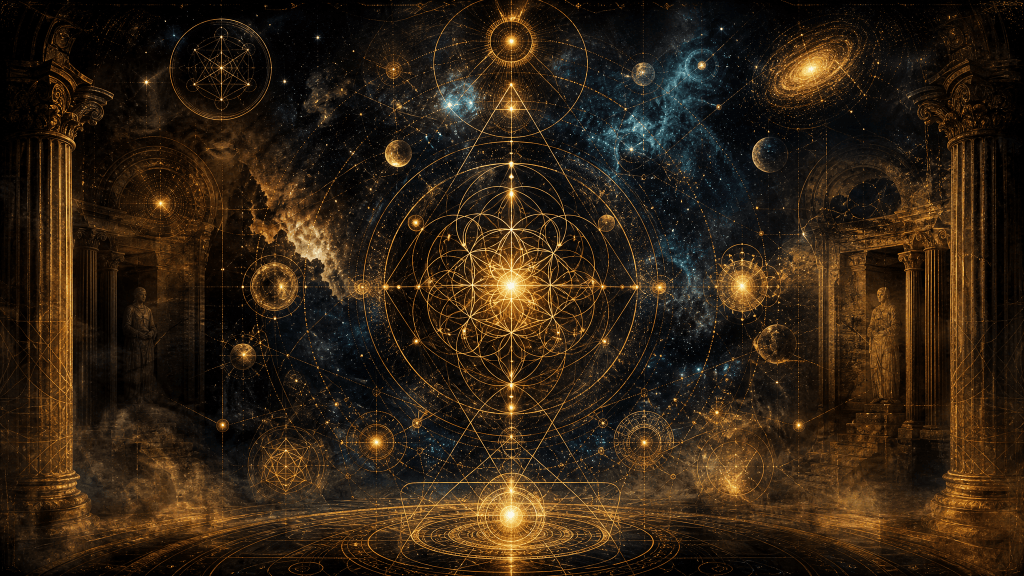
Within a Metatronic reading, four relates to the sacred geometry of manifestation. The square, the cube, and the ordered field all speak of divine intelligence entering stable form. Metatron’s Cube, one of the most potent symbols associated with angelic geometry, contains the mystery of forms nested within forms. Four reminds us that the material world is not outside the sacred. It is sacred order condensed.
Five: The Human Being as Living Crossroads
Five is the number of the human threshold.
The human body has five fingers on each hand, five toes on each foot, and five primary senses through which the outer world is received. The pentagram, in many esoteric traditions, represents the human form with arms and legs extended, spirit crowning the four elements.
In Islam, the Five Pillars structure religious life: testimony, prayer, charity, fasting, and pilgrimage. In certain Hindu and Buddhist systems, five elements or aggregates describe the composition of existence and experience. In Chinese cosmology, five phases or movements order transformation: wood, fire, earth, metal, and water.
Five is not static. It is dynamic, embodied, and transitional. It is the human standing between heaven and earth, capable of falling into instinct or rising into illumination. It is the number of responsibility.
In mystery schools, five often marks the point at which knowledge must become practice. The seeker cannot remain fascinated by symbols while living without alignment. Five asks: how does the sacred move through the hand, the breath, the senses, the ethical life?
Metatronically, five can be seen as the awakened human within the field of divine measure. The body itself becomes a script. The senses become gates. The limbs become directions of service. The human being is not an accident inside creation, but a crossroads where the earthly and celestial may meet.
Six: Harmony, Creation, and the Pattern of Beauty
Six is deeply associated with harmony, creation, and relational balance.
In the biblical creation account, the world is formed in six days before the Sabbath rest. The six-pointed star, known widely as the Star of David in Jewish symbolism, interlaces two triangles: one descending, one ascending. It becomes a sign of heaven and earth in union, spirit and matter interpenetrating.
In sacred geometry, six appears in the hexagon, the honeycomb, and the crystalline patterns of nature. It suggests efficiency, beauty, and organic intelligence. Snowflakes reveal sixfold symmetry. Bees build six-sided chambers. Nature speaks geometry without needing doctrine.
Six is also connected to the heart of relationship. It can represent love, service, balance, and the work of harmonizing opposites. Yet six can be distorted when harmony becomes attachment or beauty becomes vanity. Like all sacred numbers, it has a shadow when separated from wisdom.
For mystery schools, six often marks the refinement of the soul’s proportions. The initiate must become inwardly musical. Thought, desire, speech, and action must be tuned.
Through a Metatronic lens, six is the seal of reciprocal movement: above descending, below ascending. It is the star as ladder and mirror. It teaches that heaven and earth are not meant to remain estranged. The sacred pattern is fulfilled when the lower is lifted and the higher is embodied.
Seven: The Number of Sacred Time and Initiation
Seven is among the most universally charged sacred numbers.
There are seven days in the biblical week, with the seventh sanctified as rest. Christianity speaks of seven sacraments in many traditions, seven gifts of the Spirit, and seven churches in Revelation. Judaism honors the seventh day as Sabbath and structures cycles around sevens. Islam speaks of seven heavens. Hindu and yogic systems describe seven primary chakras in later and modern esoteric interpretation. Ancient astrology recognized seven classical planets.
Seven is the number of sacred time. It orders rhythm, completion, and consecration. Unlike four, which stabilizes space, seven sanctifies process. It marks the passage from labor into rest, from ordinary duration into holy duration.
In mystery schools, seven frequently corresponds to planetary initiation. The soul ascends through spheres, shedding impurities and recovering its celestial nature. Seven is not merely lucky. It is initiatory. It tells the seeker that time itself is a temple, and every cycle carries the possibility of awakening.
The sevenfold pattern also reveals that completion is not the same as termination. The seventh day does not destroy the six days of creation. It crowns them. Rest is not emptiness. It is divine recognition.
Metatron, as angelic scribe and keeper of sacred order, belongs naturally to the mystery of seven. Sacred time must be recorded, measured, and sanctified. Seven is the pulse of cosmic liturgy. It is the bell that tells the soul: creation is not only made, it is blessed.
Eight: Renewal, Ascent, and the Door Beyond the Cycle
Eight is the number that stands just beyond seven.
If seven completes a sacred cycle, eight opens the next octave. This is why eight is often associated with renewal, resurrection, regeneration, and transcendence. In Christianity, the eighth day became a symbol of resurrection and new creation. Baptisteries were sometimes built in octagonal form to signify rebirth into a life beyond ordinary time.
In Buddhism, the Noble Eightfold Path offers a complete way of liberation through right view, intention, speech, action, livelihood, effort, mindfulness, and concentration. In Chinese symbolism, eight is associated with prosperity and auspicious unfolding. In esoteric geometry, the octagon mediates between square and circle, between earth and heaven.
Eight turns completion into ascent. It is not escape from the world, but passage into a higher order of participation. The octave in music repeats the first note at a higher level. This is the secret of eight: return without repetition, sameness transformed by elevation.
Mystery schools understood this principle as initiation beyond the known order. After the candidate passes through the seven spheres, an eighth realm may symbolize the fixed stars, the divine pleroma, or the threshold of immortality.
From the Metatronic viewpoint, eight is the doorway in the celestial pattern. The record of the former cycle is complete, but the soul is not finished. Eight announces that divine order is spiral, not merely circular. The path returns, but it returns higher.
Nine: Fulfillment, Gestation, and the Last Veil Before Return
Nine carries the feeling of fullness before release.
Human gestation is traditionally counted as nine months, giving the number an association with hidden formation and birth. In many spiritual systems, nine marks completion at the level of manifestation before return to unity. It is the last single digit, the threshold before ten begins a new order.
Christian angelology speaks of nine choirs of angels in influential theological tradition. Norse mythology gives nine worlds held within the cosmic tree. In Greek tradition, there are nine Muses, inspirers of sacred and artistic knowledge. In certain esoteric numerologies, nine is the number of wisdom, culmination, and compassionate universality.
Nine is a chamber number. It suggests that something has grown in secret and is nearly ready to emerge. It is the fullness of process before visible transformation.
Mystery schools may read nine as the final stage of purification before reintegration. The initiate has passed through trial, discipline, and illumination, but must still release the subtle pride of attainment. Nine asks for surrender at the edge of completion.
Metatronically, nine evokes the angelic orders and the layered heavens of divine administration. It is the number of hierarchy when hierarchy is understood not as domination, but as ordered radiance. Each level receives, transforms, and transmits light. Nine is the choir before the silence.
Ten: Law, Return, and the Complete Order
Ten is the number of full expression.
The Ten Commandments structure moral revelation in the Hebrew Bible. In Kabbalistic symbolism, the ten sefirot describe the emanations through which the Infinite becomes manifest and knowable. In decimal counting, ten completes the first cycle and begins a new one at a higher place value.
Ten combines one and zero: the point and the womb, presence and potential, the mark and the circle. It is both completion and renewed beginning.
In religious symbolism, ten often appears as law, order, and totality. It suggests that divine reality is not chaotic force, but intelligible structure. The sacred does not merely overwhelm. It instructs.
Mystery schools saw ten as the return of multiplicity to a higher unity. The digits have unfolded from one through nine. Ten gathers them and opens a new register. It is the first completed ladder.
Metatron, as the scribe of divine law and measure, resonates profoundly with ten. The sacred record is not only a list of events. It is the architecture of consequence. Ten reminds the soul that freedom and order are not enemies. True freedom is movement in harmony with divine law.
Twelve: Cosmic Government and the Circle of Wholeness
Twelve governs sacred order on a cosmic scale.
There are twelve tribes of Israel, twelve apostles of Christ, twelve signs of the zodiac, and twelve months in the solar year. In many traditions, twelve marks the organized circle of wholeness, the complete community, the full celestial council.
If seven sanctifies time through rhythm, twelve organizes time into cosmic administration. It divides the year, maps the heavens, and structures sacred community. Twelve is the number of ordered multiplicity under divine design.
The zodiacal twelve, when interpreted spiritually, is not merely fortune-telling. It is a symbolic wheel of archetypal forces, a celestial grammar through which the soul encounters lessons of identity, desire, service, sacrifice, power, and transcendence. The twelve apostles and twelve tribes similarly suggest that divine mission unfolds through differentiated roles gathered into one covenantal pattern.
Mystery schools often worked with twelvefold symbolism as a map of cosmic education. To pass through the twelve is to encounter the full ring of forces shaping human consciousness.
Metatronically, twelve may be seen as the council pattern, the wheel inscribed in the heavenly record. It is not disorderly plurality. It is plurality arranged around a hidden center. Twelve teaches that wholeness does not erase difference. It consecrates difference into order.
Forty, Seventy-Two, and the Longer Measures of Transformation
Some sacred numbers do not belong to the simple sequence. They appear as larger measures of trial, revelation, or cosmic name.
Forty is one of the most powerful numbers of transformation in biblical tradition. The flood lasts forty days and nights. Moses spends forty days on Sinai. Israel wanders forty years in the wilderness. Jesus fasts forty days in the desert. Forty marks ordeal, purification, and preparation for a new covenantal state.
Forty is not punishment alone. It is gestational trial. The old identity dissolves. The new form is not yet complete. The wilderness becomes a womb.
Seventy-two carries another kind of sacred charge. In Jewish mystical tradition, the seventy-two names of God are derived through intricate interpretation of biblical verses. In angelic and esoteric traditions, seventy-two is linked with divine names, angelic intelligences, and cosmic divisions. It also appears in astronomical and precessional symbolism, where roughly seventy-two years corresponds to one degree of precessional movement, a slow celestial shift in the great sky-clock.
Whether approached through Kabbalah, angelology, or sacred astronomy, seventy-two suggests distributed divine intelligence. The One radiance refracts into many names, powers, or measures. It is not fragmentation. It is articulation.
Mystery schools used such numbers to teach that transformation happens in measured ordeals and that divine names are not casual labels. A name is a vessel of force. A number is a vessel of order.
From the Metatronic lens, forty belongs to the record of purification, while seventy-two belongs to the record of emanated names. One measures the soul’s passage through trial. The other measures the rays of divine expression. Both reveal that heaven counts differently than the marketplace counts.
Sacred Numbers as The Code of Spiritual Architecture
The secret language of sacred numbers across religions and mystery schools does not reduce all traditions to one flat system. That would be a spiritual error. Each tradition has its own revelation, grammar, lineage, and sacred caution.
Yet the recurrence of number is not accidental. Sacred numbers form bridges between scripture and cosmos, ritual and body, temple and sky. They show that spiritual imagination is mathematical without being cold. They show that mathematics can be mystical without becoming vague.
Number becomes symbol when it is contemplated. Symbol becomes doorway when it is lived. The sacred numbers are not meant only to be decoded. They are meant to reorder perception.
One teaches unity. Two teaches polarity. Three teaches reconciliation. Four teaches foundation. Five teaches embodied responsibility. Six teaches harmony. Seven teaches sacred time. Eight teaches renewal. Nine teaches fulfillment. Ten teaches divine law. Twelve teaches cosmic wholeness. Forty teaches transformation through ordeal. Seventy-two teaches the radiance of many names from one source.
This is The Code not as a slogan, but as a spiritual fact: reality is patterned. The visible world carries invisible measure. The soul moves through numbered gates whether it knows their names or not.
Metatron stands at the edge of this contemplation as the angelic intelligence of measure, record, and sacred geometry. Not because number belongs only to one angelic figure, but because the Metatronic lens helps us perceive number as living order rather than dead quantity. The universe is not merely counted. It is inscribed.
A Final Reflection on the Numbered Light
Sacred numbers do not ask us to become superstitious. They ask us to become attentive.
To see three in a temple, seven in a cycle, twelve in a holy assembly, or forty in a wilderness is to remember that spirit often teaches through pattern before it teaches through explanation. Number is one of the quietest forms of revelation. It does not shout. It recurs.
The religions and mystery schools preserved these numbers because they recognized that the soul needs maps made of more than words. It needs rhythm, proportion, architecture, and sign.
When read with reverence, sacred numbers become luminous. They do not imprison the divine in calculation. They reveal that even calculation, purified of arrogance, can become praise.
Share this:

One considered email each week
TheCode Weekly Evidence Brief
Receive the week’s strongest tablet decode, source audit or research update, plus one carefully chosen archive read. Routine posts stay on the site; the Brief is the curated signal.
Free. Usually sent on Sunday. No daily post flood. Unsubscribe at any time. See what the Brief includes.