The Anuna Speak in Service: Exact Ur Tablet P346608 and a Surviving Sumerian Predicate
Exact Old Babylonian Ur tablet P346608 preserves the un-restored Anuna as subject of a finite ritual-speech clause while damaged edges constrain the claim.
Reader orientation How to read this record TheCode.Wiki separates evidence, calculation, and visionary interpretation so readers can compare layers without flattening them.
Bottom line: the exact Old Babylonian tablet CDLI P346608 / UET 6, no. 571 preserves the Sumerian divine-group name {d}a-nun-na outside restoration brackets on obverse line 3. In the same line, the Anuna are the grammatical subject of a finite verbal core about making words favorable or pleasant, with a service nuance in the published witness translation. This is stronger than simple co-occurrence: the group is doing something in the sentence. It is also narrower than a dramatic “technology” claim. The line edges are damaged, the place and service nuances remain uncertain, and the goddess being praised is not named in the surviving text.
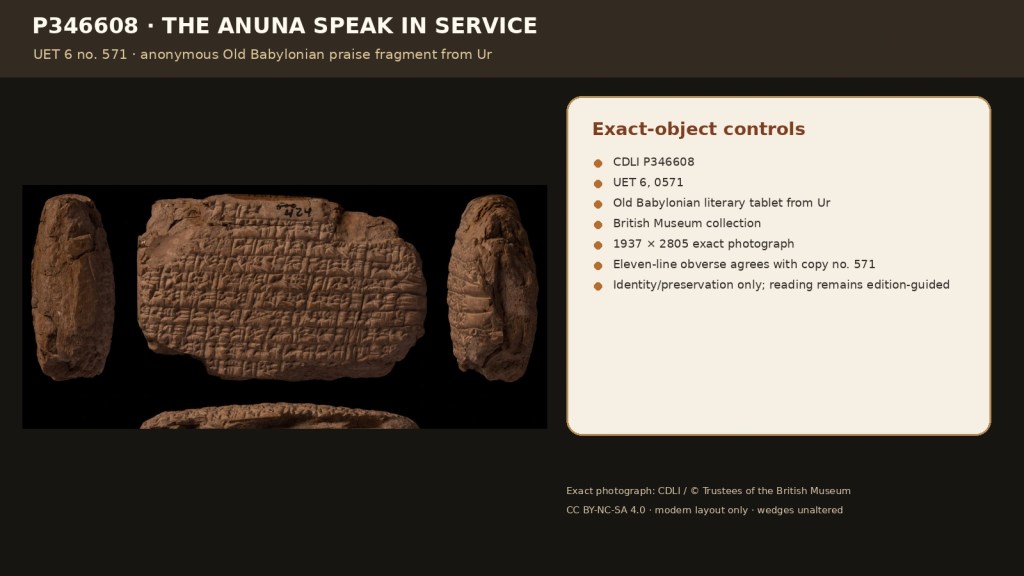
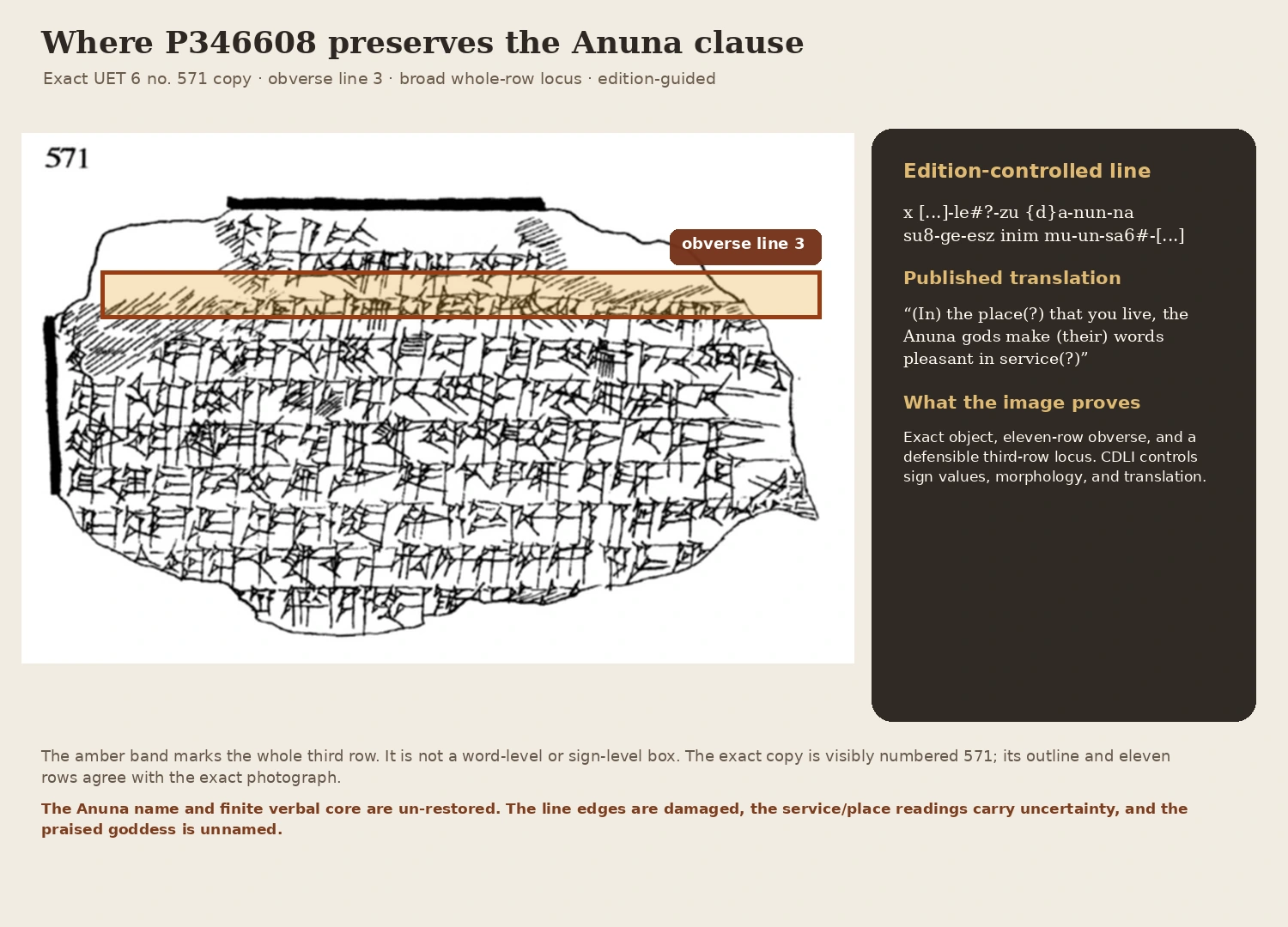
This report therefore treats P346608 as a controlled example of ritual speech and organized divine service. The exact photograph verifies the object and its eleven-line obverse. The exact UET line drawing, visibly numbered 571, lets us register line 3 as a broad whole row. CDLI controls the sign values, morphology, and translation; this is edition-guided reading, not a claim that every wedge was independently deciphered from the photograph.
The exact object: P346608 / UET 6 no. 571
CDLI describes P346608 as a literary clay tablet excavated at Ur (modern Tell Muqayyar), dated to the Old Babylonian period, approximately 1900–1600 BCE, and held in the British Museum. Its primary publication identifier is Ur Excavations Texts 6, no. 571. The object is small, dense, and unusually helpful for this workflow because a current exact photograph and an exact-object scholarly copy are both publicly linked from the same artifact record.
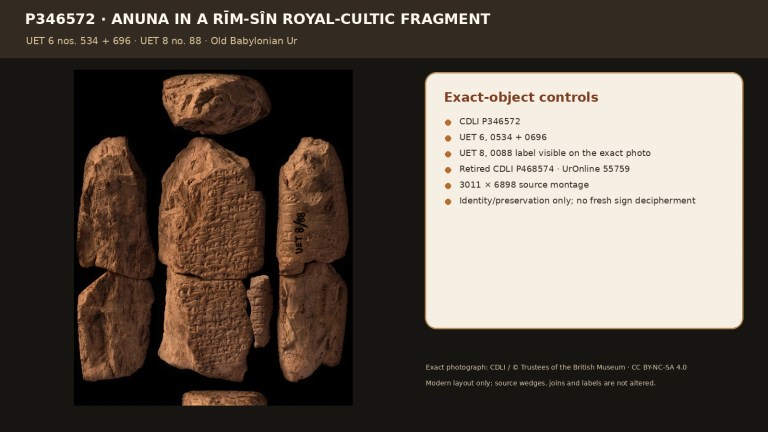
The photograph shows an obverse with eleven horizontal lines, several edge views, and a largely broken reverse. The copy repeats the same outline and eleven-line arrangement and is visibly headed “571.” Those independent physical controls lock the image, publication number, and electronic record together. They do not, by themselves, license a fresh reading of individual signs. Their job is to prove that the published line belongs to this physical object and to establish a defensible row location.
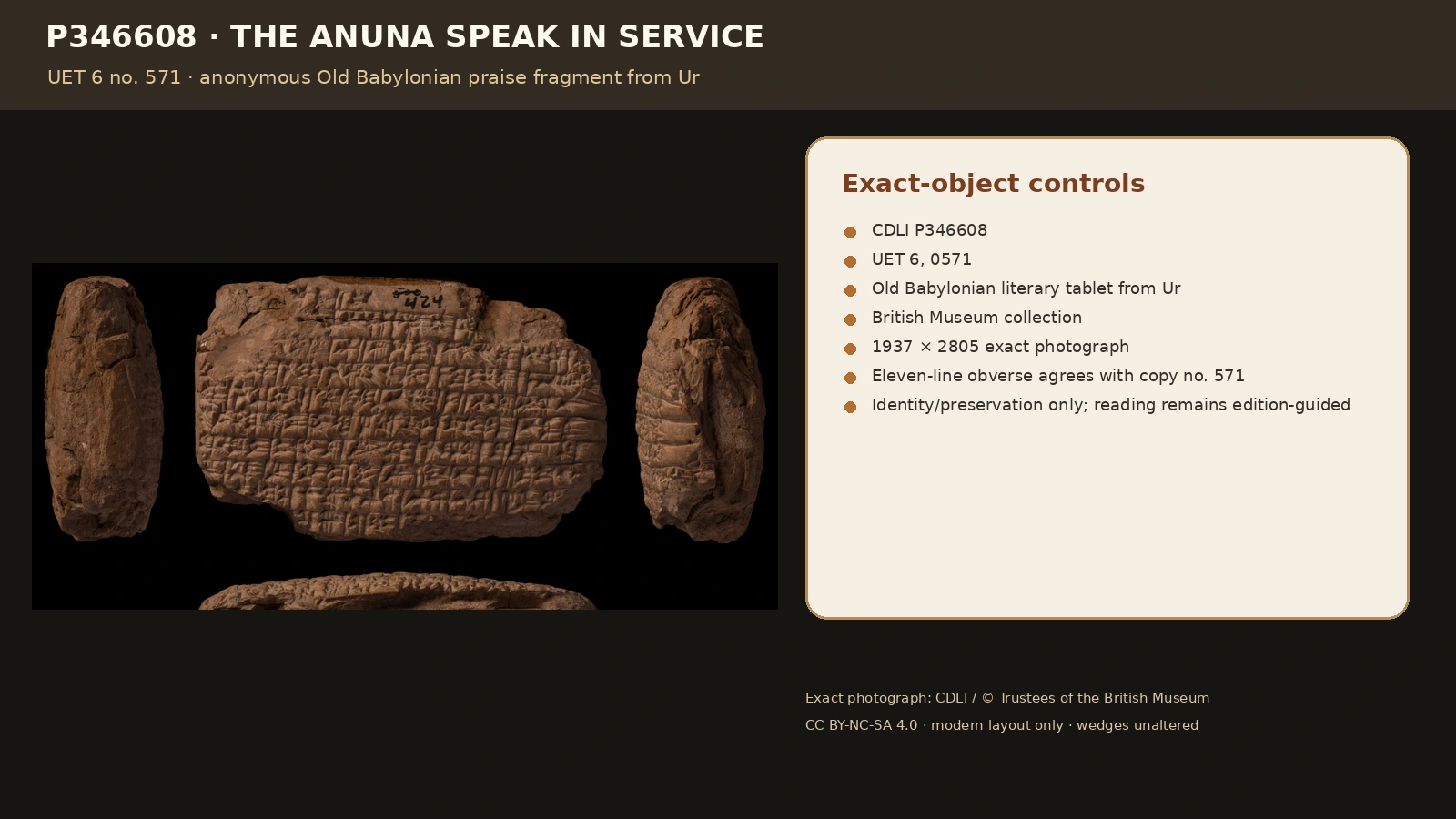
The artifact, publication number, line count, outline, provenance, period, and current collection agree. P346608 and UET 6 no. 571 were also checked against the project ledger and evidence index before selection. Neither identifier nor this direct Anuna speech/service angle had already been published in the daily corpus.
What obverse line 3 actually says
The current direct CDLI ATF gives the artifact-specific line as:
x [...]-le#?-zu {d}a-nun-na su8-ge-esz inim mu-un-sa6#-[...]
CDLI’s witness translation is:
“(In) the place(?) that you live, the Anuna gods make (their) words pleasant in service(?)”
Three components matter. First, {d}a-nun-na is not enclosed in square restoration brackets. Second, su8-ge-esz, interpreted cautiously in the witness translation with a service nuance, also survives outside brackets. Third, inim mu-un-sa6# supplies a verbal core involving inim, “word,” and sa6, “to be or make good, favorable, pleasant.” The published English keeps question marks because the beginning and ending of the line are incomplete and the exact syntactic nuance is not beyond dispute.
The surrounding fragment is praise addressed to a female divinity: line 1 calls the addressee a great wild cow among the gods, and line 6 uses “lady.” Yet no surviving divine name identifies her securely. Inanna is an understandable possibility in this genre, but possibility is not evidence. The article therefore says unnamed praised goddess rather than silently inserting a name.
Image-to-text alignment: what is visible and what is edited
The exact copy provides a simple, reproducible location rule. Starting with the top inscribed row of the eleven-line obverse, line 3 is the third whole row. The annotation marks that entire row with a broad band. It deliberately does not draw a box around {d}a-nun-na or claim independent recognition of each wedge. The photograph independently confirms that the corresponding row physically survives on the selected tablet.
| Evidence layer | What is supported | Damage or limit |
|---|---|---|
| Exact photograph | P346608 identity, tablet form, eleven-line obverse, row survival, reverse breakage | Not an independent sign-by-sign collation |
| Exact UET copy | Identifier 571, object outline, eleven rows, broad third-row locus | No word-level or individual-sign box is claimed |
| CDLI artifact ATF | {d}a-nun-na, su8-ge-esz, and inim mu-un-sa6# outside restoration brackets |
Line opening and ending are damaged; one sign and the final verbal sign carry uncertainty marks |
| Published translation | Anuna as subject of pleasant/favorable words in service | Place and service readings are explicitly questioned |
| Working translation | Ritual speech/service by the organized divine group | Recipient remains unnamed; no missing words are reconstructed |
The result is classified as exact_line_art_or_squeeze_visible at whole-row level and edition-guided for the reading. It is not parallel-only, and the thesis-critical Anuna subject is not supplied by a composite.
Published translation and cautious working translation
The published CDLI witness translation deserves to remain primary because it records its own uncertainty: “(In) the place(?) that you live, the Anuna gods make (their) words pleasant in service(?).” A cautious working translation for explanation is:
“[At/in] your dwelling-place, the Anuna, serving, make their words favorable or pleasing […].”
This version does not pretend that “dwelling-place” or “serving” is certain. It simply exposes the grammar that makes this fragment valuable: the Anuna are not a nearby noun in a broken list. They are the explicit subject associated with a surviving verbal core. The damaged ending may once have clarified the object, purpose, or setting, but it cannot be restored by imagination.
The Sumerian Anuna is historically related to the broader Akkadian forms conventionally written Anunnakū or popularized as “Anunnaki.” That continuity is useful for corpus searching, but language and period still matter. P346608 is a Sumerian Old Babylonian witness and writes {d}a-nun-na. It should not be made to say every later thing associated with Akkadian Anunnakū traditions.
Subject / action / limit firewall
The strongest contribution of this tablet is methodological. Many fragmentary texts preserve “Anuna” near temples, offerings, royal powers, or construction vocabulary but lose the verb that would identify an actor. P346608 is different: a finite verbal relation survives. That supports a real agency statement—but only within the surviving semantic field of words, praise, and service.
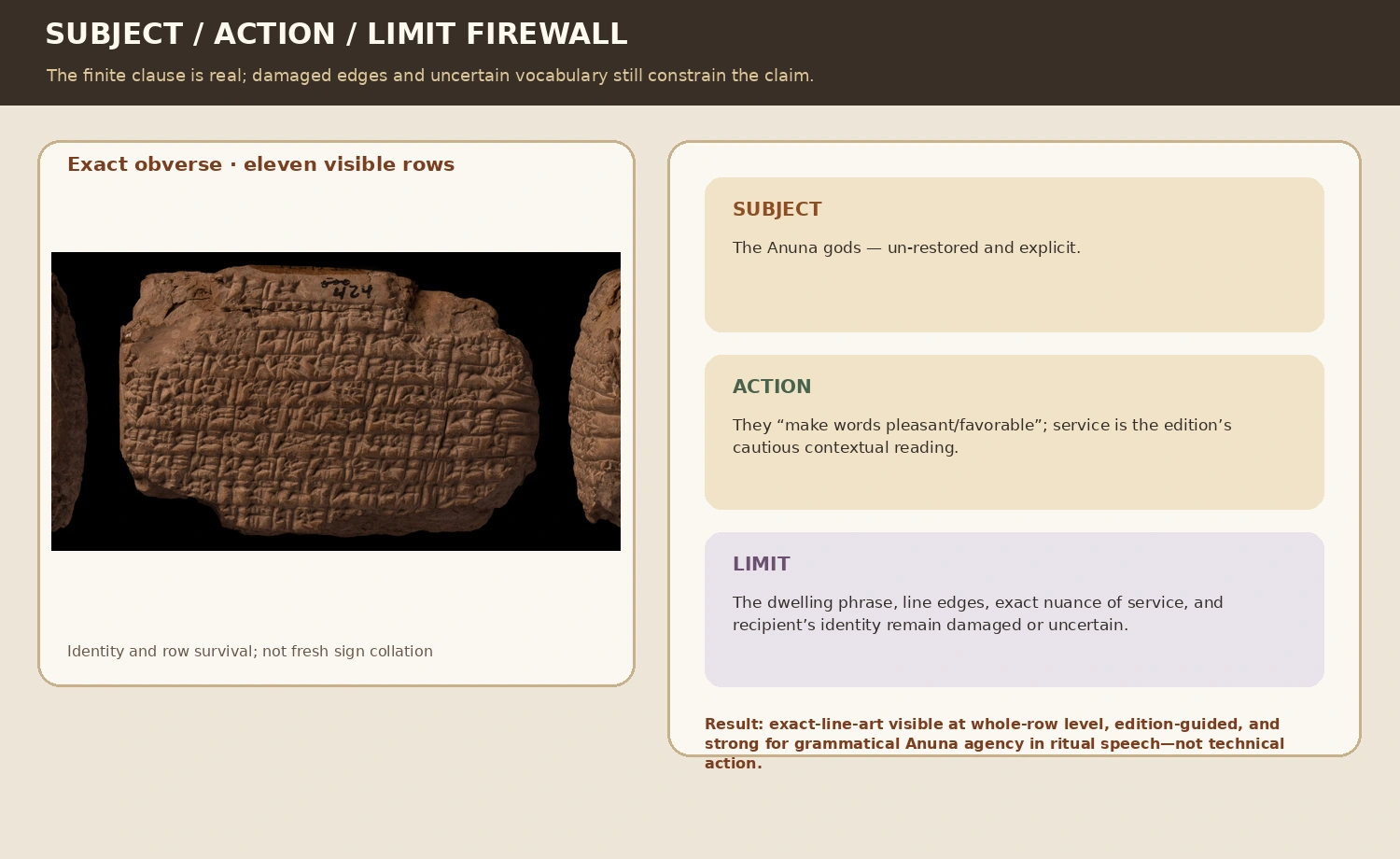
Subject: the Anuna gods. Action domain: making words favorable or pleasant, in a context the edition tentatively understands as service. Limit: neither the damaged place phrase nor the recipient’s name is secure. Nothing in the line makes the Anuna builders, engineers, miners, biological creators, travelers in vehicles, or operators of machinery.
This firewall prevents two opposite errors. One error would reduce the line to mere co-occurrence and miss that the Anuna have a grammatical role. The other would inflate ritual speech into technical action. The evidence supports organized divine participation in praise/service; it does not support a technological paraphrase.
What this adds to the cumulative corpus
The cumulative project already contains stronger texts for human creation and labor, kingship, law, divine decrees, temple planning, measurement, and organized assemblies. P346608 does not replace those sources. It adds a compact grammatical control: a real, non-restored Anuna subject joined to a surviving verbal core on one exact physical witness.
For the working Sitchin hypothesis, the result moderately supports the narrower proposition that the Anuna were imagined as an organized divine collective capable of coordinated behavior in a cultic hierarchy. It does not strengthen the ancient-astronaut portion of the hypothesis. In fact, the source helps discipline that question by showing what positive agency looks like when the grammar actually survives. Here the agency is verbal and ritual, not mechanical or extraterrestrial.
The next-selection implication is clear: prioritize exact witnesses in which an un-restored Anuna or Anunnakū subject, a finite verb, and a concrete institutional action all survive together. That would allow direct comparison between ritual speech here and actions involving decree, judgment, labor assignment, measurement, craft, or infrastructure elsewhere.
What the tablet does not prove
P346608 does not mention extraterrestrial identity, Nibiru, spacecraft, genetic engineering, laboratories, mining, advanced machinery, or recoverable technology. It does not name the praised goddess securely. It does not preserve the complete opening or ending of line 3. It does not allow us to remove the question marks from the published place and service readings.
Those limits are not defects to hide. They are the reason the fragment is useful. The tablet offers a narrow positive result: on an exact Old Babylonian object from Ur, the Anuna are grammatically active in a praise/service sentence. The source remains theological and hymnic. Any broader historical or technological theory must be tested against other evidence rather than imported into this line.
Confidence: high for artifact identity, publication-number agreement, exact-copy row location, and the un-restored Anuna name; medium for the core verbal relation; edition-controlled for sign values and translation; low for the missing line edges and the recipient’s identity.
Sources and illustrated PDF
- CDLI P346608 artifact record — current metadata, witness text, translation, photograph, line art, license, and publication reference.
- Direct CDLI ATF for inscription 2376201 — artifact-specific transliteration, damage marks, and witness translation.
- Exact P346608 photograph — CDLI / British Museum visual source.
- Exact P346608 / UET 6 no. 571 line drawing — object-specific row control.
Download the six-page illustrated PDF report.
Daily capability improvement — Surviving-Predicate Gate: record the exact subject, service or role form, finite verbal core, damaged edges, recipient identity, restoration status, and image locus before calling a divine group an actor. When the predicate survives, state its semantic domain precisely; do not broaden ritual speech into technical agency.
Share this:

One considered email each week
TheCode Weekly Evidence Brief
Receive the week’s strongest tablet decode, source audit or research update, plus one carefully chosen archive read. Routine posts stay on the site; the Brief is the curated signal.
Free. Usually sent on Sunday. No daily post flood. Unsubscribe at any time. See what the Brief includes.