
Shulgi B: Anuna, Scribal Statecraft, and the House of Nisaba
A source-backed reading of Shulgi B, where an Anuna line sits inside a broader chain of tablets, scribal art, legal cases, assemblies, governors, canals, and the House of Nisaba.

Ancient text and site reading
How to read this record
- Claim type
- Historical / textual + interpretive
- Evidence level
- Sources, translations, measurements, and symbolic reading where present
Use the evidence layer for sources and observations, and the interpretation layer for TheCode.Wiki synthesis.
Today I chose Shulgi B, CDLI Literary 000396 / Q000396 and ETCSL 2.4.2.02. It advances the corpus because a real witness, CDLI P346167 / U 16847, preserves the explicit Anuna line, while the wider CDLI/ETCSL composition ties that line to school tablets, scribal art, calculation, legal cases, multilingual decisions, assemblies, crime control, divine service, managed fields, canals, and the House of the Wisdom of Nisaba.

Why This Source
The current proof gap asks for a tighter link between Anuna/Anunnaki language and institutions: law, oath, administration, school practice, archived texts, and recorded authority. Shulgi B is a royal praise poem rather than an administrative tablet, but it gives a concentrated literary witness to the ideology behind those institutions. Shulgi’s claimed authority is not only military or devotional; it is also scribal, legal, multilingual, archival, and agricultural.
That matters for Tony’s thesis test because it strengthens the organized divine governance and civilization-maintenance strand. The source supports the idea that Sumerian tradition could place writing, judgment, deliberation, land management, and knowledge preservation inside a divine-authorized order that includes the Anuna. It does not by itself prove extraterrestrials, Nibiru, spacecraft, genetic engineering, literal mining, or machines.


Published Translation And Working Reading
ETCSL translates the early passage as Shulgi claiming that as a child he was in the academy, learned the scribal art from tablets of Sumer and Akkad, and qualified in subtraction, addition, reckoning, and accounting. Later it translates the legal passage as Shulgi providing justice in Sumer’s legal cases, answering in five languages, teaching governors to deliberate and debate, tackling crime, serving the gods, and cooling the hearts of the Anuna gods.
My cautious working reading is that Shulgi B preserves an Anuna-adjacent model of literate statecraft. The important claim is not that the tablet says ‘aliens.’ It does not. The important claim is that the divine group appears inside a passage where legitimate rule is defined through school training, tablets, accounting, legal procedure, assemblies, governors, speech discipline, crime control, provisioning, canals, and durable houses of learning.
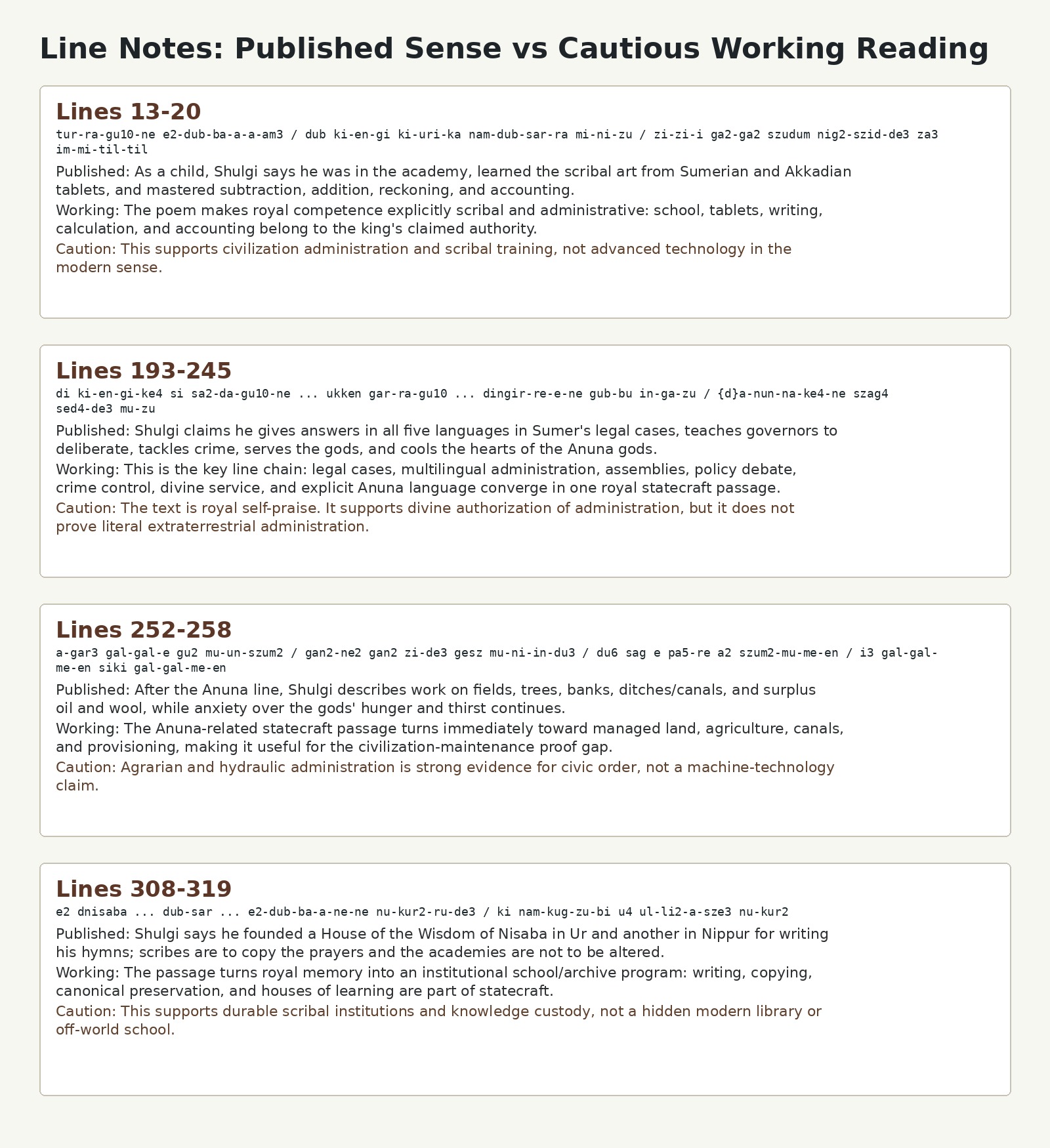
Line Notes
| Lines | Transliteration | Published sense | Cautious working reading | Limit |
|---|---|---|---|---|
| 13-20 | tur-ra-gu10-ne e2-dub-ba-a-a-am3 / dub ki-en-gi ki-uri-ka nam-dub-sar-ra mi-ni-zu / zi-zi-i ga2-ga2 szudum nig2-szid-de3 za3 im-mi-til-til | As a child, Shulgi says he was in the academy, learned the scribal art from Sumerian and Akkadian tablets, and mastered subtraction, addition, reckoning, and accounting. | The poem makes royal competence explicitly scribal and administrative: school, tablets, writing, calculation, and accounting belong to the king's claimed authority. | This supports civilization administration and scribal training, not advanced technology in the modern sense. |
| 193-245 | di ki-en-gi-ke4 si sa2-da-gu10-ne ... ukken gar-ra-gu10 ... dingir-re-e-ne gub-bu in-ga-zu / {d}a-nun-na-ke4-ne szag4 sed4-de3 mu-zu | Shulgi claims he gives answers in all five languages in Sumer's legal cases, teaches governors to deliberate, tackles crime, serves the gods, and cools the hearts of the Anuna gods. | This is the key line chain: legal cases, multilingual administration, assemblies, policy debate, crime control, divine service, and explicit Anuna language converge in one royal statecraft passage. | The text is royal self-praise. It supports divine authorization of administration, but it does not prove literal extraterrestrial administration. |
| 252-258 | a-gar3 gal-gal-e gu2 mu-un-szum2 / gan2-ne2 gan2 zi-de3 gesz mu-ni-in-du3 / du6 sag e pa5-re a2 szum2-mu-me-en / i3 gal-gal-me-en siki gal-gal-me-en | After the Anuna line, Shulgi describes work on fields, trees, banks, ditches/canals, and surplus oil and wool, while anxiety over the gods' hunger and thirst continues. | The Anuna-related statecraft passage turns immediately toward managed land, agriculture, canals, and provisioning, making it useful for the civilization-maintenance proof gap. | Agrarian and hydraulic administration is strong evidence for civic order, not a machine-technology claim. |
| 308-319 | e2 dnisaba ... dub-sar ... e2-dub-ba-a-ne-ne nu-kur2-ru-de3 / ki nam-kug-zu-bi u4 ul-li2-a-sze3 nu-kur2 | Shulgi says he founded a House of the Wisdom of Nisaba in Ur and another in Nippur for writing his hymns; scribes are to copy the prayers and the academies are not to be altered. | The passage turns royal memory into an institutional school/archive program: writing, copying, canonical preservation, and houses of learning are part of statecraft. | This supports durable scribal institutions and knowledge custody, not a hidden modern library or off-world school. |
Corpus Relevance
- Evidence value: strong for the scribal, legal, administrative, agricultural, and knowledge-preservation proof gap because explicit Anuna language stands inside a broad statecraft sequence.
- Sitchin relevance: high for the organized-divine-authority and civilization-maintenance strand of the thesis test. The source supports a memory of divine powers around writing, judgment, deliberation, land management, and archival continuity.
- Limit: the text is a royal praise poem and theological-political claim. It does not state extraterrestrial identity, Nibiru, spacecraft, genetic engineering, literal mining, metal machines, or recoverable advanced technology.
- Witness discipline: CDLI P346167 physically preserves the Anuna line; CDLI P469698/Q000396 and ETCSL supply broader line control. P262125 and P345111 are additional real witness anchors; annotations are source orientation rather than fresh collation.

Download the working report: Shulgi B, Anuna, scribal statecraft, and House of Nisaba PDF report.
Source Links
- CDLI artifact P346167, Shulgi B ex. 013 – UET 6, 82 / U 16847, Old Babylonian Ur witness whose CDLI page preserves the Anuna line in its artifact text.
- CDLI line art for P346167 – Published line art used for the direct Anuna witness panel.
- CDLI artifact P262125, Shulgi B ex. 006 – Large Old Babylonian Nippur Shulgi B witness group with Penn Museum photo and line art, used as the broad visual witness.
- CDLI photo for P262125 – Penn Museum photo used as the main artifact-image visual.
- CDLI artifact P345111, Shulgi B ex. 001 – Ist Ni 01003, Old Babylonian Nippur Shulgi B witness with line art and ETCSL/eBL cross references.
- CDLI composite P469698 / Q000396 – Composite artifact page containing the current CDLI ATF for Shulgi B.
- CDLI composite score Q000396 – CDLI score/citation page for the Shulgi B composite; the static page is citation-focused.
- ETCSL translation, Shulgi B – Published English translation used for the comparison reading.
- ETCSL composite text, Shulgi B – ETCSL composite transliteration and line numbering control.
- ETCSL bibliography, Shulgi B – Cuneiform source list for the many Shulgi B witnesses, including P262125, P346167, and P345111 equivalents.
- eBL fragment U.16847 – eBL public fragment page for the P346167 / U 16847 witness.
- ORACC AMGG Anunna page – Terminology control for Anuna/Anunna/Anunnaki.
- ePSD2 Anuna entry – Lexical check for the Anuna divine-group name.
- ePSD2 dub entry – Lexical check for tablet/writing vocabulary in the school and archive strand.
- ORACC OSL DUB words page – Control for DUB compounds such as dub-sar / scribe and related tablet terms.
Share this:

One considered email each week
TheCode Weekly Evidence Brief
Receive the week’s strongest tablet decode, source audit or research update, plus one carefully chosen archive read. Routine posts stay on the site; the Brief is the curated signal.
Free. Usually sent on Sunday. No daily post flood. Unsubscribe at any time. See what the Brief includes.


