
Utu/Shamash Bilingual Hymn: Anuna to Anunnaki on P238563
A source-backed reading of CDLI P238563, where a bilingual Utu/Shamash hymn bridges Sumerian Anuna and Akkadian Anunnaki in a judicial divine frame.

Ancient text and site reading
How to read this record
- Claim type
- Historical / textual + interpretive
- Evidence level
- Sources, translations, measurements, and symbolic reading where present
Use the evidence layer for sources and observations, and the interpretation layer for TheCode.Wiki synthesis.
Today I chose CDLI P238563, BA 10/1, 082, because it fills one of the corpus's highest-value gaps: a bridge from Sumerian Anuna to Akkadian Anunnaki. The tablet is a Neo-Assyrian bilingual hymn fragment to Utu/Shamash from Nineveh, and CDLI preserves the key Sumerian/Akkadian line pair in its ATF.
Download the working report: Utu/Shamash Anuna to Anunnaki bridge PDF report.

The source basis
CDLI identifies P238563 as a clay tablet from Nineveh, Neo-Assyrian period, in the British Museum collection, with Sumerian and Akkadian languages and a genre note identifying it as a bilingual hymn to the Sun-god. The publication record ties it to Theophile J. Meek's 1913 collection of bilingual hymns, prayers, and penitential psalms.
The report uses the CDLI artifact page, JSON metadata, ATF inscription, source photo, and Meek publication record. For context, it uses ORACC AMGG on Anunna/Anunnaki and Utu/Shamash. AMGG is especially helpful because it describes Utu/Shamash as a justice and judgment deity and records Anunna as Sumerian with Akkadian Anunnaki/Anunnaku forms.

The bridge line
The key line is P238563 obverse 3. The Sumerian side gives [uri3 {d}a-nun-na-ke4-ne] uszumgal# nun#-gal-e-ne#. The Akkadian side gives [u2-ri-in-nu {d}a-nun]-na-ki _uszum-gal_ {d}i2-gi3-gi3. The exact syntax is damaged, but the divine-group equivalence is the important corpus result: Sumerian Anuna and Akkadian Anunnaki are paired in the same ancient bilingual line group.
That bridge is not an ancient-astronaut proof by itself. It is, however, a strong witness that Anuna/Anunnaki continuity was part of ancient scribal scholarship, not a modern internet construction.

The judicial frame
The line immediately before the Anuna/Anunnaki pair introduces Utu/Shamash as the great or exalted judge of the gods: [{d}utu di-ku5-mah dingir-e]-ne paired with [{d}sza2-masz da-a-a-nu s,i-i-ru sza2] _dingir-mesz_-ni. This matters because the corpus has been looking for public institutional contexts: law, oath, court, justice, and judgment.
Utu/Shamash is the right deity for that frame. ORACC AMGG describes him as associated with life, justice, divination, and the netherworld, and explains his connection with truth, judgments, justice, treaties, oaths, and business transactions. P238563 therefore gives us an Anuna/Anunnaki bridge inside a divine legal-theological setting.

Line notes
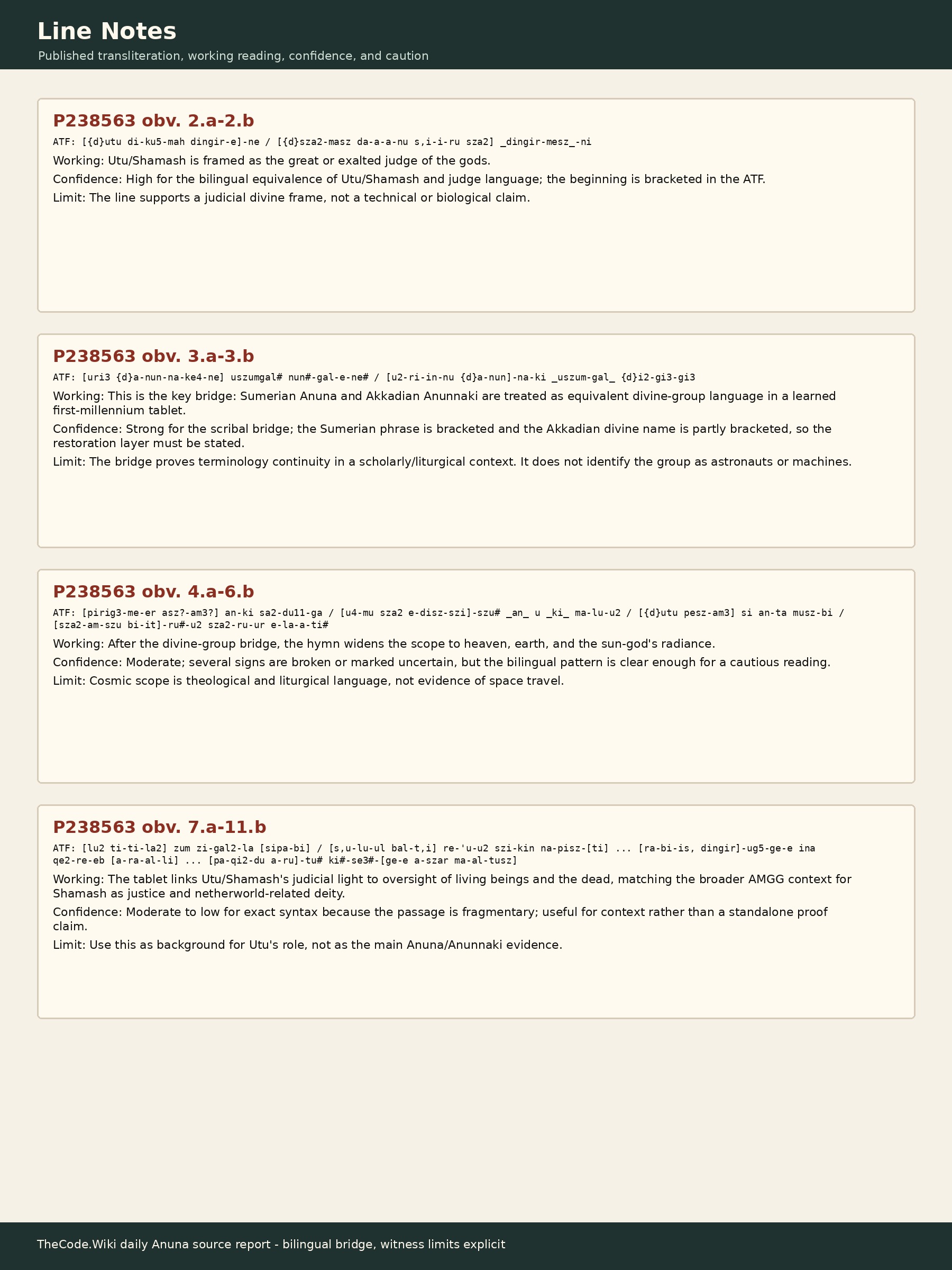
| Line | ATF | Cautious working reading | Confidence | Limit |
|---|---|---|---|---|
| P238563 obv. 2.a-2.b | [{d}utu di-ku5-mah dingir-e]-ne / [{d}sza2-masz da-a-a-nu s,i-i-ru sza2] _dingir-mesz_-ni | Utu/Shamash is framed as the great or exalted judge of the gods. | High for the bilingual equivalence of Utu/Shamash and judge language; the beginning is bracketed in the ATF. | The line supports a judicial divine frame, not a technical or biological claim. |
| P238563 obv. 3.a-3.b | [uri3 {d}a-nun-na-ke4-ne] uszumgal# nun#-gal-e-ne# / [u2-ri-in-nu {d}a-nun]-na-ki _uszum-gal_ {d}i2-gi3-gi3 | This is the key bridge: Sumerian Anuna and Akkadian Anunnaki are treated as equivalent divine-group language in a learned first-millennium tablet. | Strong for the scribal bridge; the Sumerian phrase is bracketed and the Akkadian divine name is partly bracketed, so the restoration layer must be stated. | The bridge proves terminology continuity in a scholarly/liturgical context. It does not identify the group as astronauts or machines. |
| P238563 obv. 4.a-6.b | [pirig3-me-er asz?-am3?] an-ki sa2-du11-ga / [u4-mu sza2 e-disz-szi]-szu# _an_ u _ki_ ma-lu-u2 / [{d}utu pesz-am3] si an-ta musz-bi / [sza2-am-szu bi-it]-ru#-u2 sza2-ru-ur e-la-a-ti# | After the divine-group bridge, the hymn widens the scope to heaven, earth, and the sun-god's radiance. | Moderate; several signs are broken or marked uncertain, but the bilingual pattern is clear enough for a cautious reading. | Cosmic scope is theological and liturgical language, not evidence of space travel. |
| P238563 obv. 7.a-11.b | [lu2 ti-ti-la2] zum zi-gal2-la [sipa-bi] / [s,u-lu-ul bal-t,i] re-'u-u2 szi-kin na-pisz-[ti] ... [ra-bi-is, dingir]-ug5-ge-e ina qe2-re-eb [a-ra-al-li] ... [pa-qi2-du a-ru]-tu# ki#-se3#-[ge-e a-szar ma-al-tusz] | The tablet links Utu/Shamash's judicial light to oversight of living beings and the dead, matching the broader AMGG context for Shamash as justice and netherworld-related deity. | Moderate to low for exact syntax because the passage is fragmentary; useful for context rather than a standalone proof claim. | Use this as background for Utu's role, not as the main Anuna/Anunnaki evidence. |
Corpus relevance
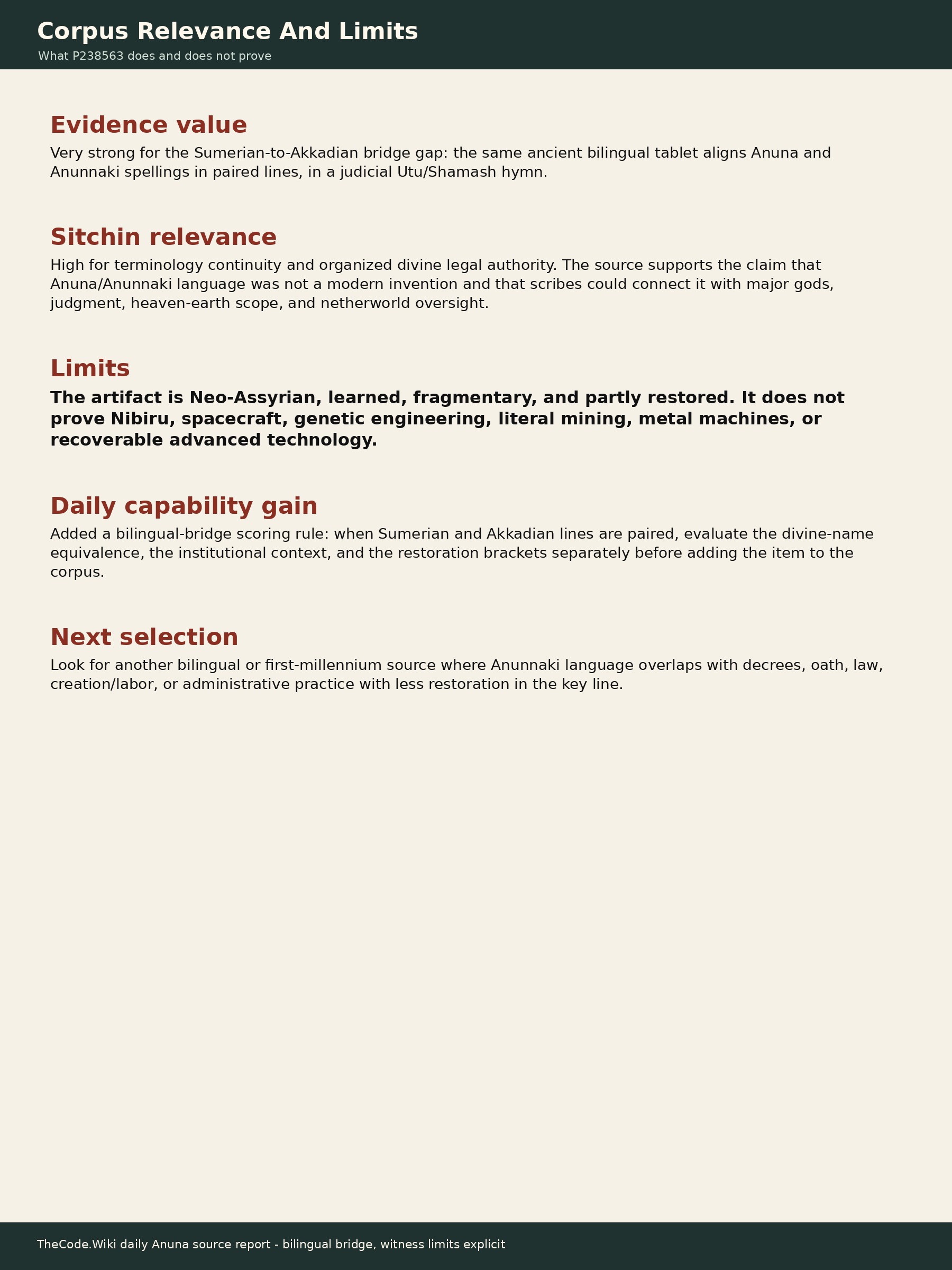
For Tony's Sitchin-thesis test, P238563 is high-value evidence for continuity and organization. It supports the claim that the Sumerian Anuna and Akkadian Anunnaki are historically connected terms and that the group could appear within a judicial divine order. It also moves the corpus from Old Babylonian Sumerian literary witnesses into first-millennium bilingual scholarship.
The limits are just as important. The tablet is fragmentary and learned; key wording is partly restored in brackets. It does not say Nibiru, spacecraft, genetic engineering, literal mining, metal machines, or recoverable advanced technology. It strengthens the language and divine-order side of the corpus, not the strongest ancient-astronaut claims.
Source links
- CDLI artifact P238563 / BA 10/1, 082 – Primary artifact page for the Neo-Assyrian Nineveh tablet, with photo, metadata, publication links, and transliteration.
- CDLI P238563 ATF inscription – Line-by-line Sumerian and Akkadian ATF for the bilingual Utu/Shamash hymn fragment.
- CDLI P238563 JSON metadata – Machine-readable metadata: Neo-Assyrian period, Nineveh provenience, British Museum collection, Sumerian and Akkadian languages, and genre note.
- CDLI source photo P238563 – Source photo used for the annotated artifact overview and close-up crop.
- CDLI publication record for Meek 1913 BA 10/1 – Publication anchor for Theophile J. Meek, Cuneiform Bilingual Hymns, Prayers and Penitential Psalms, with P238563 listed as BA 10/1, 082.
- ORACC AMGG Anunna page – Controlled context for Sumerian Anunna and Akkadian Anunnaki/Anunnaku terminology and the fate/judgment role.
- ORACC AMGG Utu/Shamash page – Controlled context for Utu/Shamash as sun god, judge, truth/justice deity, and underworld-related divine figure.
- ePSD2 Anuna lexical entry – Lexical control for the Sumerian divine-group name a-nun-na.
Share this:

One considered email each week
TheCode Weekly Evidence Brief
Receive the week’s strongest tablet decode, source audit or research update, plus one carefully chosen archive read. Routine posts stay on the site; the Brief is the curated signal.
Free. Usually sent on Sunday. No daily post flood. Unsubscribe at any time. See what the Brief includes.


