
Kesh Temple Hymn: Anuna Lords, Wisdom, Ritual Order, and Kingship Seed
A source-backed reading of the Kesh Temple Hymn where a real Old Babylonian prism calls the Anuna gods the lords of the temple.

Ancient text and site reading
How to read this record
- Claim type
- Historical / textual + interpretive
- Evidence level
- Sources, translations, measurements, and symbolic reading where present
Use the evidence layer for sources and observations, and the interpretation layer for TheCode.Wiki synthesis.
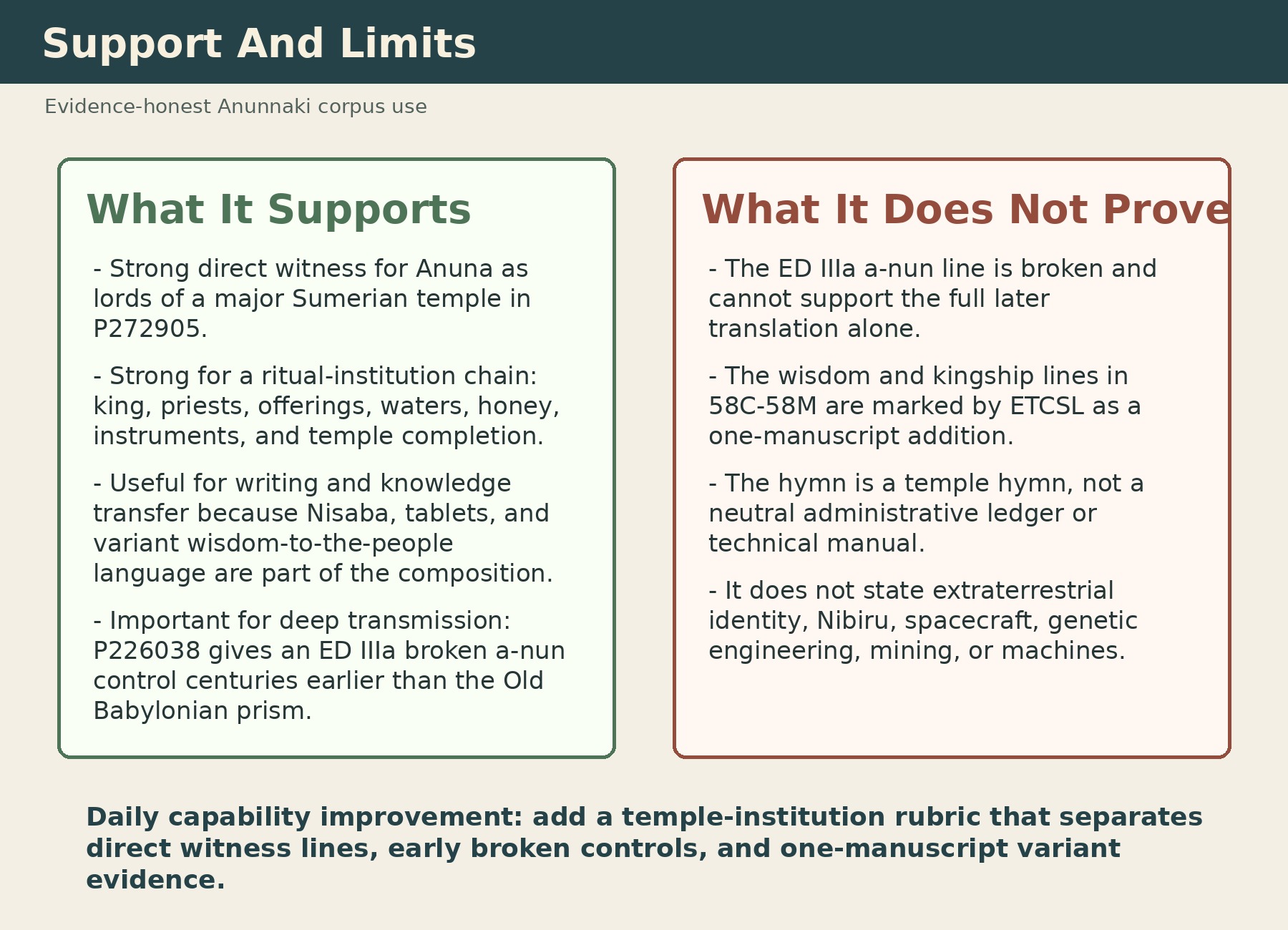
Main takeaway: CDLI P272905 / WAM 48.1802, an Old Babylonian prism witness to the Kesh Temple Hymn, directly says that the lords of the house are the Anuna gods. Around that line the composition links temple authority with Nisaba’s tablets, heaven-barge and Abzu imagery, ritual officers, offerings, and a variant strand about wisdom to the people and kingship/fate. This advances the temple, knowledge, and ritual-administration proof gap. It does not prove extraterrestrials, Nibiru, spacecraft, genetic engineering, mining, or machines.
Download the working report: Kesh Temple Hymn Anuna wisdom and ritual PDF report.

Source Basis
The main physical anchor is CDLI P272905, a clay prism in the Walters Art Museum, museum number WAM 48.1802. CDLI describes it as an Old Babylonian Sumerian literary prism and a witness to the Kesh Temple Hymn. The public visual control is the CDLI P272905 photograph, and the metadata archive uses CDLI P272905 JSON.
A second witness is CDLI P226038, IM 070295 from Abu Salabikh, dated by CDLI to ED IIIa. Its CDLI JSON metadata and line art preserve a broken a-nun line near house, Kesh, and priestly language. Text control comes from the CDLI P464240 / Q000751 composite, plus the ETCSL translation, composite text, and bibliography.

Why This Source Matters
The recent corpus needed another source where Anuna language meets a practical institution. Kesh is not a law court or tax edict, but it is a major temple-institution text. The strongest direct line is P272905 surface d 9, where the house’s lords are the Anuna gods. The surrounding lines list the king, priests, water, honey, and ritual performance. Earlier in the prism, Nisaba has the words written on tablets. In the wider composite, a one-manuscript addition calls the house of the Anuna a source of wisdom for the people and a house that gives birth to kings and determines the destinies of the land.
That combination matters for Tony’s larger thesis test because it supports an organized divine authority structure attached to knowledge custody, temple architecture, ritual labor, and kingship ideology. The evidence is still theological and literary. It is not a technical record of machines or a literal ancient-astronaut statement.

Published Translation And Working Reading
The published ETCSL translation says that the holy house Kesh is the house whose lords are the Anuna gods, and that its nuesh priests are the sacrificers of E-ana. The same section describes the king placing stone bowls, priests handling implements and waters, and temple musicians performing. Our working translation keeps the direct claim narrow: the prism presents the Anuna as temple-lords inside a ritual office sequence.
The more expansive wisdom and kingship language belongs to a variant stanza that ETCSL marks as added by one manuscript. That stanza is still valuable: it calls the house of the Anuna powerful, says it gives wisdom to the people, supports the shrines, gives birth to kings, and determines the destinies of the land. But the report labels it as variant/composite evidence, not as the main visible line on P272905.
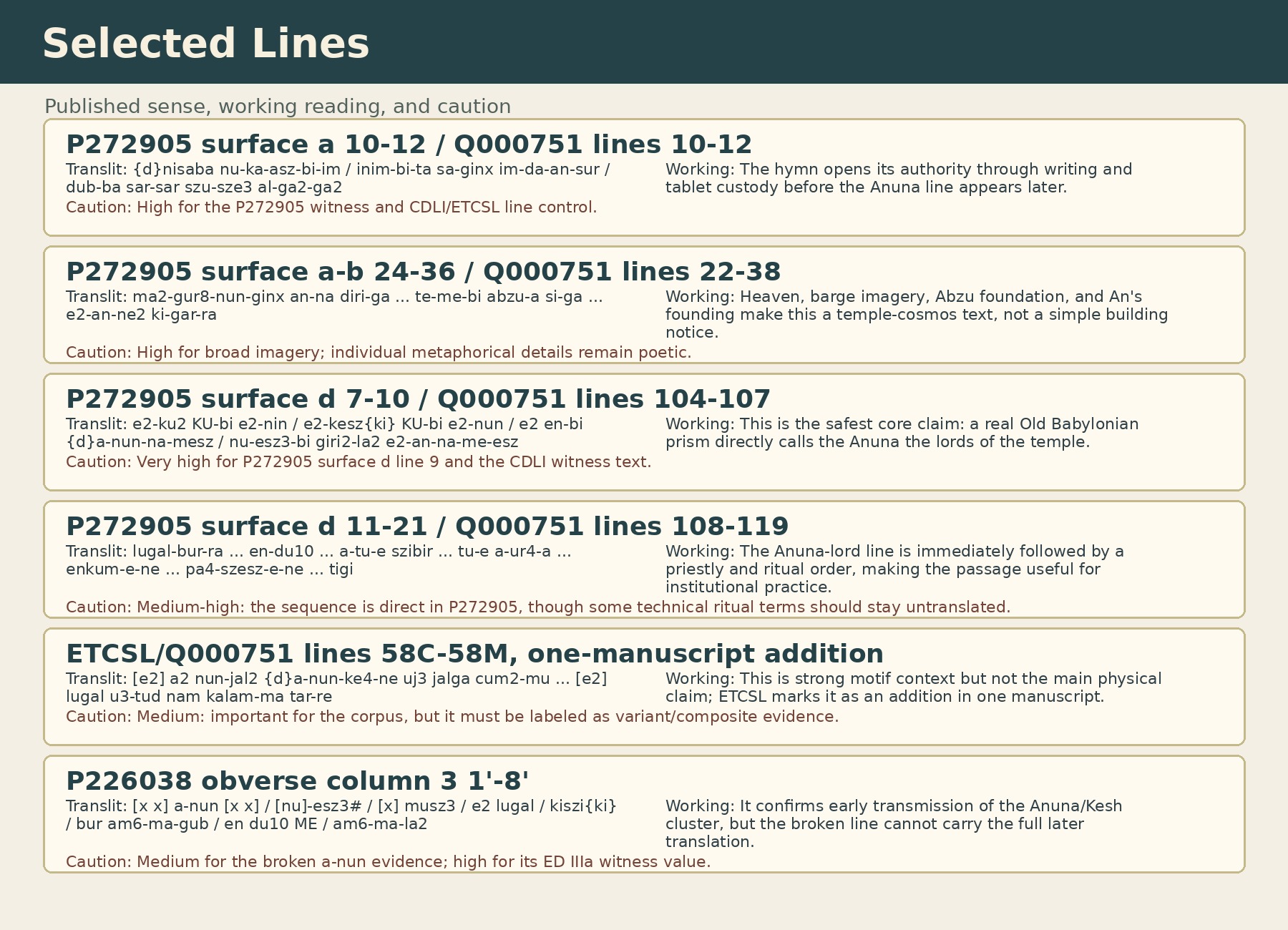
Line Notes
| Line | Transliteration | Published Sense | Working Reading | Caution |
|---|---|---|---|---|
| P272905 surface a 10-12 / Q000751 lines 10-12 | {d}nisaba nu-ka-asz-bi-im / inim-bi-ta sa-ginx im-da-an-sur / dub-ba sar-sar szu-sze3 al-ga2-ga2 | Nisaba is its decision-maker; with its words she weaves it like a net; written on tablets, it is held in her hands. | The hymn opens its authority through writing and tablet custody before the Anuna line appears later. | High for the P272905 witness and CDLI/ETCSL line control. |
| P272905 surface a-b 24-36 / Q000751 lines 22-38 | ma2-gur8-nun-ginx an-na diri-ga ... te-me-bi abzu-a si-ga ... e2-an-ne2 ki-gar-ra | The temple floats in the heavens like a princely barge; its foundations are fixed in the Abzu; the house is founded by An. | Heaven, barge imagery, Abzu foundation, and An’s founding make this a temple-cosmos text, not a simple building notice. | High for broad imagery; individual metaphorical details remain poetic. |
| P272905 surface d 7-10 / Q000751 lines 104-107 | e2-ku2 KU-bi e2-nin / e2-kesz{ki} KU-bi e2-nun / e2 en-bi {d}a-nun-na-mesz / nu-esz3-bi giri2-la2 e2-an-na-me-esz | The holy house, the house Kesh, whose lords are the Anuna gods and whose nuesh priests are the sacrificers of E-ana. | This is the safest core claim: a real Old Babylonian prism directly calls the Anuna the lords of the temple. | Very high for P272905 surface d line 9 and the CDLI witness text. |
| P272905 surface d 11-21 / Q000751 lines 108-119 | lugal-bur-ra ... en-du10 ... a-tu-e szibir ... tu-e a-ur4-a ... enkum-e-ne ... pa4-szesz-e-ne ... tigi | The king places stone bowls; the en priest holds the lead-rope; the a-tu priest holds the staff; waters, honey, enkum priests, pashesh priests, and music appear in the ritual sequence. | The Anuna-lord line is immediately followed by a priestly and ritual order, making the passage useful for institutional practice. | Medium-high: the sequence is direct in P272905, though some technical ritual terms should stay untranslated. |
| ETCSL/Q000751 lines 58C-58M, one-manuscript addition | [e2] a2 nun-jal2 {d}a-nun-ke4-ne uj3 jalga cum2-mu ... [e2] lugal u3-tud nam kalam-ma tar-re | A variant stanza calls the house the powerful house of the Anuna gods, gives wisdom to the people, supports the shrines, gives birth to kings, and determines the destinies of the land. | This is strong motif context but not the main physical claim; ETCSL marks it as an addition in one manuscript. | Medium: important for the corpus, but it must be labeled as variant/composite evidence. |
| P226038 obverse column 3 1′-8′ | [x x] a-nun [x x] / [nu]-esz3# / [x] musz3 / e2 lugal / kiszi{ki} / bur am6-ma-gub / en du10 ME / am6-ma-la2 | The archaic Abu Salabikh witness preserves a broken a-nun line near house, king, Kesh, and priestly wording. | It confirms early transmission of the Anuna/Kesh cluster, but the broken line cannot carry the full later translation. | Medium for the broken a-nun evidence; high for its ED IIIa witness value. |
Corpus Relevance
This entry adds a temple-institution rubric to the corpus: direct Anuna wording, scribal/tablet authority, cosmic architecture, priestly sequence, early witness control, and variant wisdom/kingship motifs should be scored separately. P272905 is strong for the direct Anuna-lord and ritual-office claim. P226038 is valuable as an early broken witness but cannot be forced to carry the complete Old Babylonian translation.
The Sitchin relevance is moderate to high for the organized-divine-authority and civilization-transfer strands. The hymn supports the claim that Sumerian tradition could attach Anuna authority to temple order, writing, knowledge, ritual office, and kingship/fate motifs. Its limit is clear: it remains a temple hymn and does not identify the Anuna as extraterrestrial beings or describe modern technology.
Source Manifest
Archived for this run: CDLI P272905 artifact page, JSON, and photograph; CDLI P226038 artifact page, JSON, and line art; CDLI P464240/Q000751 composite; ETCSL translation, composite text, and bibliography. Public source links are included above and verified after publication.
Share this:

One considered email each week
TheCode Weekly Evidence Brief
Receive the week’s strongest tablet decode, source audit or research update, plus one carefully chosen archive read. Routine posts stay on the site; the Brief is the curated signal.
Free. Usually sent on Sunday. No daily post flood. Unsubscribe at any time. See what the Brief includes.


