
Sargon II 117: Restored Anunnakū Formula, Broken Oaths, and a Stele Curse
RINAP restores the Anunnakū formula from parallels; the photographed stele directly supports the oath, monument, and curse evidence, not a visible Anunnakū spelling.

Ancient text and site reading
How to read this record
- Claim type
- Historical / textual + interpretive
- Evidence level
- Sources, translations, measurements, and symbolic reading where present
Use the evidence layer for sources and observations, and the interpretation layer for TheCode.Wiki synthesis.
Image-to-text epigraphic check

Audit result: RINAP column i line 1 is fragmentary, and line 2 remains unreadable where an Anunnakū spelling would be expected. The published English sequence “[Igīgū gods and] Anunnakū gods” is a scholarly comparative restoration. The photographed stele does not preserve readable signs that independently spell Anunnakū. Confidence is high that the restoration belongs to the edition; confidence is zero for a direct image reading of that divine name.
Exact-object image repair (21 July 2026): this is the selected Sargon II stele itself—not a diagram. Its photograph was recovered from figure 29 of the primary RINAP 2 edition and matched to National Museum of Iran numbers Tehran 5544/21110.

Visual inspection of the artifact image
Visual inspection: the tall limestone stele has a rounded top, a royal relief, and dense cuneiform fields. Heavy wear and breakage are visible, which is consistent with the edition’s bracketed and restored passages. The photograph controls physical description; the RINAP edition controls the reading.
Daily tablet report for 20 July 2026 (Turkey time). This report examines ORACC/RINAP Q006596, Sargon II 117, an Akkadian royal inscription whose edited text identifies the monument as a stele. Its broken opening is reconstructed from parallels as placing Aššur over the [Igīgū and] Anunnakū; later episodes frame rebellion as violation of divine oaths, and the ending turns the stele itself into a protected public memory object. Main finding: this source supports an organized divine sovereignty and oath-enforcement model. It does not identify the Anunnakū as extraterrestrials, and it does not say that the Anunnakū themselves authored each oath or curse. The name is supplied in the published translation from a comparative restoration; readable Anunnakū signs do not survive in the photographed opening, while the enforcement passages invoke the “great gods.”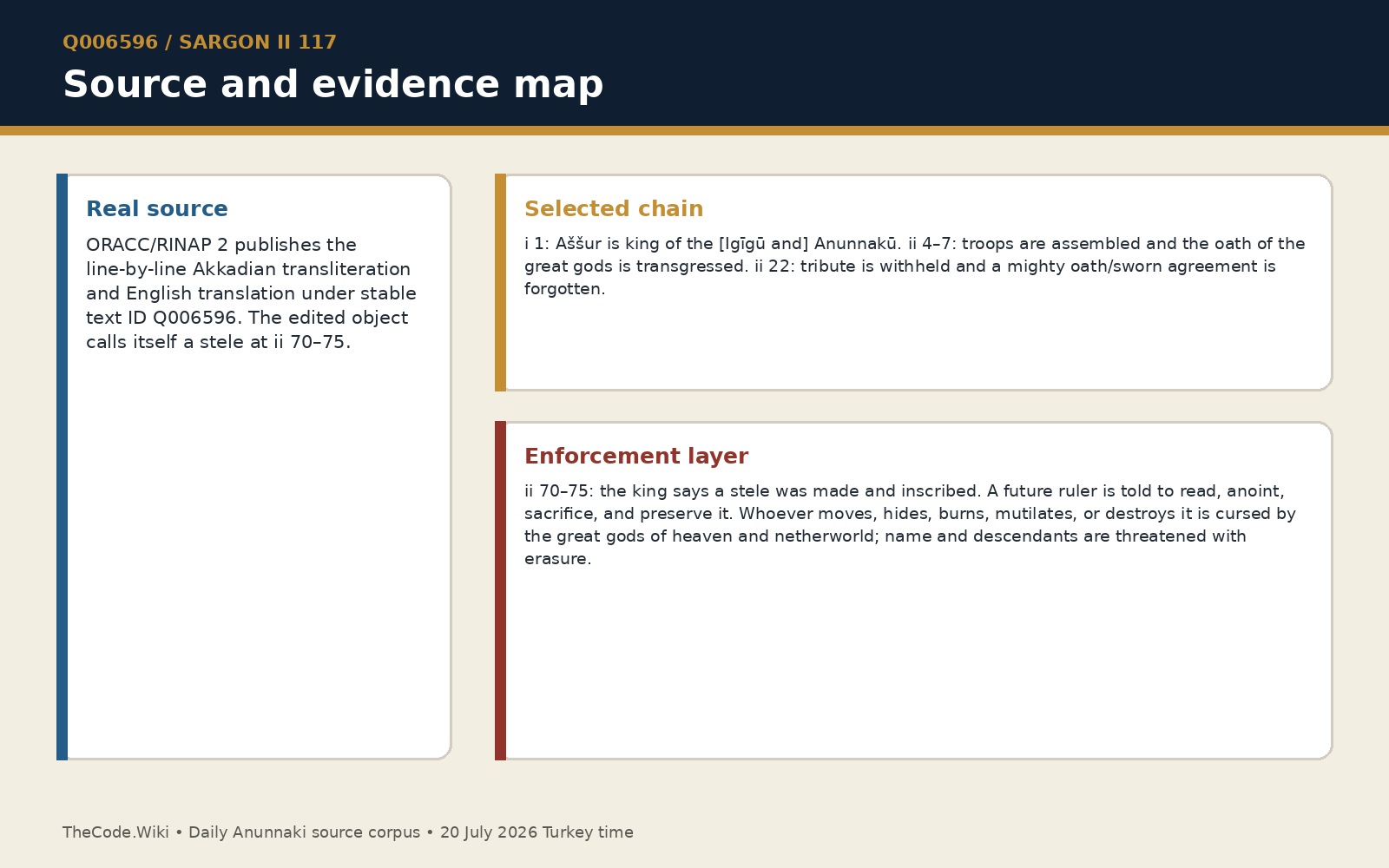
The artifact and source basis
RINAP publishes this text as Sargon II 117, stable identifier Q006596. At column ii lines 70–75, the speaker says he made a stele, engraved divine images and victorious deeds on it, erected it for the future, and prescribed how later rulers should treat it. The public page supplies the edited transliteration and English translation. During the image-provenance audit, the exact monument photograph and museum numbers were recovered from figure 29 of the primary RINAP 2 edition. The exact stele is now shown above; the RINAP edition remains the textual basis, and this report does not pretend to perform a new sign-by-sign collation. The terminology note follows the ORACC Ancient Mesopotamian Gods and Goddesses overview of Anunna/Anunnakū. “Anunnaki” is a familiar modern spelling; this Akkadian edition writes Anunnakū. The categories and number of these gods vary by text and period.Published translation and cautious working translation
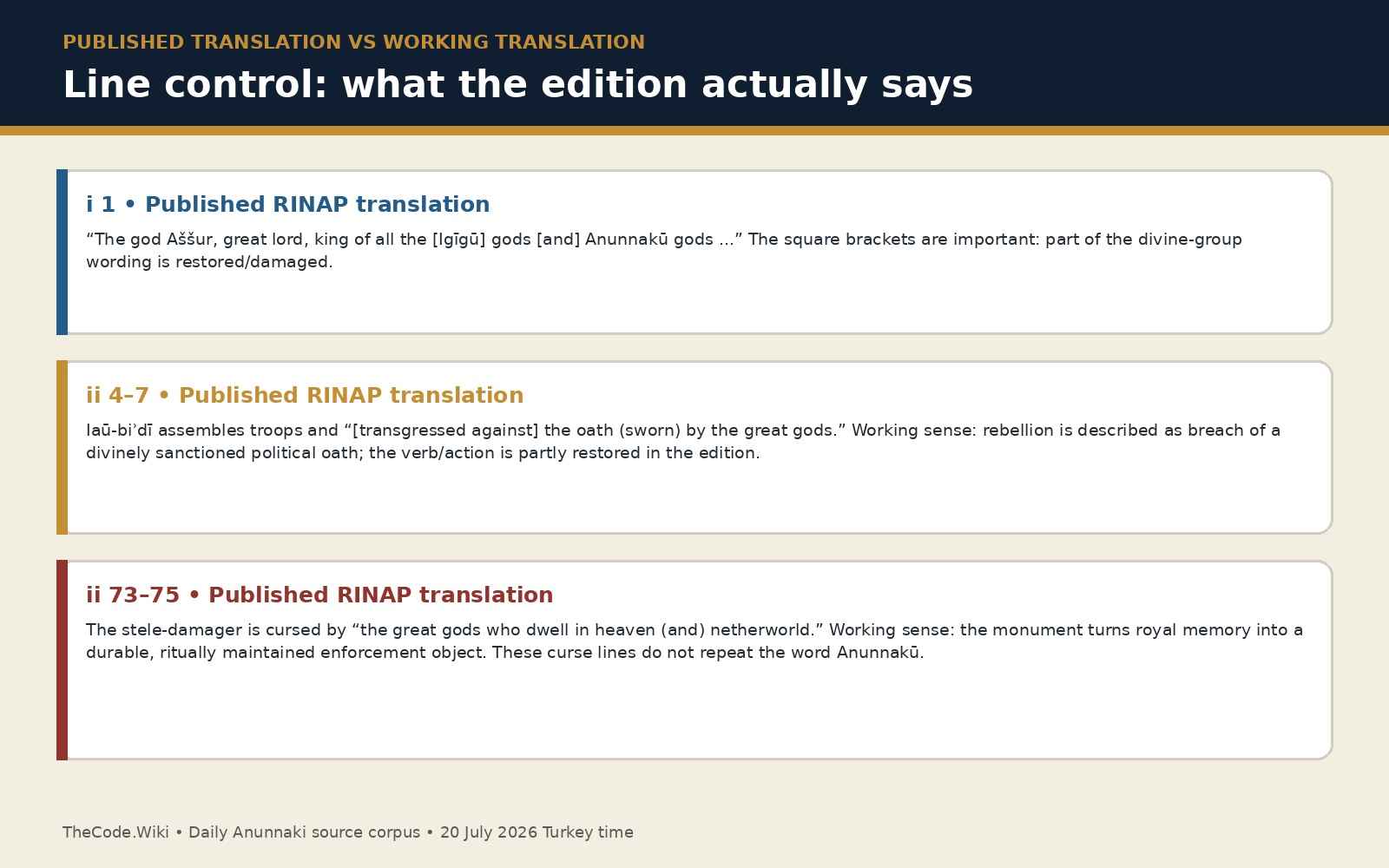
Opening, column i line 1
Edition/transliteration excerpt:⸢dA?⸣-x (x) x ⸢GAL?⸣-u LUGAL KIŠ d[NUN.GAL? u?]; the following line is too damaged to preserve a readable Anunnakū spelling. Published RINAP translation: “The god Aššur, great lord, king of all the [Igīgū] gods [and] Anunnakū gods …”
Working translation: “Aššur, the great lord, king over the [Igīgū and] Anunnakū gods …” Confidence: low for this monument by itself and dependent on RINAP’s comparative restoration. Caution: the line is a sovereignty formula, not a meeting transcript.
Column ii lines 4–7
Edition/transliteration excerpt:... ummānātīšu upaḫḫirma māmīt ilāni rabûti ... (partly broken). Published sense: Iaū-biʾdī assembled troops and “[transgressed against] the oath (sworn) by the great gods.”
Working translation: “He assembled his forces and violated the great gods’ oath.” Confidence: medium-low for the restored action, high for the surviving “oath of the great gods” cluster. Caution: this is royal narration of rebellion, followed by violent punishment; it is not neutral judicial reporting.
Column ii line 22 and context
Published sense: the ruler withholds tribute, casts off Aššur’s yoke, transgresses, fails to respect a mighty oath, and forgets a sworn agreement. Working translation: “Tribute refusal and revolt are represented as breach of a binding divine-political covenant.” Confidence: medium; the paragraph is damaged, but the oath/agreement logic is explicit in the edition.Column ii lines 70–75
Published sense: Sargon has a stele made and inscribed; a future prince should read and anoint it, make sacrifice, praise Aššur, and teach later generations reverence. Whoever alters, hides, throws into water, buries, burns, or mutilates it is cursed by the great gods of heaven and netherworld; his name and descendants are to disappear. Working translation: “The monument is designed as a durable enforcement technology in the ordinary institutional sense: text, image, ritual maintenance, authorized reading, and a divine curse protect the royal account.” Confidence: high for this broad structure. Caution: “technology” here means a human institutional technique, not advanced machinery.
What the source contributes to the Anunnaki corpus
Q006596 adds something more specific than another divine title. It shows how divine authority is operationalized in royal public culture: an oath labels rebellion, tribute becomes part of the loyalty breach, a written monument preserves the sanctioned account, later rulers receive ritual instructions, and a curse polices damage to the record. For Tony’s working thesis, this strengthens the broader oath, kingship, and public-enforcement strand, but it should no longer be counted as independent artifact-level evidence for Anunnakū. It is especially relevant to the corpus gaps for oath, law, kingship, and public institutional enforcement. It also imposes an important limit: the divine name is restored from parallels, and the later passage uses the more general “great gods.” A responsible argument cannot silently replace every later occurrence of “great gods” with “Anunnakū.”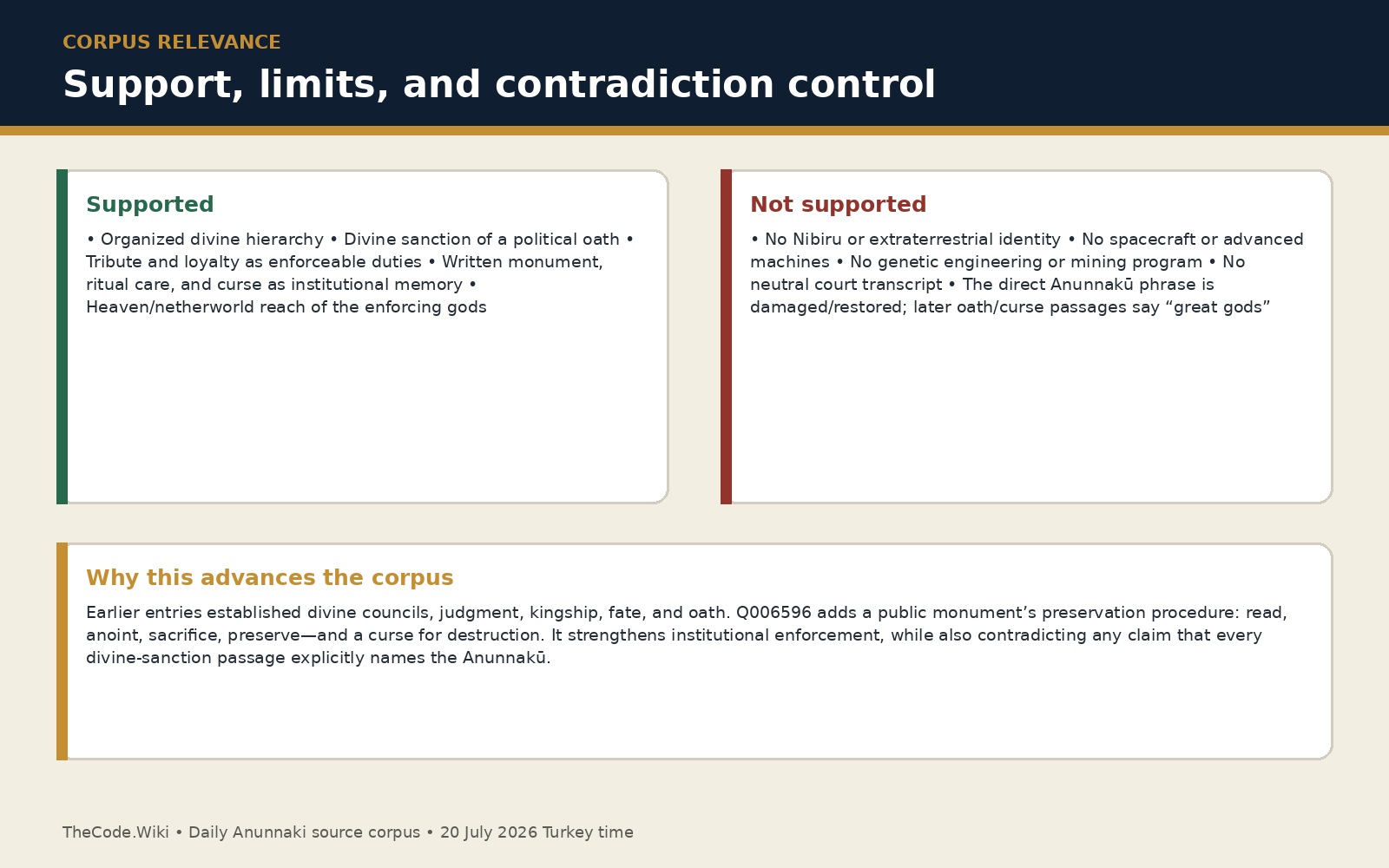
Historical and ethical caution
This is Neo-Assyrian royal ideology. It presents defeated opponents as oath-breakers and describes exemplary violence. That makes it valuable evidence for how empire framed loyalty and divine sanction, but not an objective record of guilt. The inscription’s curse protects the king’s monument and memory; it should not be confused with an impartial legal judgment.Conclusion
Best-supported takeaway: RINAP restores an Anunnakū reference in Sargon II 117’s broken cosmic-kingship formula; the directly readable evidence is stronger for oath, tribute, stele preservation, ritual upkeep, and curse enforcement by the “great gods.” This is comparative, edition-level context for Anunnakū—not a visual decoding of that name from the stele. It does not support extraterrestrial identity, Nibiru, spacecraft, genetic engineering, mining machines, or recoverable advanced technology. Download the complete illustrated PDF reportPrimary sources
Share this:

One considered email each week
TheCode Weekly Evidence Brief
Receive the week’s strongest tablet decode, source audit or research update, plus one carefully chosen archive read. Routine posts stay on the site; the Brief is the curated signal.
Free. Usually sent on Sunday. No daily post flood. Unsubscribe at any time. See what the Brief includes.


