Nabopolassar’s Etemenanki Cylinder: Anunnakū Control, Measurement, and Building Knowledge
An exact-object reading of CBS 9090 / Q005365: Marduk controls the Anunnakū, followed by survey rods, ropes, a ground plan, tools, materials, and human Etemenanki labor.
Ancient text and site reading
How to read this record
- Claim type
- Historical / textual + interpretive
- Evidence level
- Sources, translations, measurements, and symbolic reading where present
Use the evidence layer for sources and observations, and the interpretation layer for TheCode.Wiki synthesis.
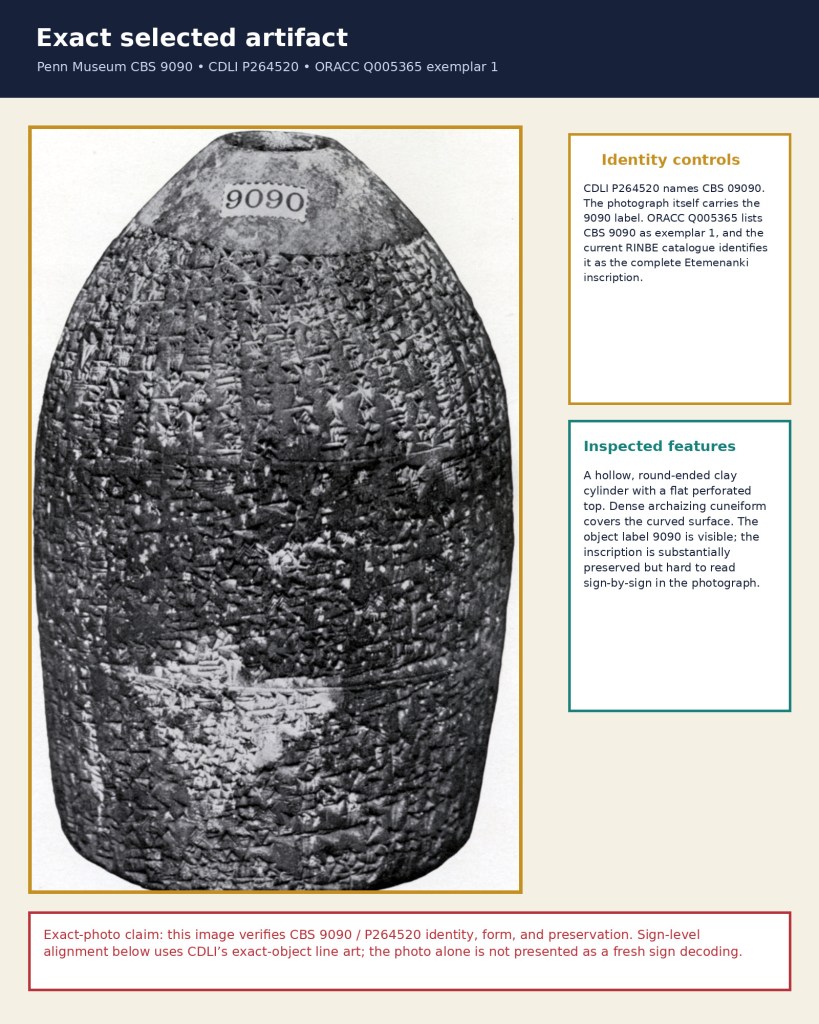
Today’s exact-object source is Penn Museum CBS 9090, a Neo-Babylonian clay cylinder from Babylon and the principal surviving witness to Nabopolassar’s Etemenanki inscription. CDLI identifies it as P264520; ORACC/RIBo edits it as exemplar 1 of Q005365 / Nabopolassar 06; and the current RINBE catalogue describes the same complete three-column witness. The source matters because column I line 4 calls Marduk the one who controls the Anunnakū gods, while the same inscription later lays out tools, workers, bricks, bitumen, expert knowledge, measurement, survey rods, ropes, a ground plan, foundation ritual, and royal labor for rebuilding Etemenanki.
n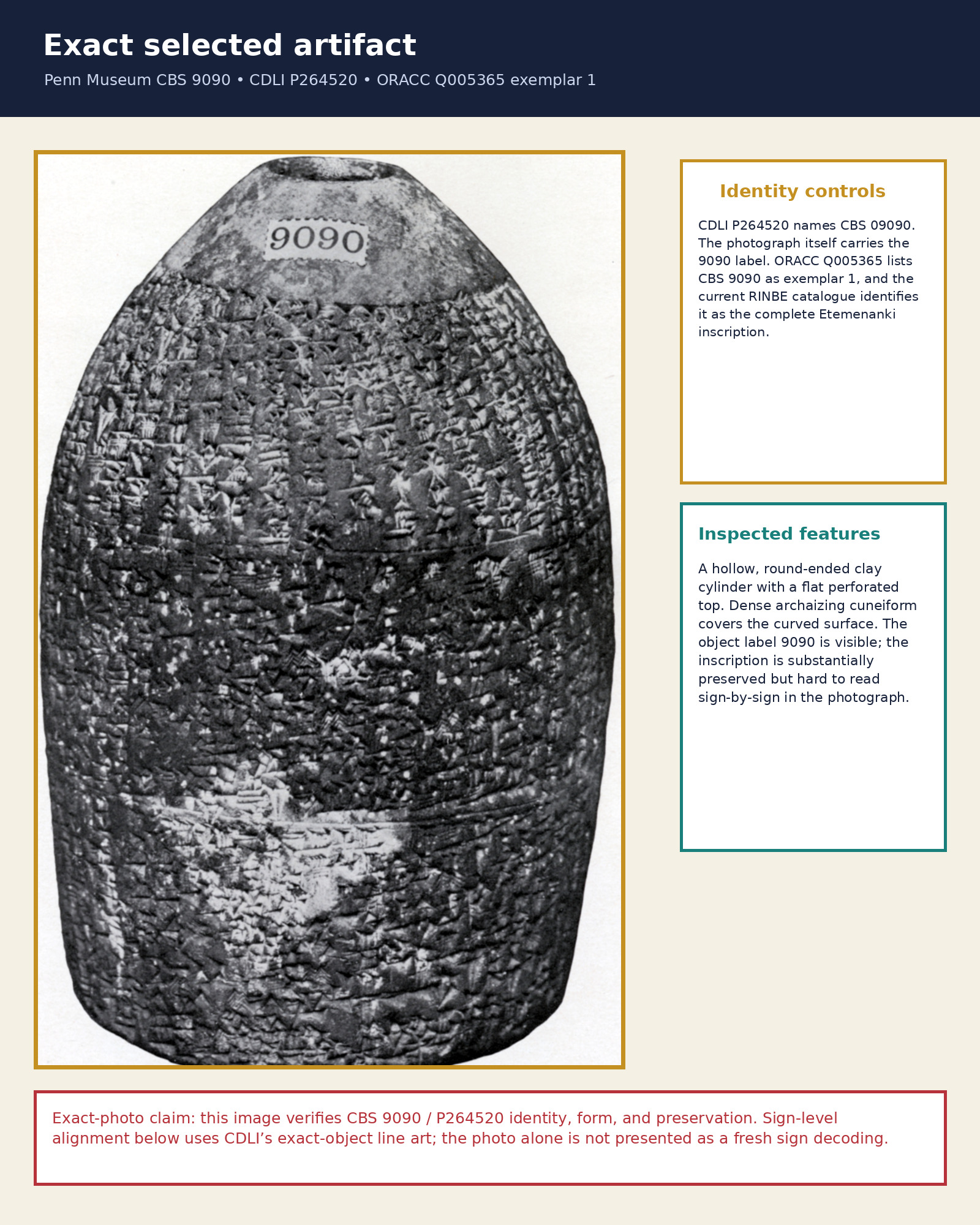
Why this source advances the corpus
The corpus has repeatedly found Anuna/Anunnakū authority near temples and kingship; today’s proof gap is tighter: can an exact photographed witness place explicit Anunnakū language in a text that also preserves real planning and measurement procedure? Q005365 does. The core Anunnakū spelling is unbracketed and visibly mapped on exact-object line art. Later clauses identify trained experts, a survey team, a measuring rod, master builders stretching ropes, and the establishment of a ground plan, alongside conventional labor and materials.
Exact-object and line-location gate
The exact CDLI photograph was downloaded and visually inspected at 2554×4032 pixels; the full-resolution source was also archived. It shows a hollow round-ended cylinder, a flat perforated top, the visible object label “9090,” dense archaizing cuneiform, and substantial preservation. Identity is controlled by the label in the photograph, CDLI P264520 / CBS 09090, ORACC’s CBS 9090 exemplar, and the RINBE catalogue. The photograph establishes the object and its preservation. Sign recognition uses CDLI’s line art attached to this exact P-number.
n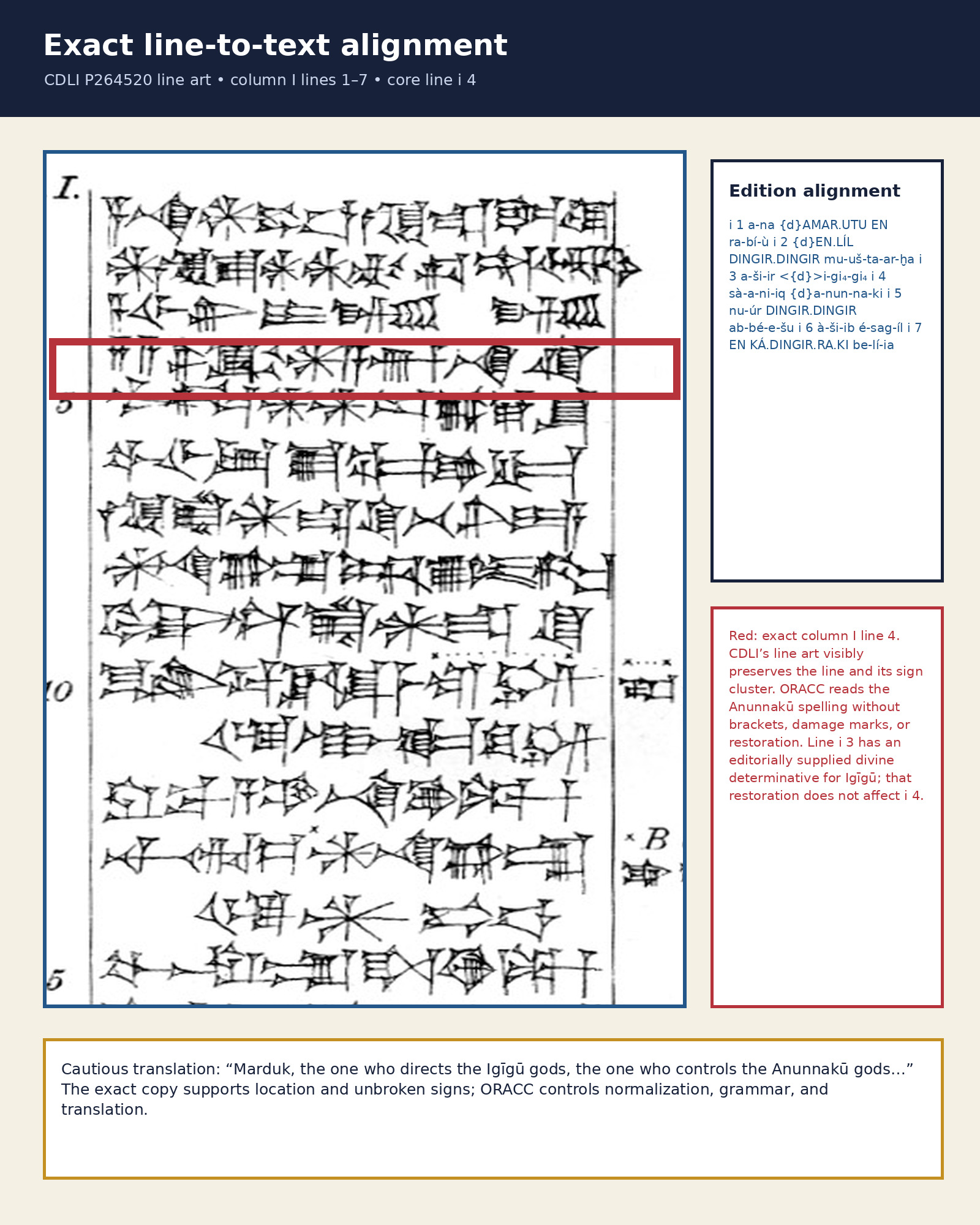
Selected passage: Q005365 i 1–7
Edition transliteration:
i 1 a-na {d}AMAR.UTU EN ra-bí-ù
i 2 {d}EN.LÍL DINGIR.DINGIR mu-uš-ta-ar-ḫa
i 3 a-ši-ir <{d}>i-gi₄-gi₄
i 4 sà-a-ni-iq {d}a-nun-na-ki
i 5 nu-úr DINGIR.DINGIR ab-bé-e-šu
i 6 à-ši-ib é-sag-íl
i 7 EN KÁ.DINGIR.RA.KI be-lí-ia
Published ORACC translation: “For the god Marduk, the great lord, the Enlil of the gods, the proud one, the one who directs the Igīgū gods, the one who controls the Anunnakū gods, the light of the gods—his fathers—the one who dwells in Esagil, the lord of Babylon, my lord.”
Cautious working translation: “For Marduk, great lord, exalted Enlil of the gods, the one who directs the Igīgū and exercises oversight over the Anunnakū, light of the ancestral gods, resident of Esagil, lord of Babylon, my lord.” The working version keeps Akkadian sāniq within the edition’s control/oversight range and does not turn it into a technological command system.
Image-to-text hard-gate result
n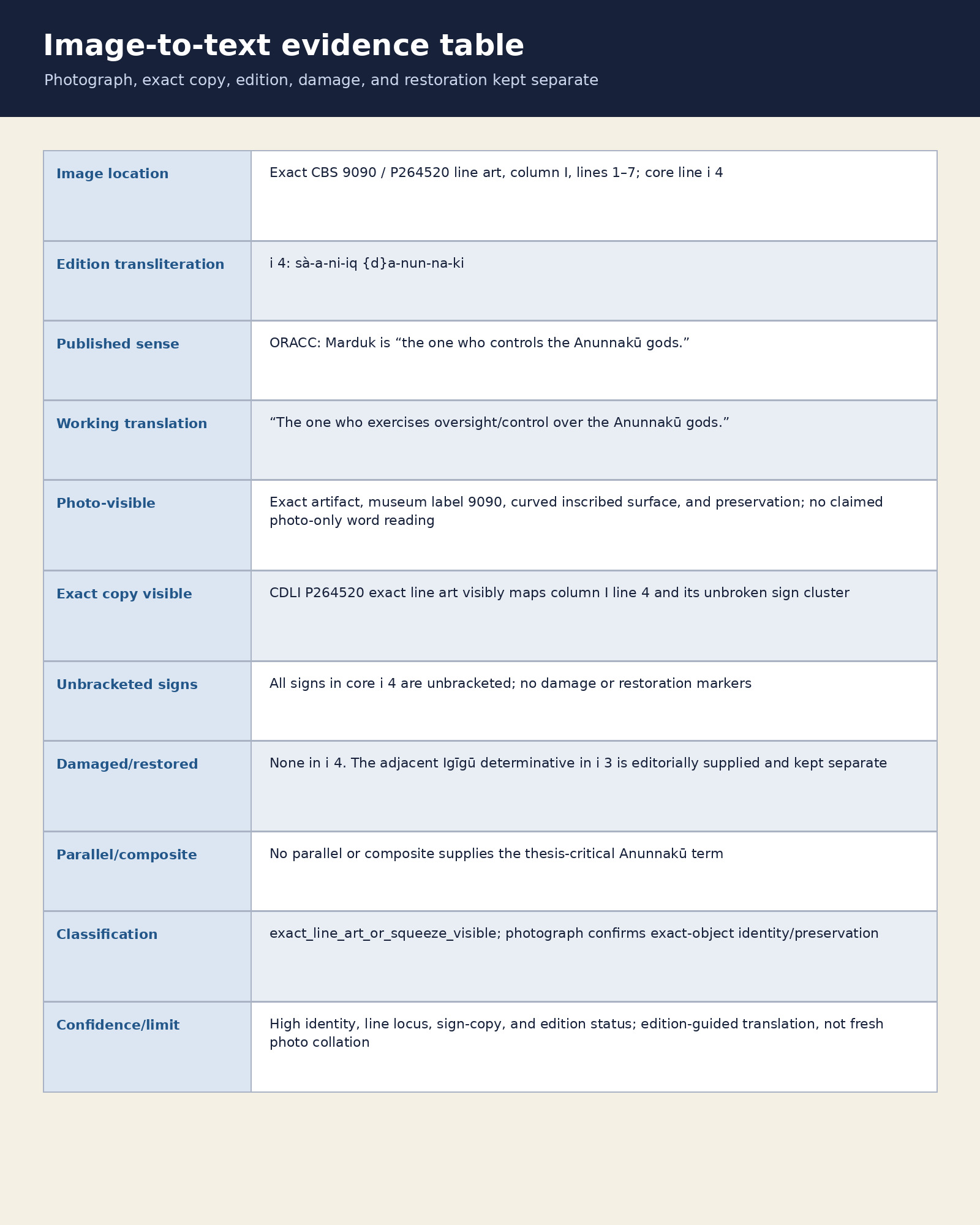
The thesis-critical term is classified exact_line_art_or_squeeze_visible. CDLI’s P264520 line art visibly labels column I and maps line 4. ORACC reads sà-a-ni-iq {d}a-nun-na-ki without brackets or damage markers. The adjacent Igīgū line has an editorially supplied divine determinative; that restoration is clearly separate and does not carry the Anunnakū claim. The photograph independently verifies object identity and preservation, but the translation remains edition-guided.
Construction and measurement procedure
Lines i 28–36 introduce Marduk’s command to secure Etemenanki’s foundation and make its summit rival heaven. Lines i 37–ii 8 then name hoes, spades, brickmolds, levied workers, mud bricks, baked bricks, refined and crude bitumen, and river transport.
The strongest measurement passage is ii 9–23. Nabopolassar says that with Ea’s knowledge, Marduk’s insight, and the wisdom of Nabû and Nisaba, he deliberated and commissioned trained experts. A survey team measured the dimensions with a measuring rod; master builders stretched measuring ropes and established the ground plan. Lines ii 24–30 add divination as a validation layer for the dimensions. Lines ii 31–48 move to purification, the original socle, deposits of gold, silver, mountain and sea stones, aromatics beneath the brickwork, and royal statues carrying baskets.
Lines ii 49–iii 24 make the labor explicitly human and royal: Nabopolassar carries mud bricks and mud on his head; Nebuchadnezzar carries prepared mud; Nabû-šumu-līšir takes up hoe and spade. This prevents a false reading in which the Anunnakū themselves are the surveyors or bricklayers.
n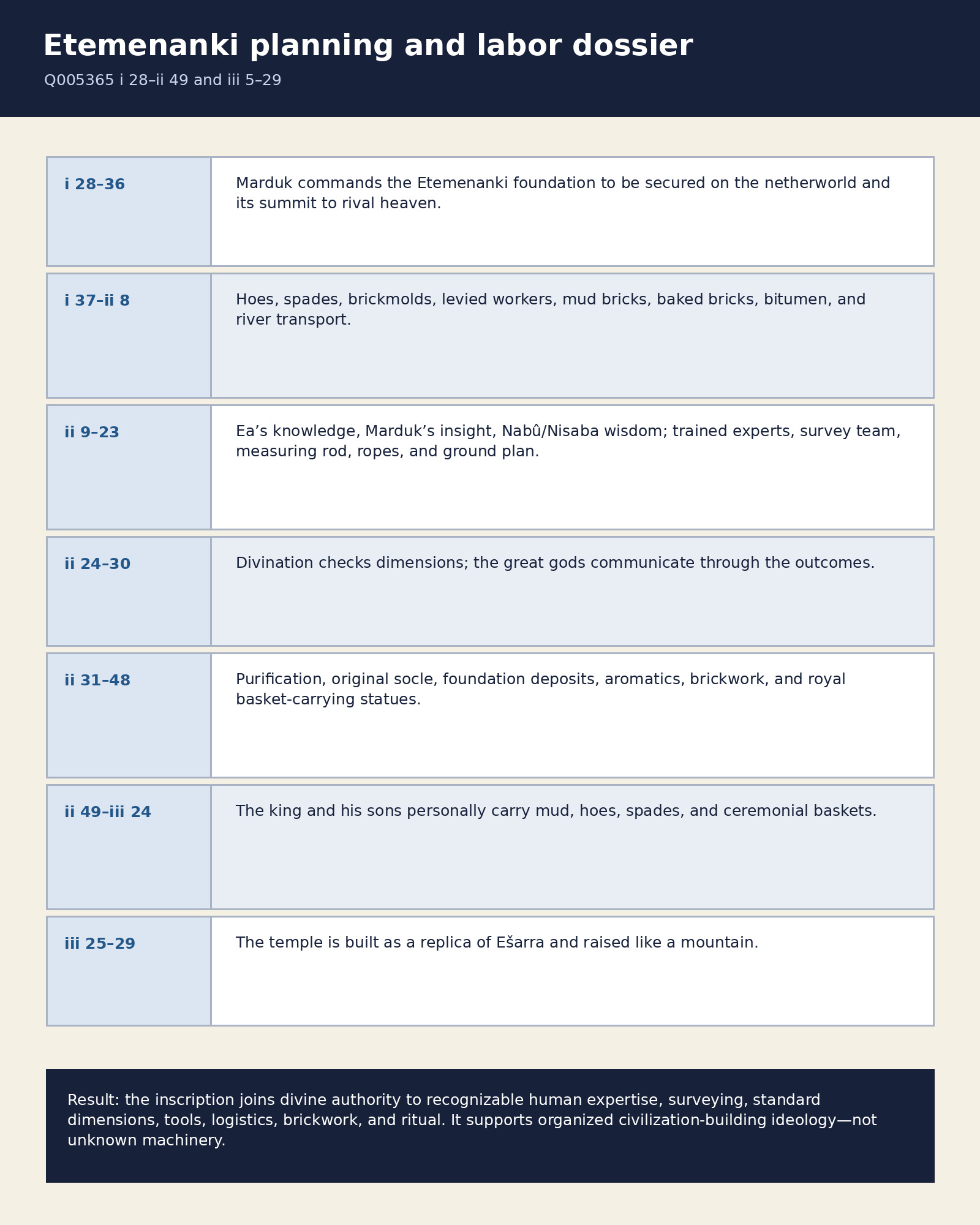
Line notes and status
i 3: Marduk “directs” the Igīgū. ORACC marks the divine determinative as supplied with angle brackets. Confidence: high edition sense, but the restoration status is explicit.
i 4: sà-a-ni-iq {d}a-nun-na-ki, Marduk as the one who controls/oversees the Anunnakū. All signs are unbracketed; the line and cluster are visible on the exact-object copy. Confidence: high.
i 28–36: divine authorization for the Etemenanki project. “Netherworld” and “heavens” are cosmic architectural rhetoric, not measurements. Confidence: high edition reading.
i 37–ii 8: tools, workers, bricks, bitumen, and transport. These are concrete building inputs. Confidence: high at edition level.
ii 9–23: knowledge, deliberation, specialists, survey, measuring rod, ropes, and ground plan. This is the central craft/measurement contribution. Confidence: high at edition level; no claim of direct photo collation for these curved-surface lines.
ii 24–30: divinatory validation of dimensions. It belongs to ritual epistemology and must not be collapsed into the survey mechanics.
ii 49–iii 24: human and royal labor. This directly limits any claim that the Anunnakū performed the construction.
Corpus relevance and limits
The source strongly supports the organized-divine-authority strand: Marduk is explicitly placed over the Anunnakū. It also materially advances the craft/measurement and civilization-building gaps because the same exact witness preserves a detailed human technical dossier grounded in expert knowledge, measurement, planning, tools, materials, and labor. The relationship is ideological: royal construction is framed under divine authority. The text does not say the Anunnakū supplied the plans, performed the survey, or built the ziggurat.
n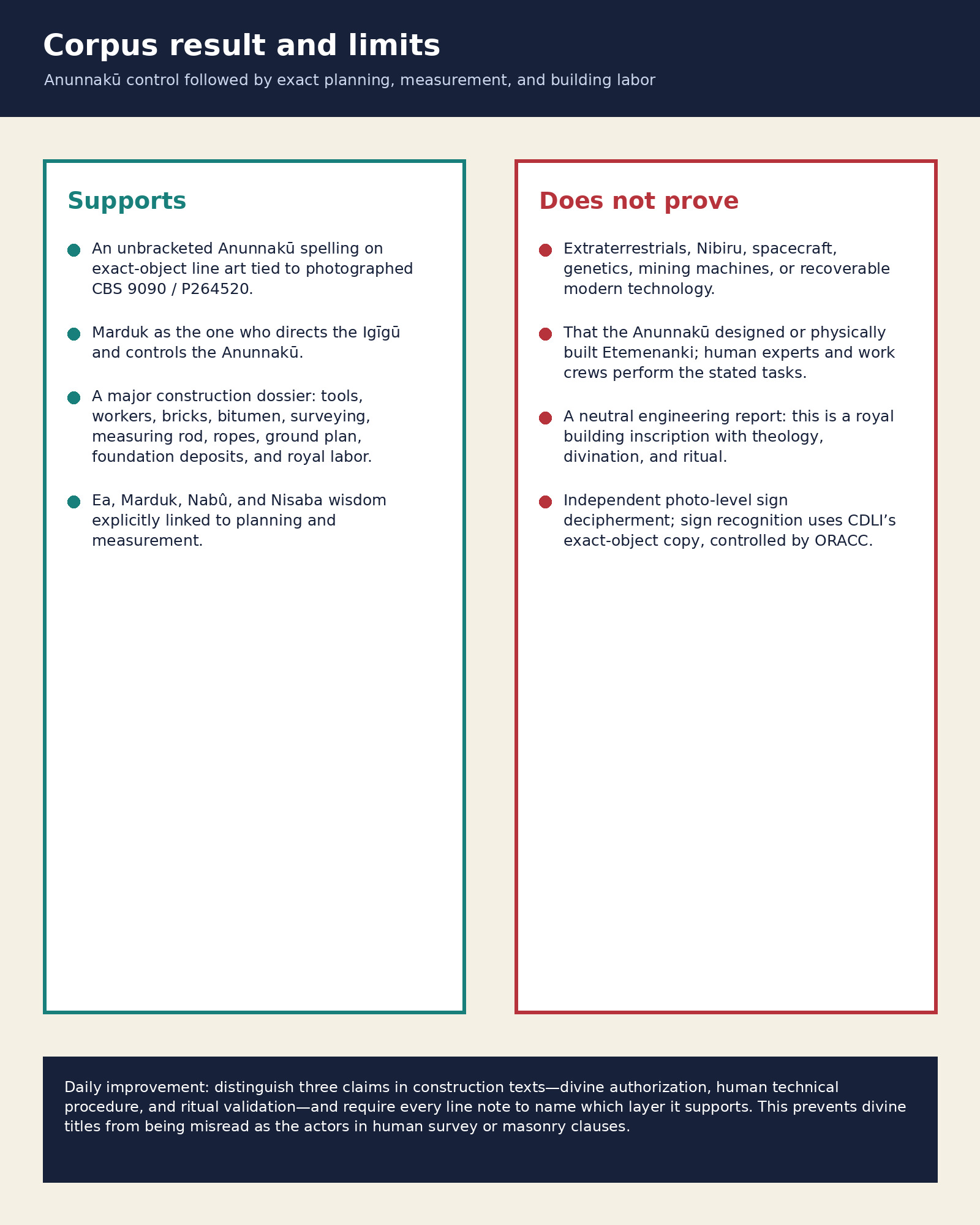
Q005365 does not identify the Anunnakū as extraterrestrials and does not mention Nibiru, spacecraft, genetic engineering, mining machines, or recoverable advanced technology. Its technical vocabulary is significant but conventional: rods, ropes, plans, tools, bricks, bitumen, river transport, specialists, and work crews within royal-religious ideology.
Sources and credits
- ORACC/RIBo Q005365, Nabopolassar 06 — current transliteration, translation, line numbering, and exemplar control.
- CDLI P264520, exact photograph, and exact line art — exact CBS 9090 visual evidence.
- CDLI’s 2026 CBS 09090 feature — object identity, discovery context, archaizing script, and link to BM 91090.
- RINBE 1/1 open-access edition — current catalogue, object photographs, exemplar comparison, and commentary.
- British Museum BM 91090 / 1886,0720.1 — exact parallel witness, cited for comparison only and not used to verify CBS 9090’s line visually.
Daily method improvement: construction reports now classify every claim as divine authorization, human technical procedure, or ritual validation. The separation prevents a divine title from being transferred onto later surveyors, builders, or materials.
Download the evidence report: Nabopolassar, Anunnakū control, and Etemenanki measurement PDF report.
Share this:

One considered email each week
TheCode Weekly Evidence Brief
Receive the week’s strongest tablet decode, source audit or research update, plus one carefully chosen archive read. Routine posts stay on the site; the Brief is the curated signal.
Free. Usually sent on Sunday. No daily post flood. Unsubscribe at any time. See what the Brief includes.