
Sennacherib 159: Aššur Molds the Anunnakū in the Apsû
Exact P396017 report: Aššur forms the Anunnakū beside Apsû and fate language, while Sennacherib retains the bronze-craft role.

Ancient text and site reading
How to read this record
- Claim type
- Historical / textual + interpretive
- Evidence level
- Sources, translations, measurements, and symbolic reading where present
Use the evidence layer for sources and observations, and the interpretation layer for TheCode.Wiki synthesis.
Source-controlled result: the exact tablet British Museum K 5413a / CDLI P396017, edited as ORACC Q003964 / Sennacherib 159, preserves an un-restored line calling Aššur the one who “molds the Igīgū and Anunnakū gods.” The preceding line says Aššur’s own form took shape in the Apsû; the following lines connect him with cosmic formation and fate. The same witness then assigns a bronze-kettledrum project to Sennacherib and human craft procedure, not to the Anunnakū.

Why this witness matters
The cumulative corpus is testing small primary-source propositions rather than forcing a modern theory onto ancient texts. P396017 advances a particularly important gap: it puts Apsû formation, the formation of the Igīgū and Anunnakū, cosmic order, and fate-setting inside one short, un-restored dedicatory invocation. It is stronger than a merely restored group name, but its genre remains royal theology.
The decisive grammatical point is agency. In obverse line 3, Aššur is the implied subject of šāpik, “the one who molds/forms,” while the Igīgū and Anunnakū are its objects. This is real ancient evidence for an organized divine-formation idea. It is not evidence that the Anunnakū themselves run a laboratory or manufacture the kettledrum described later.

Artifact and source identity
- Artifact: CDLI P396017.
- Museum number: K 5413a (ORACC normalized display: K 05413a), British Museum.
- Composition: ORACC/RINAP Q003964, Sennacherib 159.
- Object: fragmentary Neo-Assyrian clay tablet from Kuyunjik/Nineveh with a dedicatory inscription concerning a bronze kettledrum.
- Exact-image control: the 2,787 × 3,855 institutional-mirror JPEG visibly carries
K.5413a; ORACC maps K 05413a to exemplar P396017 and Q003964. - Visual inspection: the opened multi-view photograph shows obverse, reverse, edges, fracture/loss, scale, and the identifier-bearing edge.
Published translation and cautious working translation
“whose form took its beautiful shape in the apsû, king of heaven and netherworld, lord of all gods, the one who molds the Igīgū and Anunnakū gods”
ORACC/RINAP, Sennacherib 159, obverse 2–3
Edition transliteration, obverse 2: ša ina ZU.AB iš-mu-ḫu gat-tu-uš LUGAL AN-e u KI-tim. Cautious working translation: “whose form took shape in the Apsû, king of heaven and earth/netherworld.” The line is a theological epithet; Apsû should not be silently converted into a laboratory or technological installation.
Edition transliteration, obverse 3: EN DINGIR.MEŠ ka-la-ma šá-pi-ik dÍ.GÌ.GÌ u dA.NUN.NA-⸢KI⸣. Cautious working translation: “lord of all the gods, the one who molds the Igīgū and Anunnakū gods.” The group name and formation relation are not supplied in square brackets. Final KI is damaged-readable in the edition.
Obverse 4–5 continue with Aššur as the one who forms heaven and netherworld, creates the inhabited world, dwells in the bright firmament, and decrees fates. These propositions establish the ancient theological sequence. They do not independently establish a material mechanism.
Image-to-text hard gate

The exact photograph verifies artifact identity, the third-row location, surface preservation, and row survival. The result is photograph-visible at conservative whole-row level and edition-guided for sign values, word division, grammar, and translation. No word-level sign box or claim of fresh collation is made.
The thesis-critical Anunnakū term is not restored from a parallel or composite. The final sign is marked damaged-readable, not supplied. This passes the hard gate without pretending that the photograph alone yields an autonomous decipherment.
Line notes: formation, fate, and craft

Line 1: Aššur is praised as king of all gods and self-created. Line 2: his form takes shape in the Apsû. Line 3: he molds the Igīgū and Anunnakū. Lines 4–5: he forms the cosmic domains and decrees fates. The repeated agent is Aššur.
Lines 7–14: Sennacherib identifies himself and says a reddish-bronze kettledrum was skillfully made, its leather covering linked to the craft of the deity Šikaggu. The wording is damaged in places, but the human royal commissioning frame is clear. The passage must not be reassigned to the Anunnakū merely because both units occur on the same tablet.
Agency firewall

Aššur’s formation of divine groups does not become genetic engineering. The Apsû does not become a laboratory. Sennacherib’s bronze craft does not become Anunnakū technology. The exact photograph strengthens the evidence chain, but it cannot authorize propositions absent from the text’s grammar.
Corpus relevance and limits
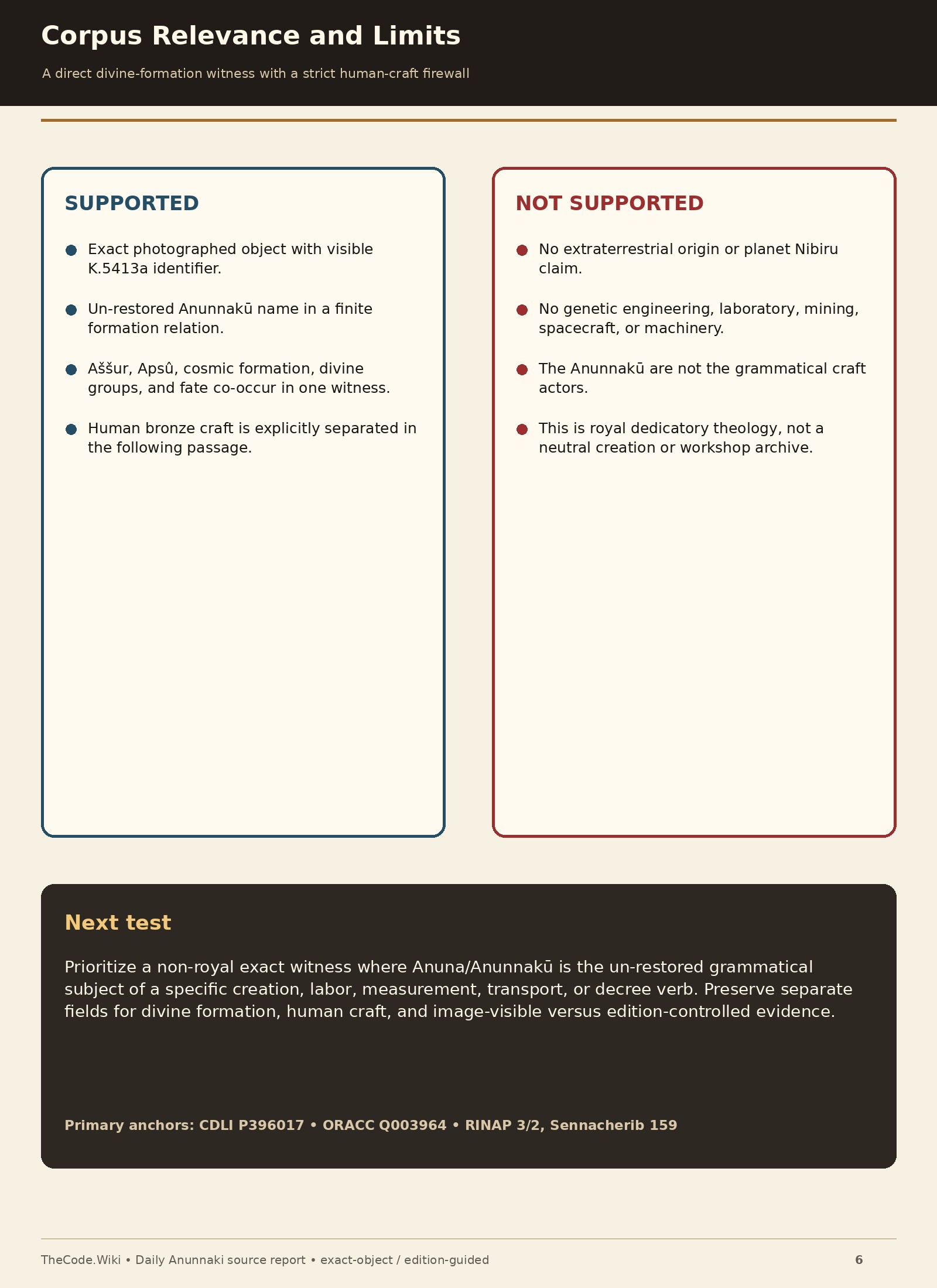
Supported: a verified exact photographed witness; an un-restored Anunnakū name in a formation relation; Aššur, the Apsû, divine-group formation, cosmic order, and fate inside one inscription; and a clear distinction between divine formation theology and later human craft procedure.
Not supported: extraterrestrial identity, Nibiru as a home planet, spacecraft, genetic engineering, mining, machinery, or the Anunnakū as the tablet’s bronze craftsmen. This is a royal dedicatory text, not a neutral biological, technical, or workshop archive.
Next test: prioritize a non-royal exact witness where Anuna/Anunnakū is the un-restored grammatical subject of a specific creation, labor, measurement, transport, knowledge, or decree verb. Preserve separate fields for divine formation, human craft, and image-visible versus edition-controlled evidence.
Primary sources
- CDLI P396017 artifact record and identifiers
- CDLI institutional-mirror exact photograph for P396017
- ORACC/RINAP Q003964 text, exemplar mapping, transliteration, and translation
- RINAP 3/2 primary edition
Share this:

One considered email each week
TheCode Weekly Evidence Brief
Receive the week’s strongest tablet decode, source audit or research update, plus one carefully chosen archive read. Routine posts stay on the site; the Brief is the curated signal.
Free. Usually sent on Sunday. No daily post flood. Unsubscribe at any time. See what the Brief includes.


