
SAA 03 044: The Anunnakū Attend to Aššur’s Royal Command
Exact P336149 report: the un-restored Anunnakū collectively attend to the establishment of the king’s command at Aššur’s utterance.

Ancient text and site reading
How to read this record
- Claim type
- Historical / textual + interpretive
- Evidence level
- Sources, translations, measurements, and symbolic reading where present
Use the evidence layer for sources and observations, and the interpretation layer for TheCode.Wiki synthesis.
Source-controlled result: the exact joined tablet British Museum K 02647 + Rm 2, 099 / CDLI P336149, published as SAA 03 044 and CT 35 13ff, preserves a direct collective response: at Aššur’s lordly utterance, the partly restored Igīgū and the un-restored Anunnakū “pay attention to” the establishment of the king’s command. The text supports organized divine hierarchy and command responsiveness. It does not make the Anunnakū the authors of Aššur’s decree or provide evidence for extraterrestrials or advanced technology.

Why this witness matters
The cumulative corpus is testing small primary-source propositions. P336149 advances the command and divine-assembly gap because the Anunnakū are not merely listed in a title: reverse line 3 gives them an un-restored plural predicate, uqaʾʾû, in response to a royal command authorized by Aššur. This is coordinated agency inside a ranked theological system.
The genre matters. SAA 03 044 is a literary “letter from Aššur” connected with Assurbanipal’s account of the Šamaš-šumu-ukīn war. The divine speaker legitimates royal victory, punishment, kingship, shrine renewal, and imperial command. It is powerful evidence for Assyrian political theology, not a neutral transcript of a divine council or a technical archive.

Artifact and source identity
- Artifact: CDLI P336149.
- Museum numbers: British Museum K 02647 + Rm 2, 099.
- Standard designations: SAA 03 044; CT 35 13ff.
- Object: joined Neo-Assyrian literary tablet from Kuyunjik/Nineveh, written in the Assurbanipal period.
- Exact-image control: the current 3,057 × 5,795 institutional JPEG visibly carries
K 2647on one edge andRm 2, 99on the other; ORACC binds those numbers to P336149 and SAA 03 044. - Visual inspection: the original-resolution multi-view photograph shows obverse, reverse, edges, joins, central loss, scale, and the identifier-bearing edges.
Published translation and cautious working translation
“At my lordly utterance, the [Igigi] and Anunnaki pay attention to his (the king’s) command!”
ORACC/SAAO, SAA 03 044, reverse 3
Edition transliteration: [a]-na e-peš pi-ia e-tel-li [dIgīgī] u dA-nun-na-ki ú-qa-ʾu-u a-na ši-kin ṭè-me-šú.
Cautious working translation: “At my lordly utterance, the [Igīgū] and the Anunnakū pay attention to the establishment of his command.” This preserves the phrase ana šikin ṭēmešu instead of flattening it into an unexplained modern command system.
The restoration boundary is decisive. The opening preposition is partly restored, and the Igīgū name is restored. The Anunnakū spelling, plural response verb, and command phrase are not supplied in square brackets. The core claim therefore rests on preserved edition text from the exact witness, while the sign values, morphology, and translation remain institution-controlled.
Image-to-text hard gate

The result is photograph-visible at conservative whole-row level and edition-guided for sign values, morphology, and translation. The exact photograph proves the joined object’s identity, the reverse-third-row locus, preservation, and row survival. It does not independently decode every sign from pixels.
The thesis-critical Anunnakū noun and its plural response predicate are not supplied by a parallel or composite. The annotated row appears here and in the PDF, satisfying the exact-object alignment gate without inventing a word-level sign box.
Line notes: utterance, fate, command, and assembly
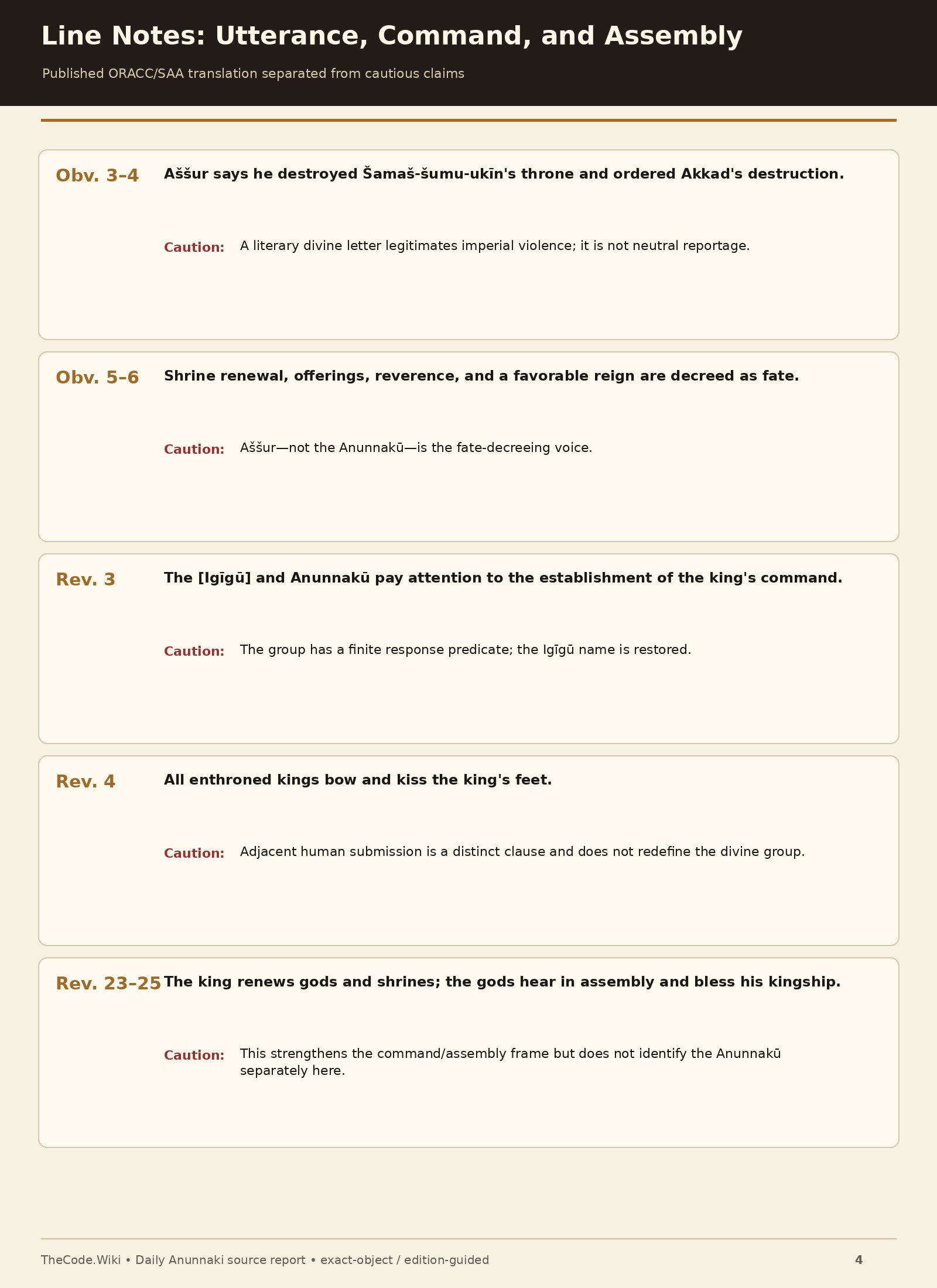
Obverse 3–4: the divine speaker says he removed Šamaš-šumu-ukīn’s royal foundations, overthrew his reign, and commanded Akkad’s destruction. Obverse 5–6: shrine renewal, offerings, reverence, and a favorable reign are decreed as the king’s fate. These are actions and decisions attributed to Aššur, not to the Anunnakū.
Reverse 3: the [Igīgū] and Anunnakū attend to the establishment of the king’s command. Reverse 4: all enthroned kings bow and kiss the king’s feet. Reverse 23–25: Assurbanipal is commissioned to renew gods and shrines; the gods hear in assembly and bless his kingship. The sequence binds divine attention, royal command, assembly, cult maintenance, and kingship, while keeping each subject distinct.
Agency firewall

Aššur supplies the lordly utterance and the wider judgment program. The Anunnakū respond collectively to the command’s establishment. Assurbanipal receives authority, military support, kingship, and a cultic commission. Proximity does not transfer Aššur’s decree authorship to the collective or turn royal propaganda into a technical report.
Corpus relevance and limits
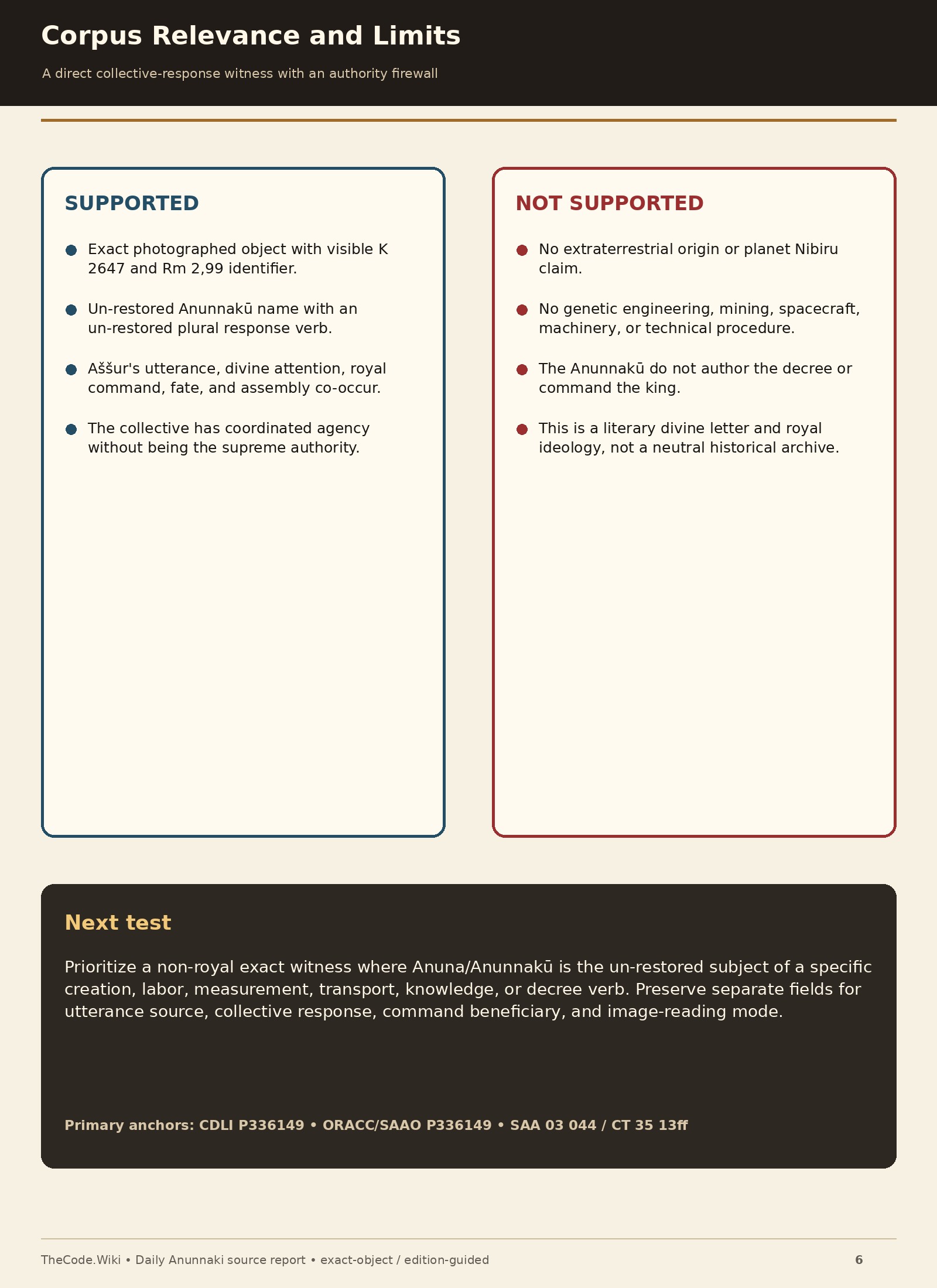
Supported: an exact photographed and identifier-locked witness; an un-restored Anunnakū noun governing an un-restored plural response predicate; and a single text joining Aššur’s utterance, fate, divine attention, royal command, assembly, shrine renewal, and kingship.
Not supported: extraterrestrial identity, Nibiru as a home planet, spacecraft, genetics, mining, machinery, or independent Anunnakū decree authorship. The witness shows structured supernatural hierarchy in Assyrian royal theology.
Next test: seek a non-royal exact witness where Anuna/Anunnakū is the un-restored subject of a specific creation, labor, measurement, transport, knowledge, or decree verb. Future reports should preserve separate fields for utterance source, collective response, command beneficiary, restoration state, and image-reading mode.
Primary sources
- CDLI P336149 artifact record
- CDLI institutional-mirror exact photograph
- ORACC/SAAO P336149 catalogue, transliteration, and translation
- State Archives of Assyria III introduction and contents
Share this:

One considered email each week
TheCode Weekly Evidence Brief
Receive the week’s strongest tablet decode, source audit or research update, plus one carefully chosen archive read. Routine posts stay on the site; the Brief is the curated signal.
Free. Usually sent on Sunday. No daily post flood. Unsubscribe at any time. See what the Brief includes.


