
SpTU 2, 28: The Anunna Prostrate before Exalted Inana
Exact P348633 report: the Anunna prostrate in a bilingual Uruk witness beside a named divine assembly and restored Inana precedence.

Ancient text and site reading
How to read this record
- Claim type
- Historical / textual + interpretive
- Evidence level
- Sources, translations, measurements, and symbolic reading where present
Use the evidence layer for sources and observations, and the interpretation layer for TheCode.Wiki synthesis.
Source-controlled result: SpTU 2, 28 / CDLI P348633, a Hellenistic bilingual Sumerian-Akkadian tablet from scholarly Uruk, gives the Anunna a direct coordinated action. Reverse 12 says that the Anunna prostrated; reverse 13 names the gathered assembly of An, Enlil, and Enki and restores Inana’s taking of the seat of honor. This supports organized divine hierarchy and collective agency. It does not describe extraterrestrials, spacecraft, genetics, mining, or advanced technology.

Why this witness matters
The cumulative corpus has found the Anuna or Anunnakū in judgment, command, labor hierarchy, fate, kingship, temple, and ritual settings. P348633 adds a tightly controlled bilingual action clause. The Anunna are not merely named in a list: they are the subject of a plural prostration predicate, immediately beside a scene of divine assembly and precedence.
The action is conventional religious submission, not technological work. Its value lies in differentiated agency: reverse 11 assigns movement outside to the Igigi, reverse 12 assigns prostration to the Anunna, and reverse 13 places Inana and three named high gods in the assembly scene. Those roles must not be merged.

Artifact and source identity
- Artifact: CDLI P348633.
- Publication and excavation number: SpTU 2, 28 / W 22729,02.
- Museum identity: Iraq Museum IM 135199 in the linked eBL record.
- Composition: Tablet I of Exalted Lady Who Alone Is Mighty, also catalogued as Exaltation of Ishtar.
- Date and place: Hellenistic period, excavated at Uruk (Warka).
- Languages: Sumerian with an Akkadian bilingual rendering.
- Exact visual: CDLI’s 656 × 594 exact-object line art, downloaded, validated as JPEG, and opened at original resolution.
- Photograph status: the current CDLI exact-photograph endpoint returned HTTP 404. Exact-object line art is therefore the permitted fallback.
- Identity controls: CDLI binds P348633, SpTU 2, 28, W 22729,02, Uruk, the exact copy, and the text; BLMS independently binds P348633 to the same publication and excavation number.
Published translation and cautious working translation
“The Anunna prostrated and …”
BLMS P348633, reverse 12
Artifact-specific transliteration: Sumerian ᵈa-nun-na šu-kin-ba? an-da-ab-eš-am₃ ...; Akkadian ᵈA.NUN.NA.KI ikmesūma šutarrû na-[...].
Cautious working translation: “The Anunna bowed down; a further coordinated action is broken and excluded from the core claim.” The Akkadian ikmesūma supports the minimum prostration sense, while the following predicate is too damaged to use.
Reverse 13 reads “in the gathered assembly of An, Enlil, and Enki” and restores the honored-seat action for Inana. That restoration supplies context, not the main proof. The thesis-critical reverse 12 Anunna noun and plural prostration predicate are unbracketed in the artifact-specific bilingual edition.
Image-to-text hard gate

The result is exact-line-art visible at a conservative whole-row level and edition-guided for sign values, morphology, and translation. The exact copy verifies artifact identity, preservation, and a defensible row location. It does not support autonomous pixel-by-pixel decoding.
The annotated exact-object alignment appears both here and in the PDF. The report does not draw a false word box, does not repair the broken second predicate, and does not use reverse 13’s restored honored-seat verb to strengthen reverse 12 artificially.
Line notes: action and hierarchy

Reverse 8–10: the bilingual narrative is broken but establishes a meeting-place context. Reverse 11: the Igigi flee or go outside. Reverse 12: the Anunna prostrate; the damaged continuation is excluded. Reverse 13: the text names the gathered assembly of An, Enlil, and Enki and restores Inana’s taking of the honored seat.
The colophon identifies Tablet I of “Exalted Lady Who Alone Is Mighty.” The object is a late scholarly witness preserving Sumerian and Akkadian together. It is valuable for grammar and reception, but it is not a contemporary administrative transcript of a divine meeting.
Authority-role firewall

The Igigi movement is not Anunna movement. Anunna prostration is not command or decree authorship. Inana’s precedence is not evidence that the Anunna built a throne or operated machinery. The witness supports hierarchy precisely because its actors do different things.
This also limits modern extrapolation. “Assembly,” “seat,” and divine rank are ancient theological and courtly concepts. Nothing in the passage identifies a planet, spacecraft, laboratory, mining operation, genetic procedure, or technical control system.
Corpus relevance and limits
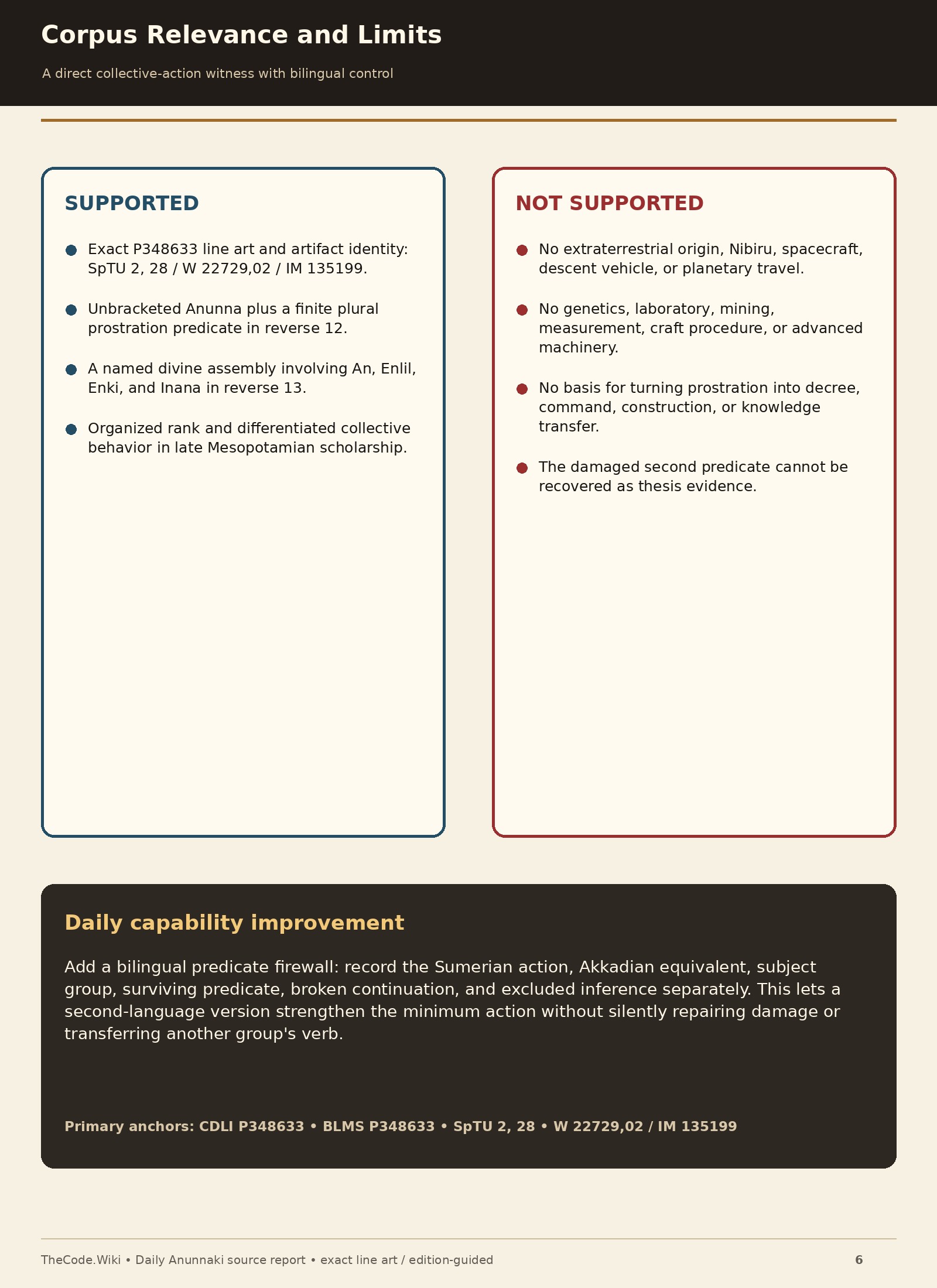
Supported: exact-object identity; an unbracketed Anunna noun with a finite plural prostration predicate; a named high-god assembly nearby; and differentiated behavior by the Igigi, Anunna, and Inana.
Not supported: extraterrestrial origin, Nibiru as a home planet, spacecraft, genetics, laboratories, mining, advanced machinery, or transfer of technical knowledge. The damaged second action cannot be reconstructed for the thesis.
Daily capability improvement: future bilingual reports will retain separate fields for sumerian_action, akkadian_equivalent, subject_group, surviving_predicate, broken_continuation, and excluded_inference. This uses the second language to confirm the minimum claim without silently repairing damage or transferring another actor’s verb.
Primary sources
- CDLI P348633 exact-witness record
- CDLI P348633 expanded catalogue JSON
- CDLI exact-object line art
- BLMS P348633 bilingual edition and translation
Share this:

One considered email each week
TheCode Weekly Evidence Brief
Receive the week’s strongest tablet decode, source audit or research update, plus one carefully chosen archive read. Routine posts stay on the site; the Brief is the curated signal.
Free. Usually sent on Sunday. No daily post flood. Unsubscribe at any time. See what the Brief includes.


