
Sîn-iddinam MS 5000: The Anuna, Divine Decrees, and the me
Exact P254031 report: a damaged Anuna clause, heaven-earth counsel, the me, and a human wall-building program on Schøyen MS 5000.

Ancient text and site reading
How to read this record
- Claim type
- Historical / textual + interpretive
- Evidence level
- Sources, translations, measurements, and symbolic reading where present
Use the evidence layer for sources and observations, and the interpretation layer for TheCode.Wiki synthesis.
Source-controlled result: Schøyen MS 5000 / CDLI P254031, a complete Old Babylonian Sumerian barrel-cylinder published as CUSAS 17, 037, places a damaged-readable Anuna clause inside a sequence of irreversible decision, heaven-earth counsel, the me, divine deliberation, and established plans. Later lines assign Ur’s wall-building and settlement work to King Sîn-iddinam and a human workforce. The text supports a real decree-to-civic-execution chain; it does not describe extraterrestrials, spacecraft, genetics, mining, or advanced machinery.

Why this witness advances the corpus
The cumulative corpus has already found Anuna or Anunnakū language in judgment, command, labor hierarchy, creation, kingship, temples, craft, and ritual. MS 5000 advances a different gap: it keeps divine deliberation, the me, a royal commission, practical city building, mobilized labor, and physical output on one exact object.
That continuity matters, but its actors must remain separate. The damaged Anuna line belongs to the authorization and decision dossier. Sîn-iddinam is the royal speaker and executor. Ur’s people are the labor force. The walls, battlements, and enlarged settlement are the physical products. The inscription does not say that the Anuna themselves laid the bricks.

Artifact and source identity
- Artifact: CDLI P254031.
- Collection number: Schøyen Collection MS 5000.
- Publication: CUSAS 17, no. 37; Konrad Volk, “Eine neue Inschrift des Königs Sîn-iddinam von Larsa,” pp. 59–88.
- Text type: Sumerian royal/display inscription of Sîn-iddinam of Larsa.
- Date: Old Babylonian period; the publication identifies the king whose reign is conventionally dated to the nineteenth century BCE.
- Object: hollow clay barrel-cylinder with four densely written column faces.
- Exact visual: current CDLI photograph, 3372 × 7720, and exact published copy, 1742 × 2954; both returned HTTP 200, validated as JPEG, and were opened for inspection.
- Identity controls: CDLI binds P254031, MS 5000, CUSAS 17, 037, photo, copy, and transliteration; SOAS identifies Volk’s chapter as the peer-reviewed primary edition.
Published-source sense and cautious working translation
Artifact-specific transliteration, obverse i 8–11: en kaš-bar / du₁₁-ga-bi nu-kur₂-ru / a₂-ag₂-ga₂ šum₂-mu / ᵈa-nun-na-ke₄-ne-er. CDLI marks the divine determinative, A, NUN, and the case ending as damaged-readable rather than bracket-restored.
Published-source sense, summarized: an irreversible decision and granted authority lead into an Anuna clause, accepted utterance, great plans and destinies, heaven-earth counsel, immeasurable me, divine deliberation, and establishment of a plan. This summary follows the artifact-specific CDLI transliteration and Volk’s edition; it is not presented as a new quotation.
Cautious working translation: “The decision-makers’ word is not changed; authority is granted. For the Anuna … what issues from the mouth is accepted; their plans and destinies are great. Heaven and earth are placed into counsel; their me have no limit. In the assembly of the gods they deliberate and establish the plan.” The ellipsis after Anuna is essential: line 12 is unclear, so the report does not invent a finite Anuna action.
The relationship between terms is historical and linguistic, not sensational: Sumerian Anuna/Anunna and later Akkadian Anunnakū are related ancient designations for a divine group. “Anunnaki” is the common modern spelling, but it does not by itself add extraterrestrial meaning.
Image-to-text hard gate

The result is exact-line-art visible at a conservative whole-row level and edition-guided for sign values, syntax, and translation. The photograph independently verifies the exact object and its preservation. The numbered copy registers the thesis-critical row. Neither image is used to claim autonomous pixel-by-pixel decoding.
The Anuna name is not entirely restored: NA survives without brackets, while several surrounding signs are marked damaged-readable. This passes the hard gate for a cautious group reference, but the broken continuation prevents a stronger claim that the Anuna themselves perform the later building work.
Line notes: from deliberation to walls

Obverse i 8–18: irreversible decision, granted authority, damaged Anuna wording, accepted utterance, plans, and destinies. Obverse i 19–29: heaven-earth counsel, limitless me, the gathered gods’ deliberation, and an established plan. Obverse i 39–54: An, Enlil, and Enki authorize the raising of Ur and Larsa, construction of the wall on clean ground, and extension of settlement. Obverse ii 65–72: Sîn-iddinam asks that Ur’s wall be completed and its inhabited area broadened.
Current scholarship independently cites MS 5000 for Sîn-iddinam’s claim to build Ur’s walls on virgin soil, raise the battlements like a mountain, and enlarge the residential area within one year so citizens could sleep securely. Those are royal claims in a display inscription, not neutral engineering records, but they anchor the theological sequence to concrete civic work.
Decree-to-execution firewall
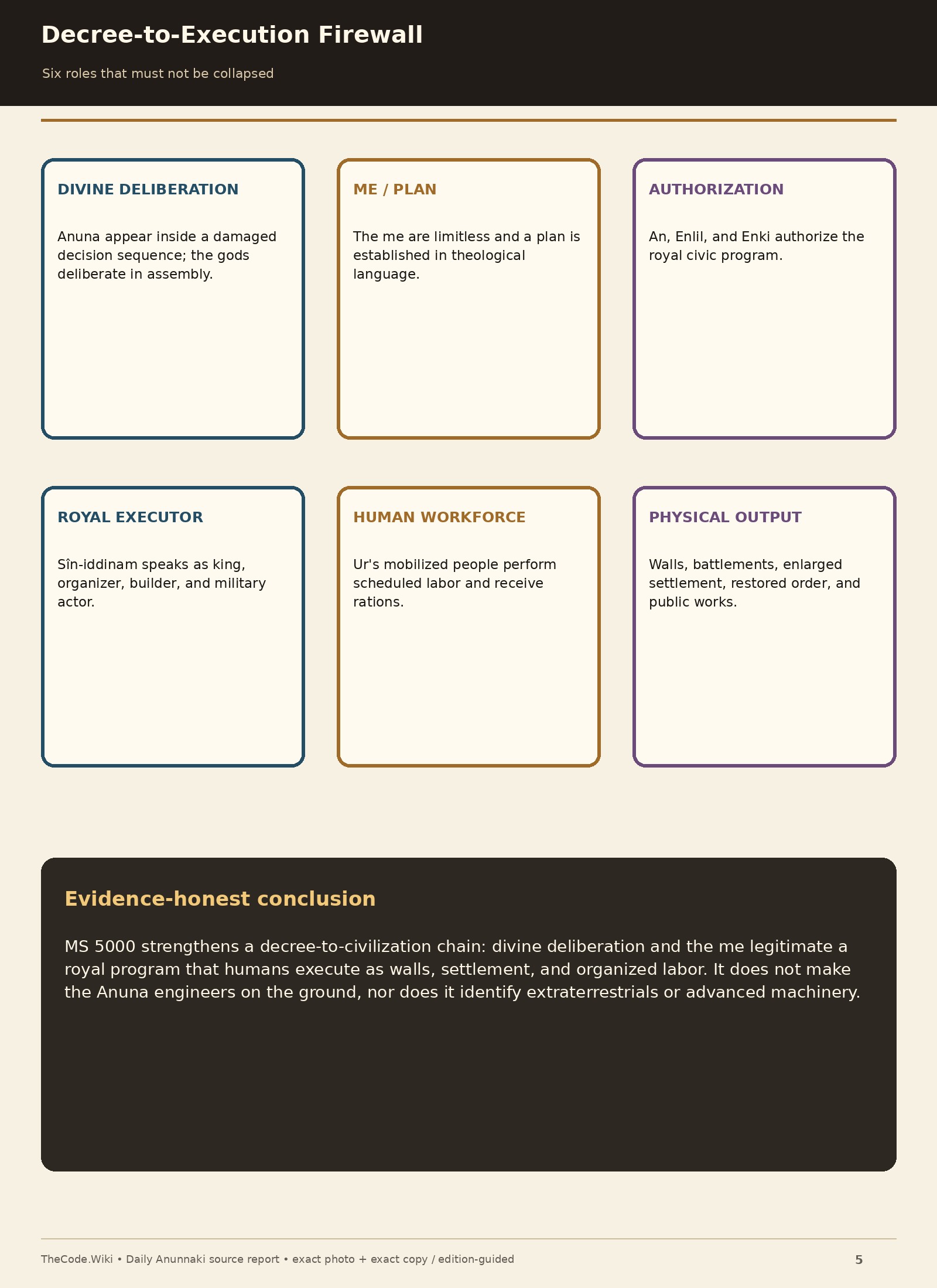
The inscription supports a limited but meaningful institutional chain: divine decision language legitimates a royal program, and human institutions execute that program through walls, settlement, mobilization, schedules, and rations. This is stronger than a detached divine name, because the source preserves ideological order and civic consequence together.
It remains weaker than an engineering dossier attributed to the Anuna. The king speaks, commands, campaigns, and builds; human laborers work; conventional materials and civic outputs are named. The passage supplies no vehicle, laboratory, genetic process, mining system, electronic control, or advanced machine.
Corpus relevance and limits

Supported: exact-object identity; a damaged-readable but un-restored Anuna reference; irreversible decision and counsel vocabulary; the me; divine assembly and plans; named royal execution; human public labor; and real wall/settlement outputs.
Not supported: extraterrestrial origin, Nibiru as a home planet, spacecraft, genetics, laboratories, mining, advanced machinery, or a claim that the Anuna physically built Ur’s walls. The exact visual establishes the object and row, while the reading remains edition-guided.
Daily capability improvement: future reports will retain separate fields for divine_deliberators, decision_language, me_or_plan_language, royal_executor, human_workforce, and physical_output. This captures institutional continuity without transferring human labor or technical action to the divine group.
Primary and scholarly sources
- CDLI P254031 exact-witness record and transliteration
- CDLI P254031 expanded catalogue JSON
- CDLI exact-object photograph
- CDLI exact-object line art / published copy
- SOAS repository record for CUSAS 17 and Volk’s peer-reviewed edition
- Adalı 2023, current scholarly discussion of Schøyen MS 5000
Share this:

One considered email each week
TheCode Weekly Evidence Brief
Receive the week’s strongest tablet decode, source audit or research update, plus one carefully chosen archive read. Routine posts stay on the site; the Brief is the curated signal.
Free. Usually sent on Sunday. No daily post flood. Unsubscribe at any time. See what the Brief includes.


