
Sennacherib 161: Aššur, the Anunnakū, and Measured Order
Exact K 8664 report: un-restored Anunnakū wording in Aššur’s cosmic title chain beside real royal-cubit specifications, with a strict agency firewall.

Ancient text and site reading
How to read this record
- Claim type
- Historical / textual + interpretive
- Evidence level
- Sources, translations, measurements, and symbolic reading where present
Use the evidence layer for sources and observations, and the interpretation layer for TheCode.Wiki synthesis.
Source-controlled result: British Museum K 8664 / CDLI P384935 / ORACC Q003966 is the exact Neo-Assyrian tablet edited as Sennacherib 161. Its second obverse line preserves the Anunnakū name outside restoration in a title chain belonging to Aššur: the partly restored opening calls him “[the one who molds] the Igīgū and Anunnakū gods,” followed by the un-restored title “the one who holds the lead-rope of heaven.” The reverse preserves real royal-cubit specifications for a bed, throne, protective figures, fittings, and inscription placement. This is valuable evidence for a Mesopotamian link between cosmic authority and measured material order—but the grammar does not make the Anunnakū the designers, measurers, builders, or operators.

Why this tablet advances the corpus
The cumulative Anuna/Anunnakū corpus already contains strong creation-and-labor traditions, divine assemblies, judgment, kingship, oath, building, and fate language. The most useful remaining tests ask whether divine-order vocabulary overlaps with concrete measurement or craft procedure on one physical object—and whether the text actually assigns that procedure to the divine collective.
K 8664 is unusually useful because the same tablet contains both layers. The obverse opens with Aššur’s cosmic and political titles, including the Anunnakū and heaven’s “lead-rope.” The reverse switches into exact dimensions and placement notes for cult furniture and protective figures. That adjacency invites a strong interpretation, but it also supplies the controls needed to test it. The result is disciplined: cosmic authority and technical measurement coexist, yet their actors and textual sections remain distinct.
Artifact and source identity
- Museum number: British Museum K 8664, conventionally displayed by ORACC as K 08664.
- Exact artifact: CDLI P384935, the exemplar linked from the Sennacherib 161 composite.
- Composite: CDLI P467176.
- Edition: ORACC/RINAP Q003966, Sennacherib 161.
- Period and provenience: Neo-Assyrian tablet from Kuyunjik/Nineveh, dated to Sennacherib’s reign, 704–681 BCE.
- Exact visual: current eBL photograph, 4635 × 6021 pixels, opened and inspected at original resolution.
- Identity controls: the photograph visibly carries K.8664; eBL JSON names K 8664 and cites RINAP 3/2 Sennacherib 161; ORACC names exemplar K 08664; CDLI P467176 links the edition to exact exemplar P384935.
The exact photograph shows a rectangular clay tablet with a complete, densely written obverse, inscribed edges, and a reverse that is partly blank. The painted museum number is unmistakable. These are physical observations from the inspected image; the sign values and translation come from the current scholarly edition.
The core line: published and working translations
Obverse 2, edition transliteration: [šā-pi-ik?] dI₂-GI₃-GI₃ u dA-NUN-NA-KI ta-me-eḫ ṣe-rat AN-e.
RINAP published translation in the opening title chain: “[the one who molds] the Igīgū and Anunnakū gods, the one who holds the lead-rope of the [great] heavens.”
Cautious working translation: “[Perhaps: the one who forms] the Igīgū and Anunnakū, the one who grasps the lead-rope of heaven.” The working rendering keeps the formation epithet bracketed and uncertain while preserving the grammatical minimum.
The restoration status is decisive. The word šāpik, “one who molds/heaps up,” is restored and marked uncertain; RINAP’s note says the suggestion is based on Sennacherib 159, while Sennacherib 155 could support a different restoration, “one who regulates.” The word “great” before heavens is also restored in the published translation. By contrast, the Igīgū and Anunnakū spellings, their conjunction, tāmeḫ (“one who grasps/holds”), ṣerrat (“lead-rope/nose-rope”), and heaven are outside square brackets.
The minimum defensible claim therefore does not depend on the restored creation verb. The tablet securely names the two divine collectives in Aššur’s title chain and securely calls Aššur the holder of heaven’s lead-rope. It does not securely say how Aššur related to the collectives in the lost opening word, and it does not make the collectives the holders of the rope.
The modern spelling “Anunnaki” reflects Akkadian Anunnakū, historically related to Sumerian Anuna/Anunna. That continuity is genuine. It does not automatically import modern claims about extraterrestrials, Nibiru, genetic laboratories, spacecraft, or advanced machinery into this specific title.
Image-to-text hard gate
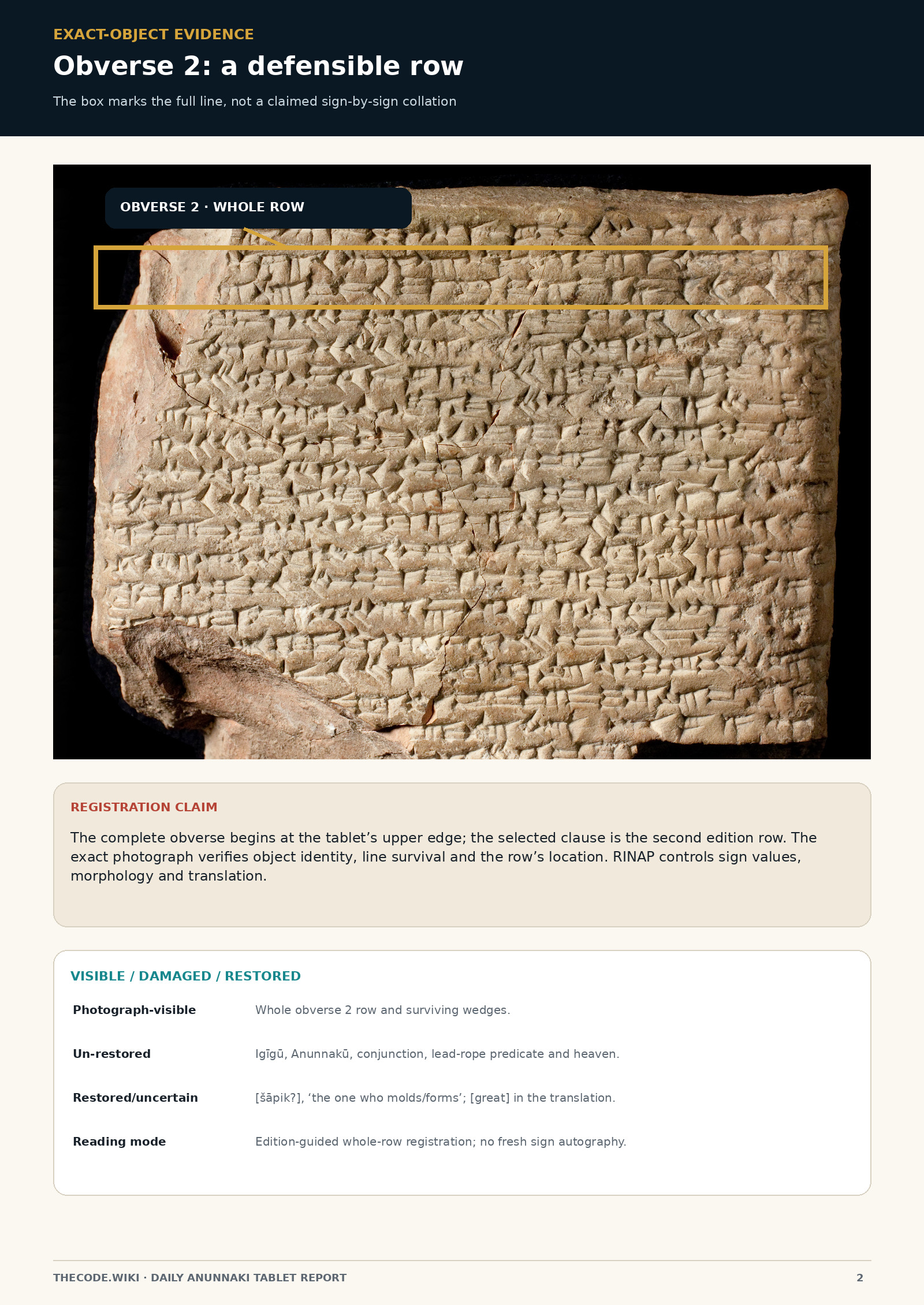
The image-to-text result is edition-guided with photograph-visible whole-row survival. K 8664 has a complete obverse whose line sequence begins at the upper edge, so obverse 2 is defensibly registered as the second row. The high-resolution photograph clearly preserves the row and its wedges. ORACC/RINAP controls word division, sign values, morphology, restoration brackets, and translation.
This is stronger than a composite-only citation and more cautious than claiming autonomous image decipherment. Exact-object identity, complete lineation, an un-restored thesis-critical divine name, and a current primary edition converge. The report does not draw a smaller box around individual Anunnakū signs because that would imply an independent sign-level collation not performed here.

The opening title chain
Obverse 1–5 praises Aššur as king and father of the gods, lofty creator, great god, the figure connected with the Igīgū and Anunnakū, holder of heaven’s lead-rope, deep-hearted self-counselor, regulator, fate-decreer, and controller of the gods of heaven and netherworld. Lines 6–11 then describe destructive power against unsubmissive lands, the imposition of tribute and payment, and daily work baskets. Line 12 returns to Aššur as holder of the lead-rope of heaven and netherworld.
This sequence strengthens the organized-hierarchy and cosmic-order strands of the corpus. It also requires a grammatical firewall. Aššur is the title holder and agent. The Igīgū and Anunnakū are coordinated named collectives inside that title chain. Subject peoples—not the divine groups—carry the daily work baskets. The reverse technical record then has its own scribal and material purpose.
Agency firewall: cosmic title is not technical operation

Aššur: holds the lead-rope, deliberates, decrees fates, and controls divine order. Igīgū and Anunnakū: named divine collectives related to a partly restored epithet. Unsubmissive lands: human political subjects burdened with tribute, payment, and work baskets. Reverse record: scribal specifications for measured cult furniture and its inscriptions.
Nothing in the source assigns the Anunnakū a measuring verb, construction verb, design verb, craft verb, transport verb, or operation of the lead-rope. The “lead-rope of heaven” is a Mesopotamian sovereignty image within Aššur’s title system. Treating it as a cable, control device, flight system, or piece of machinery would go beyond both grammar and genre.
What the reverse actually measures

Reverse 1′ states that the legs of a bed are one and two-thirds cubits by the royal cubit. Reverse 3′–8′ specifies a throne’s length and width, four lamassu figures, a kitturru fitting, a kuptu width, and a limit extending to a mušḫuššu-dragon. Reverse 9′–11′ discusses wording placed on the bed and throne and notes that text on a chest was not copied.
This is concrete measurement evidence, not vague symbolism. It belongs in the cumulative craft-and-measurement corpus. Yet its evidentiary value is clearest when the limitation is preserved: the measured objects and scribal placement notes do not make the Anunnakū their designers or builders. The same physical witness shows how easily adjacency can be mistaken for agency—and how line-level grammar prevents that error.
What the source supports
- A real Neo-Assyrian tablet with an un-restored Anunnakū spelling in a cosmic divine-title chain.
- Aššur as the named holder of heaven’s lead-rope and as a fate/sovereignty authority.
- A differentiated hierarchy connecting Aššur, Igīgū, Anunnakū, gods of heaven and netherworld, and the king’s political order.
- Human tribute and labor language in the obverse’s political theology.
- Exact royal-cubit dimensions and object-description procedure on the reverse.
- A historically real association—on one artifact—between cosmic-order rhetoric and measured cultic material culture.
What it does not support
The text does not identify the Anunnakū as extraterrestrials; name Nibiru as their home planet; describe spacecraft, flight controls, genetic engineering, laboratories, mining, engines, or advanced machinery; or assign them the reverse measuring and furniture-design procedure. The formation epithet before the divine groups is restored and must not be quoted as fully visible. The photograph verifies the exact tablet and whole-row survival, while the decipherment remains edition-guided.
Corpus relevance and daily capability improvement

Corpus relevance: K 8664 adds a same-object test of cosmic authority, human labor, and measured material procedure. It strengthens evidence that Anunnakū language belonged to an organized divine hierarchy and could appear beside real civilizational craft records. It simultaneously contradicts the stronger inference that proximity to measurement makes the collective the technical actor.
Daily capability improvement: this run adds a same-object adjacency firewall. Future reports will record a divine title, human labor clause, and technical specification as separate actor/action layers before admitting any civilizational claim. The workflow will require an explicit shared grammatical subject—not merely the same tablet—before transferring measurement, craft, movement, or material procedure to the Anuna/Anunnakū.
Next selection: prioritize a photographed non-royal administrative, canal, survey, tax, workshop, or transport object where an un-restored Anuna/Anunnakū noun is itself the grammatical subject of a concrete procedural verb. That would test direct group agency more strongly than another title or adjacent specification.
Primary sources
- ORACC/RINAP Q003966 — Sennacherib 161, current transliteration, translation, and notes
- CDLI P384935 — exact K 08664 artifact record
- CDLI P467176 — Sennacherib 161 composite and exemplar linkage
- eBL Fragmentarium K.8664 — exact museum-number metadata and bibliography
- eBL / British Museum exact K 8664 photograph
Share this:

One considered email each week
TheCode Weekly Evidence Brief
Receive the week’s strongest tablet decode, source audit or research update, plus one carefully chosen archive read. Routine posts stay on the site; the Brief is the curated signal.
Free. Usually sent on Sunday. No daily post flood. Unsubscribe at any time. See what the Brief includes.


