Samsu-iluna, the Anunnaku, and Babylon’s Foundation: What VA 2645 Actually Says
Exact-line-art study of VA 2645 / P371191: Marduk is exalted among the Anunnaku, Babylon’s foundation is secured, and Samsu-iluna—not the divine collective—claims the rebuilding.
Ancient text and site reading
How to read this record
- Claim type
- Historical / textual + interpretive
- Evidence level
- Sources, translations, measurements, and symbolic reading where present
Use the evidence layer for sources and observations, and the interpretation layer for TheCode.Wiki synthesis.
CORE PASSAGE · RIME 4.03.07.05AKKADIAN LINES 8–12
8–9 · in {d}a-nun-na-ki / šu-ma-am ṣí-ra-am i-bi₂-u₃-šu
10–12 · ká-dingir-ra{ki} / šuḫuš-šu kīma [šamê] u erṣetim / [u]kinnūšum
Published translation: “among the Anunnaku / did call him by an exalted name,” followed by “and Babylon’s foundation like heaven and earth / did make secure for him.” The divine-group phrase and naming predicate are not bracket-restored in selected exemplar P371191; the heaven sign and the opening vowel of the foundation verb are restored.
Why this witness matters
Much popular Anunnaki discussion begins with a modern conclusion and searches backward for confirming words. This report begins instead with one exact artifact witness, its published copy, its current digital edition, its restoration brackets, and the grammar of who does what.
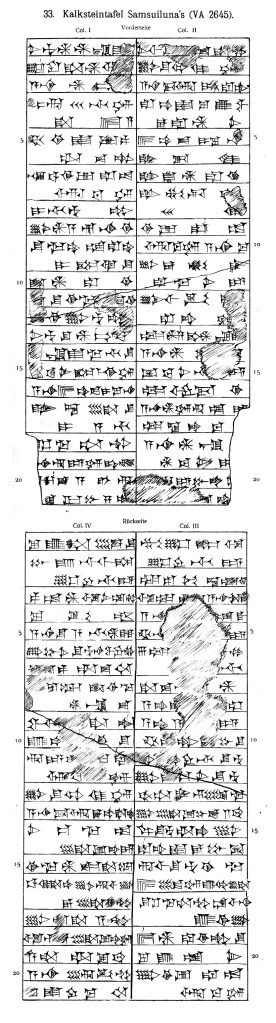
P371191 is an Old Babylonian official/display tablet in the Vorderasiatisches Museum, Berlin. CDLI records the museum number as VA 02645; the exact scholarly copy itself is captioned “Kalksteintafel Samsuiluna’s (VA 2645)”. The inscription is catalogued as RIME 4.03.07.05Akkadian exemplar 01. The current artifact page exposes exact-object line art but no photograph control, and its advertised photograph path returned HTTP 404. The line drawing therefore satisfies the exact-object gate; no photograph-level decipherment is claimed.
The corpus value is the chain of authority and execution. Anum and Enlil establish Marduk’s rank among the Anunnaku; the text connects that divine authorization to Babylon’s foundation and to Marduk’s commission of Samsu-iluna; the human king then speaks in the first person about rebuilding forts. This is strong evidence for divine hierarchy and royal foundation ideology, but not for Anunnaku masonry or advanced technology.
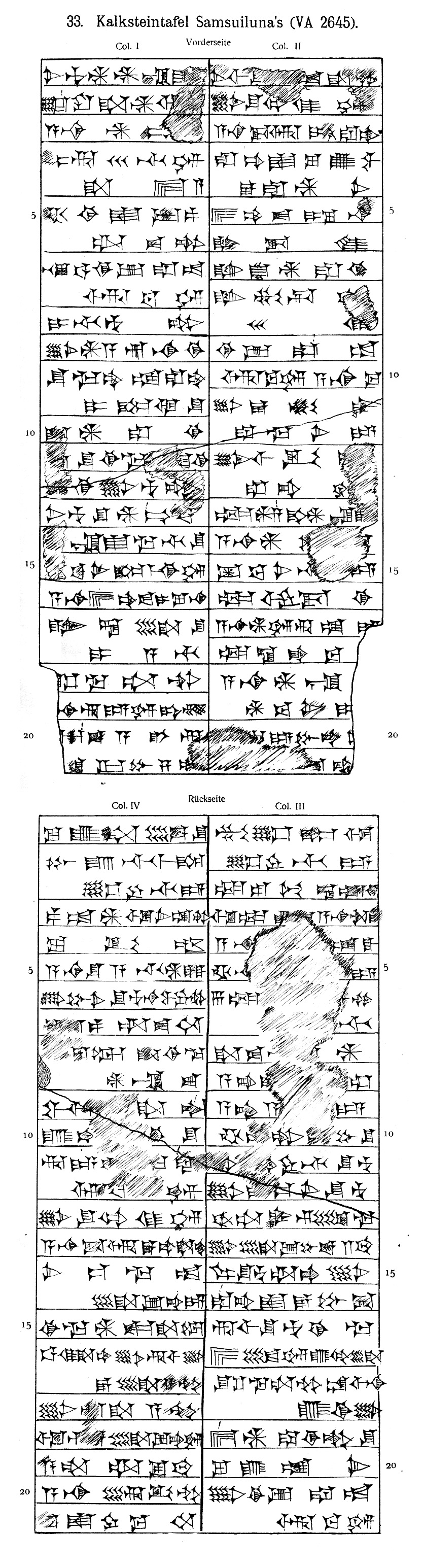
Exact-object provenance and the parallel-witness firewall
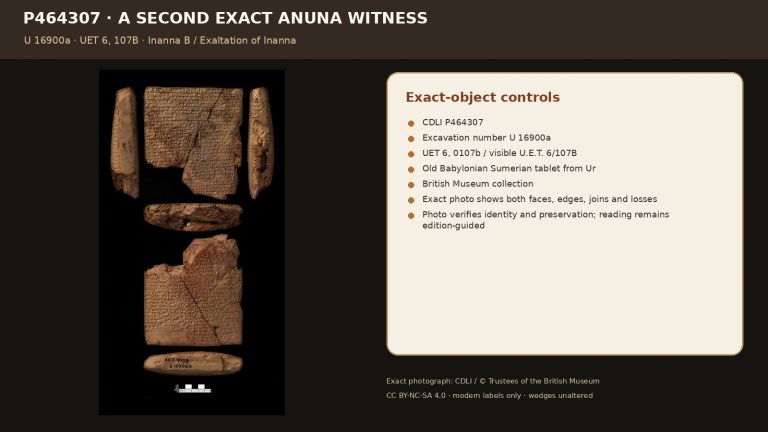
The source package uses two witnesses without conflating them. The selected artifact is VA 2645 / P371191. Its exact copy preserves the clearer opening sequence. Companion exemplar BM 038402 / P370917 carries the same inscription and has a current CDLI photograph and exact copy, but its opening is more damaged. The BM photograph can illustrate the inscription’s physical transmission; it cannot authenticate signs or rows on VA 2645.
The overview below labels P370917 prominently as a parallel witness—not the selected artifact. Every image-to-text claim comes from the exact P371191 copy. This matters because an attractive photograph of one witness must never be used to “prove” words visible only on another.
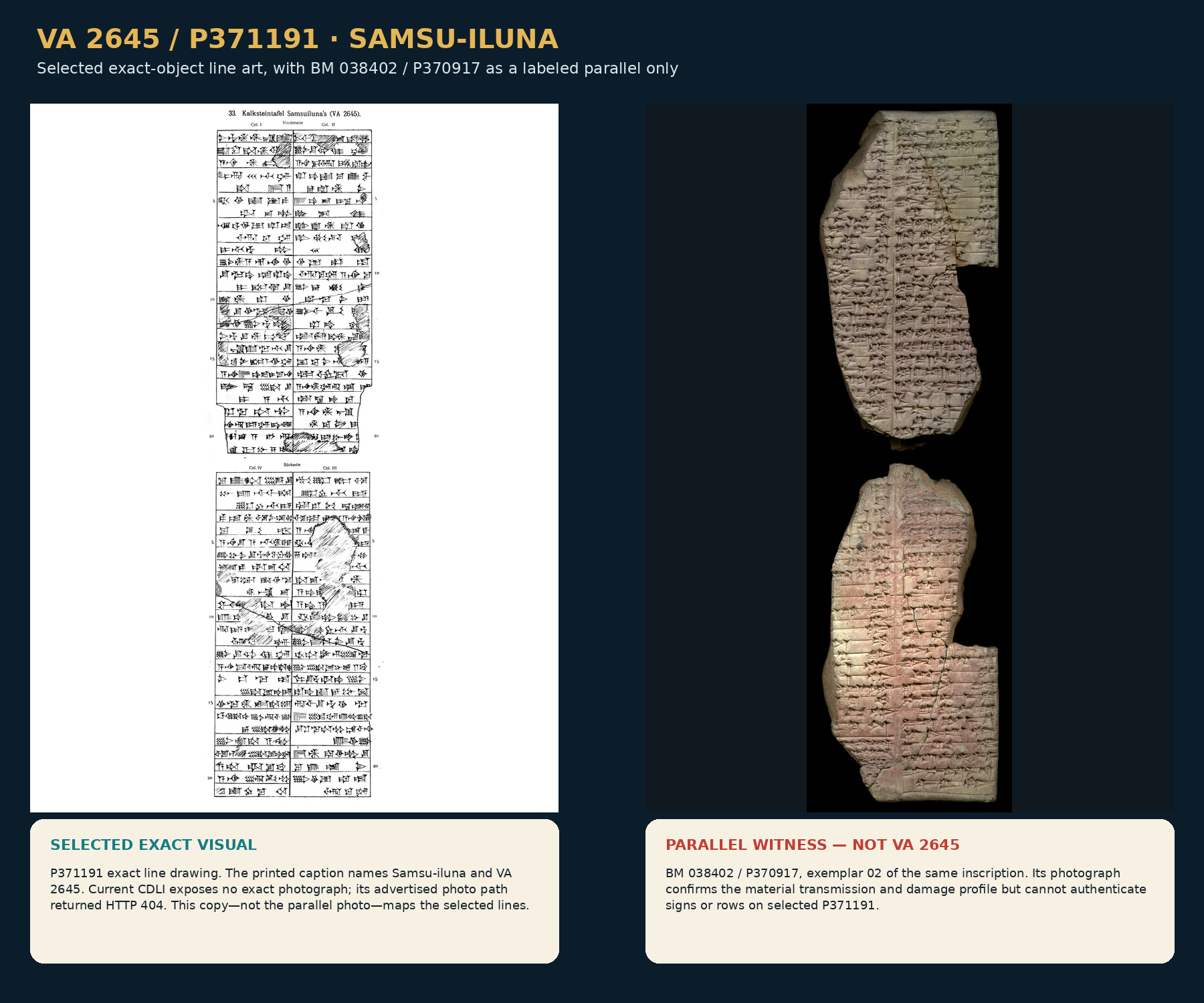
Image-to-text alignment: what is visible, damaged, and restored
The exact P371191 copy prints line controls at five-line intervals. Obverse column I lines 8–9 fall between the printed 5 and 10 controls. The annotation uses whole-row bands, not word- or sign-level boxes. CDLI/RIME controls sign values, word division, restoration, grammar, and translation. The result is classified exact_line_art_or_squeeze_visible and edition-guided.
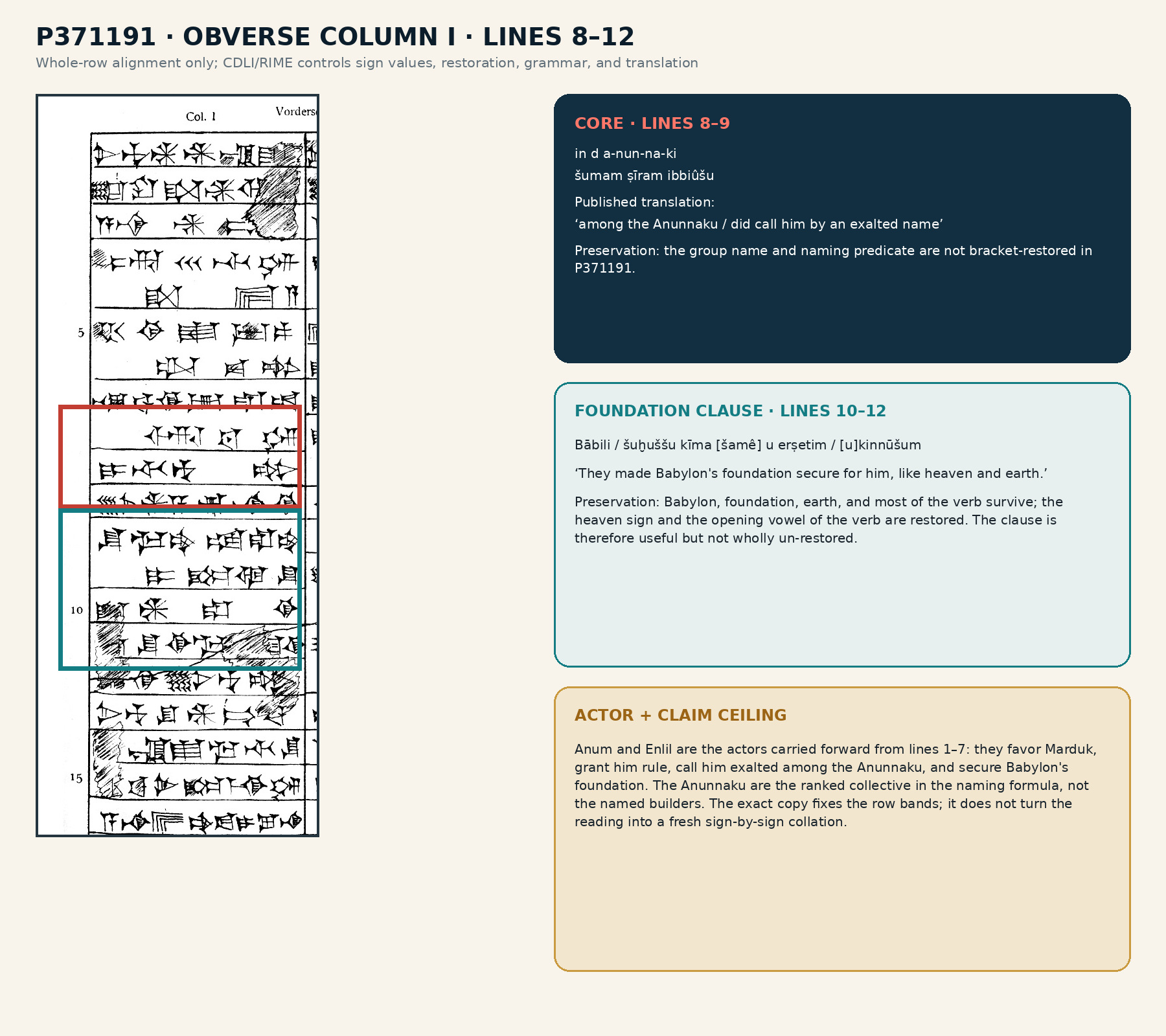
| Locus | Edition reading | Published / cautious sense | Status |
|---|---|---|---|
| Lines 8–9 | in {d}a-nun-na-ki / šumam ṣīram ibbiûšu |
“among the Anunnaku / did call him by an exalted name” | group name and predicate un-restored; whole-row exact-copy map |
| Lines 10–12 | Bābili / šuḫuššu kīma [šamê] u erṣetim / [u]kinnūšum |
“They made Babylon’s foundation secure for him, like heaven and earth.” | heaven sign and opening vowel restored; mixed preservation |
| Lines 13–24 | Marduk, “divine creator of wisdom,” commissions Samsu-iluna | royal shepherding and well-being commission | authority context; not Anunnaku agency |
| Lines 47–63 | six forts; two months; bricks; rebuilding; raised and secured foundations | Samsu-iluna’s first-person human execution sequence | partly damaged/restored; composite-controlled |
Published translation and cautious working translation
The current CDLI/RIME composite P448499 publishes both transliteration and English translation. This report quotes that published translation for the core lines. Its compressed restatements—such as “Among the Anunnaku, they called him by an exalted name”—are labeled cautious working translations rather than substituted for the edition.
The actors in the opening are carried forward from lines 1–7: Anum and Enlil look favorably upon Marduk, grant him rule over the four quarters, call him by an exalted name among the Anunnaku, and secure Babylon’s foundation for him. The Anunnaku phrase marks the divine rank field. It is not the subject of a separate building verb.
Lines 13–24 then call Marduk the “Enlil of his land” and “divine creator of wisdom.” Marduk commissions Samsu-iluna to shepherd the totality of the lands and lead the people in well-being. This is divine authorization language, not a technical specification.
The six forts: human execution, not transferred agency
Later in the same inscription, Samsu-iluna names six great forts built by his forefather Sūmû-la-Il and says they had fallen into ruin. The king claims that within two months he had their bricks made and rebuilt them in grand fashion, raised their tops like mountains, and secured the foundations of the lands. These are first-person royal actions.
That grammar sets the claim ceiling. The text links an Anunnaku rank formula to Babylonian foundation ideology and royal commissioning, but it does not say that the Anunnaku measured, molded, transported, laid, or fired the bricks. The theological frame and the human building dossier are related without sharing the same operative subject.
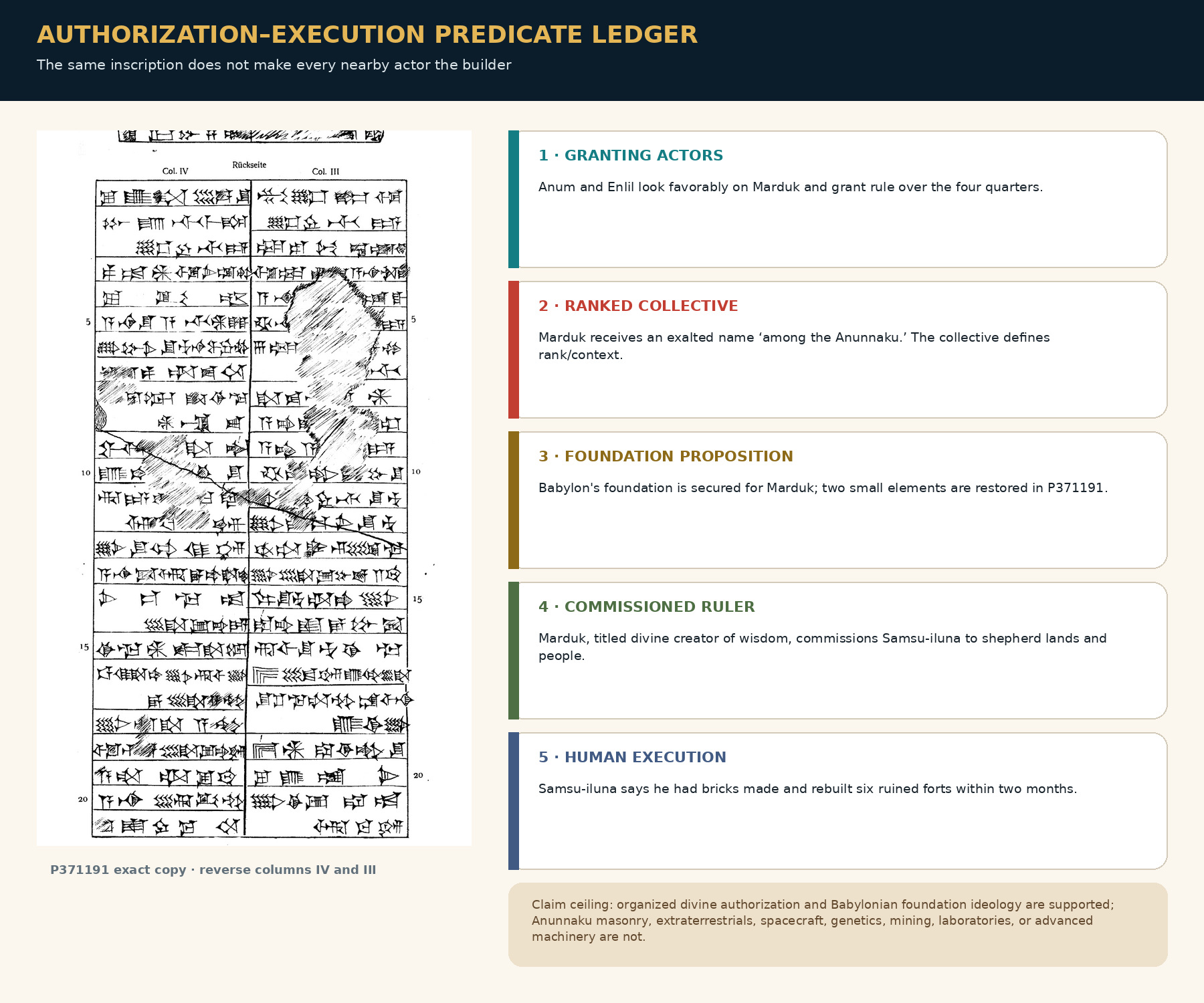
Anuna, Anunna, and Anunnaki
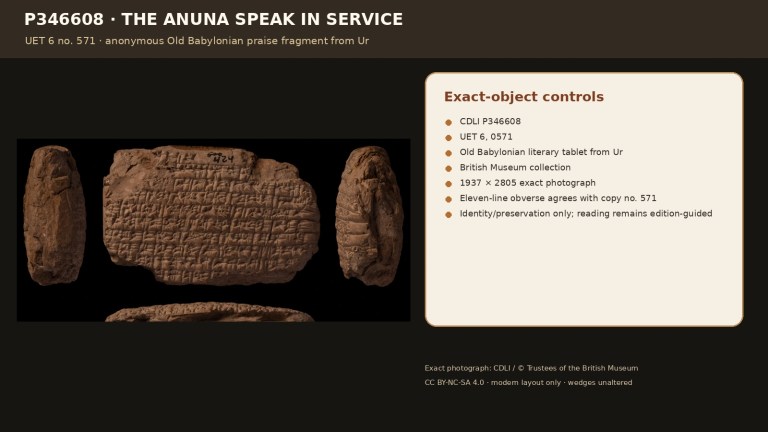
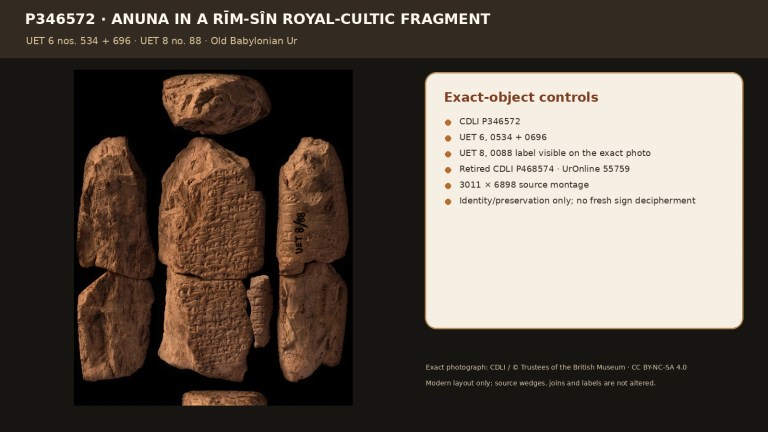
Sumerian texts commonly write the group as Anuna or Anunna; Akkadian texts use forms conventionally normalized as Anunnakū and popularly rendered “Anunnaki.” P371191 is an Akkadian Old Babylonian witness and writes the syllabic divine-group sequence {d}a-nun-na-ki. The broader ancient corpus uses the group in assembly, hierarchy, judicial, underworld, cultic, and literary settings, so the word should not be flattened into one modern definition.
Here the safest description is specific: the Anunnaku form the ranked divine collective within which Marduk receives an exalted name. The inscription’s stronger building verbs belong to Samsu-iluna. Neither the noun nor its proximity to a foundation clause supplies a planetary or biological identity.
Corpus relevance and the Sitchin test
Support: this witness adds a direct bridge between organized divine rank, Babylon’s cosmic foundation language, royal commission, and a concrete fort-rebuilding dossier. It supports the limited claim that Mesopotamian royal ideology placed civic foundations and kingship inside a structured non-human/divine authority order.
Limits: the source is royal ideology, not a neutral engineering log. The selected exact visual is line art because the photograph is currently unavailable. Two small elements in the foundation clause are restored. Most importantly, the Anunnaku do not own the first-person brickmaking or fort-rebuilding predicates.
The inscription does not identify extraterrestrials, Nibiru, spacecraft, genetic engineering, mining, laboratories, autonomous machinery, electrical systems, or recoverable advanced technology. The evidence-honest conclusion is that divine authorization and human construction are deliberately connected—but grammatically distinct.
Daily decoding capability improvement
This run adds an Authorization–Execution Predicate Ledger. Future reports will track seven fields separately: the granting actor, ranked collective, naming or decree predicate, foundation proposition, commissioned ruler, human building predicate, and restoration state by clause. A divine-group phrase near a construction dossier can no longer become false Anunnaku masonry or technology agency.
Sources
- CDLI P371191 artifact record — selected artifact identity, museum number, material, artifact-specific transliteration, and exact line art.
- CDLI/RIME composite P448499 — published transliteration, English translation, line sequence, and witness relationship.
- CDLI exact line art for P371191 / VA 2645 — exact selected-object visual and row registration.
- CDLI P370917 / BM 038402 artifact record — companion witness identity, photograph, exact copy, and artifact-specific damage control.
- CDLI photograph of companion P370917 — parallel witness only, not the selected artifact.
Download the full six-page evidence report:
VA 2645 / P371191 — Samsu-iluna, the Anunnaku, and Babylon’s Foundation (PDF)
Share this:

One considered email each week
TheCode Weekly Evidence Brief
Receive the week’s strongest tablet decode, source audit or research update, plus one carefully chosen archive read. Routine posts stay on the site; the Brief is the curated signal.
Free. Usually sent on Sunday. No daily post flood. Unsubscribe at any time. See what the Brief includes.