
Who Seats the Anunnaki? Command and Execution on K.162
On K.162, Ereshkigal commands and Namtar brings out and seats the Anunnaki. Exact-object imagery and edition-guided readings keep the divine actors distinct.

Primary-text evidence study
How to read this record
- Claim type
- Historical textual analysis
- Evidence level
- Exact artifact photograph and scholarly copy; edition-guided translation
- Status
- Witness-specific; damage and restoration distinguished
The text supports differentiated divine authority, not proof of extraterrestrials or advanced technology.
Download the complete illustrated PDF report
The result in one sentence
K.162 preserves an unusually useful command–execution pair: Ereshkigal tells her vizier Namtar to bring out and seat the Anunnaki, and the narrative then says that he did so. The Anunnaki are a recognized collective within an ordered divine procedure, but they are the grammatical objects of these actions—not their commanders or technical operators.
This is an Akkadian, not a Sumerian, tablet study. The Neo-Assyrian Nineveh witness belongs to the broader Anuna/Anunnaki research corpus, but the Akkadian Descent of Ishtar must not be conflated with the separate Sumerian Inana’s Descent. The important new evidence here is delegated authority and the preservation difference between an order and its execution on one exact artifact.
The exact artifact and what the photograph establishes
British Museum K.162 is CDLI P345482, museum identifier W_K-162. CDLI assigns it to Neo-Assyrian Nineveh; eBL identifies it as manuscript1 of the Standard Babylonian Descent of Ishtar, equivalent to manuscript A in Lapinkivi’s 2010 edition. CDLI’s composition alias is QIshtardescent, composite P497322. These identifiers describe the same physical witness rather than multiple corroborating tablets.
The inspected exact reverse photograph shows dense horizontal writing, several damaged surface pockets, a conspicuous lower break, and a largely blank lower area beneath a ruled writing field. Those observations come only from this photograph. Its identity is established by the Commons K.162 caption and the independently matching eBL/CDLI catalogue cross-references, not by an invented museum number supposedly visible on the clay.
Photograph: Marie-Lan Nguyen, Wikimedia Commons, CC BY 2.5. The displayed version is resized and carries a modern identification banner; the original evidence is not retouched. The photograph establishes identity and preservation. It does not by itself establish independent photographic recognition of the Anunnaki spelling.

How the exact copy is registered to the edition
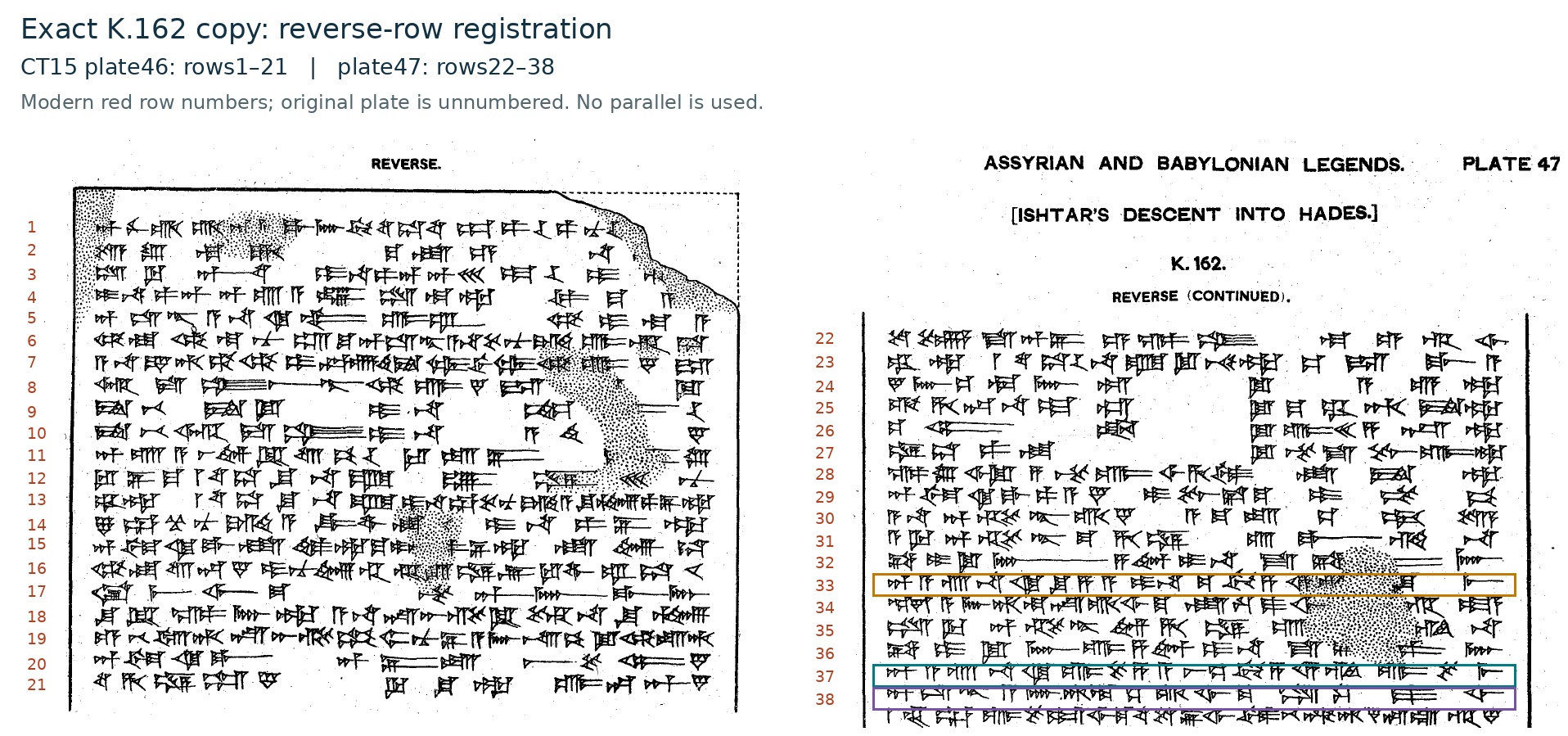
King’s 1902 CT15 plates46–47 explicitly identify K.162. Plate46 contains the beginning of the reverse in its lower panel; plate47 is labeled REVERSE (CONTINUED). Count twenty-one written rows in the first reverse panel, then continue at reverse22 on plate47. Reverse33 is the twelfth row of that continuation; reverse37 is the sixteenth and reverse38 the seventeenth.
The red row numbers are supplied by this study: they are not printed ancient line numbers or original numbers in King’s copy. The whole-row bands are registered through the continuous row count, the repeated Anunnaki clause, and eBL’s artifact-specific manuscript1 mapping. This is a defensible copy-to-edition registration, not a new sign-by-sign collation of the photograph.
The exact-copy context panel preserves the face and continuation information. The gold band marks reverse33 / composition113; teal marks reverse37 / composition117; purple marks reverse38 / composition118. The separate K.7600 and K.7601 witnesses on CT15 plate48 are not used to authenticate K.162 or to repair its writing.
Published translation and cautious working translation
The current eBL English for composition113 reads: “Bring out and seat the (netherworld) Anunna-gods on thrones of gold,” and composition117 reads: “He brought out and seated the (netherworld) Anunna-gods on thrones of gold,”. These are the edition’s translations, including its explanatory parenthesis. They are not our independent decipherment.
Our cautious working version distinguishes the speakers and verbal forms: reverse33, “[Ereshkigal orders Namtar:] Bring out the Anunnaki; seat them on gold throne-seat(s).” Reverse37, “[Namtar] brought out the Anunnaki and seated them on gold throne-seat(s).” Bracketed names in these working translations identify the contextual actor; they are not claims of missing cuneiform signs in these two rows.
Reverse29–30 names Ereshkigal as speaker and Namtar as her vizier. Reverse35 explicitly resumes Namtar as the actor; reverse37 continues that narrative subject. The singular causative forms matter more than the mere adjacency of the divine group name: the Anunnaki are whom he brings out and seats.
The source does not enumerate the seated gods. eBL uses plural “thrones”; the working rendering retains throne-seat(s) to avoid manufacturing a count from the logographic writing {giš}GU.ZA and its Akkadian construction. The gold qualification belongs to the seating furniture, not to an account of mining or production.
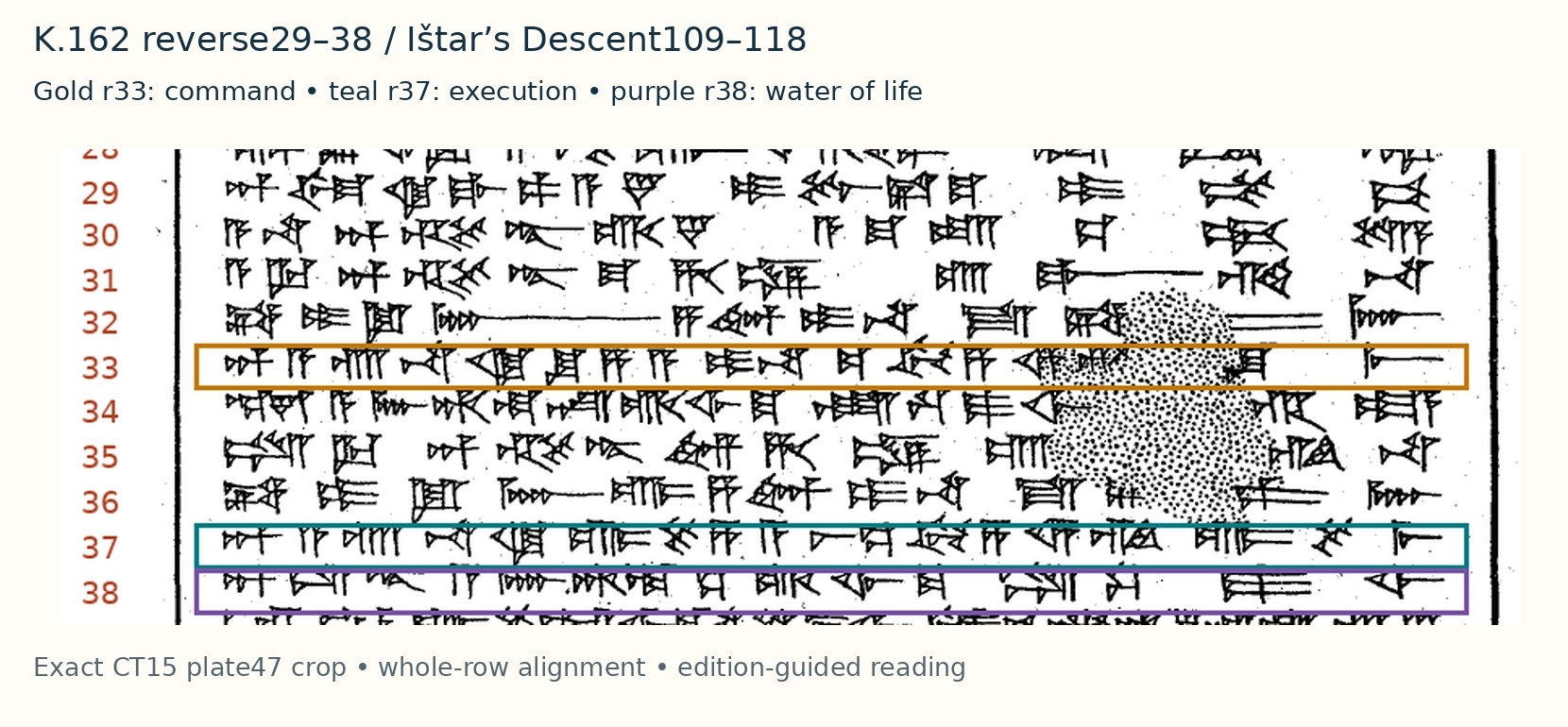
Image-to-text evidence register
Classification for the critical readings: exact_line_art_or_squeeze_visible; reading status: edition-guided. Photograph-visible sign values were not independently verified. The core Anunnaki term and both finite execution verbs in reverse37 are unbracketed and unflagged in the exact K.162 transcription; the execution clause is not supplied from a parallel or a composite.
Transcription conventions are retained rather than silently normalized: # marks an edition flag for damaged/uncertain signs; square brackets mark restoration; determinatives in braces are editorial transliteration conventions, not spoken words. An unbracketed edition reading is not automatically equivalent to independent photographic sign recognition.
Image-to-text record 1
- Exact image location
- K.162 reverse 29–30; composition 109–110; CT15 plate47, continuation row 8–9. One reverse writing column; full-row registration in the annotated exact crop.
- Edition transliteration
- {d}ereš-ki-gal pa-a-ša₂ i-pu-uš-ma i-qab-bi / a-na {d}nam-tar SUKKAL-ša₂ a-ma-ta iz-zak-kar
- Published translation
- eBL: Ereshkigal made ready to speak, / Saying these words to Namtar her vizier,
- Cautious working translation
- Ereshkigal opened her mouth and spoke; r30 names Namtar her vizier as addressee.
- Photograph-visible signs
- No individual sign values independently verified from photograph; it confirms exact-object identity and preservation.
- Exact-copy-visible / unbracketed sequence
- The corresponding whole writing row is visible in King’s exact K.162 copy; eBL supplies the listed sign values, with the damage/restoration fields below.
- Damaged signs
- None flagged in r29–30.
- Restored, composite or parallel-supplied signs
- None in these exact witness rows. No parallel witness supplies this record.
- Confidence
- High in exact-witness identity and copy-row alignment; reading is edition-controlled, not an autonomous photographic decipherment.
- Limit of visual claim
- Ereshkigal is speaker; Namtar is addressee, not the Anunnaki. Whole-row visibility does not establish independent recognition of every wedge.
- Textual evidence class
- exact_line_art_or_squeeze_visible
Image-to-text record 2
- Exact image location
- K.162 reverse 33; composition 113; CT15 plate47, continuation row 12. One reverse writing column; full-row registration in the annotated exact crop.
- Edition transliteration
- {d}a-nun-na-ki# šu-ṣa-a i-na {giš}GU.ZA KU₃#.GI# šu-šib
- Published translation
- eBL: “Bring out and seat the (netherworld) Anunna-gods on thrones of gold,
- Cautious working translation
- [To Namtar:] Bring out the Anunnaki; seat them on gold throne-seat(s).
- Photograph-visible signs
- No individual sign values independently verified from photograph; it confirms exact-object identity and preservation.
- Exact-copy-visible / unbracketed sequence
- The corresponding whole writing row is visible in King’s exact K.162 copy; eBL supplies the listed sign values, with the damage/restoration fields below.
- Damaged signs
- KI#; KU₃#.GI#. The exact copy shows a damaged zone in the latter portion.
- Restored, composite or parallel-supplied signs
- No bracketed restoration in r33. Contextual actor names in working English are explanatory. No parallel witness supplies this record.
- Confidence
- High in exact-witness identity and copy-row alignment; reading is edition-controlled, not an autonomous photographic decipherment.
- Limit of visual claim
- Imperative addressed to Namtar. Anunnaki is the object; command wording has damage flags. Whole-row visibility does not establish independent recognition of every wedge.
- Textual evidence class
- exact_line_art_or_squeeze_visible
Image-to-text record 3
- Exact image location
- K.162 reverse 37; composition 117; CT15 plate47, continuation row 16. One reverse writing column; full-row registration in the annotated exact crop.
- Edition transliteration
- {d}a-nun-na-ki u₂-še-ṣa-a ina {giš}GU.ZA KU₃.GI u₂-še-šib
- Published translation
- eBL: He brought out and seated the (netherworld) Anunna-gods on thrones of gold,
- Cautious working translation
- [Namtar] brought out the Anunnaki and seated them on gold throne-seat(s).
- Photograph-visible signs
- No individual sign values independently verified from photograph; it confirms exact-object identity and preservation.
- Exact-copy-visible / unbracketed sequence
- The corresponding whole writing row is visible in King’s exact K.162 copy; eBL supplies the listed sign values, with the damage/restoration fields below.
- Damaged signs
- No damage/uncertainty flags in the exact eBL manuscript1 row.
- Restored, composite or parallel-supplied signs
- None: group name, bringing-out verb, seating phrase and seating verb are unbracketed. No parallel witness supplies this record.
- Confidence
- High in exact-witness identity and copy-row alignment; reading is edition-controlled, not an autonomous photographic decipherment.
- Limit of visual claim
- Namtar continues as singular executor. The Anunnaki are brought out and seated; they are not the subject of these verbs. Whole-row visibility does not establish independent recognition of every wedge.
- Textual evidence class
- exact_line_art_or_squeeze_visible
Image-to-text record 4
- Exact image location
- K.162 reverse 38; composition 118; CT15 plate47, continuation row 17. One reverse writing column; full-row registration in the annotated exact crop.
- Edition transliteration
- {d}iš-tar A-MEŠ TI.LA is-luh-ši-ma il-qa-aš₂-ši
- Published translation
- eBL: He sprinkled Ishtar with the water of life and took her away.
- Cautious working translation
- He sprinkled Ishtar with the water of life and took her away.
- Photograph-visible signs
- No individual sign values independently verified from photograph; it confirms exact-object identity and preservation.
- Exact-copy-visible / unbracketed sequence
- The corresponding whole writing row is visible in King’s exact K.162 copy; eBL supplies the listed sign values, with the damage/restoration fields below.
- Damaged signs
- No damage/uncertainty flags in the exact eBL manuscript1 row.
- Restored, composite or parallel-supplied signs
- None in this exact witness row; r34 command has separate damage/restoration. No parallel witness supplies this record.
- Confidence
- High in exact-witness identity and copy-row alignment; reading is edition-controlled, not an autonomous photographic decipherment.
- Limit of visual claim
- Namtar acts; Ishtar receives. No Anunnaki production or use of a technology is stated. Whole-row visibility does not establish independent recognition of every wedge.
- Textual evidence class
- exact_line_art_or_squeeze_visible
Line notes: the order is less well preserved than its execution
Reverse33: {d}a-nun-na-ki# šu-ṣa-a i-na {giš}GU.ZA KU₃#.GI# šu-šib. The final KI in the group name and the gold signs carry damage/uncertainty flags, but the group is not wholly restored. šu-ṣa-a and šu-šib are imperatives addressed to Namtar. The whole-row copy band crosses a stippled damaged zone; no missing wedges have been manufactured or redrawn.
Reverse37: {d}a-nun-na-ki u₂-še-ṣa-a ina {giš}GU.ZA KU₃.GI u₂-še-šib. The same collective and furniture recur, now with narrative finite verbs. The exact-witness reading has no bracketed restoration or damage flag in this row. The repeated structure supports an order followed by fulfillment; it does not make the two rows independent historical witnesses.
Reverse38: {d}iš-tar A-MEŠ TI.LA is-luh-ši-ma il-qa-aš₂-ši. eBL translates: “He sprinkled Ishtar with the water of life and took her away.” This row is likewise unbracketed in K.162. It attributes sprinkling and removal to Namtar, with Ishtar as recipient. It neither states that the Anunnaki make the water nor describes a medical mechanism.
Adjacent lines are not uniformly intact. Reverse32 restores part of the shell/material writing; reverse34 has damaged life-water wording and a restored interval in the removal clause; reverse35 includes a damaged Namtar sign, a correction/variant in the striking verb and restored GAL; reverse36 flags parts of the material phrase. These limitations remain local to their clauses and are not silently cured by the better-preserved reverse37–38.
Anuna, Anunnaki and the limits of a name
Sumerian Anuna/Anunna and Akkadian Anunnakū/Anunnakkū belong to related Mesopotamian divine-group terminology. In this Akkadian passage the group appears in an object construction, conventionally normalized Anunnakkī. The popular English “Anunnaki” is useful for finding the dossier but should not flatten case, language, recension or contextual role.
The current English edition chooses “(netherworld) Anunna-gods.” The parenthetical netherworld label is contextual explanation; it is not an extra word visibly written in the r37 group name. Nothing in the spelling alone means extraterrestrial, astronaut, genetic engineer or miner.
What this contributes to the Sitchin hypothesis test
Support: the witness gives strong textual evidence for differentiated divine government—an authority who commands, a named vizier who executes, a divine collective that is brought out and seated, and a separate goddess who receives a release procedure. That is more specific than an isolated mention of a vague group of gods. It strengthens the corpus strand concerning organized hierarchy, delegated action and ordered assembly.
Limits and counterweight: this clause does not make the Anunnaki the operative agents. Namtar performs the bringing, seating and sprinkling; Ereshkigal issues the order. Treating the collective as the engineers of the procedure would reverse the grammatical evidence. A literary description of divine administration is evidence for an ancient theological representation, not an independently observed administrative event.
The passage does not prove extraterrestrials, spacecraft, Nibiru as a home planet, genetic engineering, laboratories, a mining program, electrical systems or advanced technology. Golden seats and water of life are the text’s material and life-restoration imagery; neither supplies a recoverable technical specification. A modern esoteric comparison may be offered as interpretation, but it cannot substitute for these source limits.
Next-selection implication: prioritize a nonduplicate exact witness that makes the Anuna/Anunnaki the un-restored subject of a concrete operative verb. Record separately any commander, intermediary, recipient and material adjunct. Human-creation and labor hypotheses need their own clauses and artifacts; they cannot be imported from this underworld release scene.
Daily decoding improvement: command–execution role register
This study adds a paired-clause register with separate fields for speaker, addressee, imperative, narrative executor, collective role, object or recipient, material adjunct, preservation delta and exact image locus. Applied here: Ereshkigal → Namtar → bring out/seat → Namtar → Anunnaki as object → gold seating; the following row has Ishtar as recipient of life-water sprinkling.
The preservation delta is decisive: the command flags KI and gold signs, while the execution row is unbracketed and unflagged. Repetition can clarify a damaged clause without erasing its damage or inventing a second independent witness. The registration method also records that the row numbers are modern additions to an unnumbered copy, with continuity across two explicitly identified plates.
Sources, credit and reproducibility
Current controls were checked on 14 October 2026 in Türkiye. The exact photograph’s bytes were validated against current Commons SHA1, file size and dimensions; the independently scanned CT15 PDF was validated against Internet Archive’s current original-file SHA1. The photographic license is CC BY 2.5; King’s 1902 primary-edition plates are public domain. Cropping, resizing, captions, row numbers and color bands are modern TheCode.Wiki annotations.
The translation control is eBL’s current Standard Babylonian edition and its explicit K.162 manuscript1 readings, with Lapinkivi, The Neo-Assyrian Myth of Ištar’s Descent and Resurrection (2010), listed there as the modern edition. King, Cuneiform Texts XV (1902), plates45–47, supplies the exact-object copy. CDLI independently supplies the physical and composition identifiers. Published English and cautious working versions remain labeled separately.
- CDLI P345482: exact K.162 artifact, catalogue and transcription
- eBL K.162: museum identity and P345482 cross-reference
- eBL scholarly edition: Ištar’s Descent, Standard Babylonian; manuscript1 = K.162
- Reproducible eBL chapter data: exact manuscript readings and published English
- King, Cuneiform Texts XV (1902), plates45–47: public-domain primary copy
- Exact K.162 photograph by Marie-Lan Nguyen, Wikimedia Commons
- Photograph reuse terms: Creative Commons Attribution 2.5
Share this:

One considered email each week
TheCode Weekly Evidence Brief
Receive the week’s strongest tablet decode, source audit or research update, plus one carefully chosen archive read. Routine posts stay on the site; the Brief is the curated signal.
Free. Usually sent on Sunday. No daily post flood. Unsubscribe at any time. See what the Brief includes.


