
Before the Anunna: The Sumerian Counterpart on Samsu-iluna’s BM 91083
An exact-copy study of BM91083 / P365477: the Sumerian Anunna naming clause, its Akkadian counterpart, and the difference between divine authority and human building.

Ancient text and site reading
How to read this record
- Claim type
- Historical / textual + interpretive
- Evidence level
- Sources, translations, measurements, and symbolic reading where present
Use the evidence layer for sources and observations, and the interpretation layer for TheCode.Wiki synthesis.
Download the complete illustrated PDF report
The finding in brief
A Sumerian limestone tablet of Samsu-iluna places Marduk’s exalted naming before the Anunna gods. Its decisive words are preserved without restoration in the current artifact-specific transliteration: {d}a-nun-na-ke4-ne-er / mu mah-a mi-ni-in-sa4-esz-a, column I 9–10. An and Enlil are the naming authorities; Marduk receives the exalted name. The Anunna are the collective in relation to which that status is proclaimed, not the grammatical subject of the naming action.
This is an exact-copy, edition-guided result, not an independent photographic decipherment. The original 1905 scholarly copies of this particular object have been inspected and aligned with the current edition. The central Anunna clause and the later human-building control appear in annotated exact-object panels below and in the PDF. No photograph of a parallel tablet is used to authenticate this witness.

The physical witness and why it is a new corpus entry
The current CDLI record identifies P365477 as British Museum BM 091083, formerly BM 012226, registration 1882,0714.629; P275172 is a retired CDLI identifier for the same object. It is a Sumerian official/display inscription on limestone from Sippar-Yahrurum, modern Tell Abu Habbah, catalogued as Old Babylonian. Its edition is RIME 4.03.07.05Sumerian, exemplar 01, with composite Q002222sum / P448500. The physical stone and its present condition were not inspected directly; material, provenance and period are catalog statements, not observations extracted from a photograph.
Our 23 September study examined the Akkadian counterpart on VA 2645 / P371191, not this stone. Today’s title deliberately names the Sumerian counterpart. The advance is a controlled comparison of language and grammatical roles: the Sumerian edition translates the Anunna relation as ‘before the Anunna gods’, whereas the earlier Akkadian edition rendered its relation ‘among the Anunnaku’. These are related formulations of status, not grounds for inventing a new action by the divine collective. The corpus gain is a new exact witness and a language-specific control, not a claim that this royal narrative has never been studied here.
The exact CDLI photograph endpoint returned HTTP 404; the artifact card exposes copies, not a photograph. The British Museum’s exact object page returned HTTP 403, and a Commons search for the museum identifiers found no exact image. The permitted fallback is therefore the original exact-object line art in Leonard W. King’s Cuneiform Texts XXI (1905), plates 47–50. This report uses independently retrieved public-domain plates 47 and 49 from the ETANA / Case Western Reserve University scan at Internet Archive, not the separately downloaded CDLI image. The 1905 title page and the plates’ printed 91083 / Samsu-iluna identifiers were visually checked. No claim is made that a photograph cannot exist elsewhere.
Published translation and cautious working translation
Published translation — CDLI P448500, lines 9–10: ‘before the Anunna gods / his exalted name did call’. The preceding lines explicitly introduce An and Enlil, ‘the kings of heaven and earth’, turning their joyful gaze toward Marduk, Enki’s first-born son, and granting him rule of the four quarters. The quotation is CDLI’s published English for the Sumerian composite, not a quotation from a newly read photograph.
Cautious working translation — column I 9–10 in context: ‘[An and Enlil] proclaimed his [Marduk’s] exalted name before the Anunna.’ The brackets in this English sentence clarify referents supplied by the preceding clauses; they do not represent restored or missing cuneiform signs. In the exact witness’s Sumerian I 9–10 there are no square-bracket restorations, damage hashes or question marks.
Line I 9, {d}a-nun-na-ke4-ne-er: {d} is the edition’s divine determinative. The Anunna name is followed by plural/relational morphology, here translated ‘before the Anunna gods’. It is not an independent subject statement, and its ending must not be flattened into an agent merely because the group is the topic of our research. Confidence: high for exact-row identification and the edition’s group name; interpretation of the construction remains edition-controlled.
Line I 10, mu mah-a mi-ni-in-sa4-esz-a: mu mah-a supplies an exalted or lofty name; the sa4 naming expression belongs to the plural actors introduced earlier, An and Enlil. ‘Proclaimed’ is our smoother working rendering of published ‘did call’, not an extra verb on the stone. Confidence: high for the clause-level reading, with no claim of fresh wedge-by-wedge collation.
Anuna / Anunna is the Sumerian divine-group designation in this passage. Akkadian Anunnakū and the popular modern spelling ‘Anunnaki’ belong to the broader history of that name, but one should not impose a single fixed membership or translate the word itself as a statement about extraterrestrial origin. The tablet must be read through its own grammar and genre.
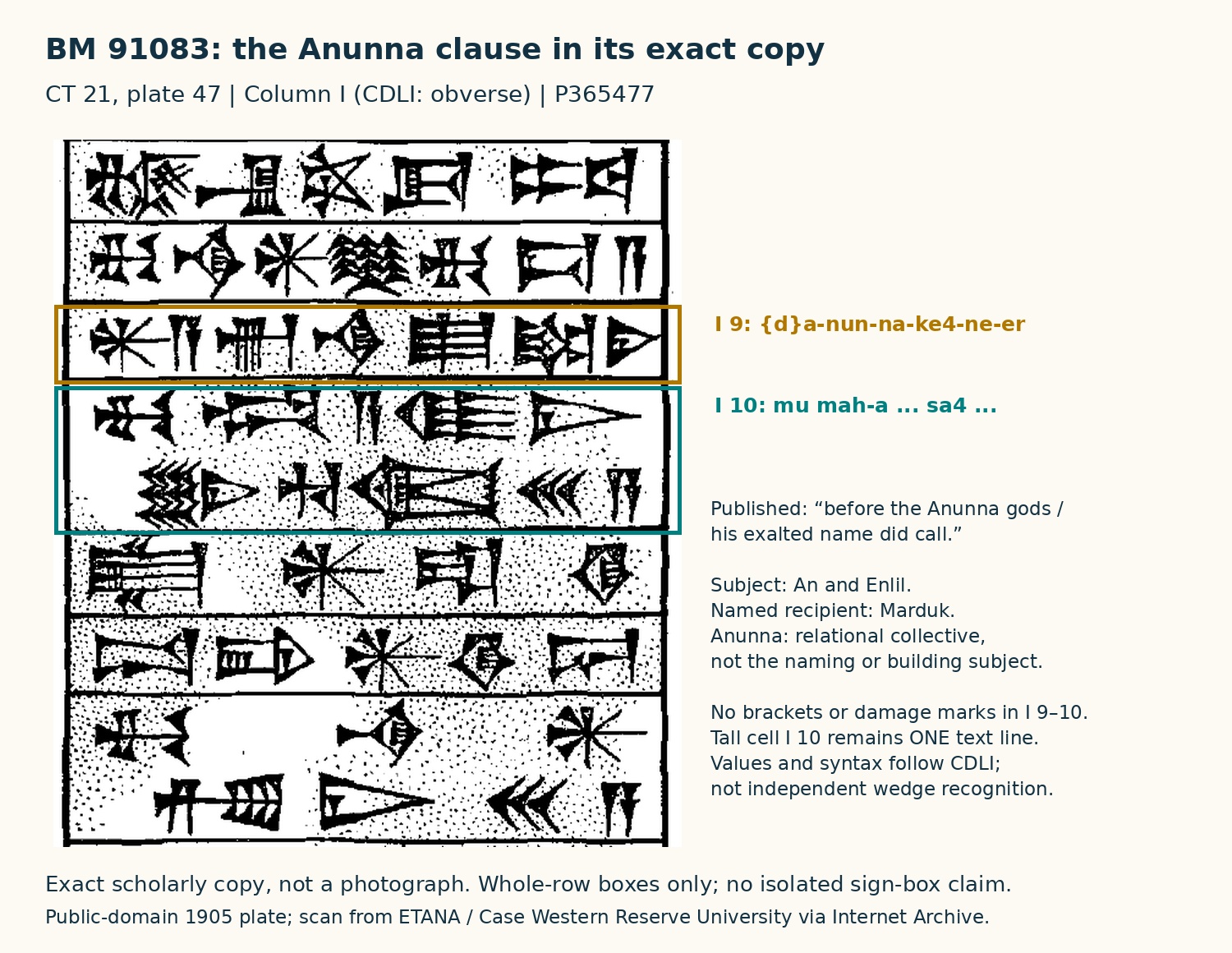
How the image is actually tied to the text
Plate 47 prints ‘Limestone tablet of Samsu-iluna’, museum number 91083 and ‘Col. I’. The current CDLI witness places these columns under its obverse heading; our face label follows that catalogue convention rather than a new physical examination. Counting the copy’s ruled textual cells from the top locates I 9 as the ninth cell. I 10 is the next taller cell, with two visual registers inside one textual line. Counting every register as a separate line would shift all subsequent annotations incorrectly.
The gold and teal boxes therefore enclose whole copy rows, not purportedly recognized individual signs. The first eight cells supply the named actors and grant; cells 11–13 supply Babylon’s foundation clause. Plate 49 independently identifies the same object’s column III. Its final six textual cells map III 17–22, with brickmaking in III 18 and rebuilding in III 19. The row map is defensible from printed object/column labels, continuous ruled cells and the edition’s line sequence.
Evidence class: exact_line_art_or_squeeze_visible. Photograph-visible signs: none claimed. The exact copy establishes the location of the written sequence; CDLI controls sign values, transliteration, grammar, damage notation and English. A century-old scholarly copy is not a current-condition photograph, and an unbracketed edition does not by itself prove that every wedge has been independently identified by us. The table records those limits rather than disguising an edition-guided result as image-decoded.
Image-to-text record 1
- Exact image location
- CDLI obverse, column I 1–8; CT21 plate47, first eight ruled cells
- Edition transliteration
- u4 an {d}en-lil2 … nam-en ub-da limmu2-ba / mu-na-an-szum2-mu-usz-a
- Published translation
- When An and Enlil … the rule of the four world quarters / did give to him
- Cautious working translation
- When An and Enlil granted Marduk lordship over the four quarters
- Photograph-visible signs
- none claimed
- Exact-copy-visible / unbracketed sequence
- An/Enlil opening and grant sequence registered by whole cells
- Damaged signs
- none marked in this selected range of current witness ATF
- Restored, composite or parallel-supplied signs
- none; ellipsis here is quotation abbreviation, not restoration
- Confidence
- high clause-level identification; edition-controlled values and syntax
- Limit of visual claim
- Exact scholarly copy and row registration, not independently photograph-verifiable sign decipherment.
- Textual evidence class
- exact_line_art_or_squeeze_visible
Image-to-text record 2
- Exact image location
- CDLI obverse, column I 9–10; CT21 plate47, ninth and tenth ruled cells; I10 has two visual registers
- Edition transliteration
- {d}a-nun-na-ke4-ne-er / mu mah-a mi-ni-in-sa4-esz-a
- Published translation
- before the Anunna gods / his exalted name did call
- Cautious working translation
- [An and Enlil] proclaimed his [Marduk’s] exalted name before the Anunna
- Photograph-visible signs
- none claimed
- Exact-copy-visible / unbracketed sequence
- Anunna phrase and naming clause; only whole-row registration claimed
- Damaged signs
- none marked by # or ? in current exact witness I9–10
- Restored, composite or parallel-supplied signs
- no square-bracket restoration in the Sumerian; English brackets clarify referents, not lost signs
- Confidence
- high identity/row alignment; grammar and translation remain edition-guided
- Limit of visual claim
- Exact scholarly copy and row registration, not independently photograph-verifiable sign decipherment.
- Textual evidence class
- exact_line_art_or_squeeze_visible
Image-to-text record 3
- Exact image location
- CDLI obverse, column I 11–13; CT21 plate47, next three ruled cells
- Edition transliteration
- ka2-dingir-ra{ki} / suhusz#-bi an-ki-gin7 / mu-na-an-ge-ne2-esz#-a
- Published translation
- and Babylon’s / foundation, like that of heaven and earth / did make firm for him
- Cautious working translation
- They made Babylon’s foundation firm for him, like heaven and earth
- Photograph-visible signs
- none claimed
- Exact-copy-visible / unbracketed sequence
- Babylon/foundation clause in the exact copy
- Damaged signs
- suhusz# and esz# in exact witness ATF, absent from smoother composite
- Restored, composite or parallel-supplied signs
- no bracket-supplied text; composite smoothing must not erase witness damage
- Confidence
- high clause identity; damaged details and values edition-controlled
- Limit of visual claim
- Exact scholarly copy and row registration, not independently photograph-verifiable sign decipherment.
- Textual evidence class
- exact_line_art_or_squeeze_visible
Image-to-text record 4
- Exact image location
- CDLI obverse, column III 17–22; CT21 plate49, final six ruled cells; III20 spans two registers
- Edition transliteration
- 17 sza3 iti 2(disz)-kam-ma-ta; 18 szeg12-bi mi-ni-du8; 19 gal-bi im-mi-du3; 20 sag-ne-ne hur-sag-gin7 mi-ni-il2; 21 kilib3 kur-kur-ra-ke4; 22 suhusz#-bi mi#-ni-ge-en
- Published translation
- within two months / their bricks I had made, / and I rebuilt them in a grand fashion
- Cautious working translation
- Within two months I had their bricks made and rebuilt them magnificently; I raised their tops and secured foundations
- Photograph-visible signs
- none claimed
- Exact-copy-visible / unbracketed sequence
- the six final copy cells; brickmaking and rebuilding registered separately as III18 and III19
- Damaged signs
- suhusz# and mi# in III22; none marked in III17–21
- Restored, composite or parallel-supplied signs
- none in selected range; English follows edition rather than a parallel image
- Confidence
- high whole-row alignment; first-person royal agency follows the edition
- Limit of visual claim
- Exact scholarly copy and row registration, not independently photograph-verifiable sign decipherment.
- Textual evidence class
- exact_line_art_or_squeeze_visible
Naming authority is not the same as construction agency
The continuation in I 11–13 says that Babylon’s foundation was made firm for Marduk, like heaven and earth. The exact witness marks suhusz# in I 12 and esz# in I 13 as damaged; the smoother composite omits those damage marks. No bracketed restoration occurs in this selected span, but damaged is not the same as fully secure. The cosmological comparison belongs to royal theology; it does not describe a measurable engineering technique.
Column III gives the material-building contrast. Published CDLI composite lines 59–61, corresponding to exact III 17–19, read: ‘within two months / their bricks I had made, / and I rebuilt them in a grand fashion.’ Our working rendering is: ‘Within two months I had their bricks made and rebuilt them magnificently.’ The first-person voice is Samsu-iluna’s royal narrative. It is not the voice of the Anunna.
The immediately surrounding account concerns six fortresses associated with named deities and an ancestral builder, Sumu-la-il. In III 20–22 the king raises their tops like mountains and secures foundations; the exact witness marks damage in suhusz# and mi# in III 22. The printed plate’s tall III 20 cell is again one edition line, not two. These details keep conventional brickmaking, rebuilding and monumental rhetoric with the stated human actor rather than transferring them to a nearby divine name.
Actor-and-role register: An and Enlil grant and name; Marduk receives exalted status and later commissions the ruler; the Anunna form the relational collective in the naming clause; Samsu-iluna narrates brickmaking and rebuilding. Later ‘great gods’ language is broader than the explicit Anunna phrase and must not silently be narrowed to that collective. The contrast is the core analytical result, not a denial that divine authorization mattered profoundly in Babylonian kingship.

What this contributes to the Anunnaki / Sitchin hypothesis
Support: the witness presents a differentiated divine order with named authorities, an exalted recipient, a divine collective and a human ruler. It links divine legitimation with the stability of Babylon, royal commission and public building. This is useful primary evidence for the limited proposition that Mesopotamian political theology represented organized non-human/divine authority as structuring human government.
Limits and counterweight: the Anunna do not own the naming verb or the brickmaking and rebuilding verbs in these clauses. The inscription is royal self-presentation, not neutral minutes of an observed divine assembly or an engineering log. It supplies no explicit extraterrestrial identity, Nibiru, spacecraft, genetic engineering, laboratory procedure, mining program, machinery or recoverable advanced technology. A theological claim to heaven-and-earth stability cannot be converted into a technical mechanism simply by juxtaposing it with an Anunna mention.
This strengthens the corpus through discrimination rather than sensationalism. It does not prove Sitchin’s stronger ancient-astronaut claims. The next high-value selection should still seek an intact, nonduplicate witness where the Anuna/Anunnakū collective itself is the explicit subject of an un-restored allocation, decree, knowledge-transfer, measurement, craft or material-transformation predicate with a clear object. Here the secure gain is the controlled Sumerian counterpart and the separation of relation from agency.
Daily decoding improvement
This run adds a Ruled-Cell and Recension Role Register. Store physical object and retired identifiers, language recension, printed plate and column, edition line, number of visual registers inside its ruled cell, collective grammatical role, named actor, damage/restoration state and the claim ceiling. I 10 and III 20 demonstrate why a taller cell must not be counted twice. BM 091083 versus VA 2645 demonstrates why a related translation must not be treated as the same photographed or copied witness.
The source-handling improvement is equally concrete: distinguish a downloadable image from permission to republish it. The excluded CBS 13902 candidate had a valid exact photograph, but permission was not established. For BM 91083 the report instead locks its visual to an independently retrieved, dated public-domain primary plate. Exact-object identity, publication rights, physical line registration and grammatical interpretation remain four separate checks.
Sources, credits and reproducibility
Primary witness metadata and transliteration: CDLI P365477. Published English and composite comparison: CDLI P448500 / Q002222sum. Print references recorded by CDLI: Frayne, Old Babylonian Period, RIME 4 (1990), 4.03.07.05Sumerian; King, The Letters and Inscriptions of Hammurabi, no. 99; King, Cuneiform Texts XXI (1905), plates 47–50. This report directly inspected CT21 plates 47 and 49 and the current CDLI texts; it does not imply that every cited print volume was newly collated.
Image credits: Leonard W. King / British Museum, CT21 (1905), public-domain original plates; electronic scan prepared by Kelvin Smith Library, Case Western Reserve University, for ETANA Core Texts, accessed through Internet Archive. TheCode.Wiki adds whole-row annotations and explanatory labels only. No cuneiform strokes are generated, reconstructed or enhanced. Full-image identity captions and exact-copy limitations remain in both this article and its PDF.
Access note: the institutional ORACC controls for an earlier discarded prism candidate were unavailable through the bounded transports used, and museum record access was restricted. Those results are not failures of the selected primary plates. The final classification is edition-guided, exact-line-art-visible; not independently photograph-verifiable, restored/composite-only or parallel-only. The composite supplies published English and contextual interpretation, not a substitute visual for the selected object.
Share this:

One considered email each week
TheCode Weekly Evidence Brief
Receive the week’s strongest tablet decode, source audit or research update, plus one carefully chosen archive read. Routine posts stay on the site; the Brief is the curated signal.
Free. Usually sent on Sunday. No daily post flood. Unsubscribe at any time. See what the Brief includes.


