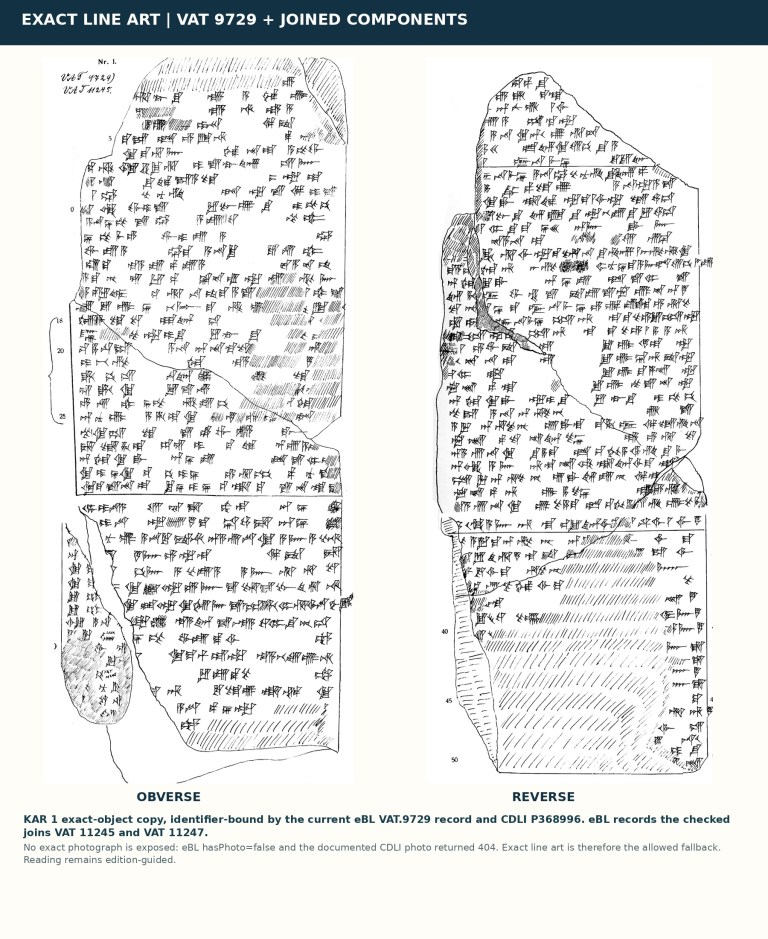
BM 65461: The Anunnaki and Their Shrines—A Verb Variant in Enūma Eliš VI
Exact-object study of BM 65461/P404914, where Enuma Elish VI 68 preserves the Anunnaki and their shrines with a verb variant that limits engineering claims.
Primary-text evidence study
How to read this record
- Claim type
- Historical textual analysis
- Evidence level
- Exact CDLI P404914 line art and current eBL Tablet VI edition
- Status
- Edition-guided exact-copy alignment
The witness preserves an Anunnaki-and-shrines line with a verb variant; it does not prove extraterrestrials or advanced technology.
A new exact-witness study shows why the standard composite translation ‘devised’ must not be turned into an engineering claim.
Reading classification: exact_line_art_or_squeeze_visible; edition-guided. Exact line art verifies identity, row registration, damage, and survival. The critical edition controls signs and translation.
Download the complete illustrated PDF report
Result in one sentence
BM 65461 preserves a partly damaged but identifiable Anunnakū reference beside ‘all of them,’ ‘their shrines,’ and the manuscript verb izzakkarū/izzakrū (‘they named/spoke’), so this exact witness supports an organized divine collective associated with cult space but does not securely say that the Anunnaki engineered or fabricated the shrines.
The selected object
The selected witness is British Museum BM 65461, registration 1882,0918.5448, joined in the eBL record with 1883,0118,2116 and linked to CDLI P404914. It is a Neo-Babylonian literary/school witness to Enūma Eliš. The current CDLI entry calls it CDLI Literary 002718.03, exemplar 006.
The current eBL fragment record reports hasPhoto=false and exposes an exact CDLI line-art copy. That makes exact line art the permitted fallback: no photograph is being hidden or replaced by a drawing. The copy itself prints BM 65461 and both registration strings, so artifact identity does not rest on resemblance alone.

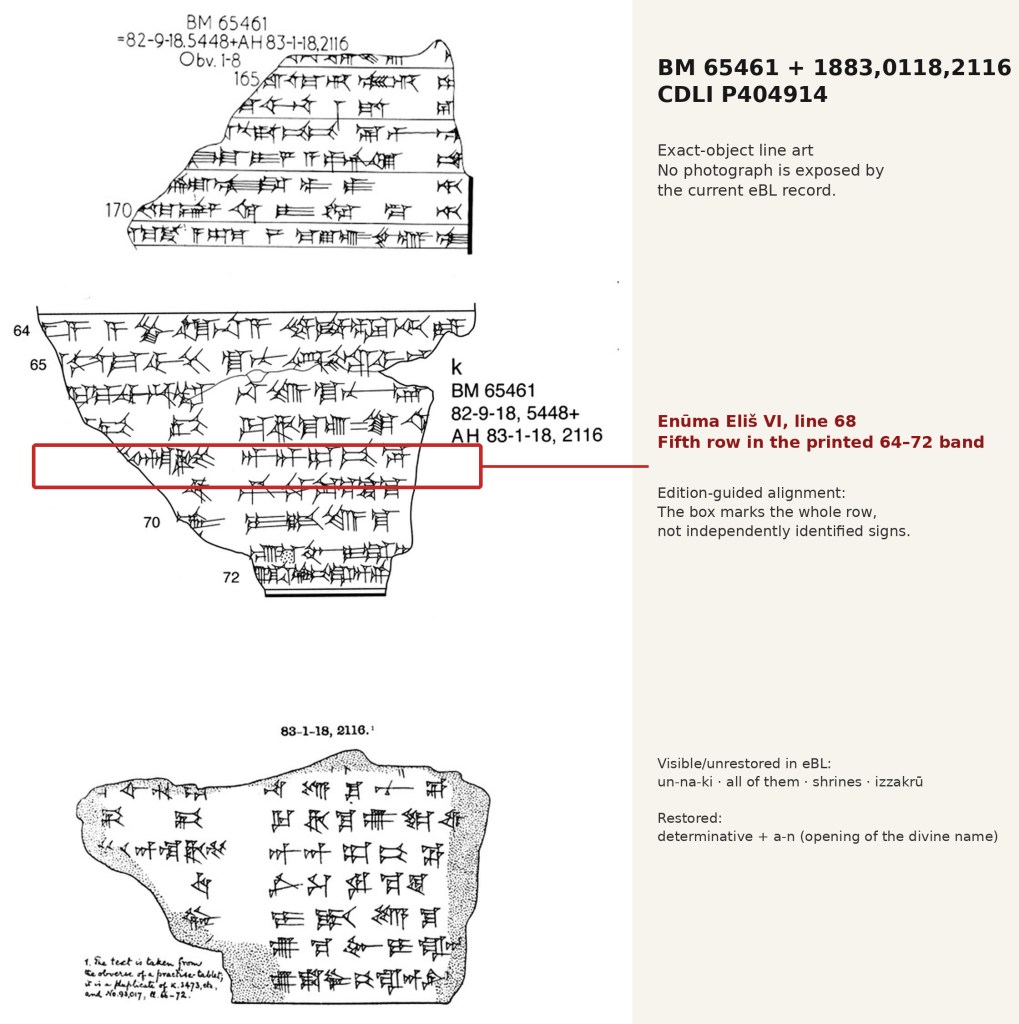
Where line 68 is on the exact copy
The central copied fragment prints line controls 64, 65, 70, and 72. Counting within that continuous register places line 68 at the fifth row. The red band marks the whole row only. It does not draw a word-sized or sign-sized box, and it does not claim an unaided fresh collation.
Evidence class: exact_line_art_or_squeeze_visible; reading mode: edition-guided. The exact copy verifies object identity, the 64–72 register, the line-68 row, the broken left edge, and surviving wedge groups. eBL controls restoration, sign values, normalization, morphology, and translation.

Published composite translation versus this witness
The current eBL composite translates Enūma Eliš VI 68: ‘All the Anunna-gods devised their own shrines.’ Its reconstructed verb is ibtašmū, aligned with a verb meaning to devise or fashion.
BM 65461 does not preserve that verb. Its manuscript line is [{d}a-n]un-na-ki ka-li-šu₂-nu BARA₂-MEŠ-šu₂-nu iz-zak-ru. The API records the witness form as normalized izzakrū. A cautious witness-level translation is therefore: ‘The Anunnakū, all of them, named/spoke of their own shrines.’ This is a working translation of the witness, not a proposal to overwrite the critical composite.
The difference matters. A popular paraphrase can move silently from ‘devised shrines’ to ‘designed technology.’ BM 65461 is a control against that move: its preserved verb points toward speaking or naming, while the line still clearly concerns the collective and its shrines.
Image-to-text hard gate
| Exact image location | BM 65461/P404914 exact copy; central fragment; obverse line 68; fifth row in the numbered 64–72 band. |
|---|---|
| Edition transliteration | [{d}a-n]un-na-ki ka-li-šu₂-nu BARA₂-MEŠ-šu₂-nu iz-zak-ru |
| Published composite translation | All the Anunna-gods devised their own shrines. |
| Cautious witness translation | The Anunnakū, all of them, named/spoke of their own shrines. |
| Exact-copy visible and unbracketed | un-na-ki; ka-li-šu₂-nu; BARA₂-MEŠ-šu₂-nu; iz-zak-ru; the row and surviving wedge groups. |
| Damaged | Broken left edge of the line; the beginning of the divine name is absent. |
| Restored | {d}a-n, the divine determinative and opening of the Anunnakū spelling. |
| Composite/parallel supplied | The composite ibtašmū and English ‘devised’ are not the verb preserved by BM 65461. |
| Confidence | High for identity, row registration, and the witness/composite difference; medium for the working translation. |
| Visual claim limit | Whole-row survival only. Sign values, restoration, morphology, and translation remain edition-controlled; no fresh sign-by-sign collation. |
| Textual evidence class | exact_line_art_or_squeeze_visible; edition-guided. |
Word and restoration notes
[{d}a-n]un-na-ki — the divine determinative and a-n are restored at the broken left edge; un-na-ki survives outside brackets. The group name is therefore partly preserved, not wholly restored and not independently photograph-decoded.
ka-li-šu₂-nu — ‘all of them’ or ‘the whole of them,’ unbracketed in this witness. It presents the group collectively.
BARA₂-MEŠ-šu₂-nu — ‘their shrines/cult daises,’ unbracketed. The possessive points to shrines belonging to or associated with the group; it does not state who quarried, transported, measured, or built them.
iz-zak-ru — the witness-specific verb, unbracketed. The cautious rendering ‘they named/spoke of’ is philologically preferable for this witness to importing the composite’s ‘devised.’
What this adds to the cumulative Anunnaki corpus
This is a new physical witness, not a new composition. Enūma Eliš VI is already central to the corpus because it links human creation, labor transfer, Anunnaki organization, hoes, bricks, Babylon, and cult construction. BM 65461 adds a different kind of value: textual control. It demonstrates that one exact witness can preserve the Anunnaki-and-shrines proposition with a different verb from the composite.
For Tony’s working thesis, the source supports the modest claim that Mesopotamian learned tradition pictured the Anunnaki as a named, collective divine order associated with cult spaces. It weakens any attempt to make this particular line prove technical design, machinery, extraterrestrial engineering, or a recoverable technology package.
Corpus proof-gap relevance: craft and civilization-transfer claims need witness-level verb control. A divine-group noun next to a shrine is not enough; the exact predicate and its manuscript history determine whether agency is technical, ritual, declarative, or merely relational.
What the source does—and does not—prove
Supported: an identifiable Anunnakū spelling survives partly outside restoration; the line treats the group collectively; the witness associates them with their shrines; the exact copy provides a defensible row; and the witness verb differs from the composite reconstruction.
Not supported: extraterrestrial identity, Nibiru, spacecraft, genetic engineering, mining, laboratories, metal machinery, advanced construction technology, or independent sign-by-sign decoding from a photograph. The text is mythic-literary and the visual reading is edition-guided.
Contradiction/limit: the standard English ‘devised’ is valid at the composite level, but BM 65461 itself writes iz-zak-ru. Any claim about this exact artifact must preserve that difference rather than letting the composite verb migrate into the witness.
Sources
- CDLI P404914 artifact record
- CDLI exact line art for P404914
- eBL BM 65461 fragment record
- eBL Enūma Eliš Tablet VI critical chapter
Method note and daily capability improvement
Today’s improvement is a witness-verb firewall: before assigning technical agency, compare the selected manuscript’s finite verb with the composite reconstruction and published translation. If they differ, the article must carry both readings and may not import the composite predicate into the exact object. This prevents a real Anunnaki noun from inheriting an engineering claim that its own witness does not preserve.
Share this:

One considered email each week
TheCode Weekly Evidence Brief
Receive the week’s strongest tablet decode, source audit or research update, plus one carefully chosen archive read. Routine posts stay on the site; the Brief is the curated signal.
Free. Usually sent on Sunday. No daily post flood. Unsubscribe at any time. See what the Brief includes.