KAR 004: Anunna, Human Creation, and Labor on P282595
A source-backed reading of KAR 004 / CDLI P282595, where Anunna/Anunnaku language stands beside human creation from divine blood and labor assigned to humanity.
Ancient text and site reading
How to read this record
- Claim type
- Historical / textual + interpretive
- Evidence level
- Sources, translations, measurements, and symbolic reading where present
Use the evidence layer for sources and observations, and the interpretation layer for TheCode.Wiki synthesis.
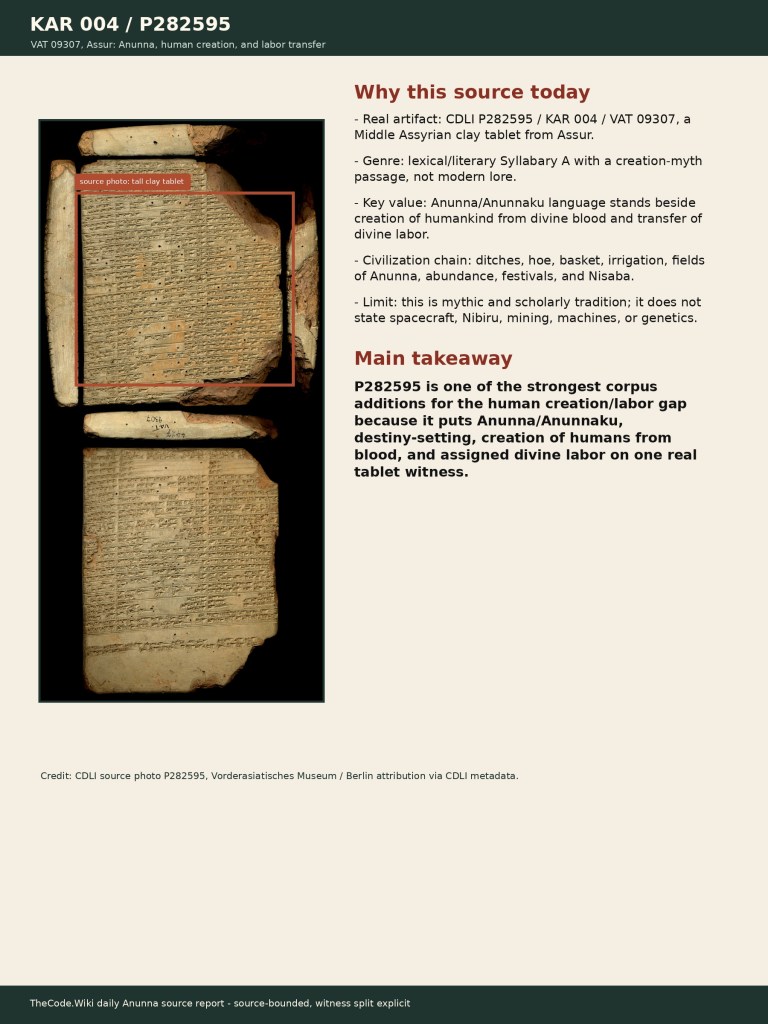
Today I chose CDLI P282595, KAR 004, because it advances the highest-value corpus gap: human creation and labor assignment tied directly to Anunna/Anunnaku language. The tablet is a real Middle Assyrian lexical/literary witness from Assur, not an internet Anunnaki claim.
Download the working report: KAR 004 Anunna human creation and labor PDF report.
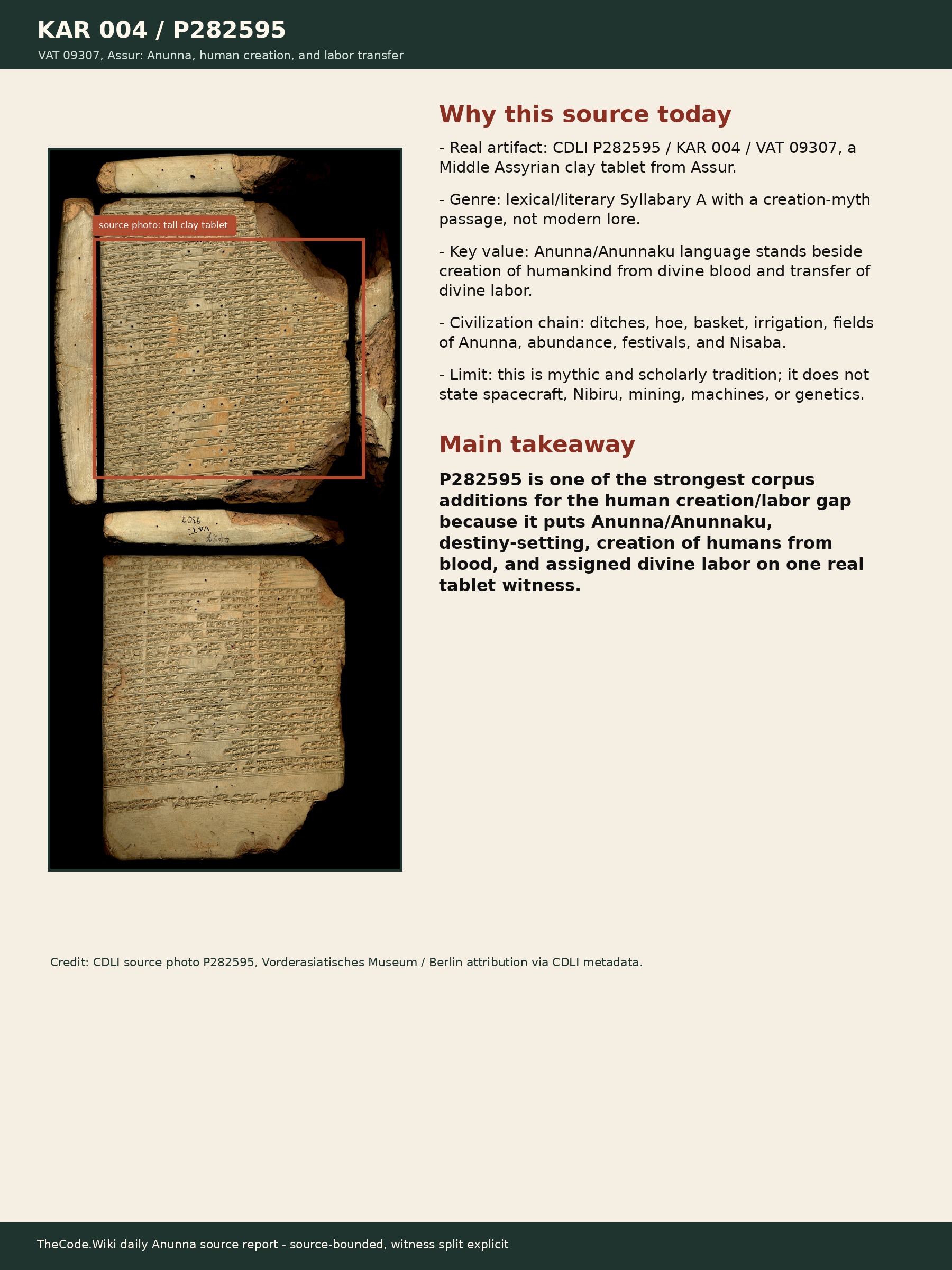
The source basis
CDLI identifies P282595 as KAR 004 / VAT 09307, a clay tablet from Assur, probably Middle Assyrian, now in the Vorderasiatisches Museum, Berlin. Its genre is listed as lexical and literary, Syllabary A with a creation-myth passage. The artifact page preserves photo, line art, metadata, and a line-by-line text.
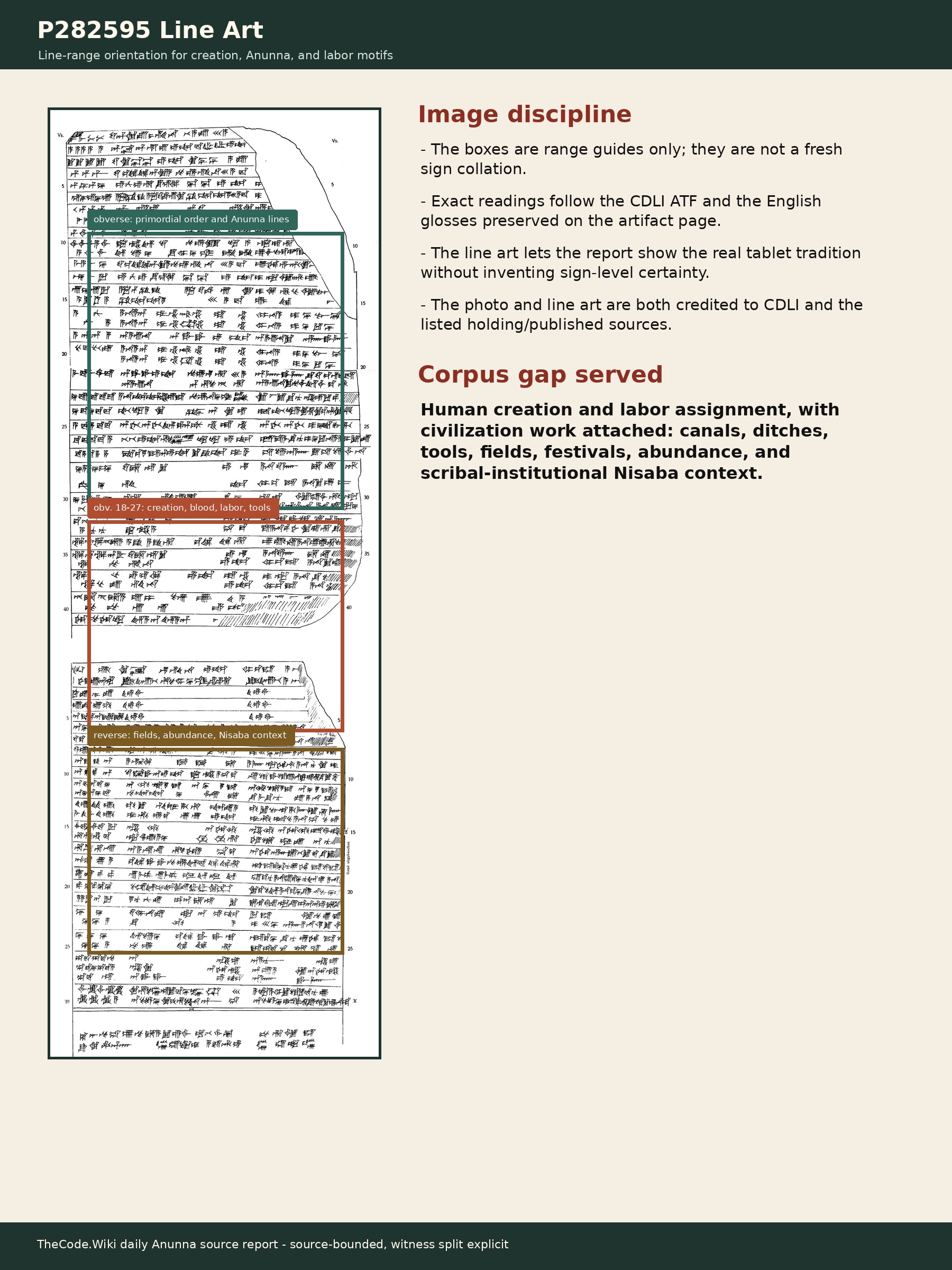
This is a learned lexical/creation text, so the article keeps the evidence layers separate. The photo and line art orient the real witness. The exact readings come from the CDLI ATF and the CDLI English glosses on the artifact page.
The Anunna and Anunnaku frame
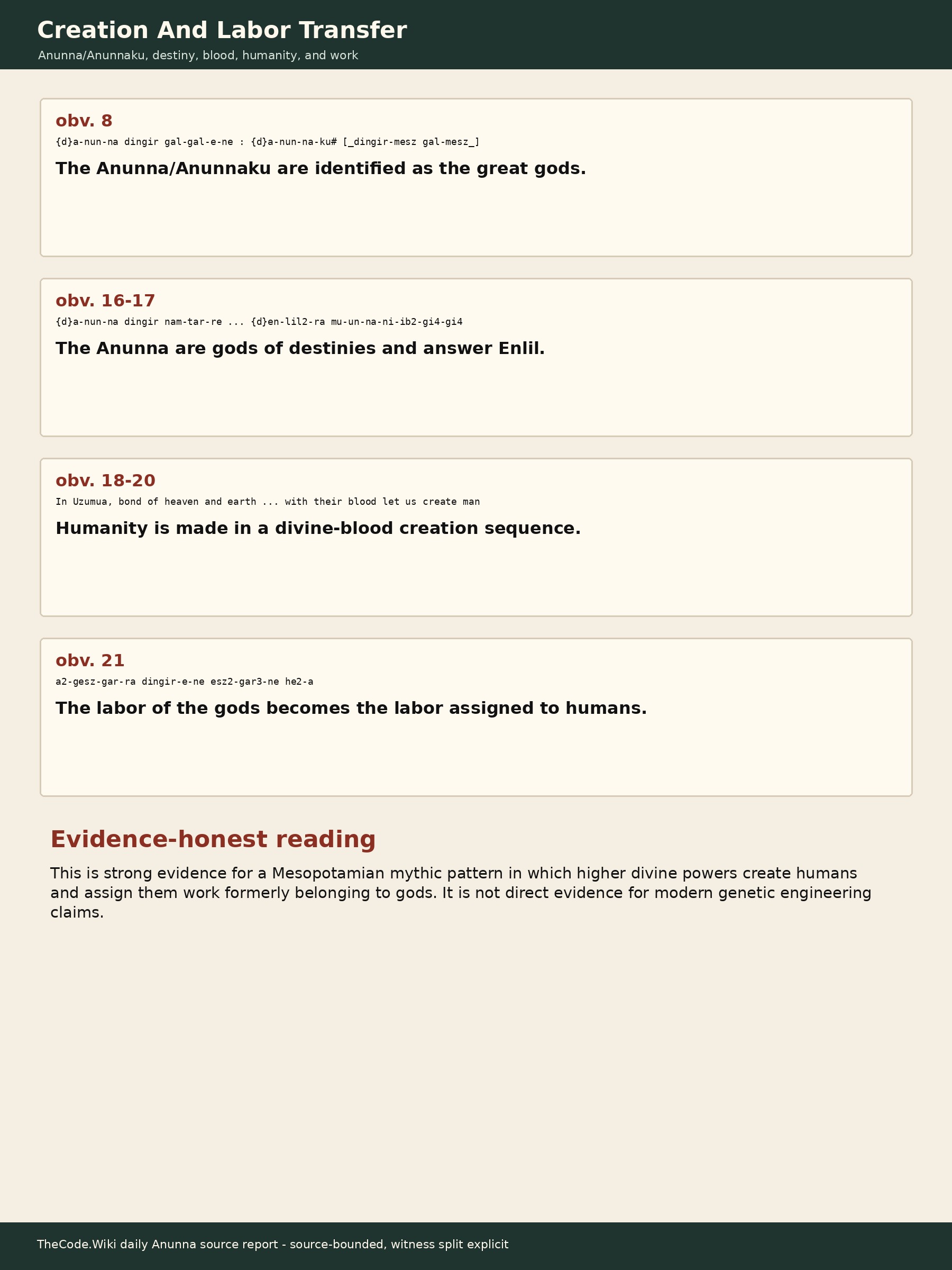
The early part of the passage sets a primordial order scene: heaven and earth are established, the plans of heaven and earth are fixed, the watercourses and irrigation canals are made orderly, and the Tigris and Euphrates have their banks established. In that frame the text names the Anunna/Anunnaku as the great gods.
The next key step is authority. The Anunna are addressed as great gods, then described as gods of destinies. They answer Enlil. This is strong evidence for the organized-divine-authority strand of the corpus, because the group is attached to fate and decision rather than appearing as a stray divine label.
Human creation and labor transfer
The strongest lines are obverse 18-21. The text says that in Uzumua, the bond of heaven and earth, the Alla-gods are to be slaughtered; with their blood humanity is created; and the labor of the gods becomes the labor assigned to humans. That is a direct creation-for-service motif in an Anunna/Anunnaku and destiny-setting context.
For Tony's Sitchin-thesis test, this is high-value evidence for the human-origin and labor strand. It supports the claim that Mesopotamian tradition could remember humans as created to take over work from a higher divine order. It still does not directly prove extraterrestrial biology or modern genetic engineering.
Civilization work after creation
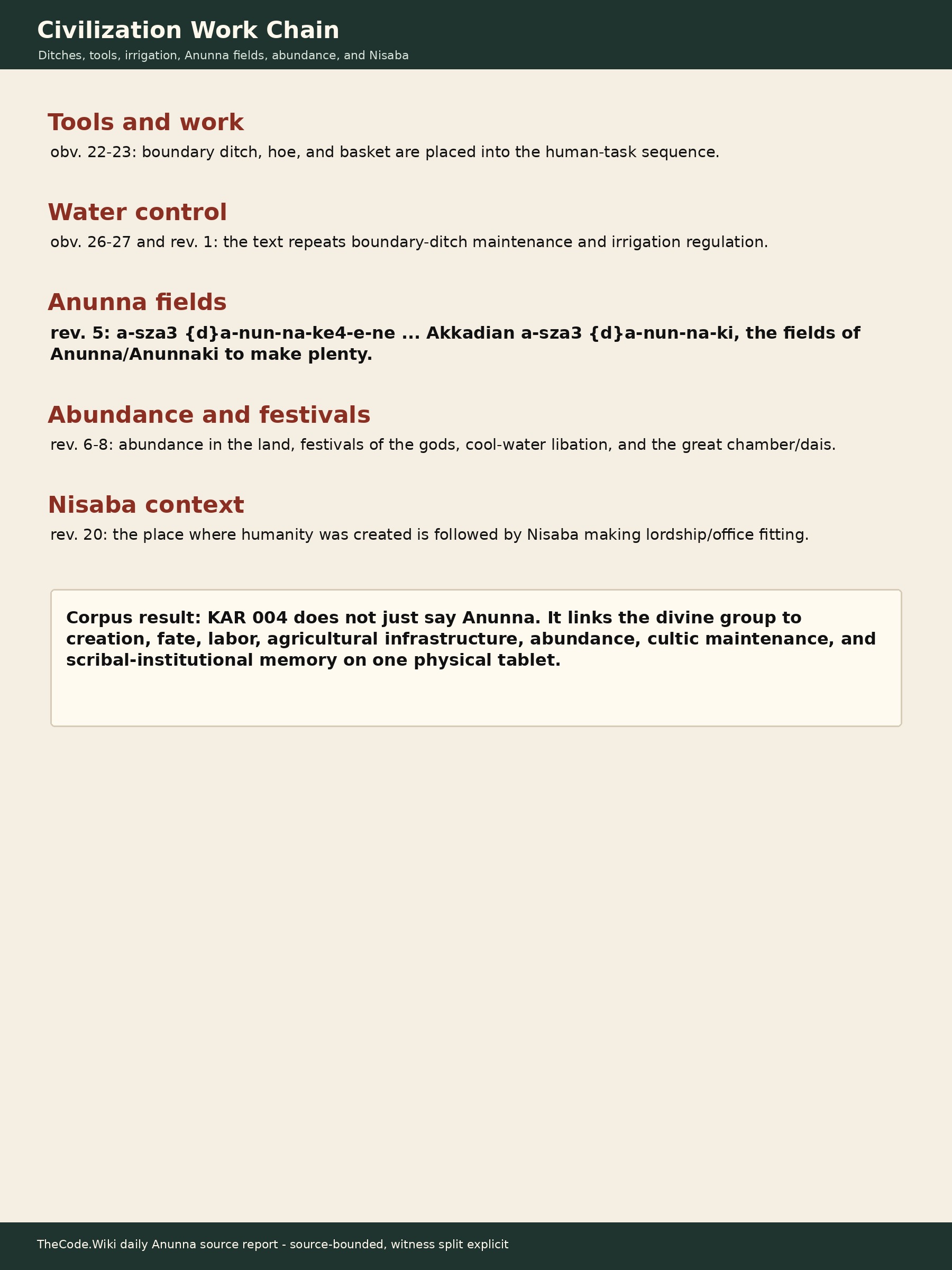
The created labor is not left abstract. The text continues into boundary ditches, hoe and basket, irrigation regulation, and later the fields of Anunna/Anunnaki to make plenty. It also names abundance in the land, divine festivals, water libation, and a Nisaba statement near the place where humanity was created.
That chain matters because the corpus has been looking for more than isolated Anuna mentions. P282595 links the divine group to creation, work, agriculture, water control, cultic maintenance, abundance, and scribal-institutional memory on one artifact.
Line notes
| Line | ATF / line control | Cautious working reading | Confidence | Limit |
|---|---|---|---|---|
| obv. 4-8 | u4 {gesz}hur-hur an-ki-a mu-un-gi-na-esz-a-ba ... {d}a-nun-na dingir gal-gal-e-ne : {d}a-nun-na-ku# [_dingir-mesz gal-mesz_] | The tablet places the Anunna/Anunnaku in a primordial planning scene after heaven, earth, watercourses, and river banks are set in order. | High for the Anunna/Anunnaku line; the Akkadian gloss has a bracketed ending. | This is a learned lexical/creation tablet, not a simple narrative tablet or a fresh sign collation. |
| obv. 14-17 | {d}a-nun-na dingir-gal-gal-e-ne ... {d}a-nun-na dingir nam-tar-re ... min-na-ne-ne {d}en-lil2-ra mu-un-na-ni-ib2-gi4-gi4 | The Anunna are not decorative names here. They are a decision-making divine group tied to destiny and Enlil's command frame. | High for the phrase chain in CDLI ATF and the English glosses. | The line supports organized divine authority and fate language, not a technical alien description. |
| obv. 18-21 | i+na uzu-mu2-a{ki} ri-ki-is _an_ u _ki_-ti# ... i+na da-me-szu-nu i ni-ib-na-a a-mi-lu-ta ... isz-kar _dingir-mesz_ lu isz-kar-szi-na | This is the strongest corpus feature: human creation from divine blood is immediately connected with transfer of divine work to humans. | High for the published CDLI reading, with some restored or uncertain signs around the bilingual columns. | It supports a mythic labor-transfer model. It does not by itself prove genetics, mining, Nibiru, or spacecraft. |
| obv. 22-27 and rev. 1-8 | boundary ditch ... hoe and basket ... irrigation works ... a-sza3 {d}a-nun-na-ke4-e-ne szar2-szar2-e-de3 : _a-sza3_ {d}a-nun-na-ki a-na [du-sze-e] | The text moves from creation to civilization work: ditches, canals, tools, fields, abundance, and cultic maintenance for the gods. | Moderate to high; the sequence is clear, while some Akkadian glosses are broken. | This is agricultural/cultic labor and order language, not recoverable machine technology. |
| rev. 19-20 | an {d}en-lil2 / {d}en-ki {d}nin-mah / dingir gal-gal-e-ne ... ki nam-{lu2}ulu3{+lu} ba-ni-in-dim2-esz ... {d}nisaba ki-bi nam-en-na-an-tum2 | The closing reinforces the human-creation frame and links the created-human place with Nisaba, the scribal/accounting deity. | Moderate; useful as motif context, not the main Anunna proof line. | Nisaba here helps connect creation/labor with institutional knowledge, but the exact social implication remains cautious. |

What this does not prove
The text is mythic and learned. It does not mention Nibiru, spacecraft, mining, metal machines, or recoverable technology. Its strongest contribution is narrower and more useful: an ancient source that puts Anunna/Anunnaku language next to human creation and labor transfer, then expands that labor into canals, fields, tools, abundance, cult, and Nisaba.
Source links
- CDLI artifact P282595 / KAR 004 – Primary artifact page for the Middle Assyrian Assur lexical/literary tablet VAT 09307, with photo, line art, metadata, and transliteration.
- CDLI P282595 ATF inscription – Line-by-line ATF for the Syllabary A / creation-myth passage used in this report.
- CDLI P282595 JSON metadata – Machine-readable metadata: Middle Assyrian period, Assur provenience, VAT 09307, lexical/literary genre, and visual assets.
- CDLI source photo P282595 – Source photo used for the annotated artifact overview and physical witness orientation.
- CDLI source line art P282595 – Published line art used for the annotated line-range orientation panel.
- CDLI Text Corpus of Middle Assyrian external-resource record – CDLI anchor for the TCMA external project linked from P282595.
- ORACC AMGG Anunna page – Terminology context for Sumerian Anunna and Akkadian Anunnaki/Anunnaku usage.
- ePSD2 Anuna lexical entry – Lexical control for the Sumerian divine-group name a-nun-na.
Share this:

One considered email each week
TheCode Weekly Evidence Brief
Receive the week’s strongest tablet decode, source audit or research update, plus one carefully chosen archive read. Routine posts stay on the site; the Brief is the curated signal.
Free. Usually sent on Sunday. No daily post flood. Unsubscribe at any time. See what the Brief includes.