
Nebuchadrezzar I Hinke Kudurru: Anunnaki Authority, Boundary Survey, and Legal Sanction
A source-backed reading of the Hinke Kudurru / NKU I 1, where Anunnaki authority frames a concrete boundary, field survey, land grant, and sanction record.

Ancient text and site reading
How to read this record
- Claim type
- Historical / textual + interpretive
- Evidence level
- Sources, translations, measurements, and symbolic reading where present
Use the evidence layer for sources and observations, and the interpretation layer for TheCode.Wiki synthesis.
Today’s source is the Hinke Kudurru, the Nebuchadrezzar I boundary stone from Nippur, identified in modern concordance work as NKU I 1 / UM 29-20-1. It is valuable because explicit Anunnaki language appears in the divine authority prologue, and the same object then records a concrete land grant with a field plan, surveyors, witnesses, and protective sanctions.

Why this source was chosen
The current corpus is looking for more direct legal, boundary, tax, oath, and administrative material where Anuna/Anunnaki language is tied to procedure rather than only to mythic praise. This source fills that proof gap better than another hymn: it is a boundary-stone record with Enlil, Igigi, and Anunnaki language at the front and practical land administration in the body.

Selected passage
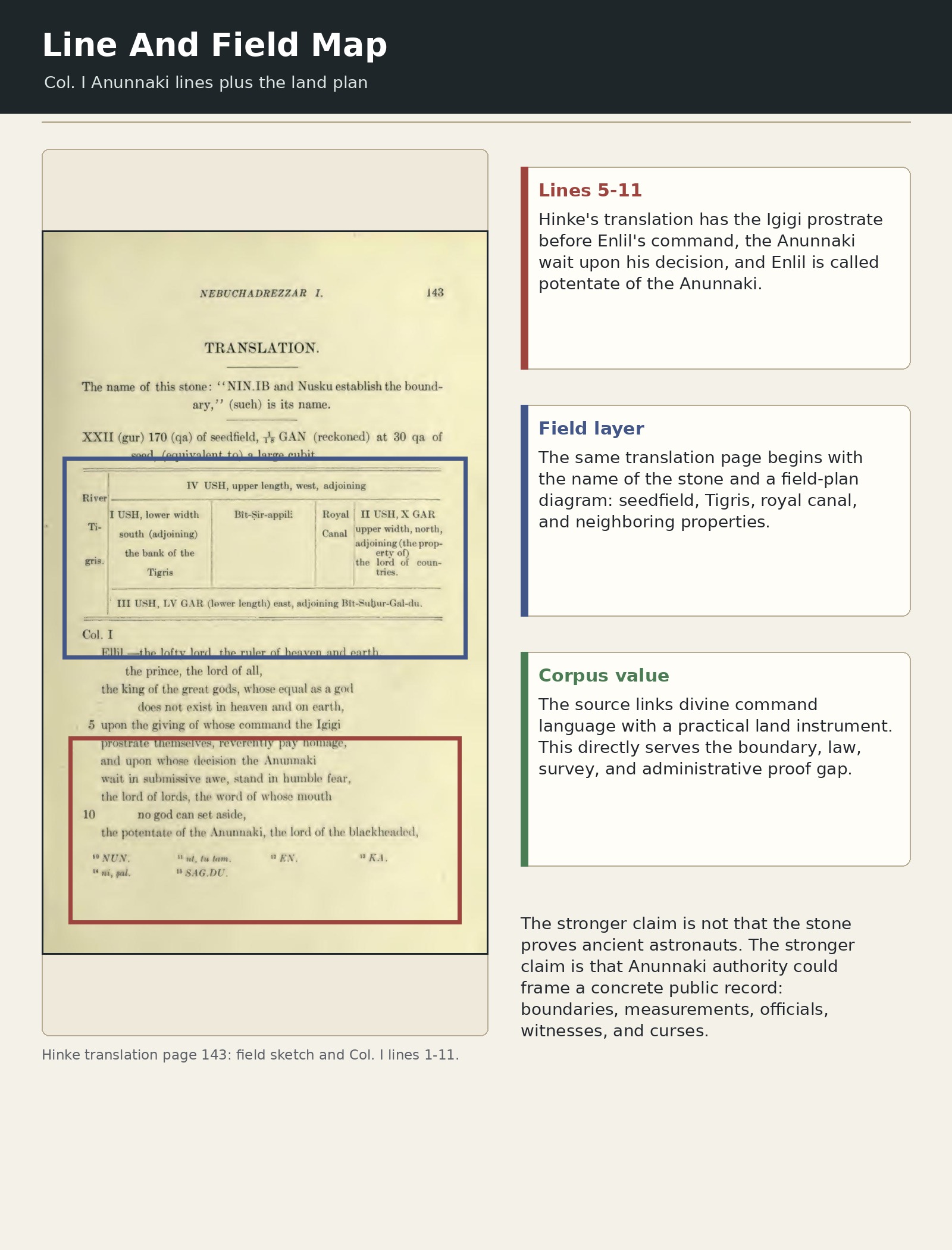
In Hinke’s translation of column I, Enlil is the lofty ruler of heaven and earth. At lines 5-8 the Igigi submit before his command and the Anunnaki wait upon his decision; at line 11 Enlil is called the potentate of the Anunnaki and lord of the black-headed people. The report treats that as the divine authority layer, not as a modern technological claim.
Land grant and survey layer
The body of the inscription moves into a concrete transaction: Nusku-ibni, son of Upahhir-Nusku and priest of Enlil, receives 22 gur and 170 qa of seedfield. The land is described beside the Tigris and a royal canal, measured by Bau-shum-iddina, and checked by named surveyors including Nabû-zēr-lēšir. This is where the object becomes a public legal and survey instrument.

Sanction layer
Columns IV and V protect the grant and the stone. Anyone who contests the grant, seizes the field, returns it to the crown, says it was not measured or received, removes the stone, hides it, burns it, throws it into water, or places it where it cannot be seen is answered by named divine curses. That is why this entry matters for the boundary and enforcement strand of the corpus.
Source links
- Internet Archive record for Hinke 1907, A New Boundary Stone of Nebuchadrezzar I from Nippur
- Internet Archive PDF scan used for figures and page controls
- Internet Archive OCR text used for bounded line extraction
- ORACC AMGG Anunna / Anunnaku / Anunnaki lexical control
- ORACC CAMS/GKAB glossary showing Anunnaku written forms
- AfO concordance review listing Hinke Kudurru as NKU I 1 / UM 29-20-1
What this supports
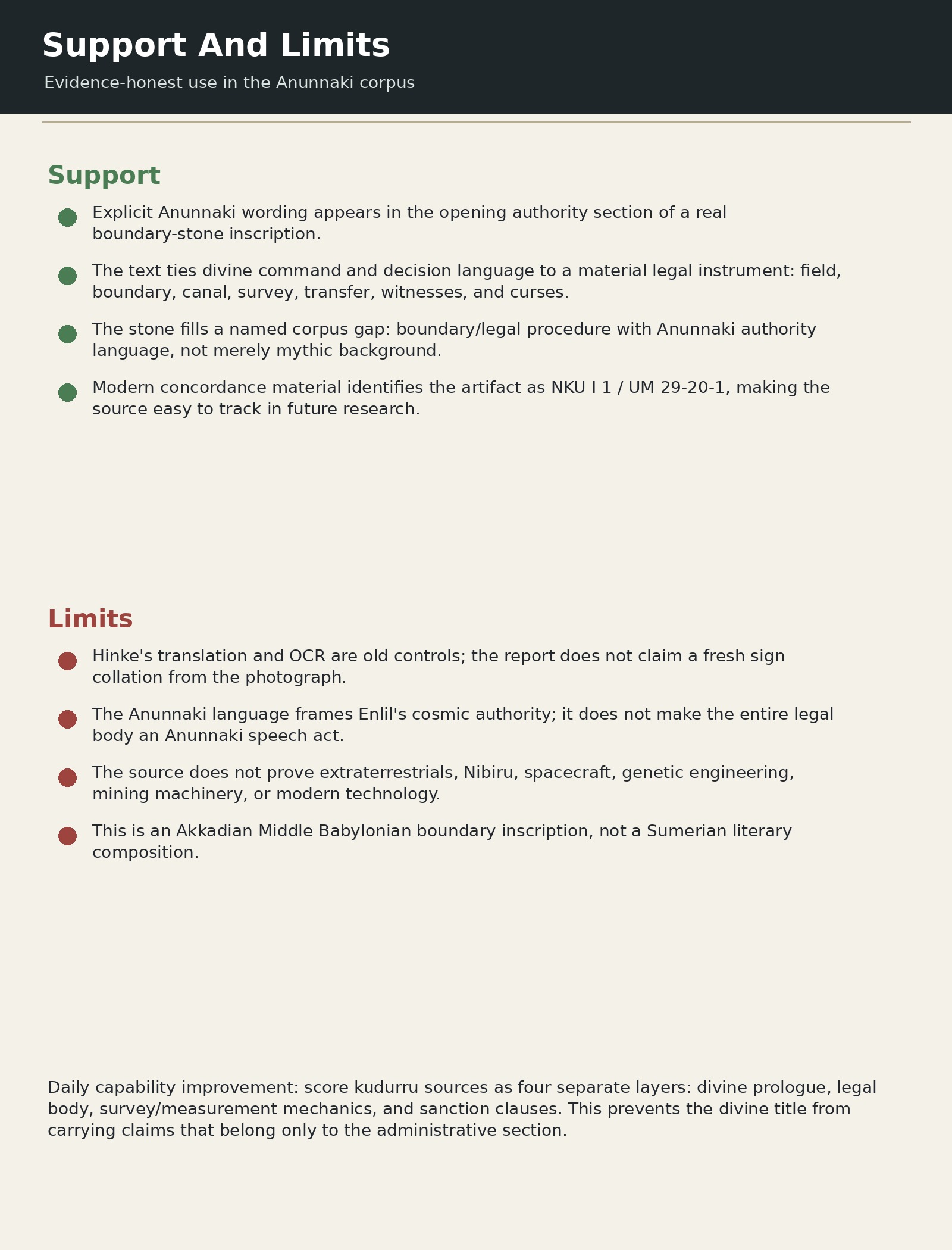
For Tony’s thesis-testing corpus, the source supports a precise claim: Mesopotamian legal memory could place concrete land, survey, boundary, and sanction procedure under an Enlil authority frame that explicitly includes the Anunnaki. That strengthens the organized divine authority and public-law strands.
What it does not prove
It does not prove extraterrestrial identity, Nibiru, spacecraft, genetic engineering, literal mining, metal machines, or modern technology. It is important because it adds a procedural boundary-stone witness, not because it converts a legal text into an ancient-astronaut technical record.
Download the working report: Hinke Kudurru Anunnaki boundary PDF report.
Share this:

One considered email each week
TheCode Weekly Evidence Brief
Receive the week’s strongest tablet decode, source audit or research update, plus one carefully chosen archive read. Routine posts stay on the site; the Brief is the curated signal.
Free. Usually sent on Sunday. No daily post flood. Unsubscribe at any time. See what the Brief includes.


