
Nebuchadnezzar I 10: Anunnakū Before Command and Divine Judgment
A source-backed reading of RIBo Q006250 where the Anunnaku gods appear before command in a passage about divine judgment and kingship.

Ancient text and site reading
How to read this record
- Claim type
- Historical / textual + interpretive
- Evidence level
- Sources, translations, measurements, and symbolic reading where present
Use the evidence layer for sources and observations, and the interpretation layer for TheCode.Wiki synthesis.
Image-to-text epigraphic check

Edition-controlled reading: ORACC/RIBo line 6 reads ù a-na na-dan ur-ti-šu dA-nun-na-ku i-ár-ru-ru … na-zu-uz-zu kam-si-iš: at the issuing of his command, the Anunnakū take fright and stand in submission. The divine name and fear verb are unbracketed in the edition; the later portion is broken/restored. Because the eBL image is a rotational contact sheet without an epigraphic line map, this article does not claim that line 6 or its individual signs were independently located or decoded from the photograph.
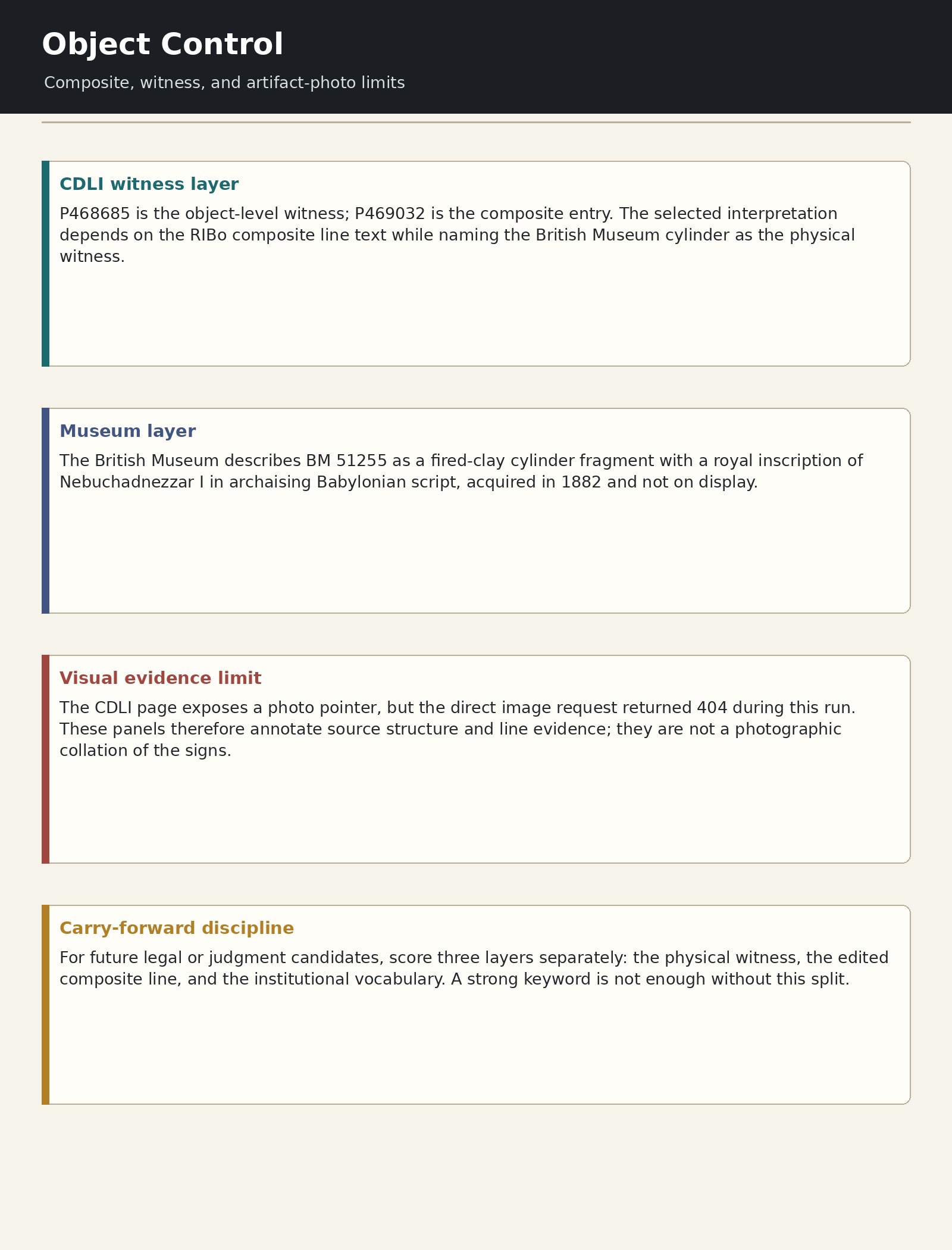
Exact-object image repair (21 July 2026): this is BM 51255, the selected physical witness—not a composite or generic cylinder. The high-resolution image was recovered through the eBL Fragmentarium record for BM 51255 and matched to the British Museum accession and CDLI identity.

Visual inspection of the artifact image
Visual inspection: the image presents multiple views of a broken fired-clay cylinder. Cuneiform runs around its curved body; the accession marking is visible, and one end is heavily abraded. These are exact-object observations, but the report does not claim a fresh sign-by-sign collation from the photograph.
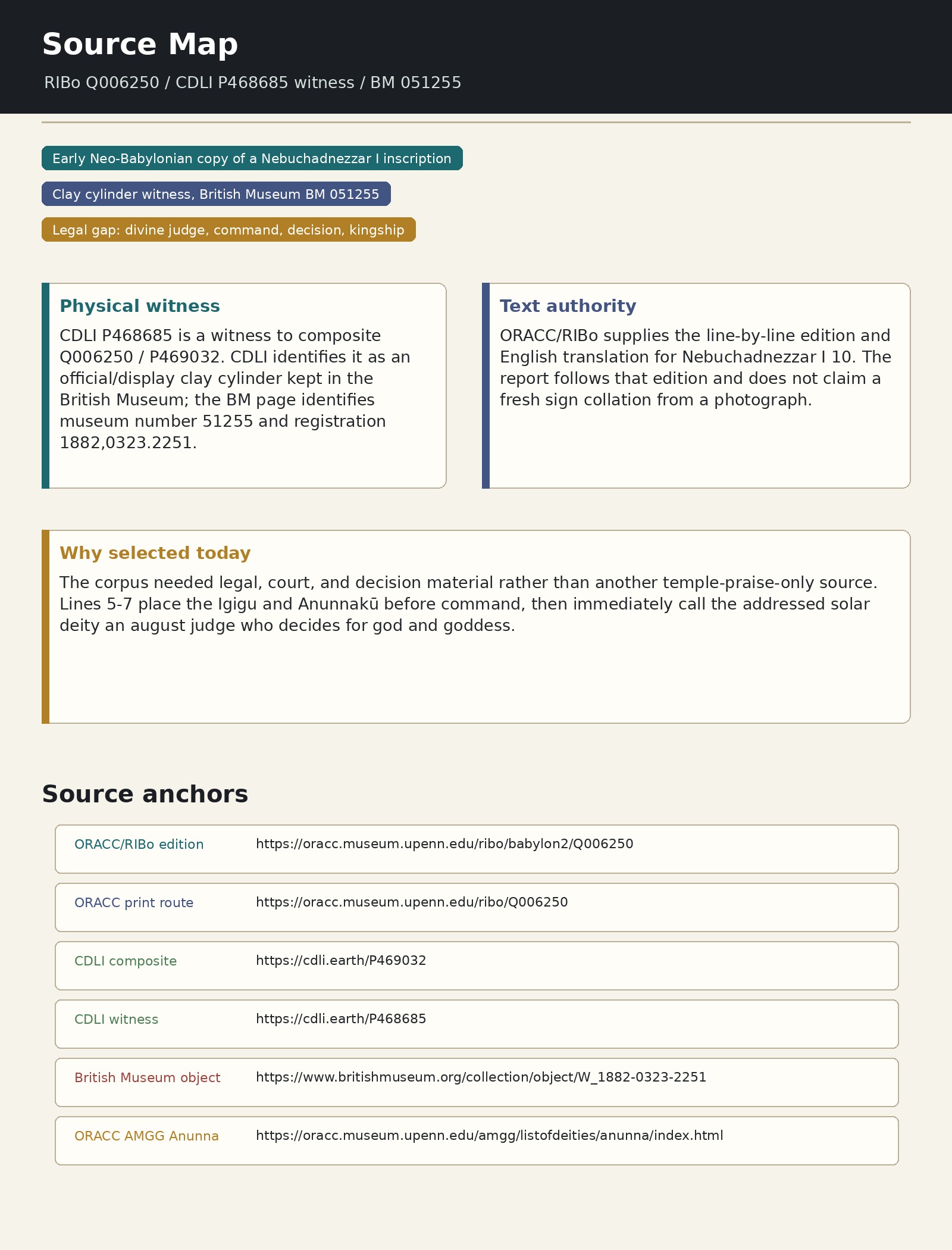
Today’s source is ORACC/RIBo Q006250, Nebuchadnezzar I 10, with the object-level witness tracked through CDLI P468685 and British Museum BM 051255. It is a clay cylinder witness to a royal/official inscription, not a modern claim about aliens or machines.
Why this source was chosen
The corpus has already covered human creation, labor transfer, divine assemblies, temples, craft, law, oaths, and command. The remaining need for testing Sitchin’s broader Anunnaki thesis is tighter legal and decision language around Anuna/Anunnaki vocabulary. Q006250 is useful because the selected short passage places the Anunnakū gods under command and immediately moves into divine judging and decision-making in a Shamash/Ebabbar context.
Selected passage
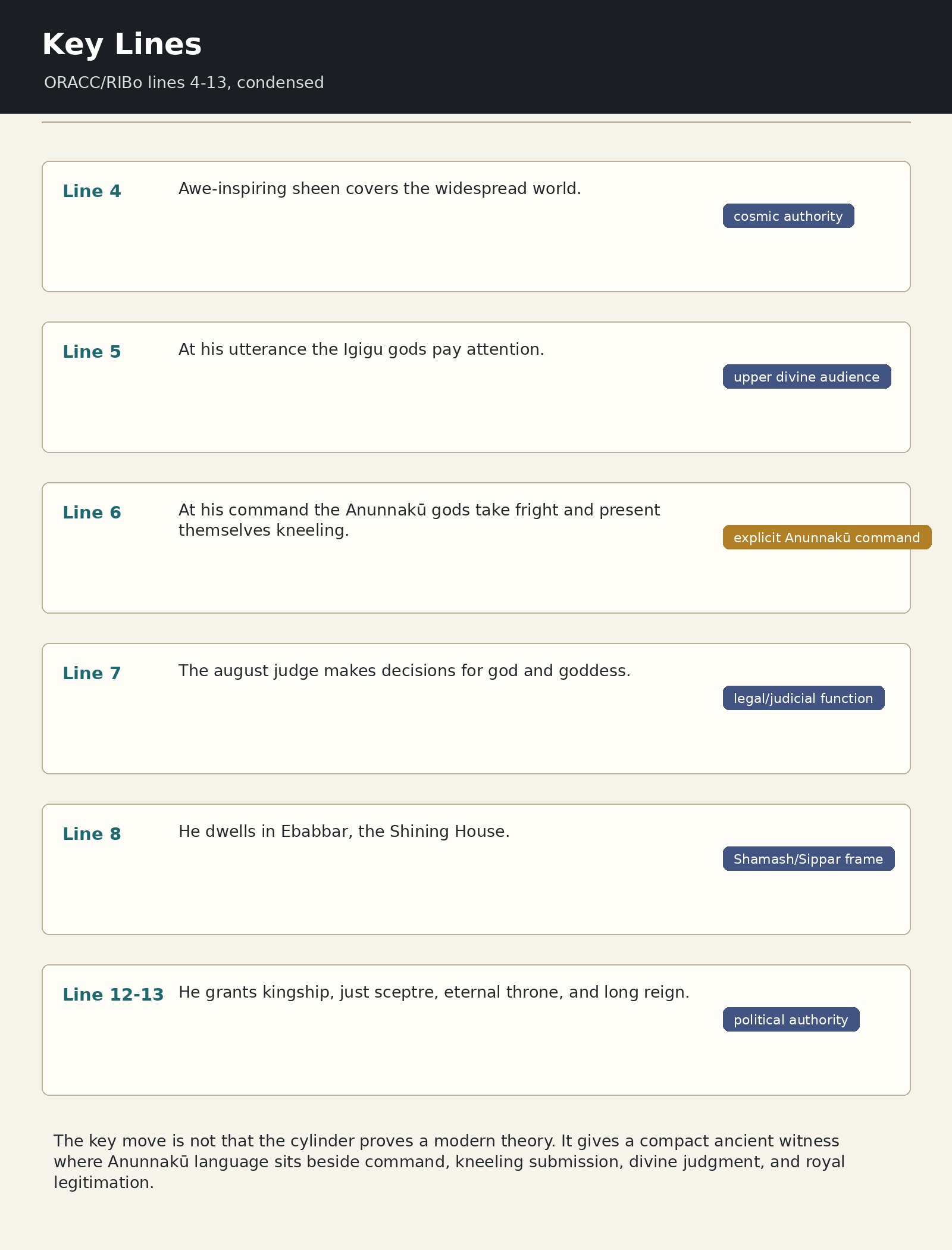
ORACC/RIBo line 6 says that at the issuing of command the Anunnakū gods take fright and present themselves kneeling. The preceding line has the Igigu gods paying attention to the utterance, while the following line calls the addressed deity an august judge who makes decisions for god and goddess. Lines 12-13 then move the passage into kingship, just sceptre, throne, and long reign.
Published translation and working translation
The published ORACC/RIBo translation is cautious and fragment-aware: the Igigu and Anunnakū lines are partly damaged, but the Anunnakū command-and-kneeling sense is clear in the edition. Our working translation reads the cluster this way: the solar judge’s utterance draws the attention of the upper gods, his command makes the Anunnakū submit in fear, and his judicial authority authorizes divine and royal order.

Corpus relevance
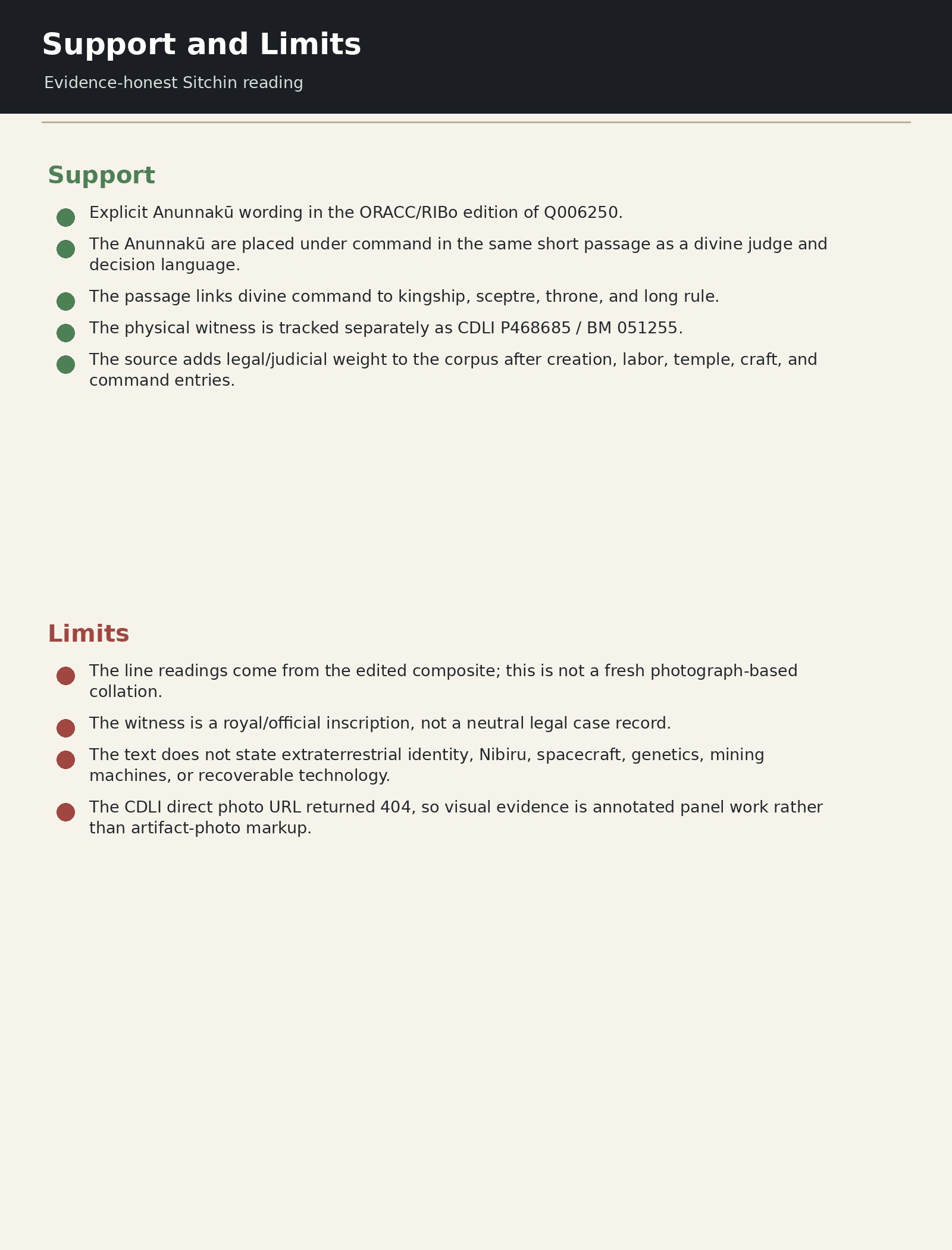
For Tony’s larger Anunnaki thesis, this supports a bounded claim: Mesopotamian royal tradition could place the Anunnakū inside a command, judgment, and kingship-authorizing chain. That strengthens the organized-divine-authority strand of the corpus, especially the legal and decision side. It does not by itself prove extraterrestrial identity, modern genetics, spacecraft, Nibiru, mining technology, or a recoverable machine tradition.
Source links
- ORACC/RIBo Q006250 edition
- ORACC/RIBo Q006250 print route
- CDLI P469032 composite
- CDLI P468685 witness
- British Museum BM 51255 object page
- ORACC AMGG Anunna background
Evidence limits
The exact line readings come from the ORACC/RIBo edited text and the CDLI composite/witness structure. The BM object page and CDLI witness page anchor the physical object. A direct CDLI photo pointer returned 404 during the original run, but this audit recovered the exact BM 51255 photograph through eBL. The contact sheet was visually inspected, but it has no published line-coordinate overlay; the article therefore makes no independent claim about the image position of line 6 and no fresh sign-by-sign collation.
Download the working report: Nebuchadnezzar I 10 Anunnakū judgment PDF report.
Share this:

One considered email each week
TheCode Weekly Evidence Brief
Receive the week’s strongest tablet decode, source audit or research update, plus one carefully chosen archive read. Routine posts stay on the site; the Brief is the curated signal.
Free. Usually sent on Sunday. No daily post flood. Unsubscribe at any time. See what the Brief includes.


