
Claim type: Spiritual testimony / visionary interpretation
Evidence level: Personal revelation and symbolic synthesis unless otherwise cited
This belongs to Tony Canon and is not presented as conventional third-party biography or institutional record.
Image-to-text epigraphic check: decoded parallel, not Q005362

What the photographed cylinder actually says: the edited Q005360 text identifies Nabopolassar as king of Babylon and protégé of Nabû and Marduk (lines 1–4); describes Imgur-Enlil as weakened, rebuilt on its old foundation, and enclosing Babylon (lines 5–17); and asks the wall to speak favorably to Marduk (lines 18–19). Those are the claims this photograph can accompany. The photographed parallel does not contain the long Q005362 passage about the Anunnakū, Ea’s plans, hoes, baskets, or inscription preservation.
Q005362 status: the exact A Babylon 11 cylinder remains inaccessible in sealed museum storage. Its reading is edition-level evidence based on Al-Rawi’s published hand copy and photograph, not a new image decoding performed here. This article is retained as a labeled retrospective exception; the strengthened future gate would reject it as the main daily image-decoding article.
Image-provenance repair (21 July 2026): the photograph below is a real Neo-Babylonian Imgur-Enlil cylinder, but it is not A Babylon 11 / Q005362. The exact selected cylinder remains inaccessible in sealed museum storage; the modern edition relies on Al-Rawi’s published hand-drawn facsimile and photograph. This article is retained as a documented retrospective exception and would be blocked by the new daily exact-image gate.

Visual inspection of the artifact image
Visual inspection of the parallel only: P283914 is a barrel-shaped clay cylinder with dense cuneiform lines around its surface. It supports the dossier’s cylinder form and wall-building tradition, but no visible detail on it is treated as evidence for lines unique to Q005362.
Today’s tablet is not an internet ‘Anunnaki tablet.’ It is a documented Neo-Babylonian royal building inscription: Nabopolassar’s long Imgur-Enlil text, ORACC/RIBo Q005362 (Nabopolassar 03; C32), whose catalogue names the clay cylinder Babylon 011 as its exemplar. Its key sequence joins Anunnakū foundations, Ea’s plans, skillful construction, human workmen, hoes, baskets, brickwork, and deliberate preservation of older inscriptions.
The result is one of the corpus’s clearest plan-to-labor-to-archive chains. It strongly supports organized divine authority and civilization-order imagery around the Anunnakū. It does not say extraterrestrials built Babylon, and it does not contain spacecraft, genetics, mining machinery, or a recoverable modern blueprint.

Download the complete PDF report: Nabopolassar Imgur-Enlil Anunnaki wall report.
Source basis and artifact identity
The primary text layer is Q005362, the long Imgur-Enlil Inscription (C32), dated to Nabopolassar’s reign (625–605 BCE). RIBo identifies its material as clay, object type as cylinder, provenience as Babylon, and exemplar as A Babylon 011 in the Nebuchadnezzar Museum collection. The exact transliteration and published English translation used below come from the RIBo open edition.
The visual control is deliberately separate. CDLI P283914 / Michael C. Carlos Museum X.3.134 is a photographed Neo-Babylonian barrel cylinder excavated at Babylon, but it belongs to the shorter Imgur-Enlil recension C11/A, edited as Q005360. That parallel confirms the artifact class and the wall-rebuilding tradition; it does not license pretending that every C32 line is visible on P283914. The museum-credited photograph is reproduced above in a clearly labeled annotated panel.
Primary and scholarly anchors checked for this run: ORACC/RIBo Q005362 long edition, ORACC/RIBo Q005360 short edition, CDLI P283914 artifact page, RINBE open-access volume, and the modern genre study.

The published passage
In Q005362 ii 13–25, Imgur-Enlil is called the wide courtyard of the Igīgū and the broad forecourt of the Anunnakū. The wall stands in the sphere of Ea’s sophisticated designs. The text then credits the Igīgū and Anunnakū with establishing the foundation in gladness, executing the work skillfully according to plan, and raising the superstructure. These are selected senses from the published edition; the full licensed translation is available at ORACC.
The human rebuilding sequence follows in ii 31–41. Nabopolassar musters workmen, makes them carry hoes and baskets, clears earth, inspects the old foundation, lays brickwork in the original place, secures the foundation, and reinforces the riverbank. In iii 7–10 he styles himself as the one who grasps the Igīgū’s hoe, bears the Anunnakū’s work-basket, and builds Imgur-Enlil for Marduk.

Line-by-line decoding notes
Q005362 ii 13–14: the two divine collectives
TÙR šum-du-lu ša dIgīgī / ki-sal-lu pal-ka-a ša dA-nun-na-ki. Literal/working sense: ‘the wide courtyard of the Igīgū / the broad forecourt of the Anunnakū.’ Confidence is high at the edition level. The line defines architectural-spatial relationships; it does not identify biological species or a place of origin.
Q005362 ii 21: Ea’s plans
a-šar GIŠ.ḪUR.MEŠ nak-la-a-ti ša dEa EN Eridu. Working sense: ‘the place of the sophisticated/ingenious plans of Ea, lord of Eridu.’ GIŠ.ḪUR supports a plan/design reading; naklāti adds skill or sophistication. This is meaningful craft-and-design vocabulary, but not a technical drawing preserved for reconstruction.
Q005362 ii 23–25: foundation and skillful execution
ša dIgīgī u dA-nun-na-ki / ina nūḫ libbišunu ukinnu temenšu / nakliš uštaṣbiʾū ullû rēššu. Working sense: ‘the Igīgū and Anunnakū, in gladness, established its foundation; they skillfully executed/arranged it and raised its top.’ Confidence is high for the overall sequence and medium-high for the most exact nuance of the construction verb. The claim is royal theology about divine precedent, not independent archaeological observation.
Q005362 iii 7–10: hoe and work-basket
ṣābit GIŠ.AL ša dIgīgī / zābil tupšikki ša dA-nun-na-ki / ēpiš Imgur-Enlil ana Marduk bēliya. Working sense: ‘grasper of the Igīgū’s hoe, bearer of the Anunnakū’s work-basket, builder of Imgur-Enlil for Marduk my lord.’ tupšikku can evoke the work-basket and imposed labor. The explicit tool vocabulary points to organized labor and royal imitation of divine models—not advanced machinery.
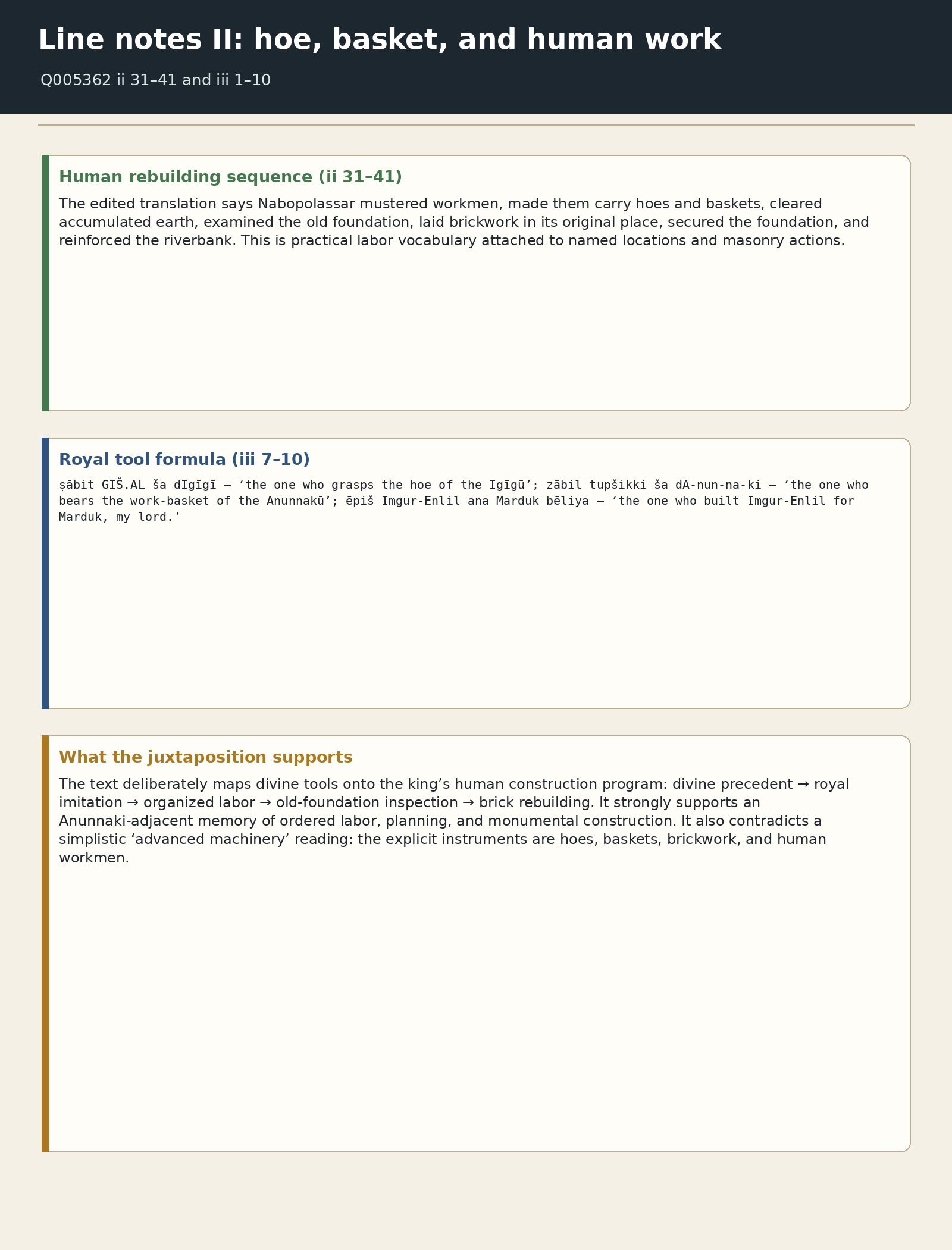
The evidence chain: plan, labor, material continuity, record continuity
- Divine frame: the wall is a courtyard/forecourt associated with the Igīgū and Anunnakū.
- Plan and foundation: Ea’s designs and the collectives’ foundation work establish precedent.
- Human procedure: workmen, hoes, baskets, earth removal, foundation inspection, and brickwork carry out the restoration.
- Material continuity: an earlier royal statue is found and preserved in the foundation.
- Written continuity: the king swears to his words and directs a future restorer to preserve earlier inscriptions and add the new one.
This five-part chain is stronger than an isolated divine epithet. It ties the Anunnakū to the conceptual memory of monumental planning while also telling us what the human restoration actually used. The source therefore supports divine authorization and civilization-order themes while placing a hard limit on mechanical or extraterrestrial extrapolation.

Oath and ancient archival protocol
In iii 11–15 Nabopolassar swears by Marduk and Šamaš that his words are reliable. That is self-authentication inside royal ideology, not modern peer review. Still, it shows a conscious concern with textual truth-claims. In iii 16–20 he says he found an earlier king’s statue and preserved it with his own in the foundation.
The final instruction, iii 30–36, tells a future restorer to find Nabopolassar’s inscription, avoid changing its location, and place it with the later ruler’s own inscribed objects. This amounts to an ancient preservation protocol: inspect old fabric, recover predecessor records, retain context, and append the present record. That protocol matters to the corpus because civilization transfer here includes the maintenance of written institutional memory.

What this source supports—and what it does not
For Tony’s working Anunnaki thesis, this inscription offers high-value evidence for a structured divine collective connected to planning, foundations, skilled execution, labor tools, major city infrastructure, and durable records. The strongest sober claim is that Neo-Babylonian royal ideology framed monumental restoration as participation in an older divine order in which the Anunnakū had a named role.
The source is also a useful contradiction to inflated readings. Human workmen perform the actual rebuild; hoes, baskets, earth removal, brickwork, and foundation inspection are explicit. The inscription does not identify the Anunnakū as extraterrestrials, mention Nibiru, describe genetic engineering, record a mining program, or preserve metal machinery. It is a royal building inscription with theological language, not a neutral engineering report.

Daily decoding improvement
This run adds a construction-layer rubric: score divine collective, plan/design vocabulary, foundation/superstructure claim, human tools/workforce/material process, and inscription-preservation protocol separately. It also adds a parallel-witness firewall: a photographed short recension may document artifact form and dossier continuity, but it cannot be used as if it visibly preserves lines unique to the long recension.

Sources
- ORACC/RIBo Q005362 — Nabopolassar 03, long Imgur-Enlil Inscription C32
- ORACC/RIBo Q005360 — Nabopolassar 01, short Imgur-Enlil Inscription C11/A
- CDLI P283914 / X.3.134 artifact record
- CDLI-hosted museum photograph of the labeled parallel (© Michael C. Carlos Museum)
- British Museum 26263, another C11/A parallel cylinder
- Royal Inscriptions of the Neo-Babylonian Empire, open-access scholarly volume
- The Many Arts of Writing a Babylonian National History
- ORACC Ancient Mesopotamian Gods and Goddesses: Anunna/Anunnaku
Translation and transliteration controls are credited to the ORACC/RIBo edition released under CC BY-SA 3.0. This report’s synthesis, diagrams, and cautious working translations are new. The museum photograph of the parallel P283914 is reproduced in a clearly labeled annotated panel; it is not presented as the selected Q005362 object.
Share this:

Discover more from The Code of the Ancients
Subscribe to get the latest posts sent to your email.