
East India House Inscription: Anunnakū, Akītu, and Babylon’s Built Landscape
An exact-photo, source-backed reading of BM 129397 / Q005473 iv 7–12, where an akītu-house for Igīgū and Anunnakū celebration is built with bitumen and baked brick.

Ancient text and site reading
How to read this record
- Claim type
- Historical / textual + interpretive
- Evidence level
- Sources, translations, measurements, and symbolic reading where present
Use the evidence layer for sources and observations, and the interpretation layer for TheCode.Wiki synthesis.
Today’s exact-object decoding source is British Museum BM 129397 (accession 1938-05-20,1), the stone tablet commonly called the East India House Inscription and edited by ORACC/RIBo as Q005473 / Nebuchadnezzar II 002. Its obverse preserves five narrow columns. In column IV, lines 7–12, an akītu-house is described as a place for the joyful celebration of the Igīgū and Anunnakū gods and as a bitumen-and-baked-brick structure in Babylon’s outskirts.

Why this source was selected
The corpus needs photographed public monuments where Anuna/Anunnakū wording and a concrete civilization-order procedure survive on the same object. Q005473 fills that gap unusually well. It is not merely a mythic composition or a composite assembled from distant fragments: the exact stone is photographed at high resolution, the selected spelling is unbracketed, and the same long inscription inventories temples, precious materials, brick construction, streets, walls, gates, canals, and palaces.
This makes the inscription important for testing a narrow claim: ancient Babylonian state theology could place Anunnakū language inside a monumental description of cultic architecture and the organized built landscape. It does not turn that architecture into advanced machinery.
Exact photograph and line location
The first identity control is ORACC’s exemplar list: Q005473 names BM 129397 and accession 1938-05-20,0001. The second is the Commons photograph description, which names British Museum ME 129397. The photo was downloaded, hashed, opened, and visually inspected. The exact object is a large rectangular inscribed stone tablet divided into vertical columns; surface wear and uneven museum lighting are visible.
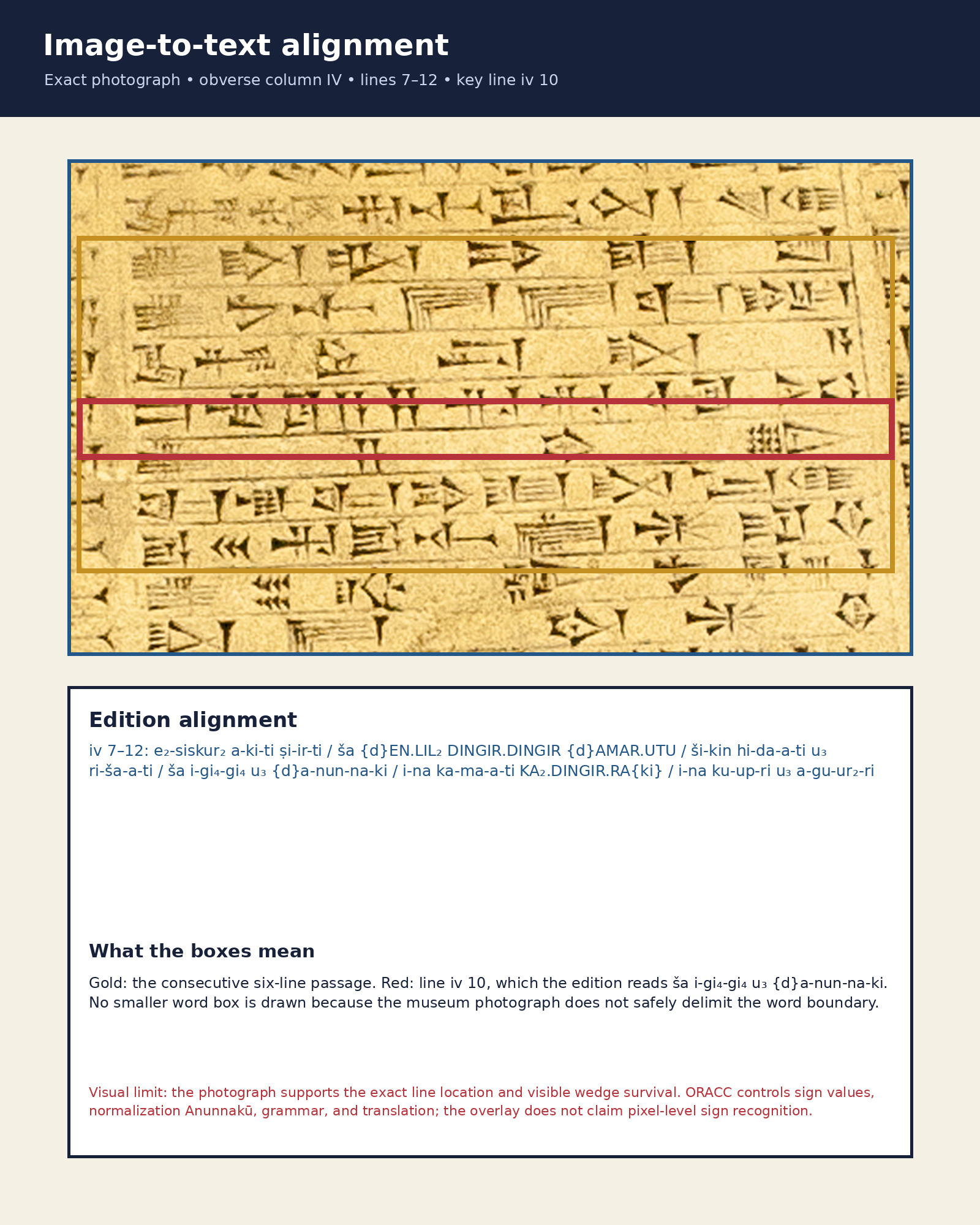
Selected passage: Q005473 iv 7–12
Edition transliteration:
iv 7 e₂-siskur₂ a-ki-ti ṣi-ir-ti
iv 8 ša {d}EN.LIL₂ DINGIR.DINGIR {d}AMAR.UTU
iv 9 ši-kin hi-da-a-ti u₃ ri-ša-a-ti
iv 10 ša i-gi₄-gi₄ u₃ {d}a-nun-na-ki
iv 11 i-na ka-ma-a-ti KA₂.DINGIR.RA{ki}
iv 12 i-na ku-up-ri u₃ a-gu-ur₂-ri
Published ORACC translation: the passage describes Esiskur as Marduk’s exalted akītu-house, established for joyful celebrations of the Igīgū and Anunnakū gods in Babylon’s outskirts, and set firmly in place with bitumen and baked brick.
Cautious working translation: “As for Esiskur, the exalted akītu-house of Marduk, Enlil of the gods, established for the joyous celebration of the Igīgū and Anunnakū in the environs of Babylon: with bitumen and baked brick I made it stand firm.” This keeps the divine collectives, festival purpose, location, materials, and royal building action distinct.
Image-to-text hard-gate result
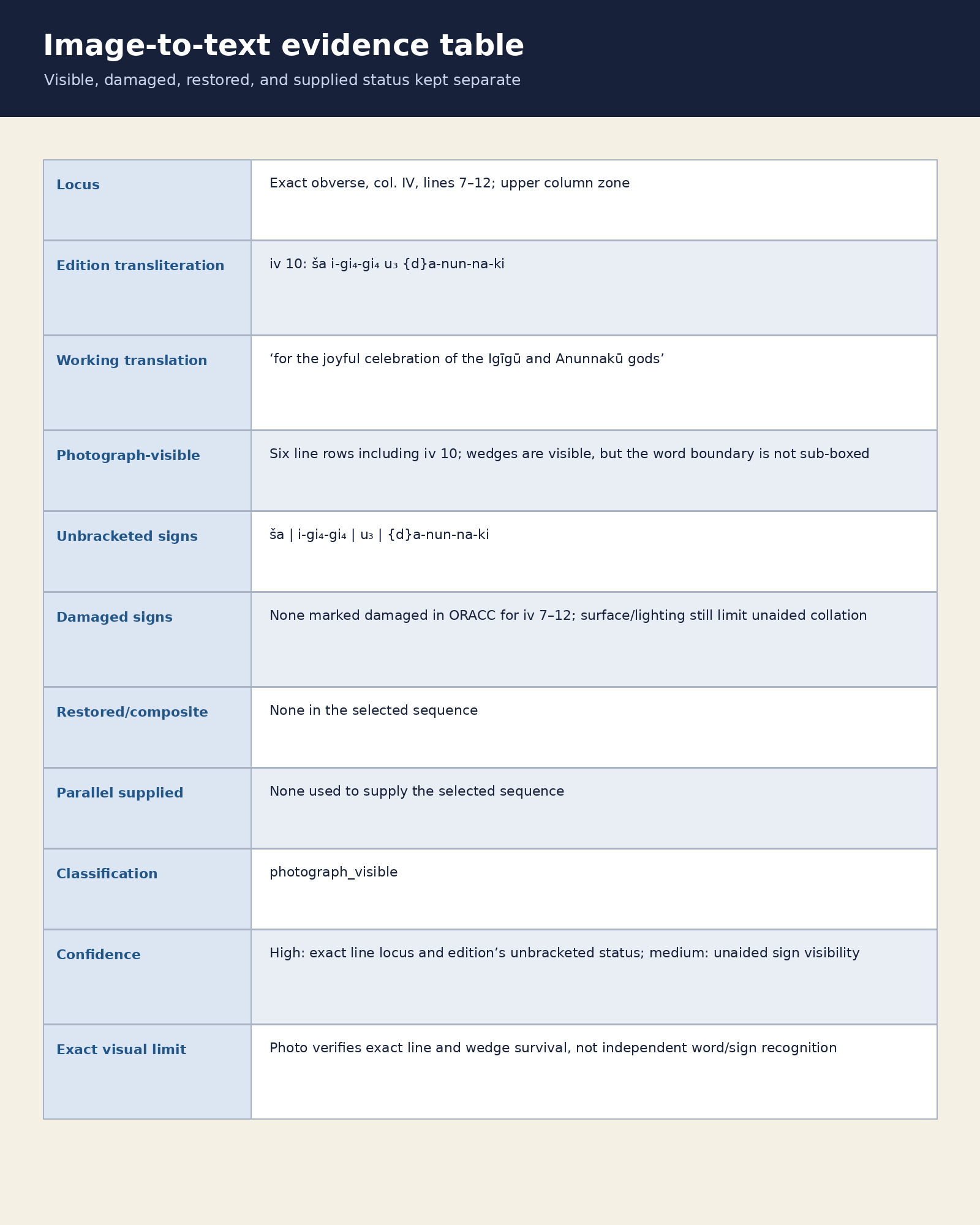
The selected evidence is classified photograph_visible at the line-survival level. Lines iv 7–12, including the exact iv 10 row, can be located on the exact photographed object. ORACC presents the selected sequence without brackets, damage markers, restoration, composite supply, or parallel supply. The normalized reading Anunnakū, word boundary, grammar, and translation remain edition-guided; the overlay does not claim computer vision or a new collation of every wedge.
Line notes
iv 7–8: names Esiskur and defines it as the exalted akītu-house associated with Marduk. Confidence: high. Caution: akītu is a festival/cultic institution, not a technological term.
iv 9–10: gives the celebratory function and names both divine collectives. The form {d}a-nun-na-ki is unbracketed in the edition. Confidence: high for the edition and exact line locus; medium for unaided sign-level recognition because museum lighting and surface texture complicate a fresh collation.
iv 11–12: locates the structure in Babylon’s environs and names bitumen and baked brick. Confidence: high. Caution: the construction verb is completed in the following lines, so the material phrase should be read with the continuing sentence.
Corpus relevance
The strongest contribution is not a generic mention of “Anunnaki.” It is the convergence of a photograph-verifiable divine-group line with a cult building and a much wider royal inventory of material civilization: temples, roof beams, gold and silver cladding, brickwork, processional streets, walls, gates, canals, and palaces. That strengthens the corpus strands for craft/material organization, city infrastructure, ritual administration, and durable public memory.
For the stronger Sitchin hypothesis, the result is mixed. It supports the historically modest proposition that Anunnakū language belonged to Babylonian explanations of organized sacred space and royal building. It limits the stronger claim because the operative building vocabulary is conventional: bitumen, baked brick, wood, stone, metals, labor, and royal restoration.
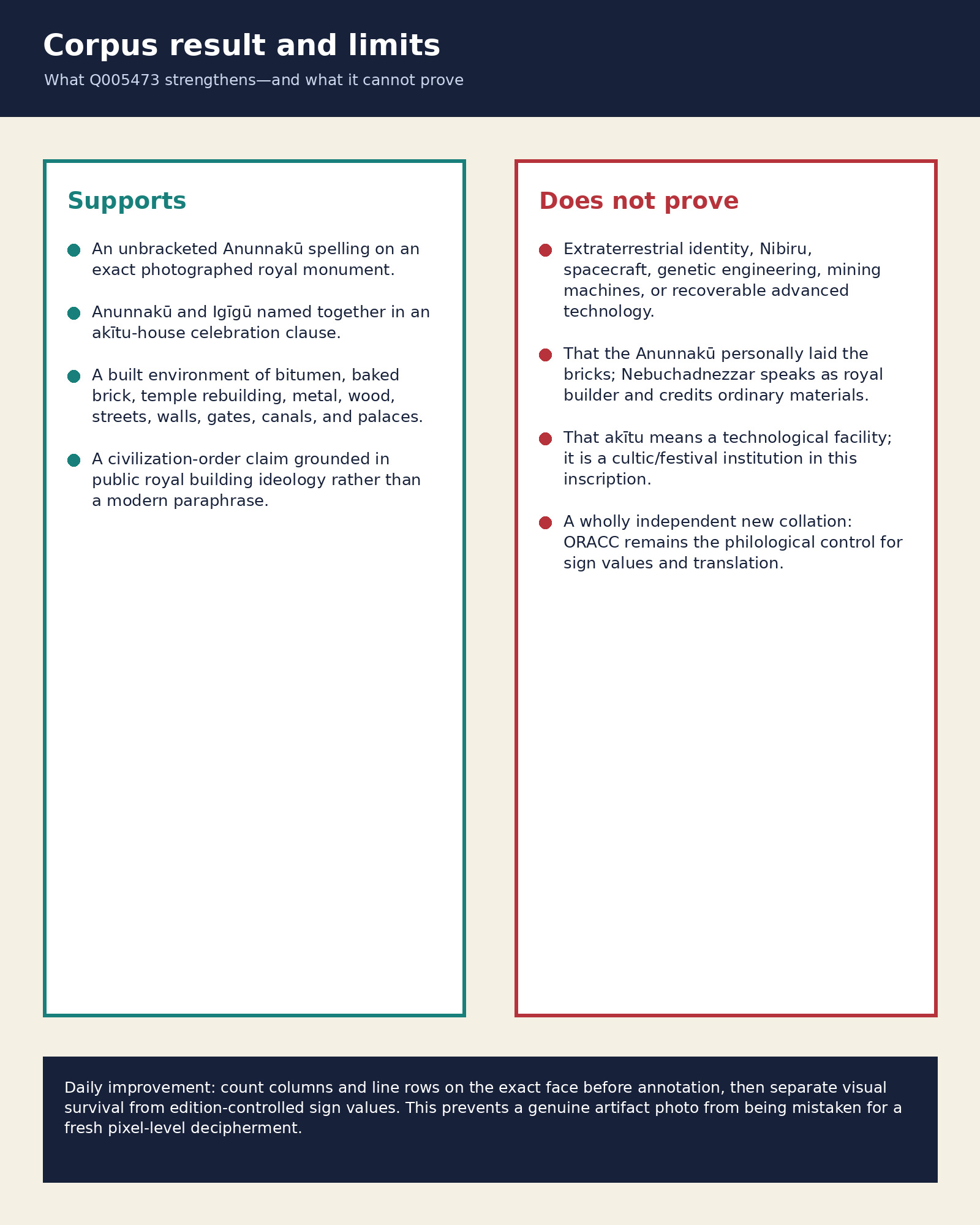
What the artifact does not prove
Q005473 does not identify the Anunnakū as extraterrestrials; it does not mention Nibiru, spacecraft, genetic engineering, mining machines, or recoverable modern technology. It does not say that the Anunnakū personally manufactured the bricks. It is a Neo-Babylonian royal inscription whose rhetoric magnifies Nebuchadnezzar’s piety and building program.
Sources and image credits
- ORACC/RIBo Q005473, Nebuchadnezzar II 002 — transliteration, translation, line numbering, and exemplar control.
- ORACC RIBo Babylon 7 JSON package — machine-readable sign and line data.
- British Museum collection URL for accession 1938-05-20,1 — automated requests currently return 403; identifier remains a catalog control.
- BabelStone photograph of BM 129397, CC BY-SA 3.0.
- Szilas photograph of the East India House Inscription, CC BY-SA 4.0.
Method improvement: this run adds a column-and-row registration gate. Before drawing a box, count the exact face’s columns and line rows against the edition, then record separately what the pixels show and what the edition supplies. That is how a genuine object photograph becomes real image-to-text evidence without overstating pixel-level decipherment.
Download the evidence report: East India House Anunnakū and akītu PDF report.
Share this:

One considered email each week
TheCode Weekly Evidence Brief
Receive the week’s strongest tablet decode, source audit or research update, plus one carefully chosen archive read. Routine posts stay on the site; the Brief is the curated signal.
Free. Usually sent on Sunday. No daily post flood. Unsubscribe at any time. See what the Brief includes.


