The Anuna Ratify a Royal Grant: Exact Ur Tablet P346564 and the Authorization/Execution Divide
Exact tablet P346564 names the Anuna inside a divine body that fixes fate and ratifies Išme-Dagan’s grant, while the human king performs the later civic and cultic actions.
Exact-witness divine-ratification audit
How to read this record
- Claim type
- Sumerian textual analysis
- Evidence level
- Mixed
TheCode.Wiki separates evidence, calculation, and visionary interpretation so readers can compare layers without flattening them.
An Old Babylonian tablet from Ur places the Anuna inside an enumerated divine body that fixes fate and ratifies a royal grant. The exact witness is CDLI P346564, associated with UET 6/3 no. 526 (+) UET 8 no. 95 and the Sumerian composition Self-praise of Išme-Dagan (Q000451 / CDLI Literary 000451 / ETCSL 2.5.4.1). The secure result is narrower—and more historically useful—than a sensational reading: the Anuna participate as one named member of a longer divine list, while Išme-Dagan remains the human king who later claims to establish justice, secure Nippur, gather the Ekur’s divine powers, attend to old ordinances and restore neglected rites.
Download the six-page illustrated source report (PDF)
1. The source and the question
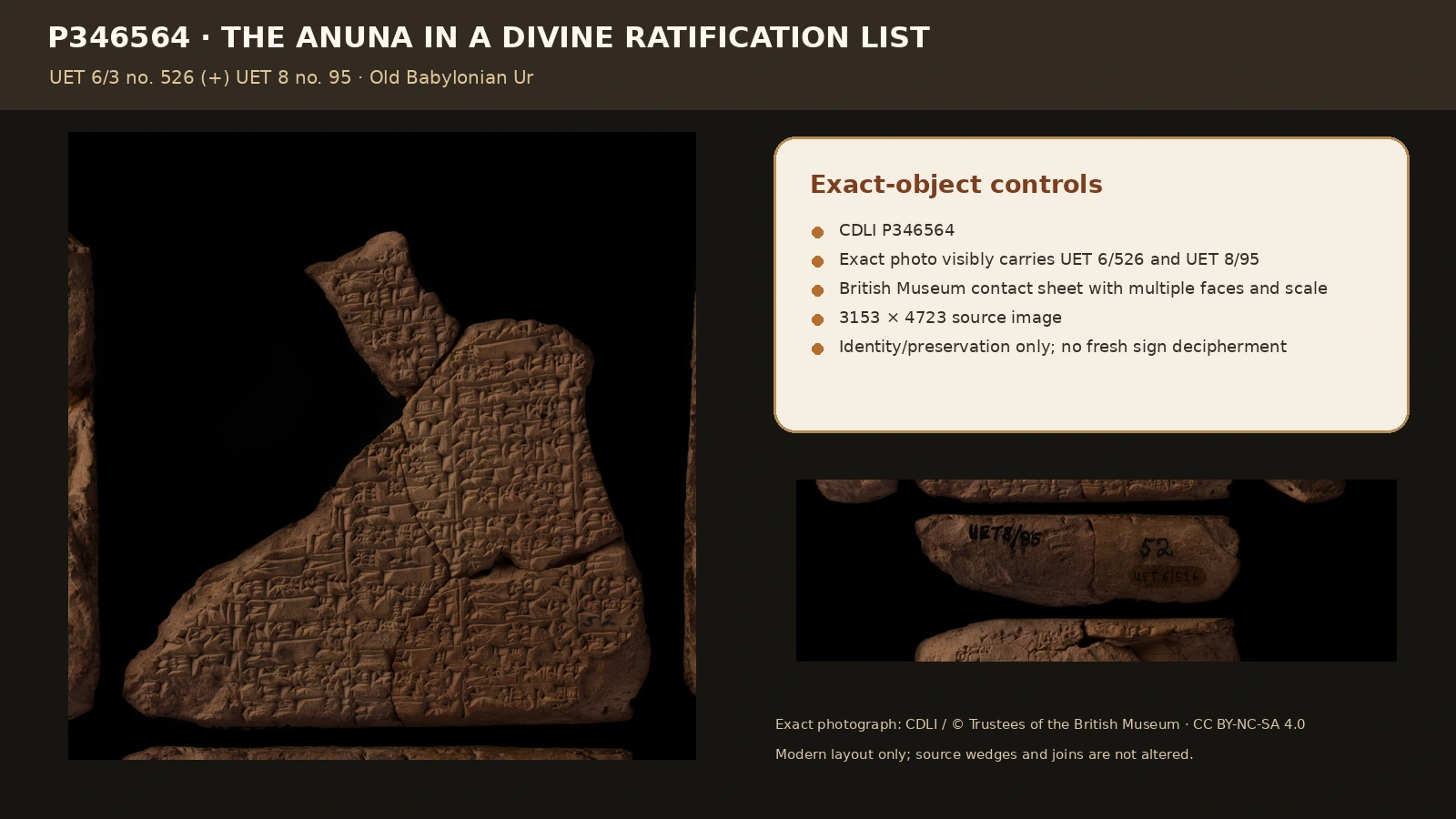
P346564 is a fragmented Old Babylonian Sumerian literary tablet excavated at Ur and now in the British Museum. CDLI identifies it as witness 007 of Q000451, the composition conventionally called Self-praise of Išme-Dagan (Išme-Dagan A+V). The central question is grammatical and institutional: does the witness merely mention the Anuna, or does it place them in a structured act of divine authorization?
The answer comes from the artifact-specific sequence in column IV, lines 12′–18′. Those lines enumerate Enki, Ninki, Enul, Ninul, the Anuna, fate-determining lord(s), and the protective spirits associated with Nippur and the Ekur. CDLI’s witness translation treats the list collectively as the great divine body that had determined fate and spoke an irrevocable “it is so.” That supports a ratification scene. It does not make the Anuna the sole decreers, and it does not transfer the king’s later actions to them.
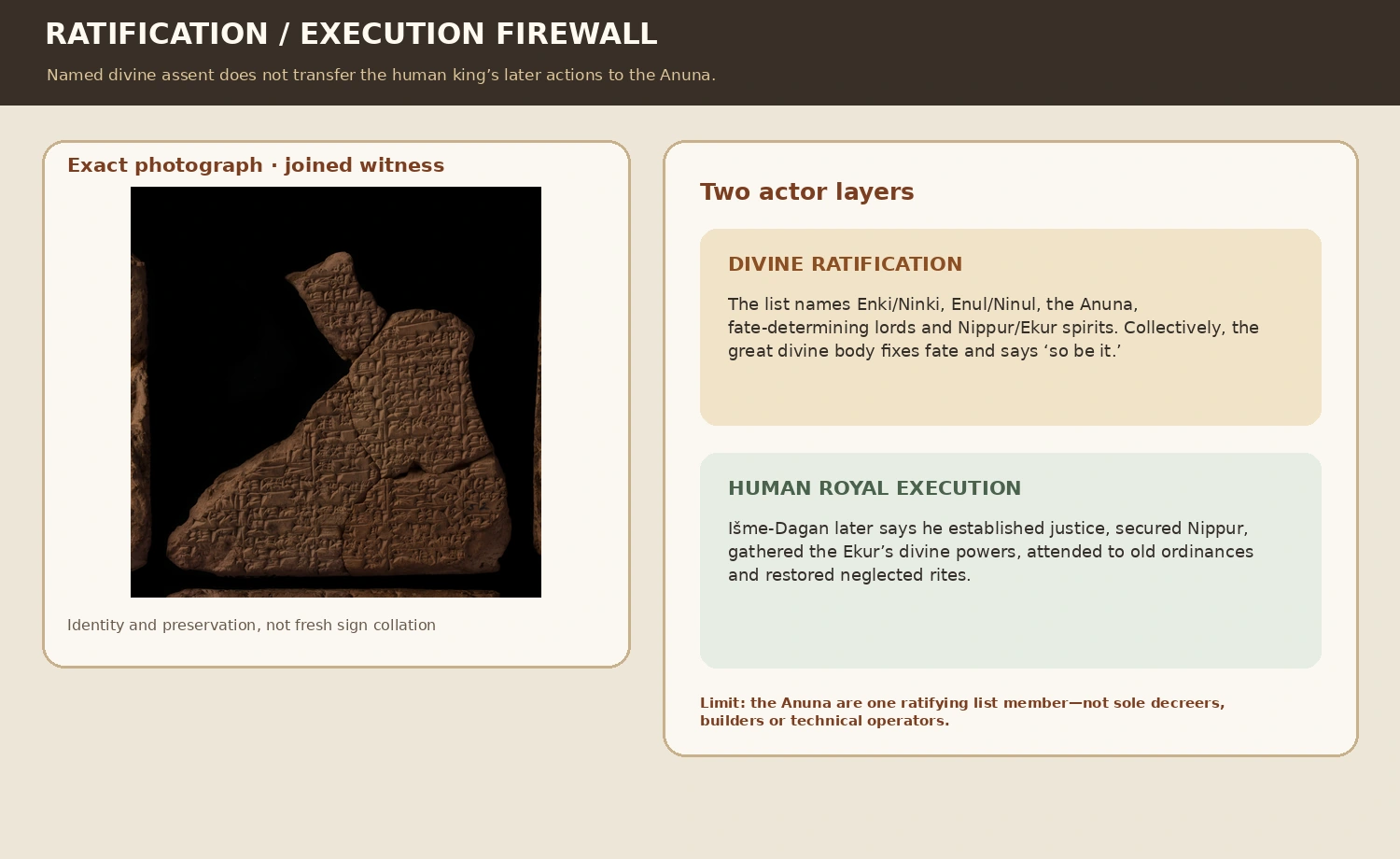
This distinction matters for the Anunnaki research corpus. A divine name near justice, plans, cult, or royal power is not enough to assign those actions to that group. The report therefore applies a Ratification/Execution Firewall: record the authorizing list, shared predicate, each list member, later grammatical subject, finite verb, clause boundary, restoration status and exact visual locus before assigning institutional or technical agency.
2. Exact-object provenance and visual inspection
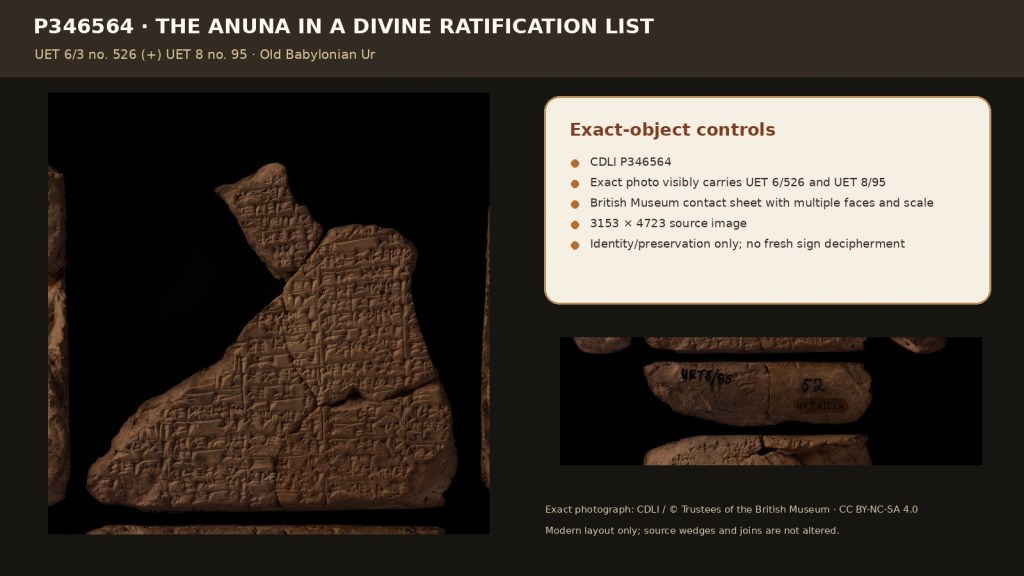
The exact-object gate passed with two mutually reinforcing visuals. The current CDLI photograph of P346564 is a 3153×4723 JPEG whose contact sheet shows multiple faces and edges of the joined, heavily fragmented witness, a museum scale, and painted publication labels. The source visibly carries UET 6/526 and UET 8/95. The current exact-object line drawing is captioned “526 obv.” and “526 rev.” and labels the UET 8/95 join. Those identifiers agree with the current CDLI artifact record.
The photograph establishes object identity, joins, physical preservation and the existence of inscribed rows. It is not used as though every wedge were independently read from pixels. The exact copy supplies the defensible image-to-text control: the right-hand column preserves the artifact-specific line sequence, and line 16′ can be registered conservatively as one broad row by surviving line count. The annotation marks that whole row only. It does not draw a sign box around {d}a-nun-na.
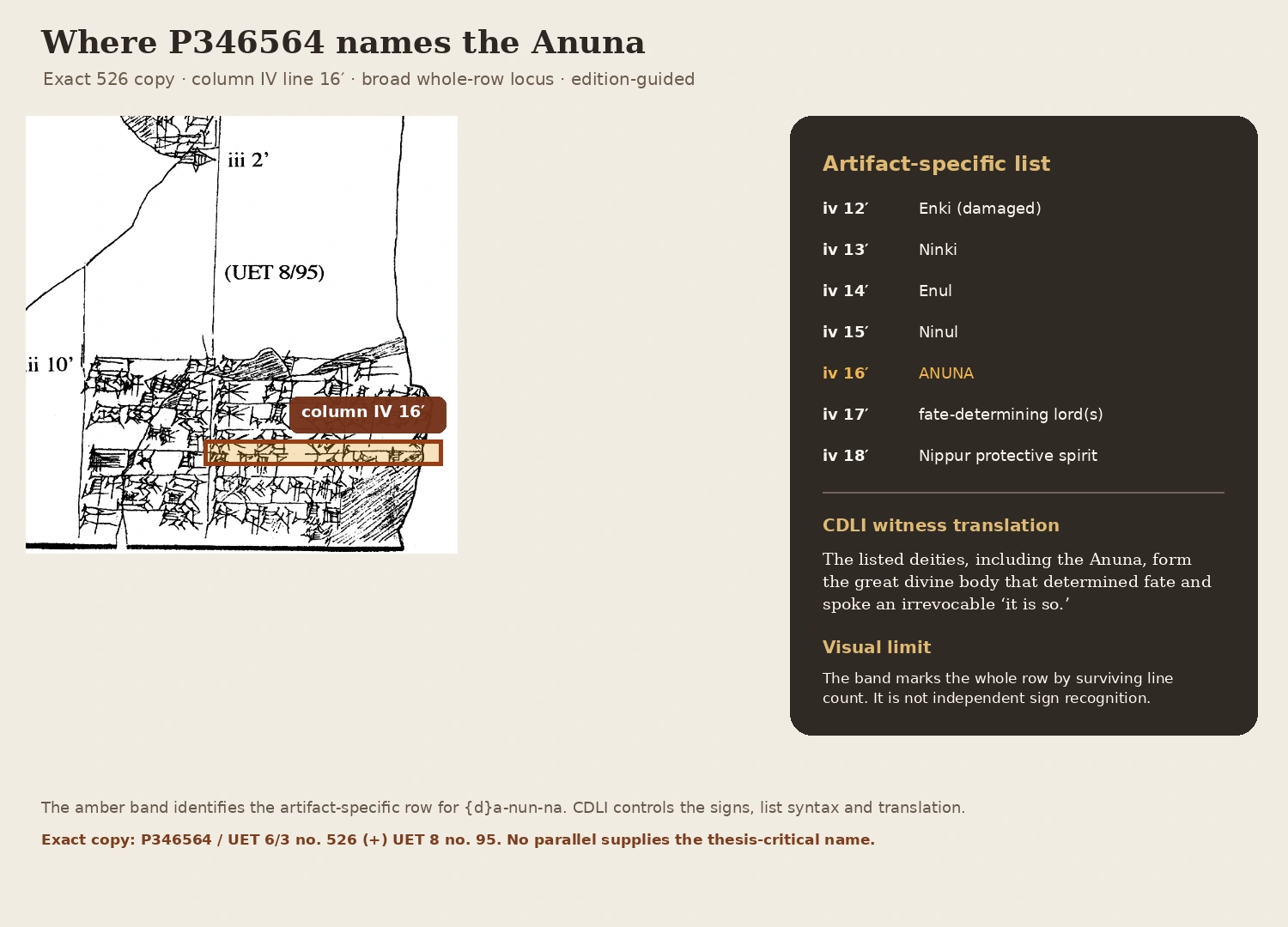
exact_line_art_or_squeeze_visible at whole-row level and edition-guided—not independent sign recognition.3. Artifact text, published translation and cautious working translation
The artifact-specific sequence is:
iv 12′ {d#}en#-ki#iv 13′ {d}nin9-kiiv 14′ {d}en-uliv 15′ {d}nin9-uliv 16′ {d}a-nun-naiv 17′ en nam tar-re-biiv 18′ {d}udug nibru{ki}
CDLI’s published witness translation: “Enki, Ninki, Enul and Ninul (ancestors of Enlil), the Anuna, the fate-determining lord(s), the udug protective spirit of Nibru, the lamma protective spirits of the Ekur temple, (all?) the great gods who have determined fate, spoke the irrevocable ‘it is so’.”
Cautious working translation: “Enki and Ninki, Enul and Ninul, the Anuna, the fate-determining lords, and Nippur/Ekur’s protective spirits—the great divine body that fixed fate—ratified the grant with an unalterable ‘so be it.’”
The working version uses “ratified” to explain the institutional force of the concluding assent, but it keeps the edition’s uncertainty visible. The Anuna name itself is un-restored. The Enki line is damaged, the object is fragmentary, and the exact distribution of the concluding predicate across every list member remains edition-controlled. The safest claim is collective inclusion: the Anuna are named inside the ratifying body, not isolated as its only actors.
4. Image-to-text evidence table
| Evidence field | P346564 result | Limit |
|---|---|---|
| Exact object | CDLI P346564; UET 6/526 and UET 8/95 labels agree between photograph and copy. | The tablet is heavily fragmented and joined from pieces. |
| Image location | Obverse, right-hand column IV, lines 12′–18′; Anuna at line 16′. | The annotation marks a broad whole row, not a sign cluster. |
| Visible/un-restored | {d}a-nun-na is printed outside restoration brackets in line 16′. |
Sign values and morphology follow the scholarly edition. |
| Damaged | The Enki line carries damage marks; the physical witness has large losses. | Not every list-to-verb relationship can be re-collated from the photograph. |
| Restored/composite | No parallel supplies the thesis-critical Anuna name. ETCSL controls the wider composition. | Later royal-action language is composition-level context, not claimed as photograph-visible wording. |
| Textual class | exact_line_art_or_squeeze_visible, edition-guided. |
Not an unaided pixel-level decipherment. |
| Agency result | The Anuna participate in the longer divine ratification list. | They are not the sole decreers and do not inherit Išme-Dagan’s later verbs. |
5. What the divine list supports
The passage strengthens the corpus in three connected ways. First, it presents the Anuna as an identifiable constituent of an organized divine body rather than a vague background label. Second, the body is associated with fate determination and an irrevocable assent formula. Third, the ratification stands inside a royal composition concerned with destiny, kingship and Ekur service. Together these points support a Mesopotamian model in which human kingship can be framed as authorized by an ordered, plural divine institution.
This is stronger than simple praise because the list performs a recognizable institutional role. The formula resembles approval or confirmation: the grant is not merely admired; it is fixed through a collective “so be it.” Yet the witness also constrains the claim. The phrase does not say that the Anuna alone created kingship, built the Ekur, designed a machine, or personally executed civic policy. The list contains several divine categories and named beings. The Anuna are participants within that structure.
The Sumerian Anuna is the relevant term in this witness. “Anunnaki” is the familiar Akkadian/popular form used for the wider research topic, but translation across periods and languages must not erase the artifact’s actual Sumerian spelling or its literary setting.
6. What Išme-Dagan—not the Anuna—does
The current ETCSL translation of Išme-Dagan A supplies the wider sequence. Enlil determines a favorable destiny, grants shepherdship and kingship, and assigns cultic obligations. Later, Išme-Dagan speaks in the first person: he says that he established justice in Sumer, secured Nippur, gathered the Ekur’s divine powers, paid attention to old ordinances and restored neglected rites.
Those are royal claims about human execution under divine authorization. They cannot be transferred backward to the Anuna simply because the divine list occurs nearby in the same tablet. The grammatical actors change. Divine ratifiers authorize; the king says he performs the later civic and cultic work. That separation is the main methodological gain of this report.
7. Corpus result, contradictions and theory limits
Main result: high confidence that un-restored {d}a-nun-na in P346564 column IV line 16′ places the Anuna within a longer divine list tied by the edition to fate determination and irrevocable assent. Confidence is also high for exact-object identity and the whole-row copy registration. The reading remains edition-guided for signs, collective syntax and translation.
Corpus relevance: the witness strengthens the organized-divine-governance, decree and kingship strands. It contributes a useful authorization/execution distinction: a plural divine body ratifies, while a named human king later claims the practical civic and cultic acts. This is evidence for remembered divine political theology and institutional hierarchy.
Contradiction control: the source weakens interpretations that treat every nearby action as Anuna agency. It does not isolate the group as the sole source of the decree; it does not make them establish justice, gather the Ekur’s powers, investigate plans or restore rites. Those are Išme-Dagan’s claims in the wider composition.
Unsupported claims: P346564 contains no evidence for extraterrestrial identity, Nibiru, spacecraft, genetic engineering, biological intervention, laboratories, mining operations, autonomous machinery, electrical systems or recoverable advanced technology. The text is royal literary theology, not a technical report.
8. Sources and method
- CDLI P346564 artifact record — catalogue, artifact-specific transliteration and witness translation.
- CDLI Q000451 score — composition and witness controls.
- Exact P346564 photograph — object identity, publication labels and preservation.
- Exact P346564 line art — publication-locked row registration.
- ETCSL 2.5.4.1 translation — wider destiny, kingship, justice, divine-power, ordinance and rite context.
Method note: current source checks were used after bounded search endpoints timed out. The artifact record, score, ETCSL translation, exact photograph and exact line art all returned successfully. The selected Anuna name is un-restored and mapped to a defensible exact-copy row. The report preserves the longer-list scope, damaged signs, edition control and the separation between divine ratification and human royal execution.
Share this:

One considered email each week
TheCode Weekly Evidence Brief
Receive the week’s strongest tablet decode, source audit or research update, plus one carefully chosen archive read. Routine posts stay on the site; the Brief is the curated signal.
Free. Usually sent on Sunday. No daily post flood. Unsubscribe at any time. See what the Brief includes.