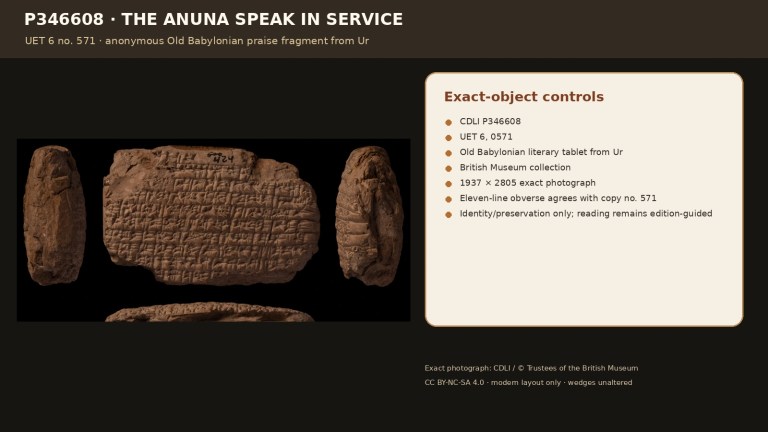
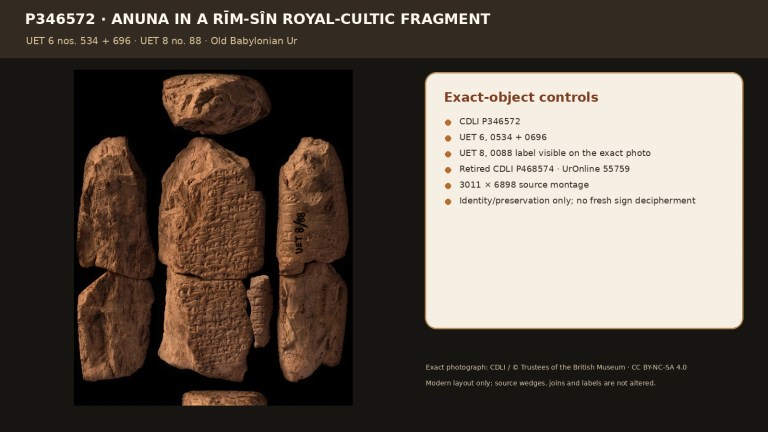
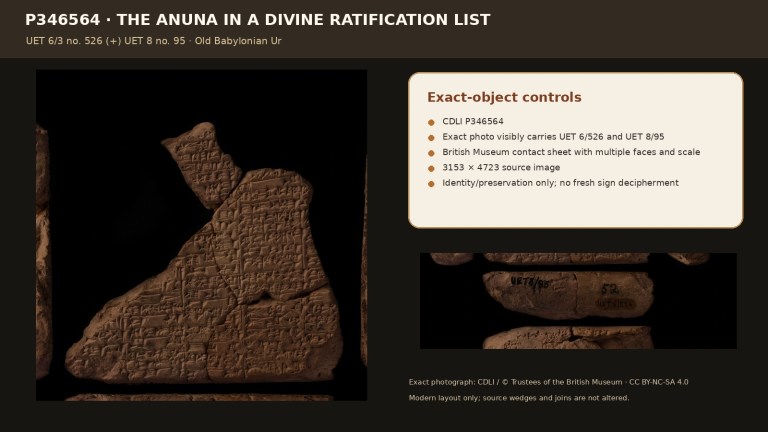
Nabonidus’s Harran Stele: Heaven-Descent Language and the Anunnakū Under Divine Command
Exact-image reading of Harran H2A / P519077: Sîn came from heaven, while the Anunnakū later tremble before his command. The grammar does not say the Anunnakū descended.
Ancient text and site reading
How to read this record
- Claim type
- Historical / textual + interpretive
- Evidence level
- Sources, translations, measurements, and symbolic reading where present
Use the evidence layer for sources and observations, and the interpretation layer for TheCode.Wiki synthesis.
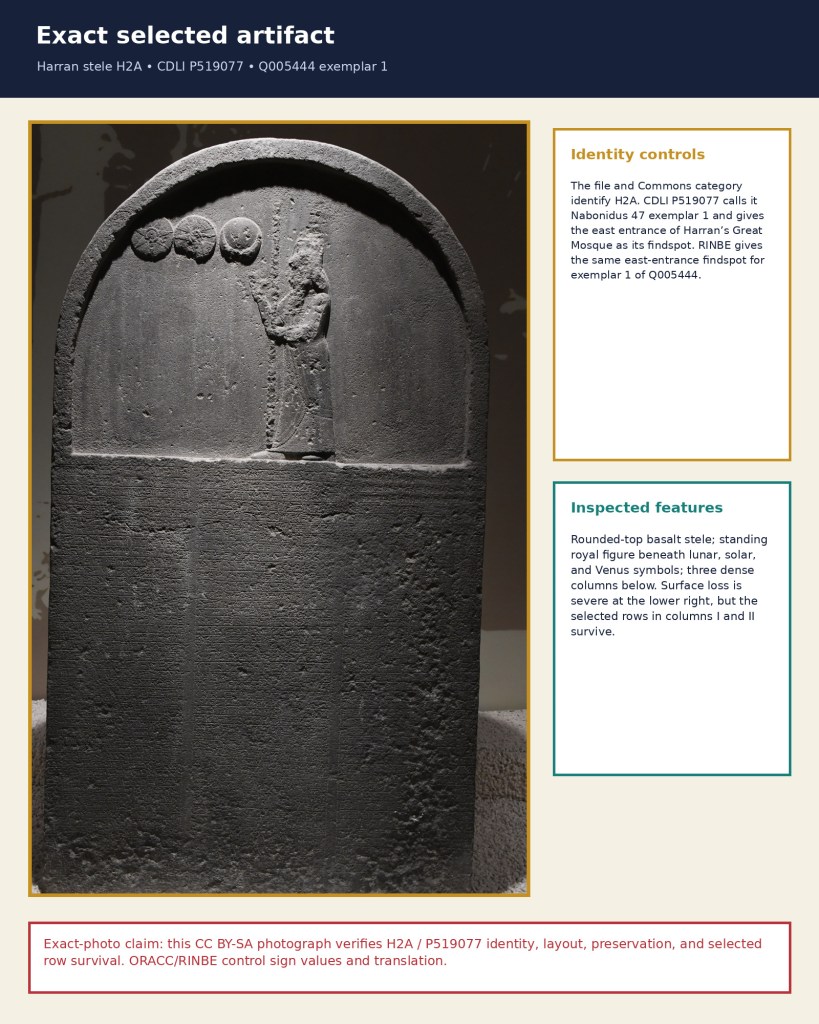
Today’s exact selected artifact is Harran stele H2A, the basalt monument catalogued by CDLI as P519077 and edited as exemplar 1 of ORACC/RIBo Q005444 / Nabonidus 47. It matters because the same exact physical witness preserves two unusually valuable clauses: column I says that the moon-god Sîn “came from heaven,” while column II names the Anunnakū gods trembling before Sîn’s unchangeable command.
The result is a strong new heaven-earth and divine-command witness—but with a decisive grammatical limit. Sîn is the subject of the descent clause. The stele does not say that the Anunnakū descended from heaven.

Why H2A passes the exact-object gate
The exact photograph was downloaded at 8256×5504 pixels and opened for visual inspection in its portrait orientation. It shows a rounded-top basalt stele, a royal figure beneath lunar, solar, and Venus symbols, and three columns of cuneiform. The Wikimedia Commons file and category explicitly identify the object as H2A. CDLI P519077 identifies “RINBE 2, Nabonidus 47, ex. 01” and gives the east entrance of Harran’s Great Mosque as its findspot. RINBE’s catalogue gives the same east-entrance findspot for exemplar 1 and states that it preserves column I line 1 through column II line 42, then column III lines 1–38.
Those independent controls link H2A, P519077, Q005444 exemplar 1, and the east-entrance discovery context. The photograph is licensed CC BY-SA 4.0 and credited to Dosseman.
Exact image-to-text alignment
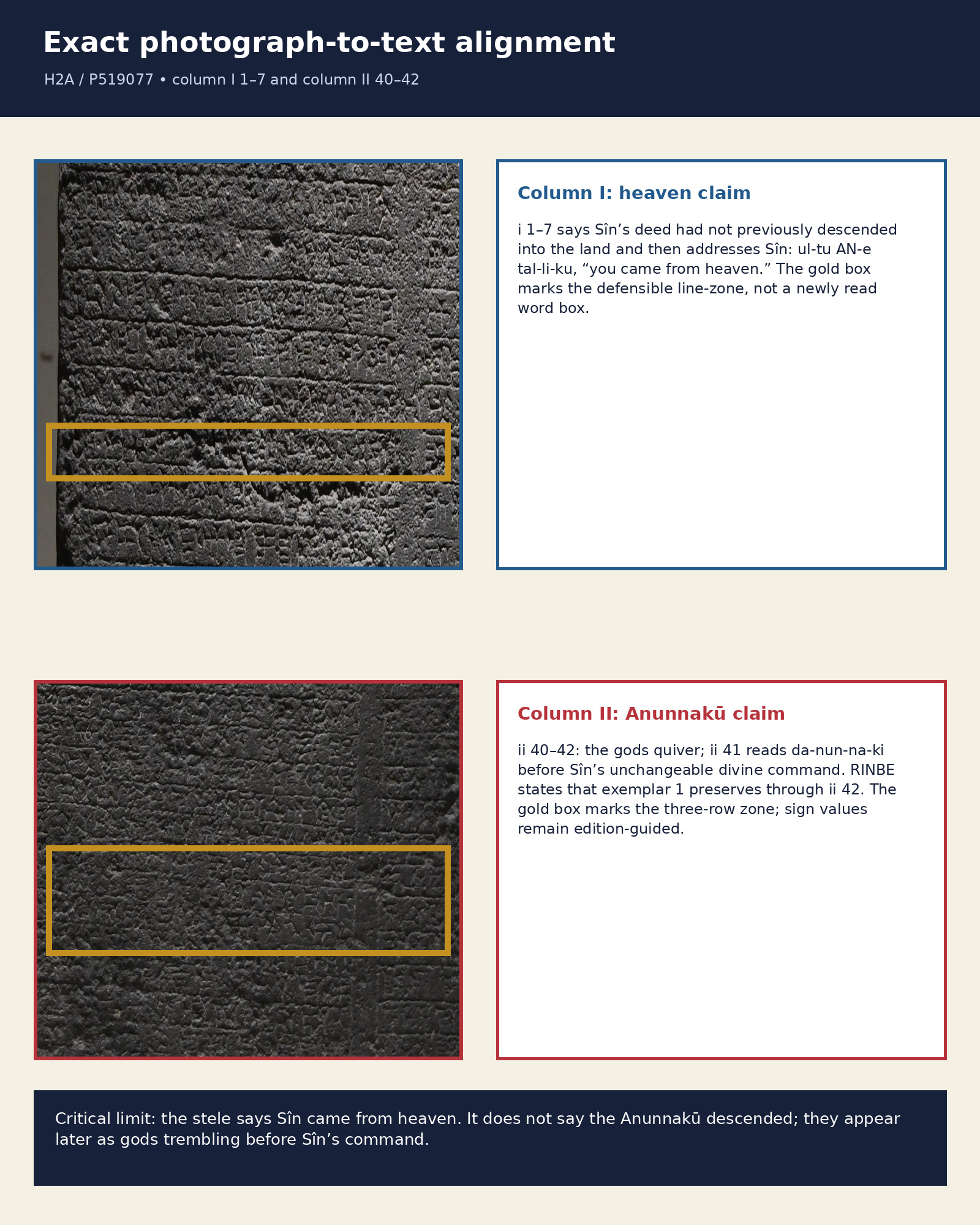
The gold boxes identify defensible row zones. They do not pretend to supply a fresh word-level collation from pixels. The line numbers are controlled by RINBE’s exemplar catalogue and its statement that exemplar 1 preserves through ii 42; ORACC/RINBE control sign readings, normalization, grammar, and translation.
Passage A: Sîn “came from heaven” — i 1–7
Edition transliteration:
i 1 i-piš-ti {d}30 GAL-ti šá DINGIR.MEŠ ù {d}IŠ.TAR
i 2 ma-am-ma-an NU ZU-šú šá ul-tu u₄-mu ru-qu-tu
i 3 a-na KUR la tu-ri-du u UN.MEŠ KUR <la> ip-pal-su-ma
i 4 i-na ṭup-pi la iš-ṭu-ru-ma la iš-tak-ka-nu
i 5 a-na u₄-mu ṣa-a-ti {d}30 EN DINGIR.MEŠ u {d}INANNA a-ši-bu-tú
i 6 šá AN-e šá ina pa-ni …
i 7 ul-tu AN-e tal-li-ku
Published ORACC translation: the passage calls this the great deed of Sîn, unknown to the gods and goddesses, not previously descended into the land, unseen by the people and unwritten on a tablet for eternity; it then addresses Sîn as lord of the gods and goddesses residing in heaven and says that he “came (down) from heaven” in Nabonidus’s time.
Cautious working translation: “This is Sîn’s great deed—previously unknown, not brought down into the land, not witnessed or written for permanent record: Sîn, lord of the heavenly gods and goddesses, you came from heaven in the time of Nabonidus.” The verb and second-person subject refer to Sîn. Line i 3 contains the edition’s supplied <la>; the core i 7 clause is unbracketed.
Passage B: the Anunnakū before divine command — ii 40–42
Edition transliteration:
ii 40 ⸢DINGIR⸣.MEŠ GIM GI i-šub-bu i-na-ar-ru-ṭu
ii 41 {d}a-nun-na-ki šá la-pa-ni qí-bit DINGIR-ti-šú
ii 42 ⸢GAL-ti⸣ šá la ⸢in⸣-nen-nu-⸢u⸣ …
Published ORACC translation: “The gods were quivering like reed(s), the Anunnakū gods, who (…) in front of the command(s) of his great divinity, which cannot be changed, were trembling…”
Cautious working translation: “The gods shook like reeds; the Anunnakū trembled before the command of his great, unchangeable divinity.” The syntax is partly interrupted by damage in ii 42 and the following eight illegible lines, so the working translation stays close to the edition and does not reconstruct the missing continuation.

Image-to-text hard-gate result
Both core clauses are classified photograph_visible at the row-survival level. H2A’s exact photograph visibly preserves the selected row zones and their wedges; ORACC/RINBE print i 7 and ii 41 without brackets or restoration marks. Exemplar 1 independently preserves the full selected spans. Q005444 is a conflated master text because a second exact duplicate also exists, but no parallel or composite reconstruction is needed to supply i 7 or ii 41 on H2A.
The result remains edition-guided for word division, sign values, grammar, and translation. No pixel-level independent decipherment is claimed.
From heaven to kingship and rebuilding
The opening does more than use heaven language. Lines i 7–14 say Sîn called Nabonidus to kingship and commanded him in a dream to rebuild Eḫulḫul at Harran. Lines i 27–31 describe gods residing in heaven as carrying out Sîn’s command. Lines ii 11–25 praise Sîn as holding divine offices associated with Anu, Enlil, and Ea; his word is not spoken twice, and his great divinity fills heaven and earth.
Lines ii 32–42 then place all heavenly gods under that command and explicitly name the Anunnakū as trembling before it. Finally, lines iii 17–27 move into the operative rebuilding dossier: Nabonidus musters people from Akkad and Hatti, builds Eḫulḫul, returns the divine statues, and supplies offerings. The text assigns the construction to royal and human action, not to Anunnakū engineering.

Line notes and confidence
i 1–7: high confidence in the edition reading and exact-row location. The rhetoric calls Sîn’s arrival unprecedented and record-worthy. It does not name the Anunnakū in this clause.
i 7–14: high confidence at edition level. Kingship and the Eḫulḫul command follow the heaven clause, but they are narrated as divine legitimation, not a technical transmission manual.
i 27–31: high confidence at edition level. Heavenly gods carry out Sîn’s command; the named protective deities are Šamaš, Ištar, Adad, and Nergal.
ii 11–25: high confidence with one lexical caution. RINBE notes uncertainty over the reading of the sign in ii 15, often translated “weapon of Anu.” That uncertainty is not needed for today’s Anunnakū claim.
ii 40–42: high confidence for unbracketed {d}a-nun-na-ki in ii 41 and its exact-row survival. The continuation in ii 42 is damaged and is followed by eight illegible lines; the report does not fill them.
iii 17–27: high confidence at edition level. Human populations and Nabonidus perform the stated rebuilding and cult restoration.
Corpus relevance and limits
This source strongly advances two gaps at once: heaven-earth movement and organized divine command. It preserves an explicit “came from heaven” clause, a written-record motif, dream-based royal commission, divine offices of heaven and earth, an unchangeable command, and a named Anunnakū group subordinated to that command. That is meaningful evidence for a structured non-human/divine hierarchy in Mesopotamian royal theology.
But the strongest popular inference fails the grammar test: the actor who comes from heaven is Sîn, not the Anunnakū. The Anunnakū enter more than seventy lines later in a command-subordination clause. Proximity within one inscription is relevant to the theology, but it does not merge the two subjects.

The stele does not identify extraterrestrials, Nibiru, spacecraft, genetic engineering, mining machines, or recoverable advanced technology. It also does not attribute Eḫulḫul’s construction to the Anunnakū. The defensible result is a heaven-residing high god, royal authorization, and an organized Anunnakū group under divine command within Neo-Babylonian theology.
Sources and credits
- ORACC/RIBo Q005444, Nabonidus 47 — current transliteration, translation, line numbering, and exemplar score.
- CDLI P519077 — exact H2A / Q005444 exemplar 1 metadata and east-entrance findspot.
- CDLI P519078 — exact duplicate exemplar 2, used as an edition control and not as the selected visual.
- Wikimedia Commons H2A category and exact photograph page — H2A identity, discovery description, image credit, and CC BY-SA 4.0 license.
- RINBE 2 open-access edition — catalogue, preservation ranges, commentary, transliteration, translation, and bibliography.
Daily method improvement: the workflow now applies a grammatical-agent firewall. Any extraordinary action must be tied to its explicit grammatical subject, verb, line, and exact image zone; a nearby Anunnakū noun cannot inherit another deity’s action.
Download the evidence report: Harran H2A, Sîn, heaven, and the Anunnakū PDF report.
Share this:

One considered email each week
TheCode Weekly Evidence Brief
Receive the week’s strongest tablet decode, source audit or research update, plus one carefully chosen archive read. Routine posts stay on the site; the Brief is the curated signal.
Free. Usually sent on Sunday. No daily post flood. Unsubscribe at any time. See what the Brief includes.