
Nabonidus’s Emašdari Cylinder: Ištar as Princess of the Anunnakū
Exact-image reading of VA Bab 2971 / P518910: Ištar is exalted among the Igīgū and princess of the Anunnakū, while Nabonidus performs the temple rebuilding.

Ancient text and site reading
How to read this record
- Claim type
- Historical / textual + interpretive
- Evidence level
- Sources, translations, measurements, and symbolic reading where present
Use the evidence layer for sources and observations, and the interpretation layer for TheCode.Wiki synthesis.
Today’s exact selected artifact is VA Bab 2971 (excavation number BE 43242), the complete Neo-Babylonian clay-cylinder exemplar catalogued by CDLI as P518910 and edited as exemplar 1 of ORACC/RIBo Q005399 / Nabonidus 2. Its opening hymn calls Ištar of Agade the most exalted of the Igīgū and the rubâtu, “princess,” of the Anunnakū.

Why this cylinder advances the corpus
The corpus already has many texts in which one high god commands, judges, or outranks the Anunnakū. Q005399 adds a more precise institutional datum: a named goddess holds the title “princess of the Anunnakū,” while the same inscription connects her cult to regular offerings, sanctuary upkeep, foundation recovery, brickwork, and royal rebuilding. This is strong evidence for differentiated rank and durable civic-religious organization. It is not a technology narrative.
Exact-object identity and inspection
RINBE 2 figure 7 explicitly captions the photographed object “VA Bab 2971 (Nabonidus no. 2 ex. 1)” and identifies it as a two-column cylinder for rebuilding Emašdari. The accompanying catalogue gives excavation number BE 43242, provenance in Emašdari’s northern enclosure wall, and preservation from column I line 1 through column II line 31. CDLI P518910 independently records museum number VA Bab 02971, excavation BE 43242, designation “RINBE 2, Nabonidus 02, ex. 01,” and composite Q005399.
The photograph was opened and visually inspected. It shows a barrel-shaped clay cylinder with a ruled two-column inscription, a broad inter-column band, sharply preserved wedge fields, and curvature/shadow toward the lower edge. These matching museum, excavation, edition, exemplar, and composite identifiers satisfy the exact-object identity gate.

Selected passage: column I lines 1–15
Edition transliteration, core sequence:
i 1 a-na {d}iš-tar šu-úr-bu-tim
i 2 ru-um-tì ì-lí qá-ri-it-tim
i 3 {d}IN.NIN i-la-at ta-am-ḫa-ru
i 4 e-pí-ša-at tu-qu-un-tim
i 5 na-mi-ir-ti be-le-et da-ad-mi
i 6 ša-qu-tì i-gi₄-gi₄
i 7 ru-ba-a-tì {d}a-nun-na-ki
i 8 na-ša-a-at pu-lu-úḫ-tim
Published RINBE translation: the passage addresses Ištar as supreme, beloved of the gods, valiant goddess of battle, radiant lady of the settlements, most exalted of the Igīgū, princess of the Anunnakū, bearer of fear, and lady whose brilliance covers heaven and whose radiance overwhelms the earth.
Cautious working translation: “For Ištar, supreme and beloved among the gods, valiant goddess who wages battle: radiant lady of the inhabited places, exalted among the Igīgū, princess among the Anunnakū, bearer of awe.” The title marks rank or status within a divine collective. It does not by itself describe a council session, command chain, biological species, or place of origin.
Image-to-text epigraphic gate
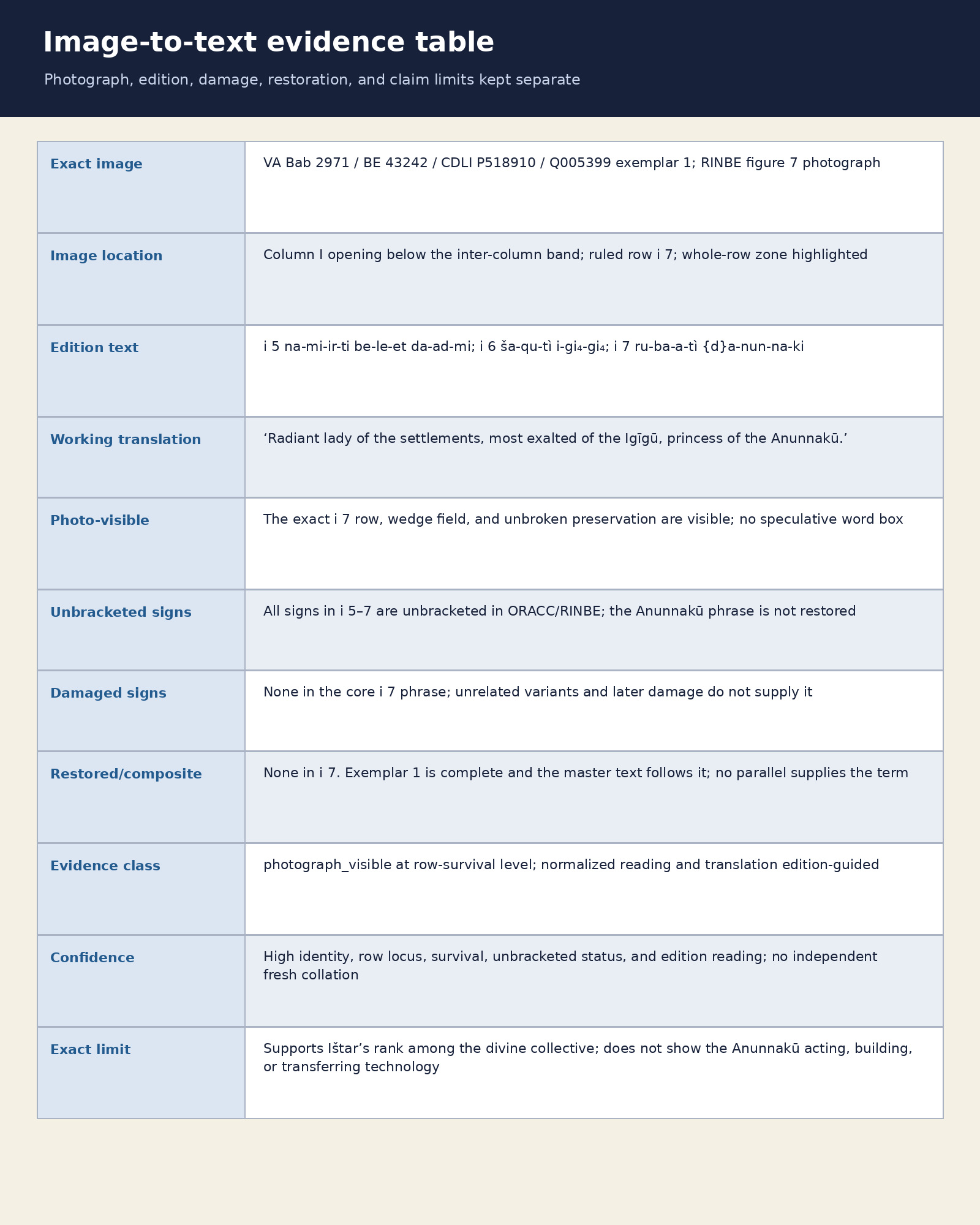
The lower inscription field begins immediately below the blank inter-column band. Because exemplar 1 is complete and the master text follows it, counting the ruled rows from the top of column I gives a defensible whole-row location for i 7. The row and its surviving wedges are visible in the exact photograph; ORACC/RINBE print ru-ba-a-tì {d}a-nun-na-ki without brackets or damage markers.
The evidence classification is photograph_visible at whole-row survival level. The exact artifact and line locus are independently visible; normalized sign values, word division, Akkadian grammar, and translation are edition-guided. No sign cluster is boxed because the photograph does not support a responsible fresh word-level collation.
From divine rank to temple maintenance

Lines i 16–32 shift from Ištar’s titles to Nabonidus. He describes himself as reverent, submissive, attentive to divine will, and responsible for regular offerings and all divine sanctuaries. Lines i 33–ii 9 say Emašdari’s foundations had disintegrated, its brickwork had been burned by alkali, its site was desolate, its cella ruined, and incense offerings had stopped.
The following building report assigns the operative work to the king: he clears the site, locates the earlier foundation, secures the foundations, raises the superstructure, and completes the temple. The inscription thus places a concrete human institution—royal provision, offerings, foundation knowledge, brickwork, and cult continuity—under Ištar’s divine rank. It does not say that the Anunnakū performed the construction.
Line notes and confidence
i 5–7: high confidence. The key phrase is unbracketed on a complete exact exemplar. The exact line row is photograph-visible; sign normalization and translation remain edition-guided.
i 8–15: high edition confidence. Awe, heaven-wide brilliance, earth-wide radiance, Ištar of Agade, battle, and Emašdari expand the title’s theological setting.
i 16–32: high edition confidence. These lines establish royal piety, offerings, and sanctuary provisioning, not Anunnakū labor.
i 33–ii 19: high edition confidence for the repair narrative. Physical decay, old foundations, and reconstruction are conventional Neo-Babylonian temple-maintenance claims.
Corpus relevance and limits
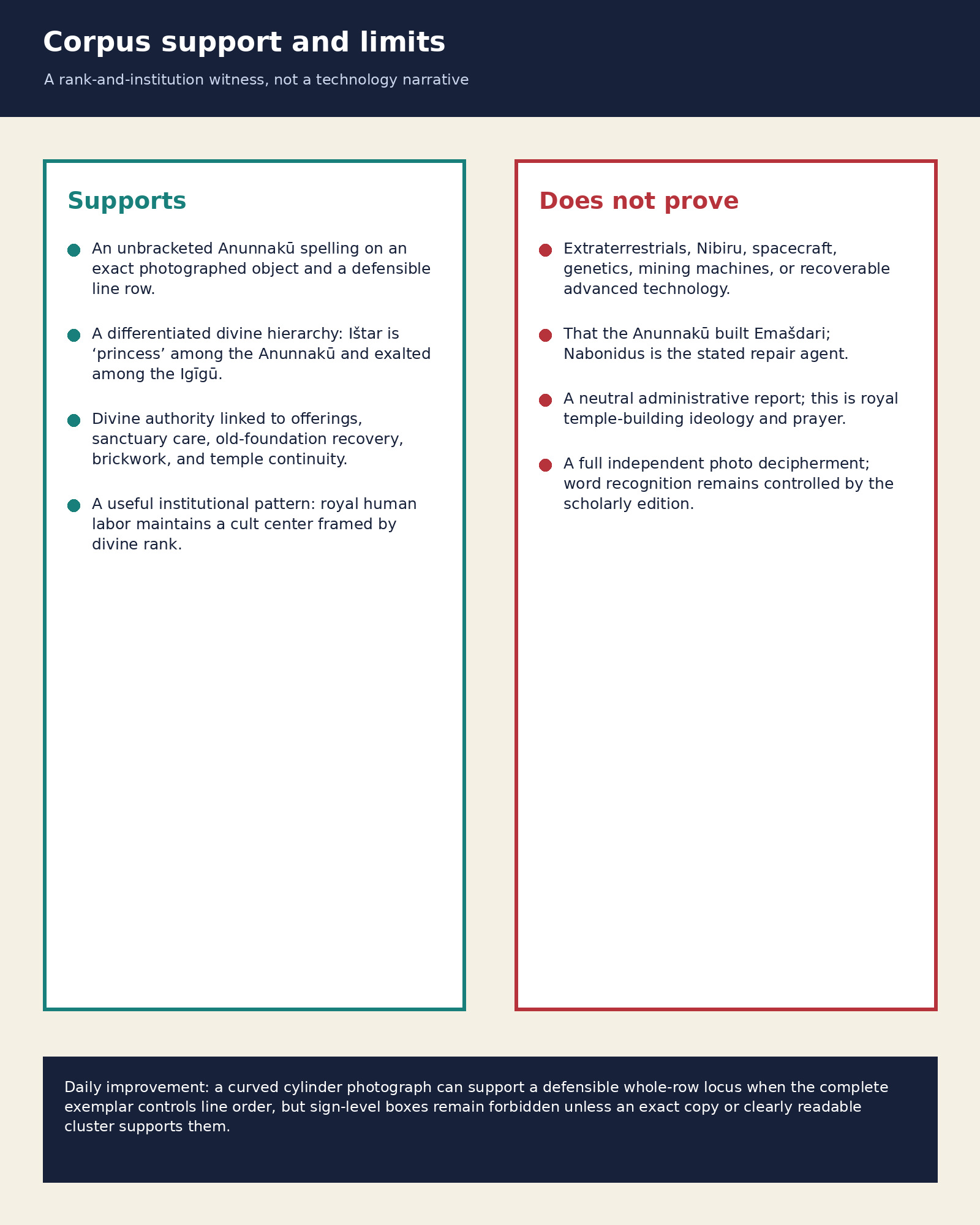
Q005399 strongly supports the organized-divine-hierarchy strand of Tony’s working thesis: the Anunnakū are a named collective within which Ištar can hold a specific rank. It moderately supports the civilization-maintenance strand because offerings, sanctuary administration, foundation recovery, and brick rebuilding are framed by that divine order. The labor, however, is royal and human.
The cylinder does not identify the Anunnakū as extraterrestrials and does not mention Nibiru, spacecraft, genetic engineering, mining machines, or recoverable advanced technology. It is a royal building inscription and prayer, not a neutral administrative or scientific record.
Sources and credits
- ORACC/RIBo Q005399, Nabonidus 2 — current transliteration, translation, line numbering, and exemplar score.
- CDLI P518910 — exact exemplar metadata, museum number, excavation number, and Q005399 linkage.
- Weiershäuser and Novotny, RINBE 2 open-access edition, pp. 55–59 — exact photograph, catalogue, text, translation, and commentary. Figure 7 credit: Staatliche Museen zu Berlin—Vorderasiatisches Museum; photo Olaf M. Teßmer.
Daily method improvement: curved cylinder photographs now use a row-counting gate anchored to a complete exemplar and an explicit inter-column boundary. Whole-row claims are allowed when defensible; word/sign boxes remain prohibited without an exact copy or independently legible sign cluster.
Download the evidence report: VA Bab 2971, Ištar, and the Anunnakū PDF report.
Share this:

One considered email each week
TheCode Weekly Evidence Brief
Receive the week’s strongest tablet decode, source audit or research update, plus one carefully chosen archive read. Routine posts stay on the site; the Brief is the curated signal.
Free. Usually sent on Sunday. No daily post flood. Unsubscribe at any time. See what the Brief includes.


