Marduk, the Anunnakū, and the Plan of Babylon’s Wall
Exact-object report on BM 86918 / Q008329: Marduk rules the Anunnakū and establishes archetypes, while the king, labor forces, and craftsmen rebuild Babylon’s wall.

Ancient text and site reading
How to read this record
- Claim type
- Historical / textual + interpretive
- Evidence level
- Sources, translations, measurements, and symbolic reading where present
Use the evidence layer for sources and observations, and the interpretation layer for TheCode.Wiki synthesis.
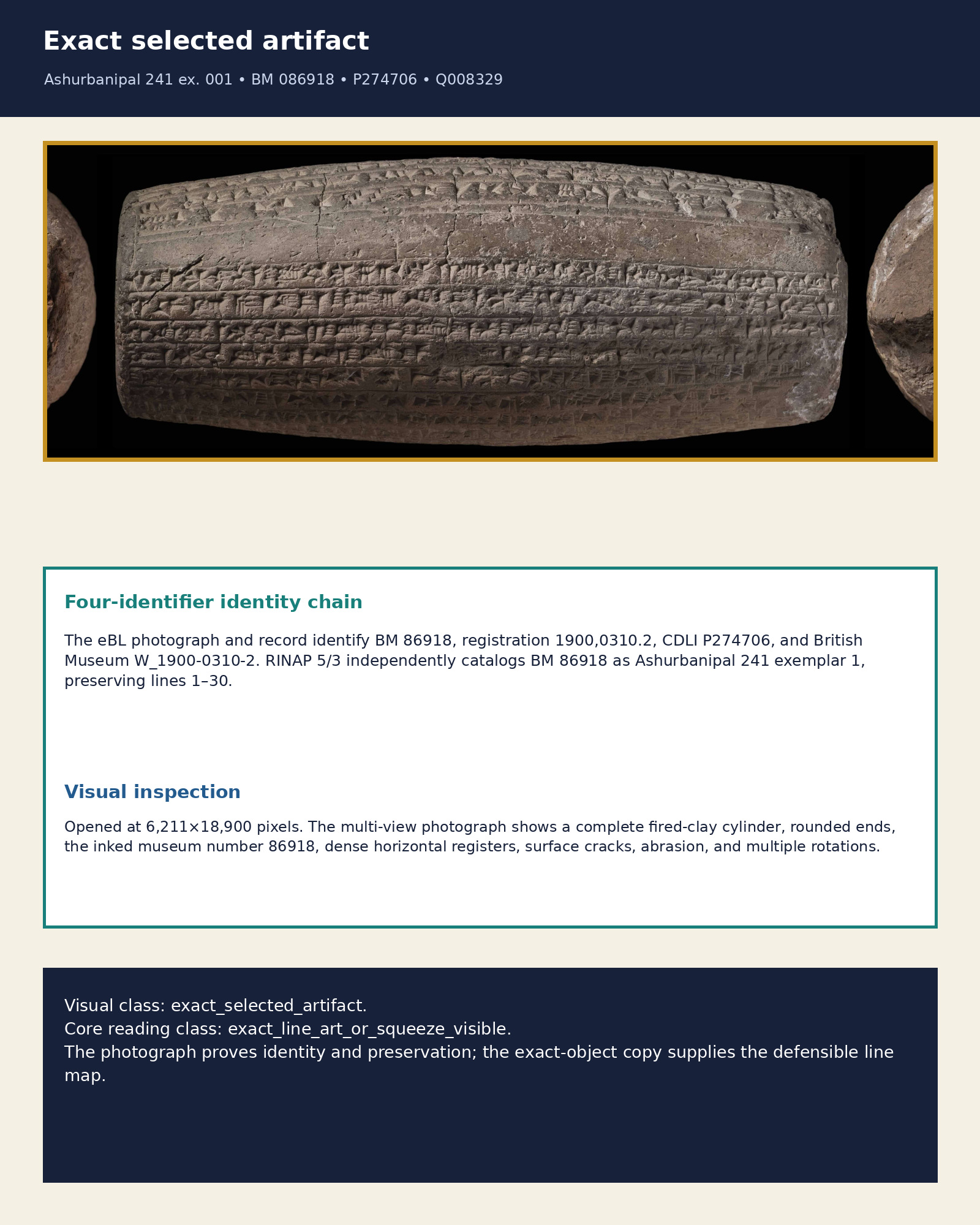
Today’s exact selected artifact is British Museum BM 086918, registration 1900,0310.2, indexed as CDLI P274706 and edited as ORACC/RINAP Q008329, Ashurbanipal 241 exemplar 001. Its complete opening line calls Marduk “king of all the Igīgū and Anunnakū,” “creator of heaven and netherworld,” and mu-kin giš-ḫur-ru, the one who establishes “archetypes.” The same inscription then records a real wall-and-gate restoration at Babylon.
Why this source advances the corpus
This witness advances the corpus’s planning, craft, labor, fortification, and civilization-maintenance gap. It places explicit Anunnakū language in an invocation of Marduk’s cosmic and archetypal authority, then moves to the damaged outer wall of Babylon, labor forces, the craft of Kulla, gates and doors, skilled craftsmen, ancient specifications, and the future preservation of an inscribed object.
The source is unusually useful because it also prevents an agency mistake. Marduk is the divine sovereign and establisher of archetypes; Kulla supplies the craft frame; Ashurbanipal, his labor forces, and future skilled craftsmen are the construction agents. The Anunnakū are members of Marduk’s divine constituency, not wall builders.
Exact-object identity and inspection
The public eBL record identifies the exact photograph as BM 86918, gives registration 1900,0310.2, CDLI number P274706, and British Museum identifier W_1900-0310-2. CDLI independently identifies P274706 as “RINAP 5/3, Ashurbanipal 241, ex. 001” and museum number BM 086918. RINAP’s catalogue identifies BM 86918 as exemplar 1 and records lines 1–30 as preserved.
The 6,211×18,900 eBL photograph was opened and inspected. Its multi-view montage shows a complete fired-clay cylinder with rounded ends, the inked number 86918, dense ruled registers, cracks, abrasion, and successive rotations. Physical observations in this report apply only to BM 86918.
Core passage: lines 1–2
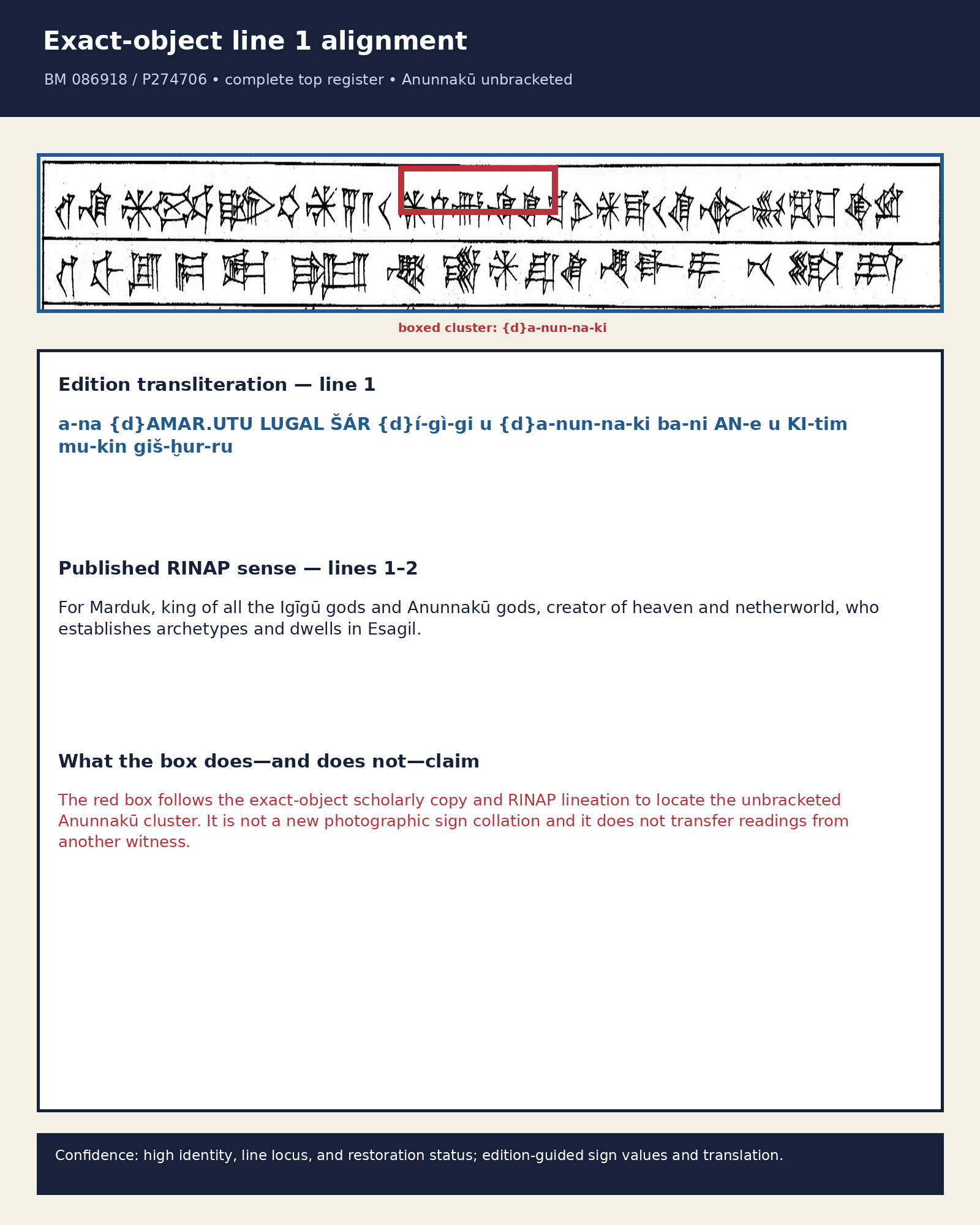
Edition transliteration, line 1: a-na {d}AMAR.UTU LUGAL ŠÁR {d}í-gì-gi u {d}a-nun-na-ki ba-ni AN-e u KI-tim mu-kin giš-ḫur-ru.
Published RINAP translation, lines 1–2: “For the god Marduk, king of all the Igīgū gods and Anunnakū gods, creator of heaven and netherworld, who establishes archetypes (and) dwells in Esagil, lord of Babylon, great lord, my lord.”
Cautious working translation: “To Marduk, king of all the Igīgū and Anunnakū, creator of heaven and earth/netherworld, establisher of plans/archetypes, dwelling in Esagil, lord of Babylon, great lord, my lord.” “Plan” is a contextual gloss for gišḫurru; RINAP’s published choice is “archetypes.” Neither word should be inflated into a claim that a technical blueprint survives.
Image-to-text epigraphic gate

The opening line and its syllabic spelling a-nun-na-ki are complete and unbracketed. The exact-object scholarly copy gives a defensible top-register line map, so the core evidence class is exact_line_art_or_squeeze_visible. The exact photograph independently verifies object identity and preservation. The report does not claim that the photograph was freshly decoded sign by sign; RINAP controls the sign values, word divisions, grammar, and translation.
From divine archetype to construction procedure

Lines 10–16a say that Marduk returned to Babylon and took up residence in Esagil. Ashurbanipal says he reconfirmed offerings, restored Babylon’s privileged status, installed his brother as king so that the strong would not harm the weak, and adorned Esagil.
Lines 16b–22 turn to infrastructure. Imgur-Enlil, Babylon’s city wall, and Nēmetti-Enlil, its outer wall, had become old, buckled, and collapsed. Ashurbanipal says that, to strengthen the security of Esagil and Babylon’s sanctuaries, with the strength of his labor forces he rebuilt the outer wall quickly with the craft of Kulla, refitted its gates, made new doors, and fixed them in place.
Lines 23–27a address a future ruler. If the work falls into disrepair, that ruler must question skilled craftsmen, rebuild the walls according to their ancient specifications, inspect Ashurbanipal’s inscription, anoint it, offer sacrifice, and place it with the new inscription. This is a clear sequence of inherited model, human expertise, construction, and archival continuity.
Published evidence versus working inference
Published layer: RINAP supplies the catalogue, score, lineation, transliteration, and English translation. It identifies Marduk as establisher of archetypes and the king and his forces as builders.
Cautious inference layer: one exact witness joins Anunnakū hierarchy to a conceptual model and a concrete infrastructure dossier. The bridge is historically meaningful: theology frames civic construction. It is not evidence that the Anunnakū themselves designed or built the wall.
Corpus relevance and limits
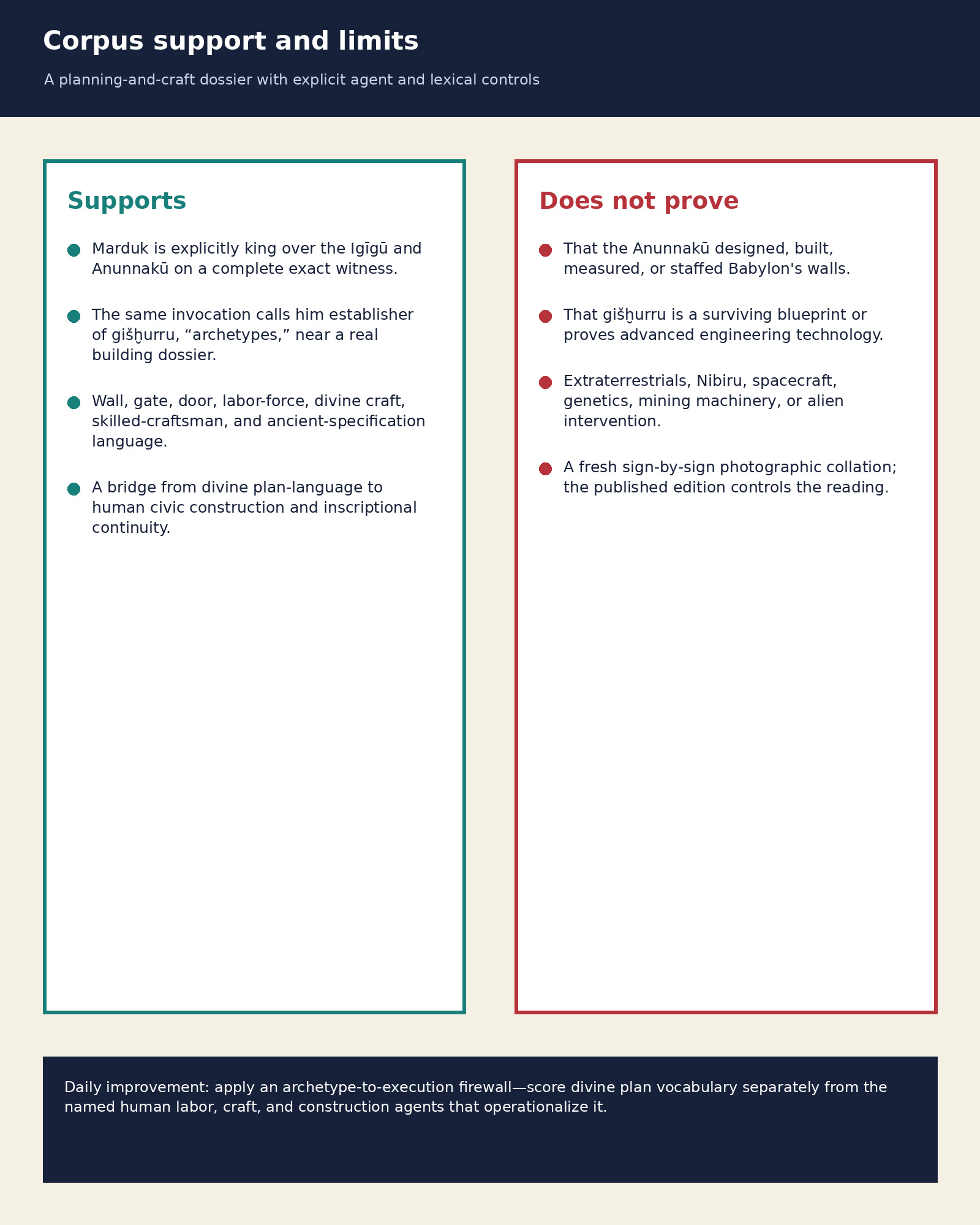
This source supports the limited claim that Anunnakū language could appear inside a theology of cosmic order and archetypal planning that framed real royal construction. It also supports a civilization-maintenance chain involving damaged infrastructure, labor forces, divine craft, skilled experts, ancient specifications, doors, gates, walls, and preserved inscriptions.
It does not prove extraterrestrials, Nibiru, spacecraft, genetics, mining machinery, or advanced technology. It does not say that the Anunnakū built, measured, or designed Babylon’s wall. The exact result is an edition-guided, exact-line-art-verifiable planning-and-craft dossier with human operative agency.
Sources and credits
- ORACC/RINAP Q008329, Ashurbanipal 241 and the official RINAP 5/3 edition — catalogue, lineation, transliteration, score, and published translation.
- eBL BM.86918 — exact multi-view photograph and identifier chain.
- CDLI P274706 — artifact metadata and exact-object scholarly copy.
- British Museum W_1900-0310-2 — institutional object record.
Daily capability improvement: apply an archetype-to-execution firewall: score divine plan vocabulary separately from the named human labor, craft, and construction agents that operationalize it.
Download the evidence report: BM 86918, Marduk, Anunnakū, archetypes, and Babylon wall PDF report.
Share this:

One considered email each week
TheCode Weekly Evidence Brief
Receive the week’s strongest tablet decode, source audit or research update, plus one carefully chosen archive read. Routine posts stay on the site; the Brief is the curated signal.
Free. Usually sent on Sunday. No daily post flood. Unsubscribe at any time. See what the Brief includes.