

Claim type: Spiritual testimony / visionary interpretation
Evidence level: Personal revelation and symbolic synthesis unless otherwise cited
This belongs to Tony Canon and is not presented as conventional third-party biography or institutional record.
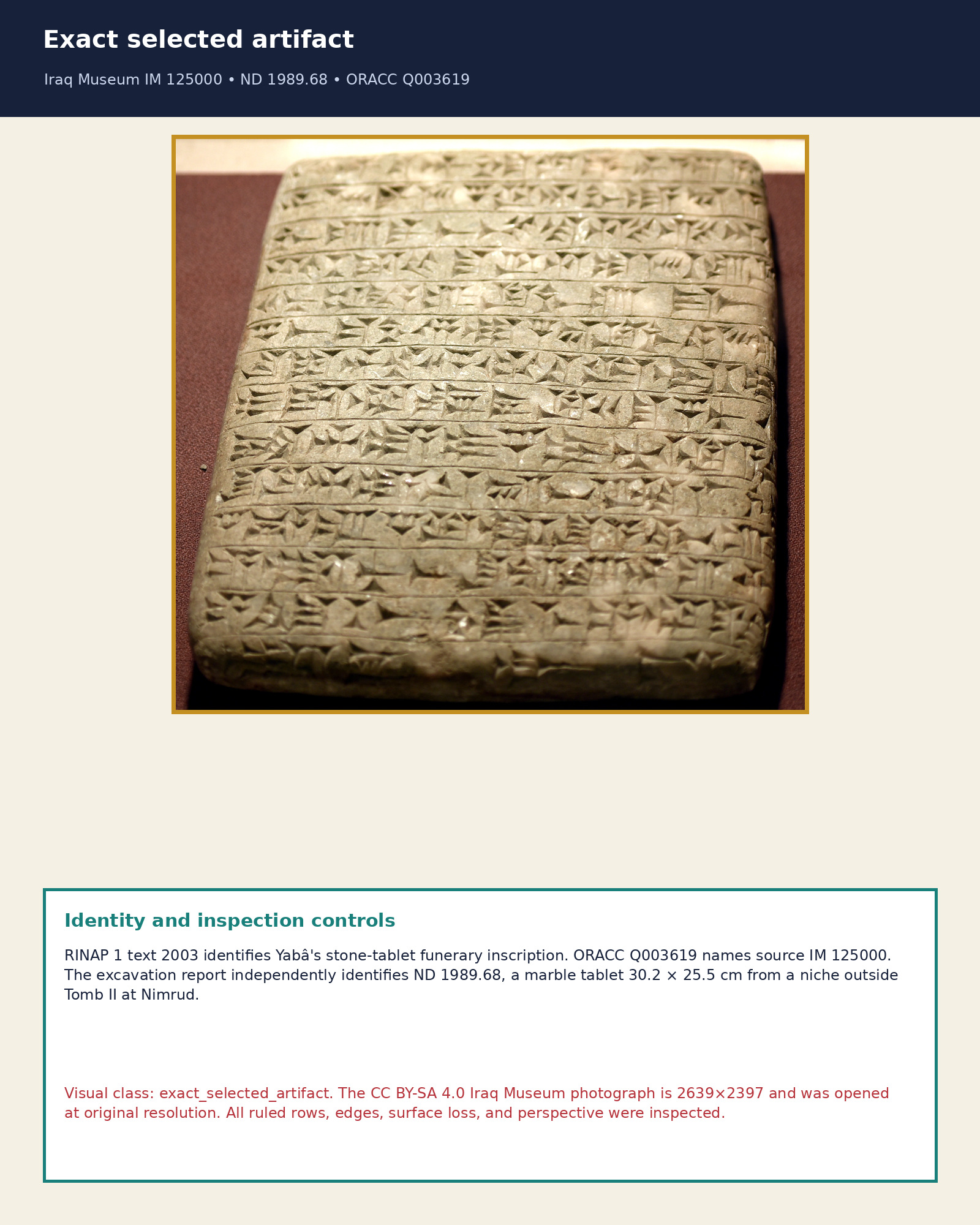
Today’s exact selected artifact is Iraq Museum IM 125000, excavated as ND 1989.68 and edited as ORACC/RINAP Q003619, Tiglath-pileser III 2003. This marble funerary tablet of Queen Yabâ preserves Anunnakū twice: in its opening netherworld authority formula and in the operative denial of offerings to a tomb violator.
Why this witness matters
The corpus already contains creation, kingship, temple, oath, craft, and royal-building dossiers. Yabâ’s tablet adds a non-building funerary sanction: tomb integrity, property, sealing, ritual entitlement, and underworld authority converge on one photographed object. It also shows that Neo-Assyrian Anunnakū can be specifically underworld-focused.
Exact-object identity and inspection
RINAP 1 identifies text 2003 as Yabâ’s stone-tablet funerary inscription. ORACC Q003619 lists source IM 125000. The excavation report independently identifies ND 1989.68, a marble tablet measuring 30.2 × 25.5 cm from a niche in the west wall of Tomb II’s outer chamber at Nimrud. The modern Iraq Museum photograph depicts the same named Yabâ funerary tablet and carries a CC BY-SA 4.0 license.
The 2639×2397 image was opened at original resolution. Twenty horizontal ruled rows are visible. Perspective and surface abrasion make fresh sign-by-sign collation unsafe, but rows 1 and 17 can be located by counting from the top.
Two thesis-critical passages
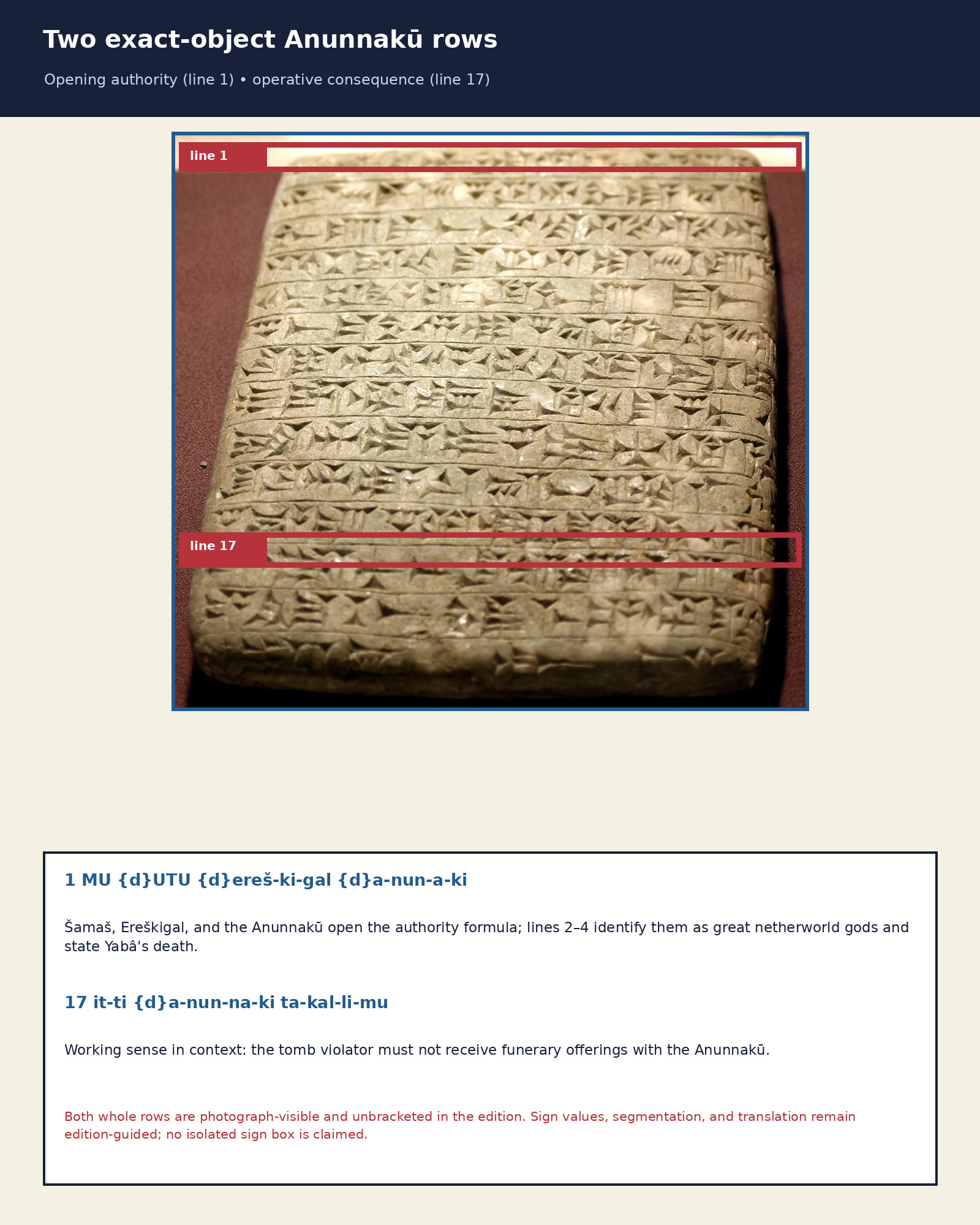
Lines 1–4: opening authority
Edition transliteration, line 1: MU {d}UTU {d}ereš-ki-gal {d}a-nun-a-ki.
Published ORACC translation in context: “On the life of the god Šamaš, the goddess Ereškigal, (and) the Anunnakū gods, the great gods of the netherworld, the destiny of a (mortal) life took Yabâ, the queen, into death …”
Cautious working translation: “By the authority/life of Šamaš, Ereškigal, and the Anunnakū—the great gods of the netherworld—mortal destiny overtook Queen Yabâ.” The exact nuance of MU is edition-controlled; the divine names and Anunnakū spelling are unbracketed.
Lines 15–17: operative consequence
Edition transliteration, line 17: it-ti {d}a-nun-na-ki ta-kal-li-mu.
Published ORACC translation in context: below in the netherworld the violator “may … not receive with the Anunnakū gods offerings from the libation of water, the finest beer, wine, (and) flour.”
Cautious working translation: “May the offender not be shown/receive the funerary provision together with the Anunnakū.” The denial concerns the human violator; it does not make the Anunnakū builders, craftsmen, or technical agents.
Image-to-text gate

This result is independently photograph-verifiable at whole-row survival level and edition-guided for sign reading and translation. Both Anunnakū spellings are unbracketed. The photograph supports row survival and location; it does not justify a new pixel-level decipherment.
Tomb law, ritual entitlement, and underworld order

The curse forbids removing Yabâ, inserting another body, taking her jewelry, and opening the tomb seal. The threatened consequences split into two zones: above, the ghost wanders thirsty; below, the offender is denied offerings with the Anunnakū. Ningišzida and Piṭuḫ-idugul then receive the explicit affliction clause.
This grammatical sequence matters. The Anunnakū are invoked authority and the divine community associated with legitimate funerary provision. The text does not say that they manufactured the stone, built the tomb, or performed technical work.
Published layer versus working inference
Published layer: ORACC/RINAP supplies the object identifier, lineation, transliteration, and translation. RINAP 1 identifies the stone tablet; the excavation report supplies ND 1989.68, context, dimensions, and an independent translation. Wikimedia Commons supplies the licensed exact photograph.
Working inference: access to funerary offerings “with the Anunnakū” marks membership or reception within an ordered underworld community. That supports organized divine authority and ritual law. It does not establish extraterrestrial identity or technology.
Corpus relevance and limits

The source strongly advances the judgment/law, oath/sanction, property protection, ritual administration, and underworld organization strands. It does not prove extraterrestrials, Nibiru, spacecraft, genetic engineering, mining machinery, or advanced technology.
Sources and image credit
- ORACC/RINAP Q003619, Tiglath-pileser III 2003 — edition, source IM 125000, transliteration, and translation.
- RINAP 1 primary edition — Yabâ text 2003 and corpus catalogue.
- Nimrud: The Queens’ Tombs — excavation context, ND 1989.68, dimensions, and translation.
- Exact Iraq Museum photograph — Osama Shukir Muhammed Amin, CC BY-SA 4.0.
- ORACC Ancient Mesopotamian Gods and Goddesses: Anunna — historical forms and changing functions.
Daily capability improvement: add a dual-occurrence funerary-sanction gate: map both the opening authority formula and operative consequence, then label invoked authority, associated divine group, and threatened human actor separately.
Download the evidence report: Queen Yabâ, the Anunnakū funerary sanction, and Tomb II PDF report.
Share this:

One considered email each week
TheCode Weekly Evidence Brief
Receive the week’s strongest tablet decode, source audit or research update, plus one carefully chosen archive read. Routine posts stay on the site; the Brief is the curated signal.
Free. Usually sent on Sunday. No daily post flood. Unsubscribe at any time. See what the Brief includes.


