Sargon II’s Aššur Charter: Anunnakū Authority and Corvée Exemption
Exact-object report on K 1349 / P393884 / Q006570: Aššur is king of the Igīgū and Anunnakū in a charter that later restores civic service, corvée, levy, and dues exemptions.
Ancient text and site reading
How to read this record
- Claim type
- Historical / textual + interpretive
- Evidence level
- Sources, translations, measurements, and symbolic reading where present
Use the evidence layer for sources and observations, and the interpretation layer for TheCode.Wiki synthesis.
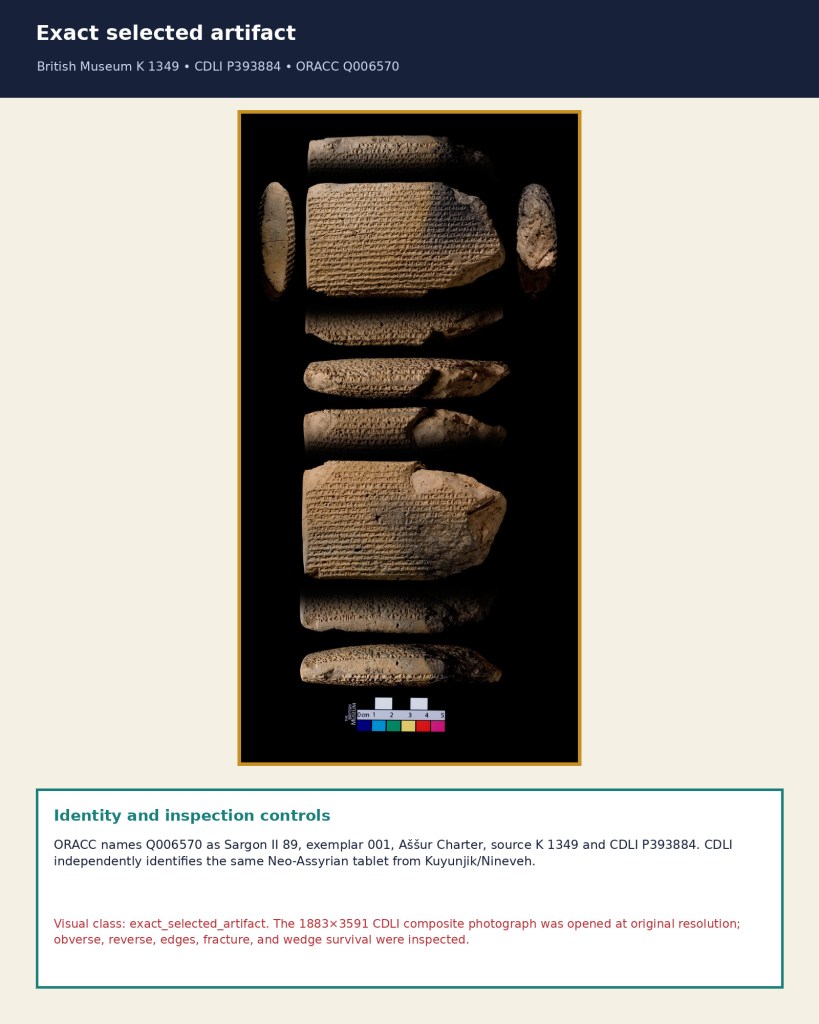
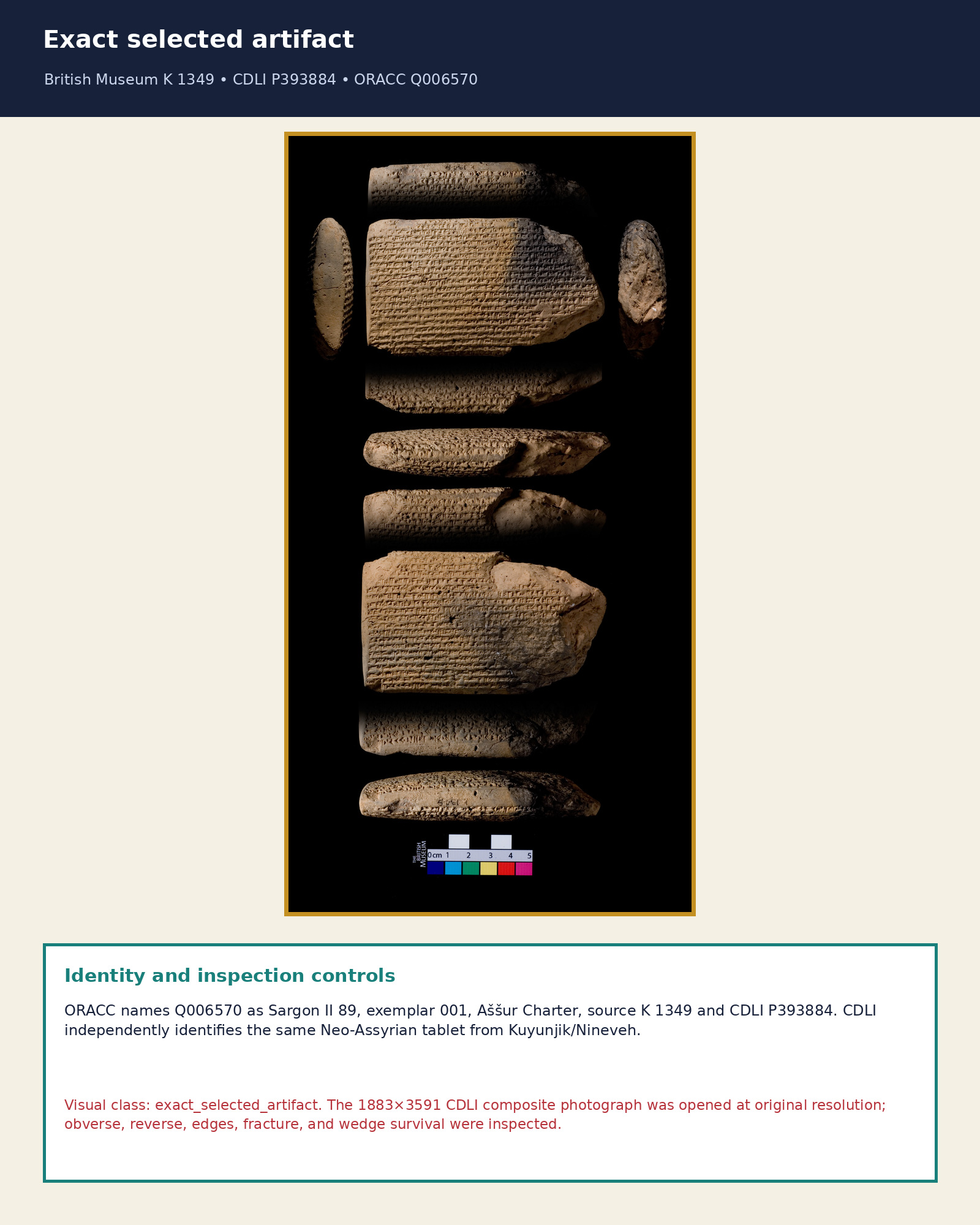
Today’s exact selected artifact is British Museum K 1349, catalogued as CDLI P393884 and edited as ORACC/RINAP Q006570, Sargon II 89. The clay tablet conventionally called the Aššur Charter opens by calling Aššur king of the Igīgū and Anunnakū gods, then places royal authority inside a public-law dossier about judgment, oath, state service, corvée, levy, and civic exemptions.
Why this witness matters
The corpus already includes creation-for-labor, royal command, temple administration, building, craft, oath, and funerary sanction. K 1349 advances a tighter divine-authority-to-public-law question: does un-restored Anunnakū language occur on the same exact object as operative labor and fiscal policy? Yes—but the grammar requires a limit. The Anunnakū appear in Aššur’s authority title; Sargon and human government perform the exemptions.
Exact-object identity and inspection
ORACC’s current RINAP catalogue identifies Q006570 as Sargon II 89, exemplar 001, the Aššur Charter, with source K 01349 and CDLI identifier P393884. CDLI independently identifies P393884 as RINAP 2 Sargon II 89 ex. 001, a Neo-Assyrian tablet from Kuyunjik/Nineveh.
The CDLI photograph is 1883×3591 pixels and was opened at original resolution. It shows the obverse, reverse, edges, profiles, fracture, and surviving wedges. CDLI’s exact-object drawing is labeled K.1349 and numbers obverse lines 1–20, edge lines 21–23, and reverse lines 24–43. That copy—not guesswork from a dense photograph—controls the line map.
Thesis-critical line: obverse 1

Edition transliteration: [a-na] {d}a-šur KUR-i GAL-e LUGAL KIŠ {d}NUN.GAL u {d}a-nun-na-ki […].
Published RINAP translation: “[To] the god Aššur, the great mountain, king of all the Igīgū gods and Anunnakū gods, […]”.
Cautious working translation: “[To] Aššur, the Great Mountain, king of the totality—the Igīgū and Anunnakū gods …”. The initial [a-na] is restored, while {d}a-nun-na-ki is unbracketed. The row and copy are exact-object visible; sign values, segmentation, and translation remain edition-controlled.
Image-to-text gate
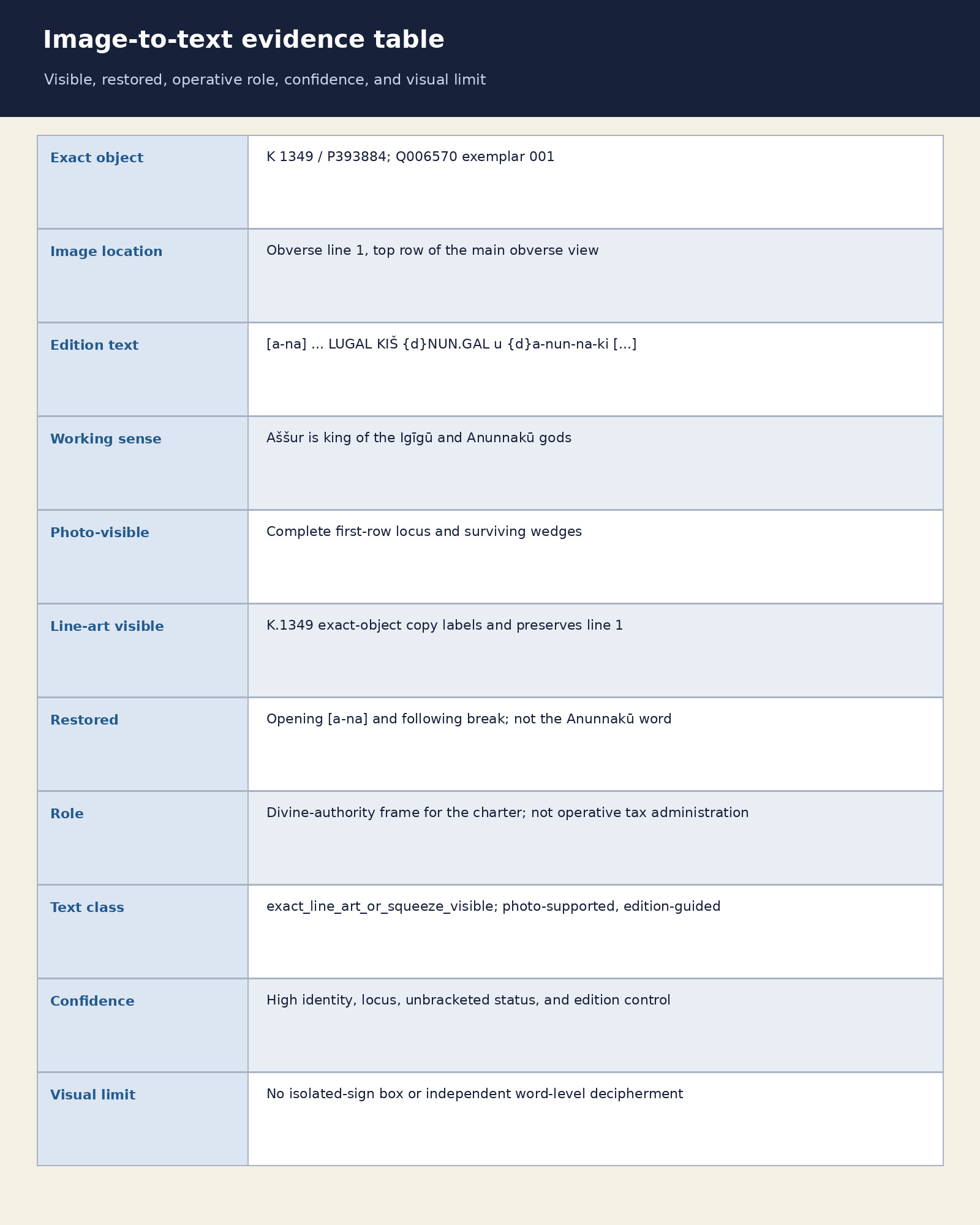
This result is exact-line-art visible, photograph-supported, and edition-guided. The core Anunnakū word is not supplied from a parallel or composite restoration. Because the obverse is densely written, this report marks the defensible complete row and does not claim a fresh pixel-level sign decipherment.
Judgment, oath, and charter authority
Obverse lines 3–6 describe Aššur as the Assyrian Enlil without whom judgment cannot be rendered or decisions canceled by another god. The same passage invokes an oath that is not broken. This does not say the Anunnakū themselves issue the charter; it says Aššur, identified as their king, anchors its judicial and oath-bound authority.
Service, corvée, levy, and dues

Reverse lines 31–34 say the people of Aššur had not known state service or corvée from remote times, accuse Shalmaneser V of imposing those burdens, and attribute his overthrow to divine anger. Reverse lines 35–40 then link Sargon’s scepter, throne, and crown to restoring exemptions from state service, corvée duty, land levy, herald proclamation, and quay/ferry dues.
The evidence is therefore stronger than a generic divine-list mention but narrower than a claim that the Anunnakū administer taxation. The group belongs to the charter’s hierarchy frame. The operative fiscal and labor acts belong to kings and institutions.
Published layer versus working inference
Published layer: RINAP supplies the catalogue, lineation, transliteration, translation, and Aššur Charter identification. CDLI supplies the exact photograph, exact line drawing, and P393884 metadata.
Working inference: placing Aššur’s kingship over the Anunnakū at the head of a legal charter helps explain how organized divine hierarchy legitimates civic privilege and royal policy. It does not turn the Anunnakū into tax collectors, labor overseers, extraterrestrials, or engineers.
Corpus relevance and limits
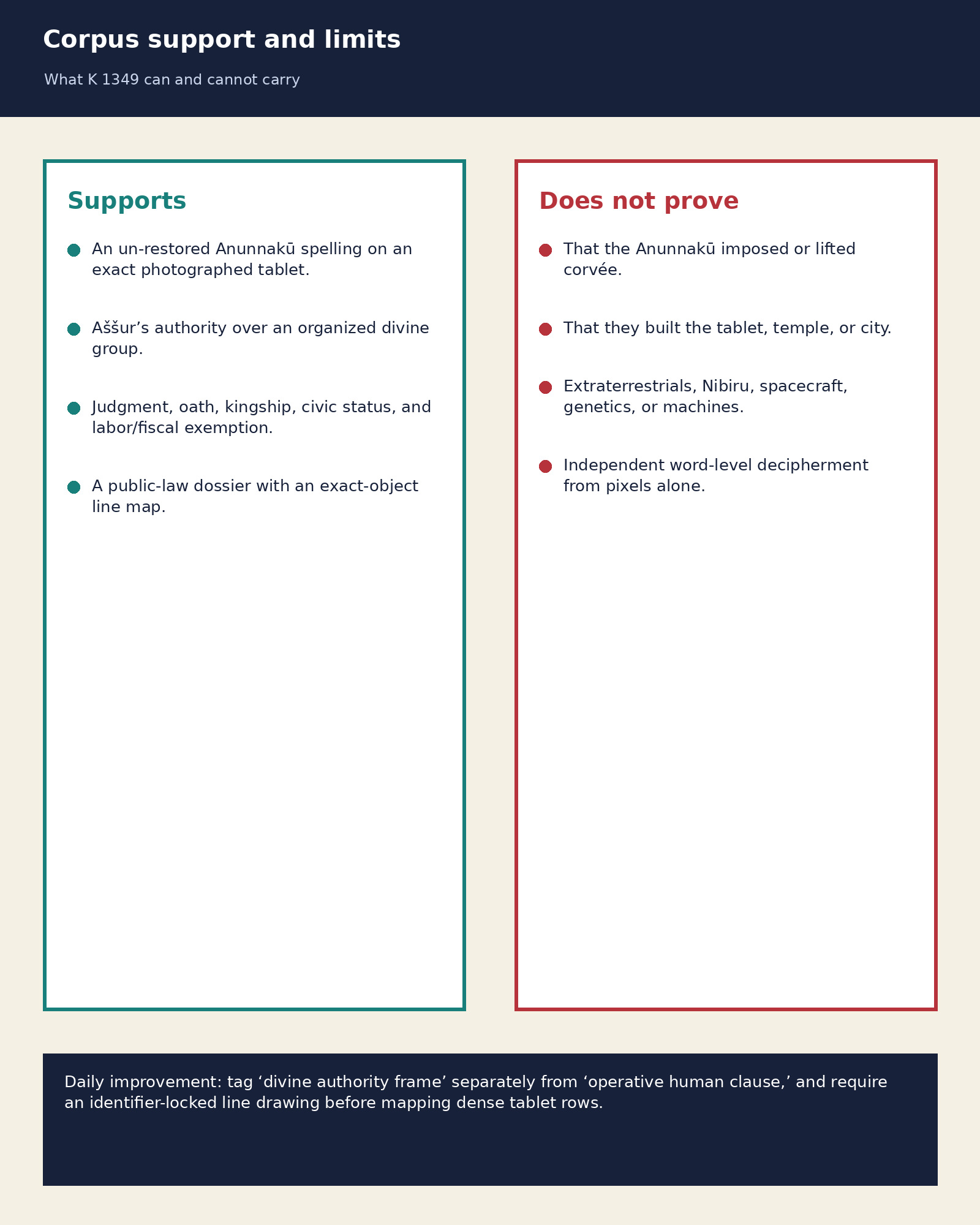
The source strongly advances the divine decrees, judgment/law, oath, kingship, human labor, civic privilege, and institutional authority strands. It does not prove extraterrestrials, Nibiru, spacecraft, genetic engineering, mining machinery, or recoverable advanced technology.
Sources and image credit
- ORACC/RINAP Q006570, Sargon II 89 — current catalogue, lineation, transliteration, translation, and notes.
- CDLI P393884 — exact artifact record, photograph, exact line drawing, and metadata.
- RINAP 2 primary edition — Sargon II 89 / Aššur Charter edition.
- ORACC Ancient Mesopotamian Gods and Goddesses: Anunna — historical forms and changing functions.
Daily capability improvement: add a frame-versus-operative-clause gate: identify where divine-group wording legitimates authority, then separately identify the human actor who performs the legal or economic action. Require an identifier-locked line drawing before mapping dense rows.
Download the evidence report: Sargon II’s Aššur Charter, Anunnakū authority, and corvée exemption PDF report.
Share this:

One considered email each week
TheCode Weekly Evidence Brief
Receive the week’s strongest tablet decode, source audit or research update, plus one carefully chosen archive read. Routine posts stay on the site; the Brief is the curated signal.
Free. Usually sent on Sunday. No daily post flood. Unsubscribe at any time. See what the Brief includes.