
Erra and Išum I: The Anunnakū Ascend—and the Text Turns to the Apsû
Exact-line-art report on P338333 / STT 1, 16: a partly restored Anunnakū subject takes an ascent verb, while Erra separately travels between heaven and the Apsû.

Ancient text and site reading
How to read this record
- Claim type
- Historical / textual + interpretive
- Evidence level
- Sources, translations, measurements, and symbolic reading where present
Use the evidence layer for sources and observations, and the interpretation layer for TheCode.Wiki synthesis.
Today’s selected artifact is STT 1, 16, catalogued by CDLI as P338333: a Neo-Assyrian clay-tablet witness from Huzirina (Sultantepe), now in the Anadolu Medeniyetleri Müzesi in Ankara. It preserves Tablet I of the Akkadian poem Erra and Išum. The key passage finally reaches a difficult corpus gap: one line makes the Anunnakū the subject of a plural verb meaning “go up” or “ascend.”
The result needs two immediate cautions. First, CDLI provides no usable photograph; the exact published line art is the permitted fallback. Second, the opening half of the Anunnakū spelling in the ascent line is restored. The verb and the surviving end of the group name are visible in the exact copy, but this is not a complete independent sign reading.

Why this witness advances the corpus
The cumulative corpus already shows Anuna/Anunnakū as judges, divine collectives, beneficiaries, and respondents to command. What remained unusually hard to document was movement language with the group itself as grammatical actor. Reverse column i line 50 of P338333 reads in part [{d}A.NUN].⸢NA⸣.KI il-lu-nim-ma: “The Anunnakū will go up …”.
That is stronger than proximity. The plural group noun and plural finite verb belong to one clause. Yet it is weaker than a completely un-restored spelling: {d}A.NUN is supplied, while NA.KI and illūnimma survive outside brackets. The article therefore classifies the result as exact-line-art visible and edition-guided, with partial restoration.
Artifact identity and exact-object image gate
CDLI identifies STT 1, 016 as P338333, a clay tablet excavated at Huzirina, dated to the Neo-Assyrian period (ca. 911–612 BCE), and held in Ankara’s Museum of Anatolian Civilizations. ORACC independently titles the same object “STT 1, 016 [Erra and Išum 1]” and links to CDLI P338333.
The exact downloaded plate is a 1191×3819 JPEG headed “16.” It displays the ancient tablet’s four-column copy, broken edges, joins, and numbered line loci. CDLI’s advertised photograph endpoint currently returns HTTP 404 and the artifact record exposes only the exact line-art reader. This is why the report uses exact_line_art, not a parallel, generated tablet, composite reconstruction, or related witness.
Two mapped movement loci

Reverse i 50: the group as subject
Edition transliteration: [{d}A.NUN].⸢NA⸣.KI il-lu-nim-ma šik-[na-at ZI{ti3} …]
Published ORACC translation: “The Anunnaku will go up and […] the living beings.”
Cautious working translation: “The Anunnakū will ascend, and […] living creatures.” The working version changes no philological claim; it merely makes the future plural movement clearer in English.
Image-to-text status: the exact copy locates reverse i 50. The final signs NA.KI and the finite verb illūnimma are unbracketed. The divine determinative and A.NUN are restored. The following phrase is damaged. Confidence is high for artifact identity, row, and the surviving verb, but only moderate for independent visibility of the complete divine name.
Reverse ii 3–4: Erra’s heaven/Apsû itinerary
Edition transliteration:
ana šamê ellīma ana Igīgī […] urta
urradu ana ABZU {d}A.NUN.NA.⸢KI⸣ upaqqad
Published ORACC translation: “I will go up to heaven and […] an order to the Igigi. I will go down to Apsu (and) care for the Anunnaku.”
Cautious working translation: “I will ascend to heaven and […] an instruction for the Igīgū; I will descend to the Apsû and attend to the Anunnakū.” Here the first-person subject is Erra. The Anunnakū are the object of his administrative care in the Apsû, not the travelers in this couplet.
Image-to-text hard gate

The report deliberately uses two kinds of claims. Reverse i 50 is the direct group-agency clause, but its group name is partly restored. Reverse ii 3–4 preserves ABZU, the Anunnakū logogram, and upaqqad without restoration, but Erra is the moving subject. Neither clause is allowed to borrow the other’s strengths.
No pixel-level word box claims more than the published copy can sustain. The line-art crops identify the rows and surface zones. Normalization, morphology, and English remain controlled by the scholarly edition.
Line-by-line context

Obverse ii 43–44: Erra’s boast
Erra describes himself as a hero among the Igīgū and the strongest among the Anunnakū. This frames him as a dangerous power within a differentiated divine hierarchy. It is rhetoric about rank; it does not yet make the groups agents of the later violence.
Reverse i 46–50: broken catastrophe and ascent
The surrounding sequence is badly damaged. It refers to arising, heavenly stars, winds, people or living beings, and confrontation before the ascent line. Because so much is lost, the report does not reconstruct a complete scenario. Only the surviving grammatical minimum is used: a partly restored Anunnakū name followed by an un-restored plural ascent verb.
Reverse ii 1–4: delegated order
Erra addresses Marduk during a period in which Marduk enters a house and the Fire-god cleanses his garment. Erra says that until Marduk returns, he will guide the judgment of heaven and earth. He then sets out a vertical administrative itinerary: up to heaven toward the Igīgū, down to the Apsû to attend to the Anunnakū.
Reverse ii 5–12: violence and destination
Erra proposes dispatching furious gallû-demons to the Land of No Return and making his weapons triumph. He later says he will make Anu and Enlil lie in wait at Marduk’s gate. Marduk approves Erra’s words, and the catchline says Erra set his face toward the dwelling of the Anunnakū. This is mythic conflict and divine geography, not a technical itinerary.
Colophon: a checked scholarly copy
The colophon says the tablet was written and checked according to its original and names Nabû-šuma-iškun, son of Kandalānu, as owner. The surviving object is therefore evidence for Neo-Assyrian scholarly transmission of the poem as well as for its literary theology.
Who moves—and who does not?

The Anunnakū are the partly restored subject of “will go up” in reverse i 50. Erra is the first-person traveler in reverse ii 3–4. The Igīgū are the heaven-associated recipients of an order. The Anunnakū are the Apsû-associated recipients of Erra’s care. A later scholar owns and checks the physical copy.
This split-agent reading is the main methodological result. A real ascent clause does not authorize assigning every nearby movement verb to the same divine group.
What this means for the Anunnaki thesis
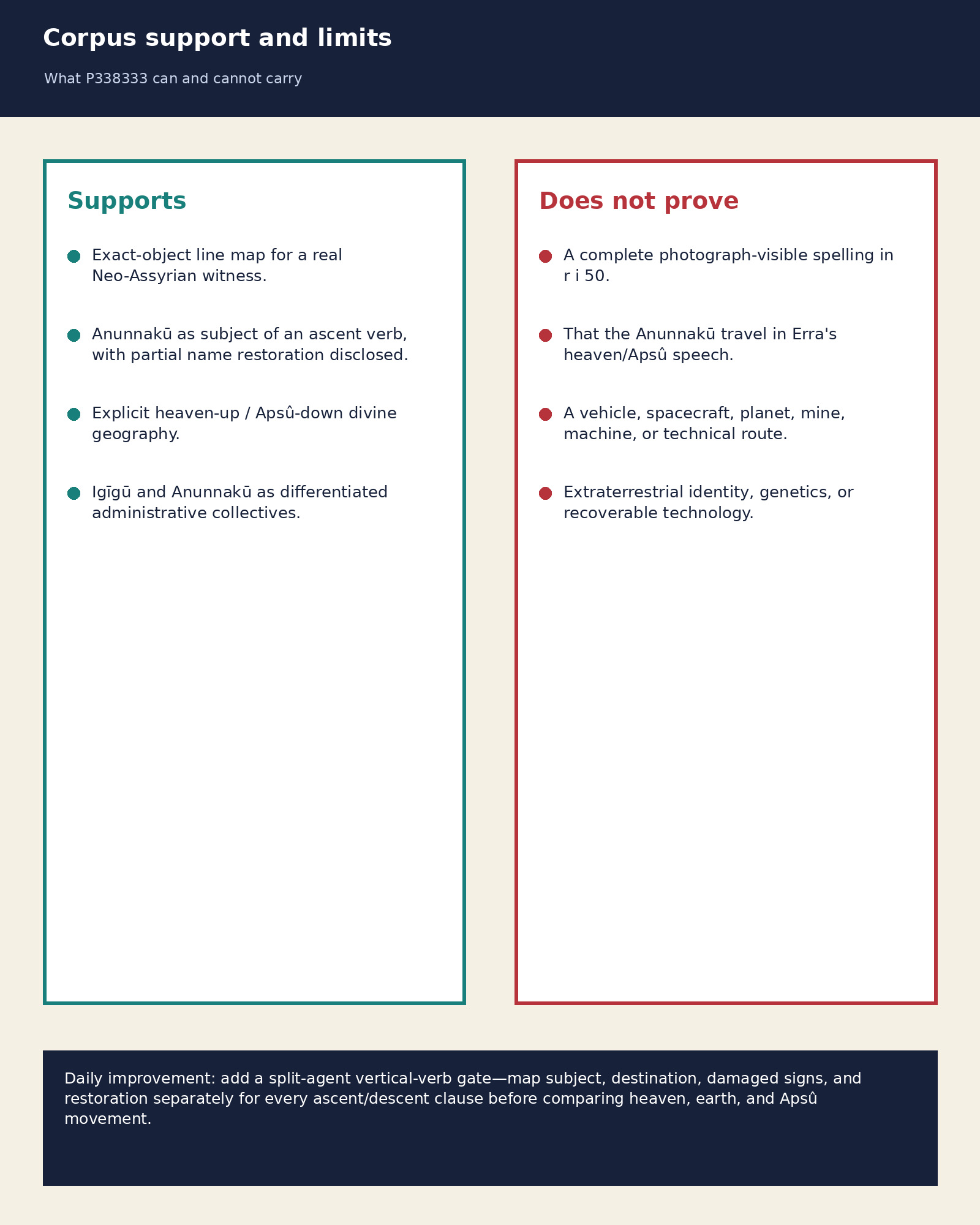
Support: P338333 preserves an exact-object line map where Anunnakū is the grammatical subject of ascent. The same witness explicitly differentiates heaven, Apsû, Igīgū, and Anunnakū in an ordered divine geography. This strengthens the limited thesis that Mesopotamian scholars imagined organized non-human/divine collectives acting within a vertically structured cosmos.
Limits and contradiction: the subject’s full written name is partly restored in reverse i 50; the poem’s next explicit heaven/Apsû travel belongs to Erra, not to the Anunnakū; and no vehicle, machine, planet, mine, genetic act, or technical route appears. The source does not prove extraterrestrials, Nibiru, spacecraft, genetic engineering, mining technology, or recoverable advanced science.
Sources and image credit
- ORACC/CAMS-GKAB P338333, STT 1, 16 [Erra and Išum 1] — current transliteration, translation, line numbering, and colophon.
- CDLI P338333 — artifact identity, period, provenience, collection, exact line art, and publication reference.
- CDLI exact line art for P338333 — the inspected four-column publication copy used for the visual gate.
- ORACC Ancient Mesopotamian Gods and Goddesses: Anunna — concise scholarly terminology overview.
- Gurney and Finkelstein, The Sultantepe Tablets I (1957), plate/text no. 16 — primary publication identified by CDLI.
Image credit: exact line art from Gurney and Finkelstein 1957, delivered by CDLI as P338333. Reproduced for artifact identification, research, and close commentary with source and publication credited. All colored boxes and explanatory panels are local overlays; no cuneiform signs were redrawn.
Daily capability improvement: use a split-agent vertical-verb gate. For every ascent or descent clause, separately record grammatical subject, destination, surviving signs, damaged text, restored signs, and the exact visual locus before comparing heaven, earth, and Apsû movement.
Download the evidence report: Erra and Išum, Anunnakū ascent, and Apsû movement PDF report.
Share this:

One considered email each week
TheCode Weekly Evidence Brief
Receive the week’s strongest tablet decode, source audit or research update, plus one carefully chosen archive read. Routine posts stay on the site; the Brief is the curated signal.
Free. Usually sent on Sunday. No daily post flood. Unsubscribe at any time. See what the Brief includes.


