
STT 1, 12: The Anunnakū Kiss Marduk’s Feet after the Apsu Ministry Is Assigned
Exact-line-art report on P338328: Usmu receives the Apsu ministry, the Igigi bow, and the Anunnakū as a complete collective kiss Marduk’s feet.

Ancient text and site reading
How to read this record
- Claim type
- Historical / textual + interpretive
- Evidence level
- Sources, translations, measurements, and symbolic reading where present
Use the evidence layer for sources and observations, and the interpretation layer for TheCode.Wiki synthesis.
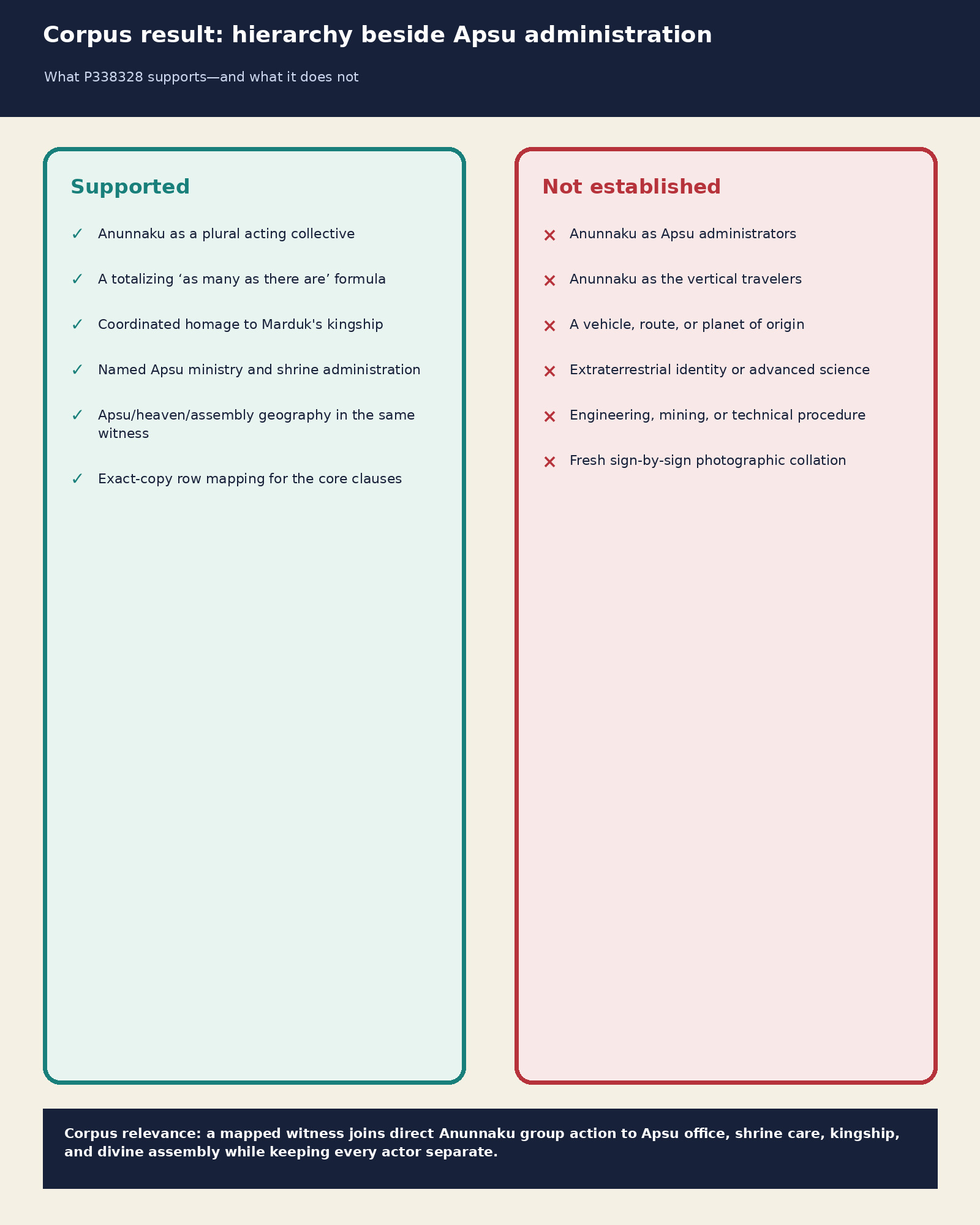
Main result: obverse 33′ / standard Tablet V line 86 makes the Anunnakū a plural acting collective. The divine determinative is restored and A is damaged-readable, but NUN.NA.KI, the totalizing phrase, the plural kissing verb, and “his feet” are un-restored. This is direct group agency, but its meaning is homage and submission to Marduk’s kingship—not travel, construction, mining, or technical work.

Why this exact tablet matters
CDLI P338328 identifies a Neo-Assyrian literary tablet from Huzirina, museum number SU 1951, 098, published as STT 1 no. 12, and labels it a witness to Enūma Eliš V. eBL SU-1951.98 independently repeats the museum number, P338328, STT no. 12, and Lambert manuscript V H; it reports hasPhoto=false and exposes only the exact CDLI line art. ORACC CAMS/GKAB P338328 supplies the exact-witness transliteration and published translation.
The 901×2660 copy was opened at original resolution. It depicts obverse, reverse, and the right edge with printed five-line register marks. CDLI’s advertised photograph returns 404, and eBL explicitly reports no photograph, so the runbook’s exact-line-art fallback applies.

Image-to-text hard gate
The printed obverse 30′ and 35′ register marks, ORACC witness numbering, and eBL’s current Tablet V apparatus converge on the two annotated rows. Obverse 31′ maps to standard V 84; obverse 33′ maps to standard V 86. The classification is exact_line_art_or_squeeze_visible and edition-guided for sign values, morphology, word division, syntax, and translation.

Published translation and cautious working translation
Obverse 31′ / V 84, edition: [i?-qi]p?-šu-ma šuk-kal-lu-ut ap-si-i pa-qa-du eš-re-e-ti. Published: “he entrusted the ministry of the Apsu (and) the care of the shrines.” Working: “He assigned him the Apsu ministry and oversight of the sanctuaries.” The opening verb is damaged/restored; the office, Apsu, and shrine-care terms are un-restored.
Obverse 33′ / V 86, edition: [{d}]a#-nun-na-ki ma-la ba-šu-u u₂-na-aš₂-ša₂-qu GIR₃-MIN-MEŠ-šu₂. Published: “The Anunnaku, as many as there are, kissed his feet.” Working: “All the Anunnakū who were present kissed his feet.” The divine marker is restored, A is damaged-readable, and the remainder of the group name plus the finite action phrase is un-restored.

What the passage actually says
Damkina celebrates Marduk. Usmu, the messenger who brought her gift and news, receives the Apsu ministry and care of shrines. The Igigi assemble and bow. The Anunnakū then kiss Marduk’s feet and join the larger submission scene. Later rows make Marduk king, promise obedience to his command, and place a proposed divine dwelling above the Apsu.
The agency boundary matters. Usmu receives the office. The Igigi prostrate themselves. The Anunnakū perform the kissing verb. Marduk receives kingship and proposes the sanctuary. Adjacency does not make the Anunnakū administrators of the Apsu, builders of the dwelling, or the explicit subjects of the later up/down movement clauses.

Apsu, heaven, and assembly
Reverse 13′–20′ / standard V 119–128 preserves Marduk’s speech about a residence above the Apsu and gods coming up from the Apsu or down from heaven for assembly. This is important vertical divine geography. Yet the exact lines do not explicitly name the Anunnakū as the travelers, identify a vehicle, describe a route from another planet, or give a technical travel procedure.
Corpus relevance and the Sitchin question
This witness advances the organized-divine-authority, Apsu, shrine-administration, kingship, and assembly gaps. It supports a historically grounded proposition: Mesopotamian tradition could portray the Anunnakū as a coordinated, totalized divine collective performing a consequential act of submission inside an ordered hierarchy with named offices.
It does not identify extraterrestrials, name Nibiru as their origin, describe spacecraft, preserve genetic engineering, or document advanced machinery. Its Apsu terminology belongs to divine geography and cultic administration; its direct Anunnakū verb is kissing, not engineering.
Sources and method
- CDLI P338328 / SU 1951, 098 / STT 1, 12 — exact artifact catalogue and line art.
- ORACC CAMS/GKAB P338328 — exact-witness transliteration and published translation.
- eBL SU-1951.98 — identifier, bibliography, photo-availability, and manuscript control.
- eBL Enūma Eliš Tablet V — current critical apparatus mapping manuscript V H to standard lines 84–86 and 113–128.
- ORACC AMGG: Anunna — terminology and historical function control.
Share this:

One considered email each week
TheCode Weekly Evidence Brief
Receive the week’s strongest tablet decode, source audit or research update, plus one carefully chosen archive read. Routine posts stay on the site; the Brief is the curated signal.
Free. Usually sent on Sunday. No daily post flood. Unsubscribe at any time. See what the Brief includes.


