Esarhaddon’s Zinçirli Stele: Marduk, the Anunnakū, and Royal Power
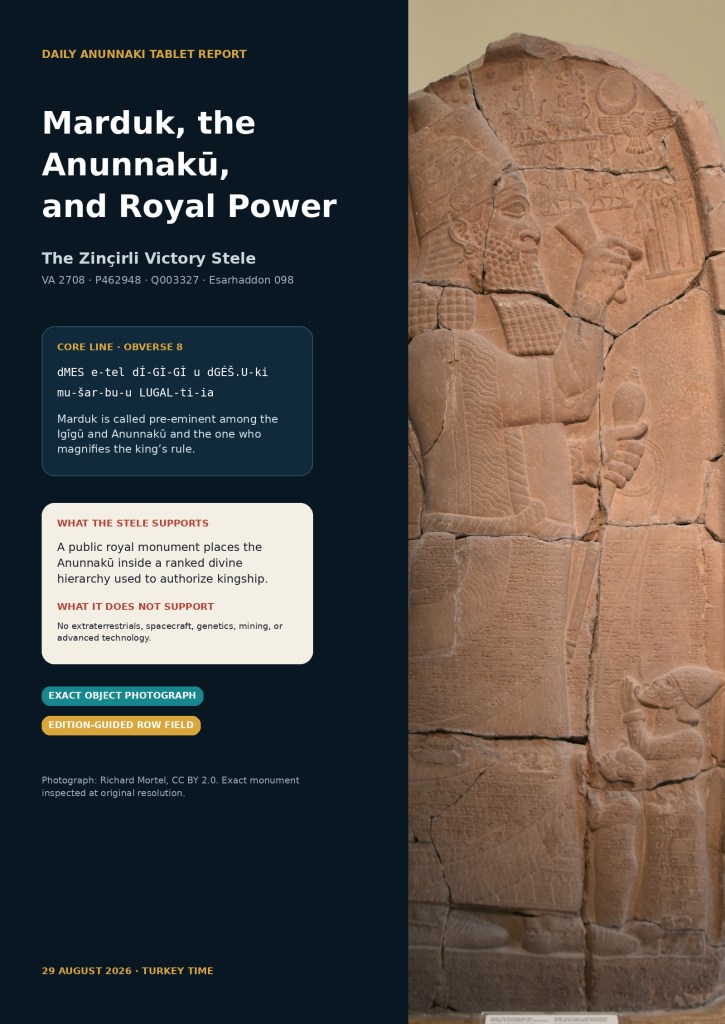
Exact VA 2708 report: Marduk is pre-eminent among the Igīgū and Anunnakū and magnifies Esarhaddon’s kingship on a public victory stele.
Ancient text and site reading
How to read this record
- Claim type
- Historical / textual + interpretive
- Evidence level
- Sources, translations, measurements, and symbolic reading where present
Use the evidence layer for sources and observations, and the interpretation layer for TheCode.Wiki synthesis.
Source-controlled result: VA 2708, the monumental Zinçirli victory stele of Esarhaddon, preserves an un-restored Akkadian line in which Marduk is called pre-eminent or heroic among the Igīgū and Anunnakū and “the one who makes my kingship great.” This is real evidence for a ranked divine hierarchy used to authorize royal power. It does not make the Anunnakū the actors of Esarhaddon’s campaign, and it does not support extraterrestrials, spacecraft, genetics, mining, or advanced technology.
Why this monument advances the corpus
The cumulative Anuna/Anunnakū corpus already shows the group in creation and labor traditions, divine assemblies, judgment, ritual submission, command structures, temple building, and royal theology. VA 2708 advances a narrower open gap: it places explicit Anunnakū language, Marduk’s hierarchical position, and the magnification of a historical king’s rule on one public stone monument.
The connection is meaningful because it is grammatical, not merely visual or thematic. Marduk is the named center of the title chain. The Igīgū and Anunnakū are the coordinated divine groups among whom he is pre-eminent. The participle mušarbû, “one who makes great / magnifies,” describes Marduk’s action toward Esarhaddon’s kingship. The line therefore supports a theology of ranked divine authorization. It does not say that the Anunnakū fought in Egypt, erected the stele, carved its relief, or managed an earthly administration.
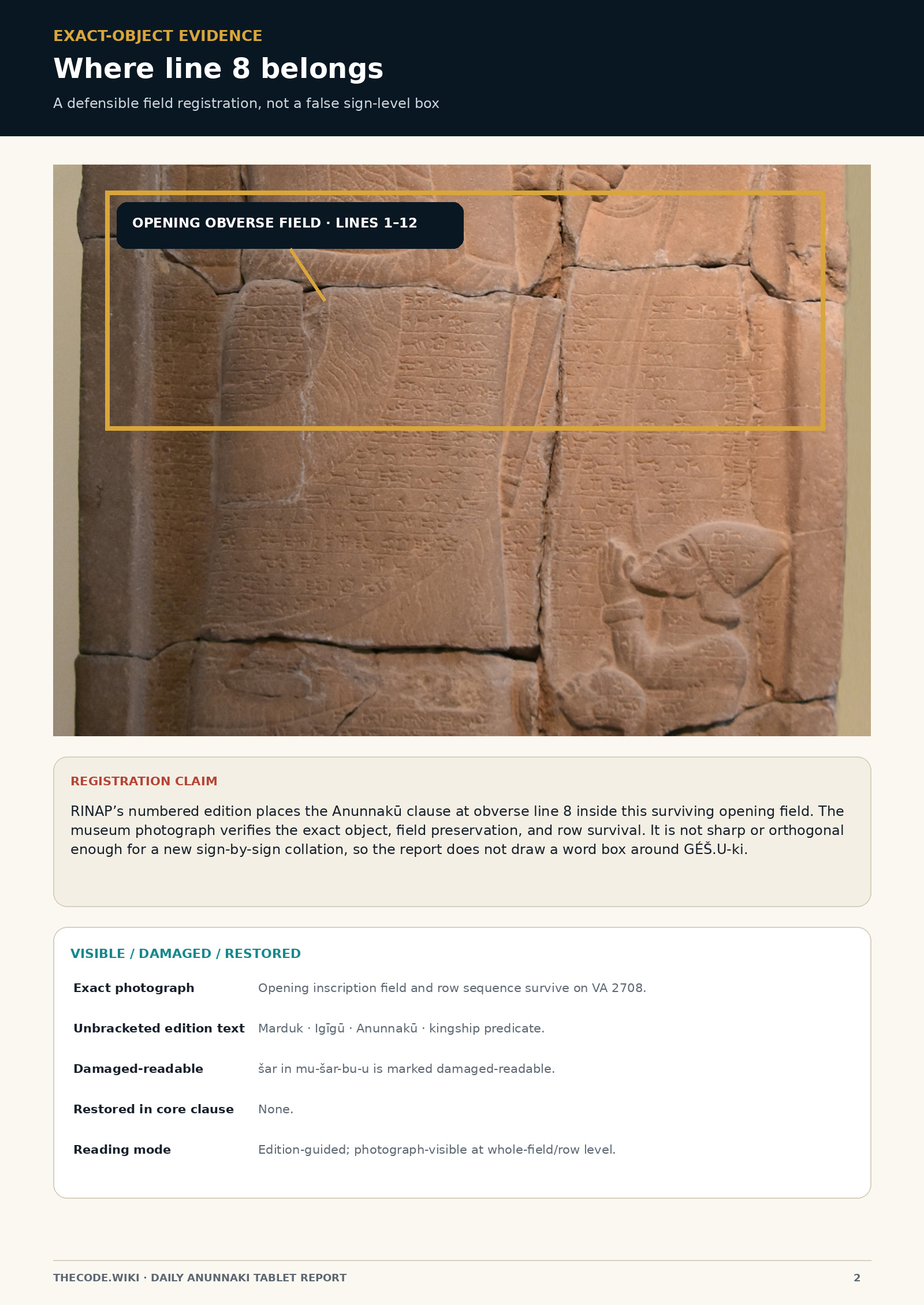
Artifact and source identity
- Museum number: VA 2708, Vorderasiatisches Museum, Berlin.
- ORACC: Q003327, Esarhaddon 098, conventionally Monument A.
- CDLI: P462948, the Esarhaddon 098 composite record.
- Findspot: Zinçirli, ancient Sam’al, beside the stone base in the small court inside the outer city gate.
- Dimensions: 322 × 135 × 50 cm in the RINAP catalogue.
- Date: composed after 22 Du’uzu 671 BCE in connection with Esarhaddon’s Egypt campaign; the current ORACC catalogue gives 671–669 BCE.
- Object: reconstructed monumental stone stele with royal relief, divine symbols, captive figures, and extensive Akkadian inscription.
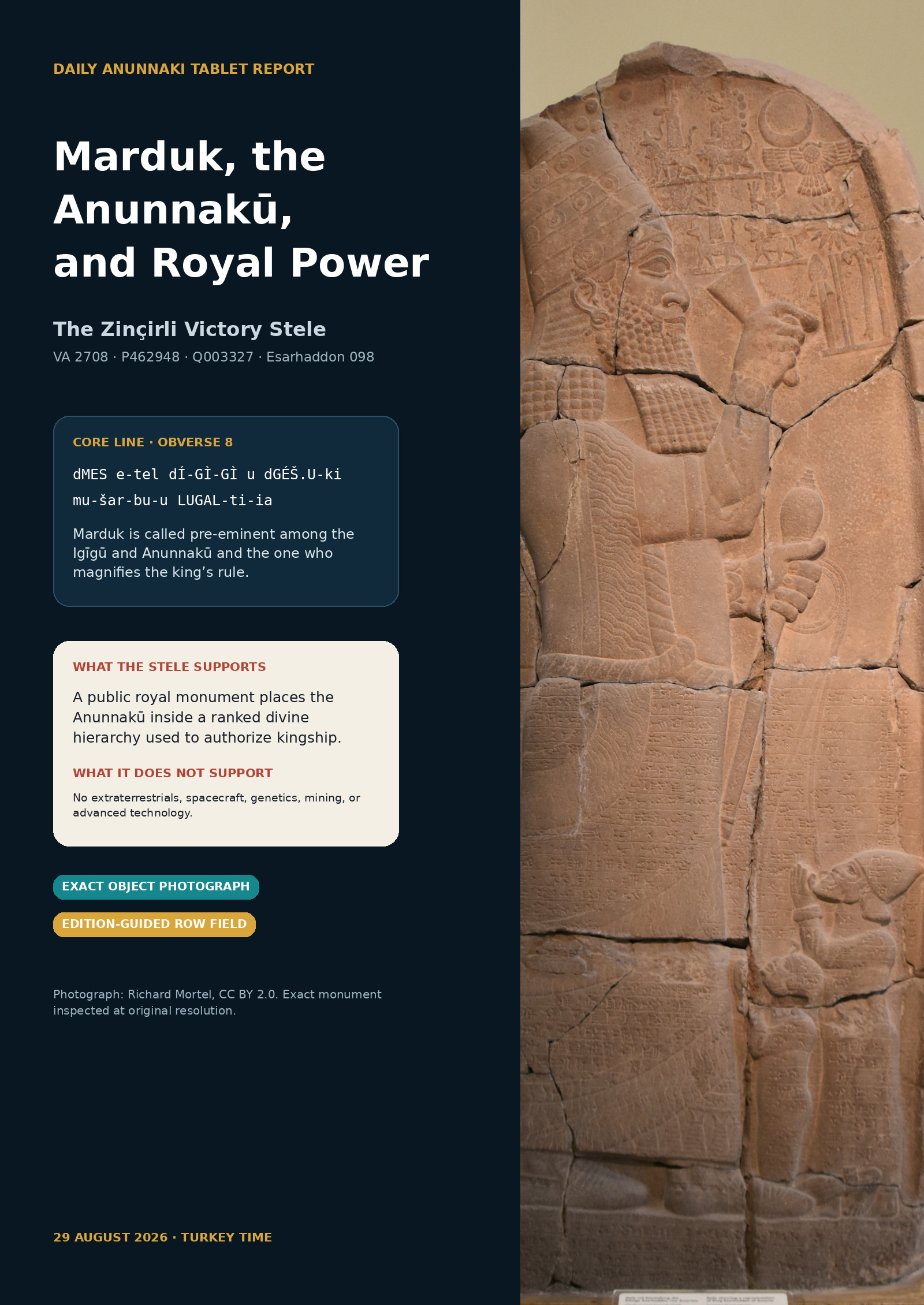
- Exact visual: a 2281 × 4361 straight full-object photograph plus 4016 × 6016 front/side and 3569 × 6016 reverse views, all downloaded, validated, and opened at original resolution.
- Identity controls: the RINAP catalogue and figure caption name VA 2708; ORACC binds VA 2708 to Q003327; the current Commons photographs identify the same Esarhaddon monument in Berlin.
The core line: published and working translations
Obverse line 8, edition transliteration: dMES e-tel dÍ-GÌ-GÌ u dGÉŠ.U-ki mu-šar-bu-u LUGAL-ti-ia.
RINAP published translation: “the god Marduk, hero of the Igīgū and Anunnakū gods, the one who makes my kingship great.”
Cautious working translation: “Marduk, the pre-eminent champion among the Igīgū and Anunnakū, the one who magnifies my kingship.” The working version makes the relational syntax explicit but does not change the basic published proposition.
The divine names and the kingship predicate are outside square brackets in the current edition. ORACC marks the sign šar in mu-šar-bu-u as damaged-readable. No sign in the Anunnakū spelling is supplied by restoration. This makes the text substantially stronger than a composite-only or wholly restored group reference.
The common modern spelling “Anunnaki” reflects later Akkadian Anunnakū, historically related to Sumerian Anuna/Anunna. That linguistic continuity is real; it does not, by itself, import modern claims about aliens, planets, genetic laboratories, or technology into the ancient word.
Image-to-text hard gate
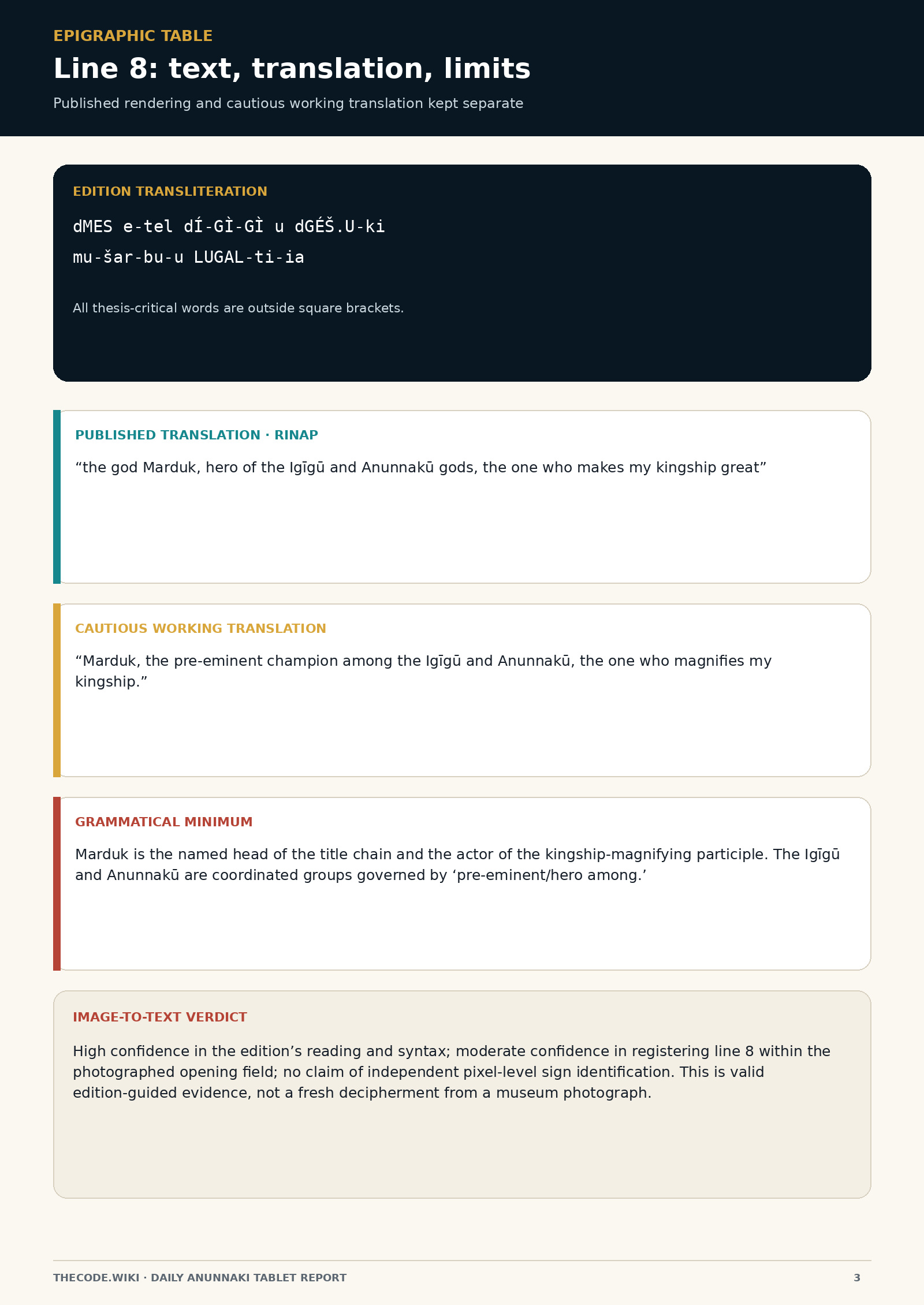
The result is edition-guided with photograph-visible row-field survival. The exact photograph independently verifies the monument, its preservation, the royal relief, and the survival of the opening obverse inscription field. RINAP’s numbered primary edition controls the row sequence and line 8. The museum photograph is not sufficiently orthogonal or sharp for a new pixel-by-pixel collation, so the annotation marks the opening field rather than drawing a deceptive word box around GÉŠ.U-ki.
This distinction matters. An exact photograph proves that the selected physical object exists and that the relevant inscribed field survives. It does not automatically prove every sign value. The line is accepted because exact-object survival, a numbered scholarly edition, an un-restored thesis-critical spelling, and current ORACC data converge. The result is not advertised as an autonomous decipherment from a museum photograph.
The opening divine hierarchy
Lines 1–12 form a tightly organized divine preface. Aššur is father of the gods and lover of Esarhaddon’s priestly service. Anu calls his name. Enlil confirms his reign. Ea decrees his destiny. Sîn makes omens favorable. Šamaš judges heaven and earth and provides legal decisions. Adad makes the king’s troops prosper. Marduk is then placed over the Igīgū and Anunnakū and magnifies kingship. Ištar accompanies the king in war, the Sebitti overthrow enemies, and the great gods decree destiny and give victorious might to their favored king.
This sequence strongly supports an organized, differentiated divine power structure. It also prevents careless role transfer. Šamaš owns the judicial clause; Ea owns the destiny clause at line 4; Marduk owns the line-8 kingship predicate; the great gods own the later destiny-and-victory clause. The Anunnakū are not made the grammatical authors of every nearby action simply because their name occurs in the same preface.
Agency firewall: hierarchy is not engineering

Marduk: title holder and grammatical center of line 8. Igīgū and Anunnakū: ranked divine collectives within that title. The great gods: collective fate and victory authorities in lines 11–12. Esarhaddon and his army: the operative earthly actors of campaign, conquest, prisoners, and monumental commemoration.
The source therefore supports divine authorization of royal power, not a technical work crew. Nothing in the core line assigns the Anunnakū a campaign verb, a construction verb, a craft verb, a movement verb, or a procedural administrative verb. The stele does not show them operating machines, directing transport, mining materials, or performing genetic work.
What the exact monument shows
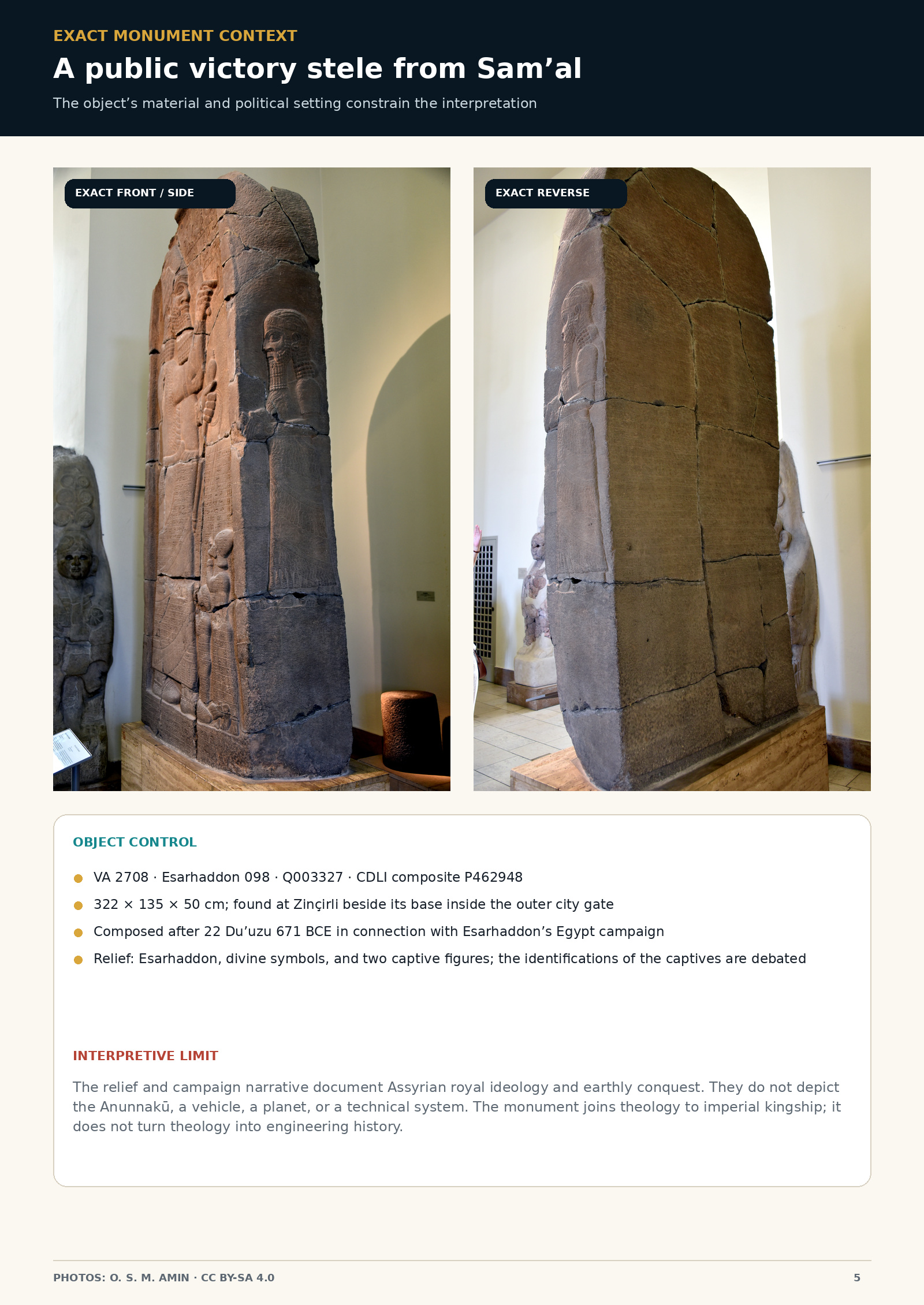
The relief presents an over-life-size Esarhaddon beneath divine symbols, holding ropes connected to two much smaller captives. RINAP notes that the identities of those figures remain debated. The inscription commemorates Esarhaddon’s invasion of Egypt. This is a public program of Assyrian royal ideology: divine order, victorious kingship, captured enemies, and durable monument are made to reinforce one another.
That political setting is not a reason to dismiss the divine vocabulary; it is the reason to interpret it carefully. The monument shows that Anunnakū language could function inside a state theology of royal legitimacy. It does not turn mythic or theological hierarchy into a hidden engineering record. The king’s army, captives, campaign, and monumental display remain human-imperial history framed by divine authority.
Corpus relevance, limits, and next step
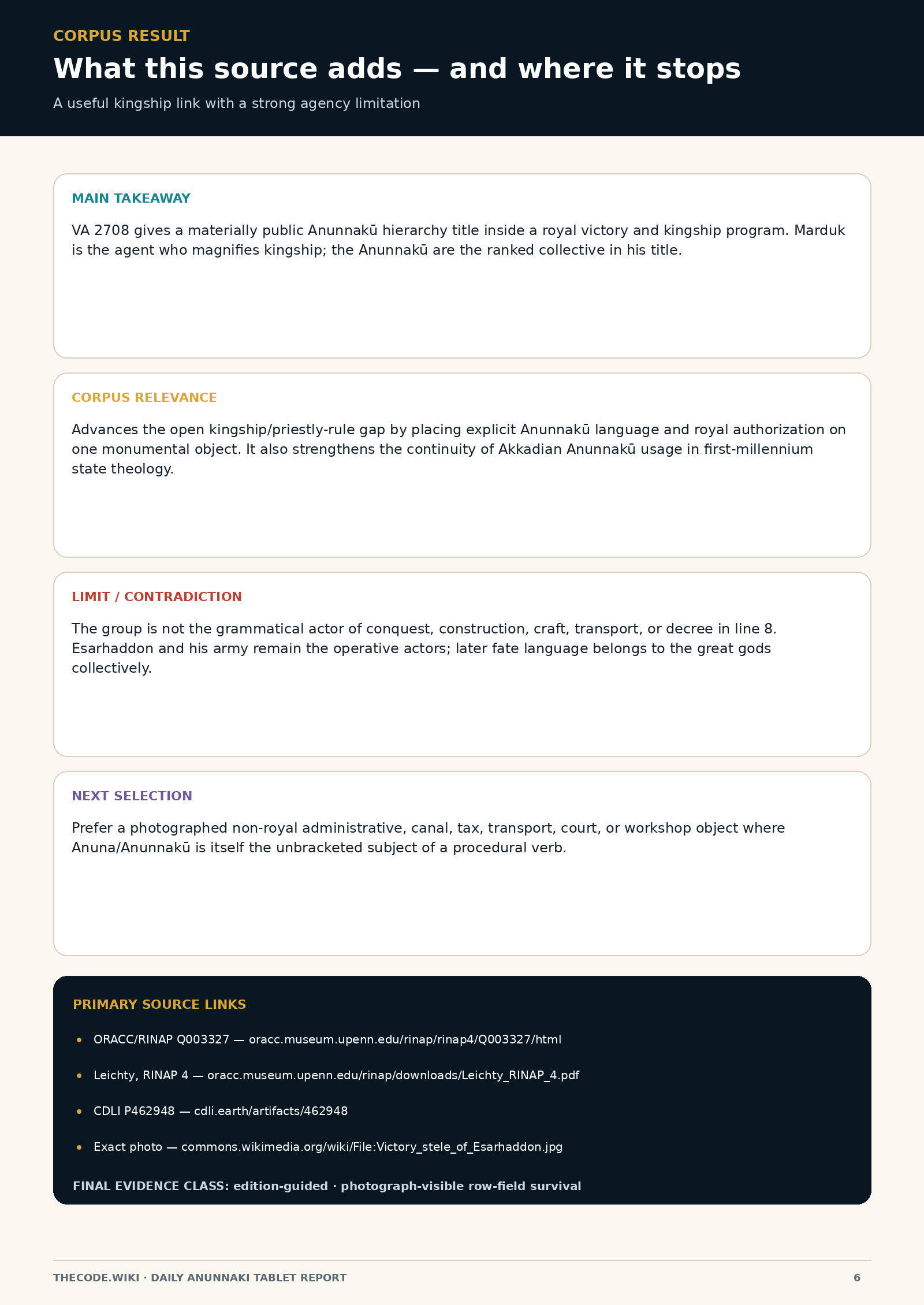
Supported: a materially public Anunnakū hierarchy title; Marduk’s pre-eminence over two divine collectives; the magnification of historical kingship; a wider divine program of destiny, judgment, military prosperity, and victory; and a real first-millennium Akkadian bridge for Anunnakū language.
Not supported: extraterrestrial origin, Nibiru as a home planet, spacecraft, genetics, laboratories, mining, advanced machinery, or an Anunnakū role in carving, transporting, erecting, or militarily using the monument. The exact image establishes the object and field; the reading remains edition-guided.
Daily capability improvement: this run adds a title-holder / ranked-collective / beneficiary firewall. Future reports will store the title holder, relational collective, verbal actor, royal beneficiary, operative human actor, and physical output independently. A group named inside a god’s title will no longer inherit the god’s predicate or the king’s later action.
Next selection: prioritize a photographed non-royal administrative, canal, tax, transport, court, or workshop object where Anuna/Anunnakū is itself the unbracketed grammatical subject of a procedural verb. That would test group agency outside royal ideology more directly than another divine title.
Primary and visual sources
- ORACC/RINAP Q003327 — Esarhaddon 098, current transliteration and translation
- Erle Leichty, RINAP 4 — catalogue, commentary, line 8, dimensions, and exact figure
- CDLI P462948 — Esarhaddon 098 composite and provenance control
- Exact full-object photograph by Richard Mortel, CC BY 2.0
- Exact front/side photograph by Osama Shukir Muhammed Amin, CC BY-SA 4.0
- Exact reverse photograph by Osama Shukir Muhammed Amin, CC BY-SA 4.0
Share this:

One considered email each week
TheCode Weekly Evidence Brief
Receive the week’s strongest tablet decode, source audit or research update, plus one carefully chosen archive read. Routine posts stay on the site; the Brief is the curated signal.
Free. Usually sent on Sunday. No daily post flood. Unsubscribe at any time. See what the Brief includes.