P277890: The Anuna Cower Before Nergal
Exact-witness analysis of P277890, where the un-restored Anuna collective cowers before Nergal—while kingship, fate, and operative authority remain with named deities.
Ancient text and site reading
How to read this record
- Claim type
- Historical / textual + interpretive
- Evidence level
- Sources, translations, measurements, and symbolic reading where present
Use the evidence layer for sources and observations, and the interpretation layer for TheCode.Wiki synthesis.
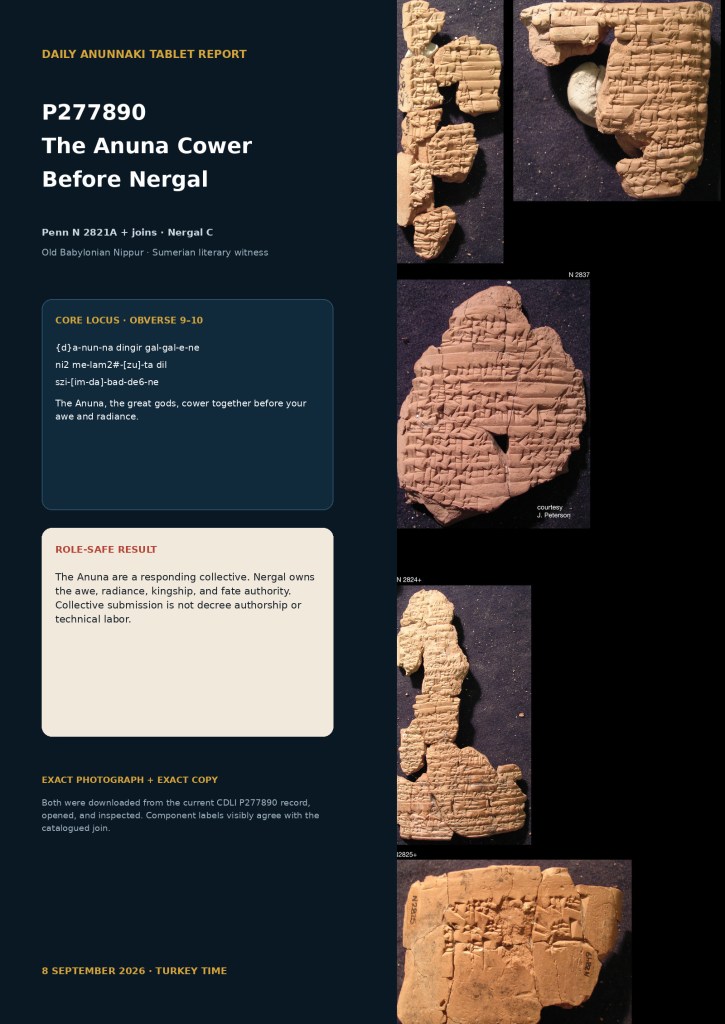
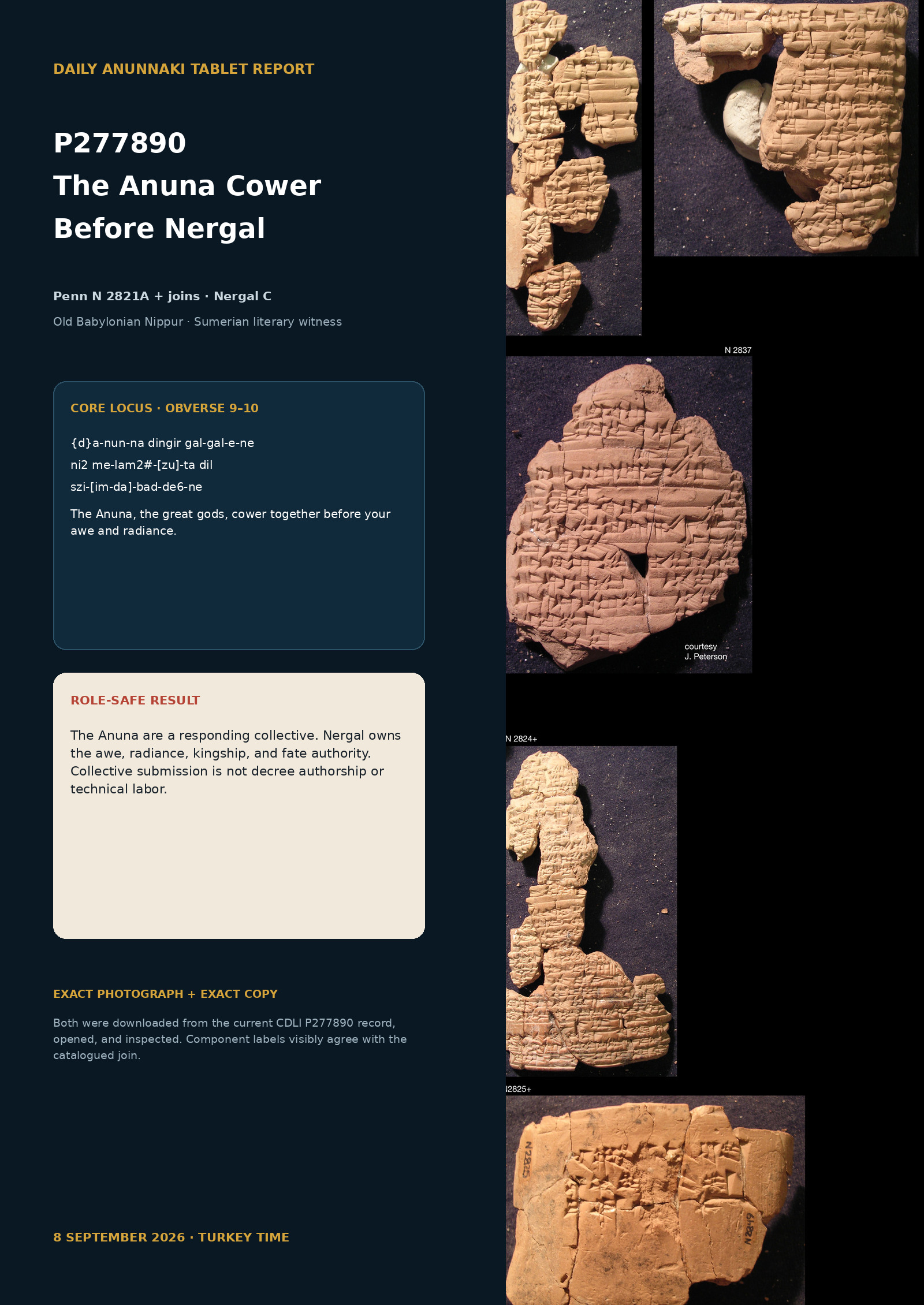
Today’s source is a real Old Babylonian manuscript, not a free-floating “Anunnaki tablet” claim. CDLI P277890 is a joined Penn Museum N-series tablet from Nippur and an exact witness to Nergal C (CDLI Literary 000695; ETCSL 4.15.3). Its opening repeated stanza names the Anuna as “the great gods” and describes them cowering together before Nergal’s awe and radiance. That is direct evidence for a differentiated divine collective—but it is not evidence that the Anuna create, decree fate, hold kingship, or operate technology in this passage.
Why this exact object qualifies
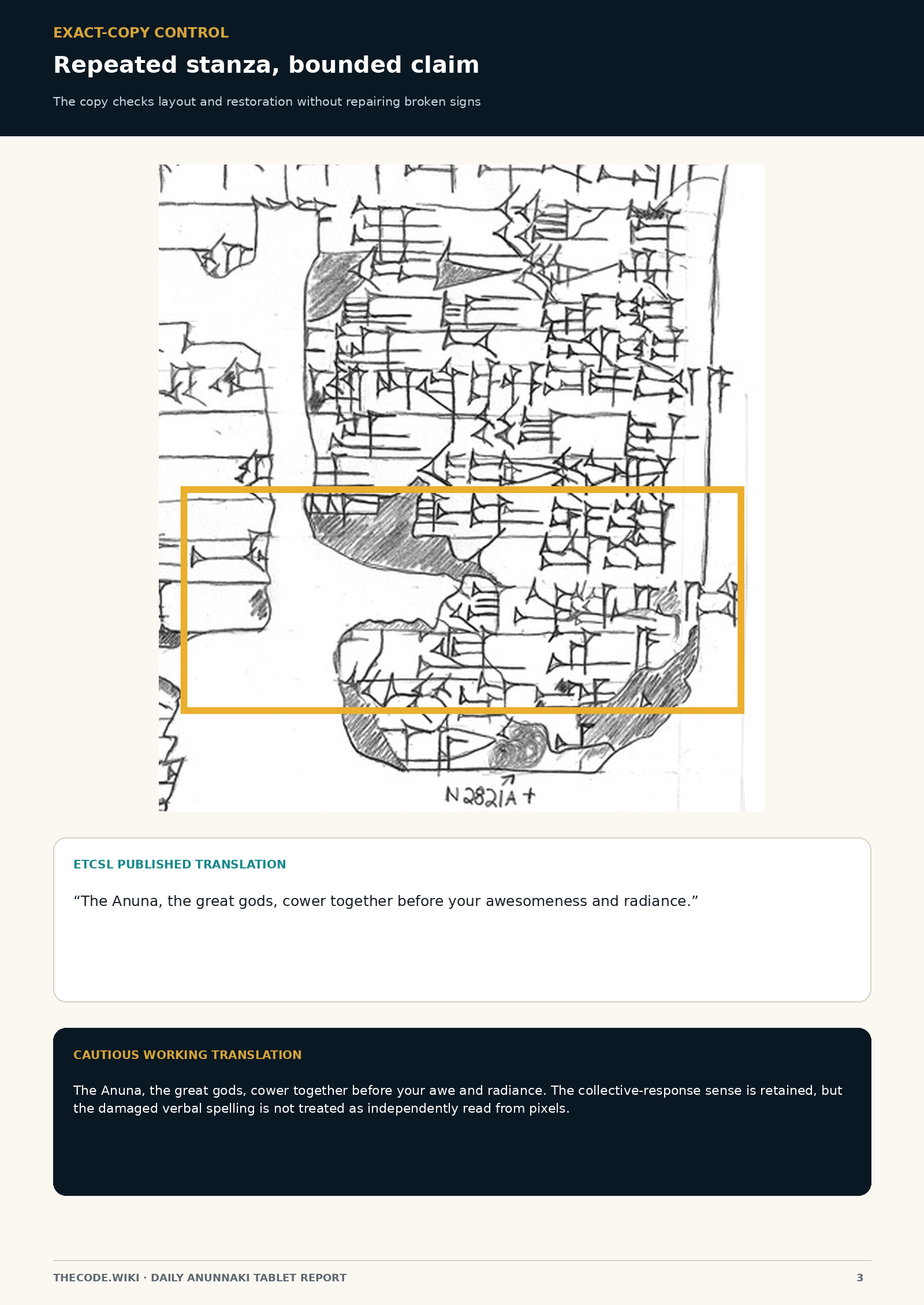
The current CDLI artifact page for P277890 identifies an Old Babylonian Sumerian literary tablet from Nippur in the Penn Museum. Its museum-number field begins with N 2821A and lists the joined N-series fragments. The current exact “Photo (detail)” asset is a 4798×15086 JPEG whose montage visibly prints N 2821A+, N 2836+, N 2837, N 2824+, and N 2825+. The exact-object line art is a separate 663×2808 JPEG and prints the same component labels.
Both exact assets were downloaded from CDLI, opened at original resolution, and visually inspected. CDLI’s Nergal C composite P478913 independently lists P277890 as a witness. These converging identifiers establish the selected object; neither image is a parallel, stock tablet, composite reconstruction, or generated illustration.
Obverse 9–10: published text and cautious translation
| Locus | CDLI witness transliteration | Cautious working translation | Status |
|---|---|---|---|
| Obverse 9 | {d}a-nun-na dingir gal-gal-e-ne | The Anuna, the great gods, | Full Anuna name and apposition are un-restored. |
| Obverse 10 | ni2 me-lam2#-[zu]-ta dil szi-[im-da]-bad-de6-ne | cower together before your awe and radiance. | me-lam2# is damaged-readable; [zu] and part of the response spelling are restored. |
The ETCSL published translation of Nergal C renders the repeated stanza: “The Anuna, the great gods, cower together before your awesomeness and radiance.” The working translation above keeps that minimum collective-response sense. It does not claim a fresh sign-by-sign decipherment from the photograph, because the verbal row is damaged and partly restored in the exact witness.
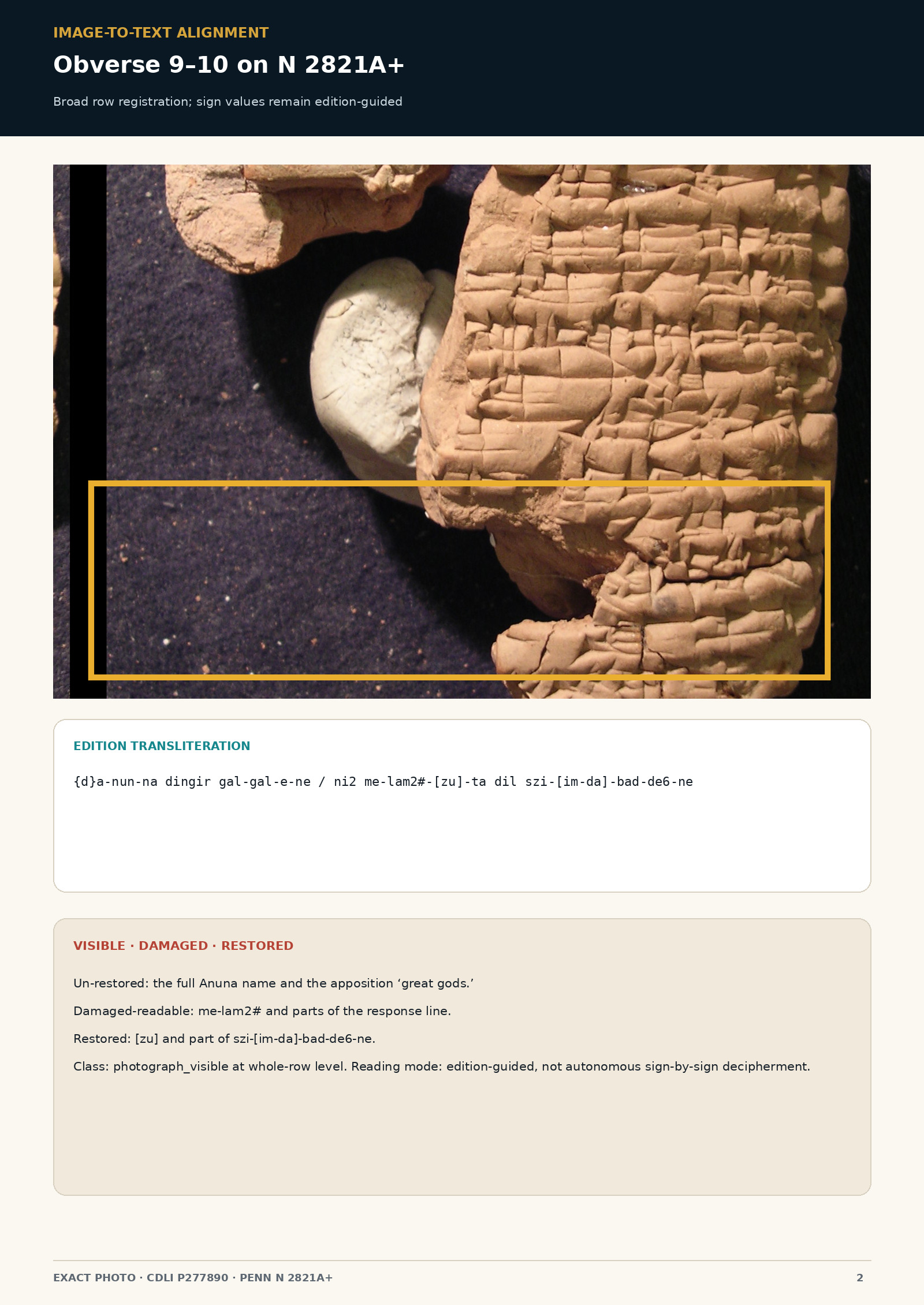
Image-to-text hard gate
The visual class is exact_selected_artifact, with an exact-line-art control. The textual evidence class is conservatively photograph_visible at whole-row level, while the reading remains edition-guided. The photograph verifies identity, preservation, component labels, and survival of the registered rows. The copy verifies layout and damage patterns. Neither visual is used to erase brackets or damaged-sign marks published by the editions.
| Image location | Visible / unbracketed minimum | Damaged | Restored or supplied | Confidence and exact limit |
|---|---|---|---|---|
| N 2821A+, obverse 9 | Full Anuna name; “great gods” apposition in the witness edition | None marked in the selected group name | None in the group name | High for row survival and un-restored subject; sign values edition-guided. |
| N 2821A+, obverse 10 | Surviving response-line signs | me-lam2# and other elements | [zu]; part of szi-[im-da]-bad-de6-ne | Moderate for minimum “cower/respond” sense; not autonomous image decoding. |
| Composite lines 4–5 | Parallel repeated stanza | Witness line 4 has damaged NUN and restored material | Some first-stanza wording | Comparative control only; it does not repair the exact second stanza. |
The repeated stanza: what it controls
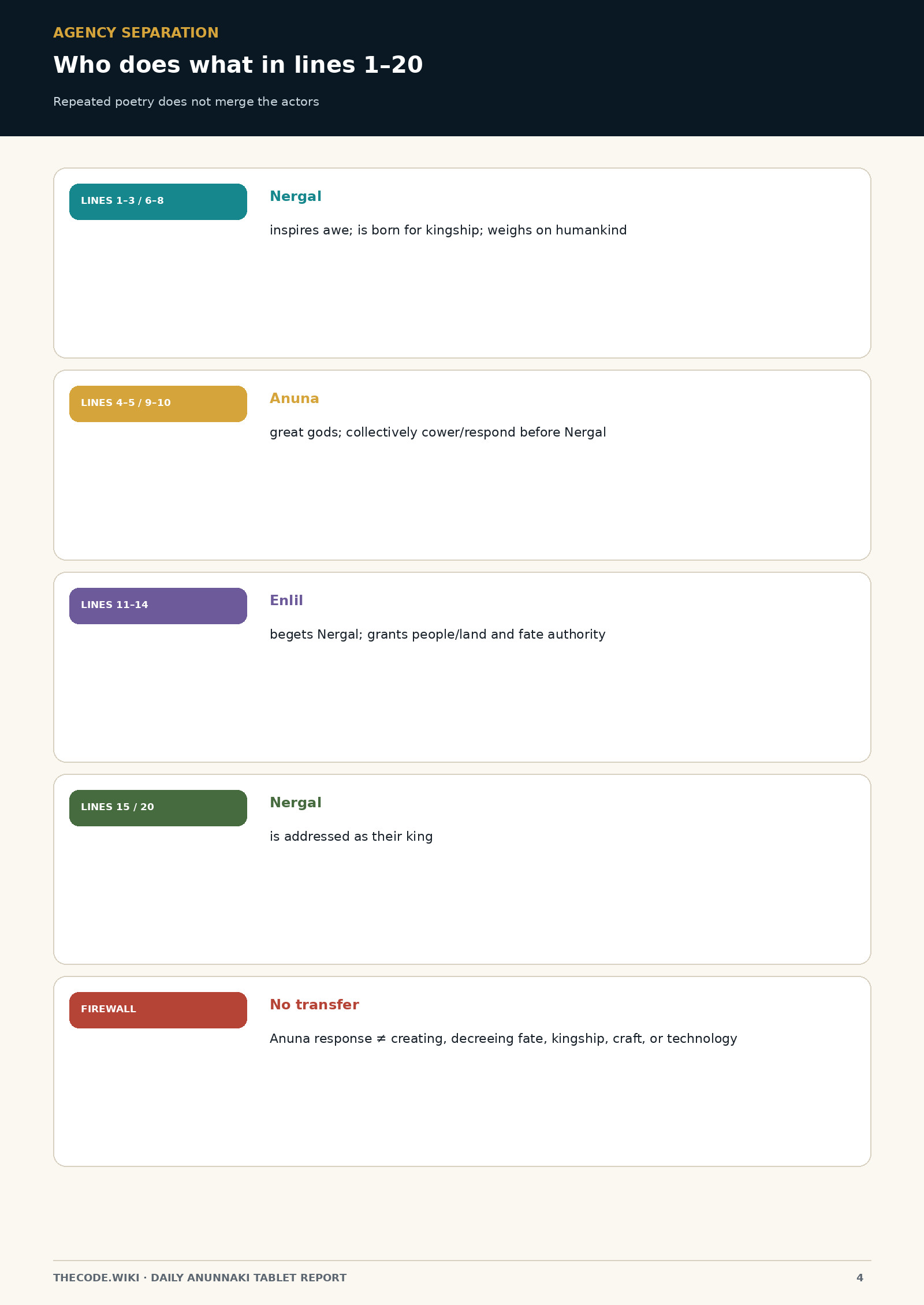
Nergal C repeats its opening five-line unit. Lines 1–3 describe a lord who inspires awe, is born for kingship, and weighs upon the black-headed people; lines 4–5 give the Anuna’s collective response. Lines 6–10 repeat that sequence with Nergal named explicitly. The second occurrence is especially valuable because line 9 preserves the full Anuna name without restoration, even though line 10 still carries damage and bracketed material.
The repetition provides a disciplined comparison, not permission to create a cleaner text than the artifact preserves. A surviving sign in one stanza may explain the edition’s reconstruction of the other, but it does not become photograph-visible on the damaged row. The report therefore records each occurrence separately.
Who owns kingship and fate?
Lines 11–15 shift to Nergal’s authority: Enlil begets him, grants him the people and the earth, and places fate-deciding authority in his hands; Nergal is addressed as their king. In this grammar the Anuna are the responding collective. Nergal and Enlil own the authority chain. The article therefore does not transfer the nearby kingship, creation, fate-setting, or command verbs to the Anuna.
What this adds to the cumulative corpus
P277890 advances the corpus’s organized-divine-collective strand with a real, exact witness and a direct plural response. The Anuna are not decorative scenery: they are named as “the great gods” and behave together in relation to a superior divine figure. The repeated stanza also supplies an unusually clear method for testing subject visibility against predicate restoration.
The result is strongest as evidence for hierarchy and collective behavior. It does not fill the harder proof gap of an un-restored Anuna subject governing a creation, measurement, transport, knowledge, or craft verb. It instead sharpens the boundary between collective response and another deity’s authority.

What the tablet does—and does not—support
The strongest positive claim is moderate support for an organized and ranked divine order. The Anuna appear as a plural body that responds together before Nergal. This is compatible with the broader picture of the Anuna/Anunnaki as a structured collective rather than vague mythic decoration.
The limits are decisive. This passage does not say the Anuna created humans, decreed fate, bestowed kingship, taught craft, measured land, transported materials, or built anything. It contains no evidence for extraterrestrials, Nibiru, spacecraft, genetics, laboratories, mining, machinery, or advanced technology. Divine radiance and awe are theological language, not a technical description.
Daily decoding improvement
This run adds a repeated-stanza restoration matrix and a response/authority firewall. For repeated passages, each occurrence must separately record group-name visibility, apposition, response predicate, damaged signs, restored signs, authority holder, and image-reading mode. A secure collective subject cannot inherit another deity’s kingship, fate, creation, command, or craft verbs merely because those ideas occur nearby.

Sources
- CDLI P277890 exact witness record and visuals
- CDLI P478913 Nergal C composite and witness list
- ETCSL 4.15.3 published translation
- Jeremiah Peterson, “An Adab Composition of Nergal/Meslamtaea at Lagaš and Ĝirsu for Šulgi,” JCS 67 (2015), 45–63
Download the full report
Bottom line: exact P277890 preserves an un-restored Anuna collective in a repeated scene of submission before Nergal. That strengthens the evidence for organized divine hierarchy while leaving fate, kingship, and operative action with the named deities who grammatically own them.
Share this:

One considered email each week
TheCode Weekly Evidence Brief
Receive the week’s strongest tablet decode, source audit or research update, plus one carefully chosen archive read. Routine posts stay on the site; the Brief is the curated signal.
Free. Usually sent on Sunday. No daily post flood. Unsubscribe at any time. See what the Brief includes.