
VAT 8242: Shamash, the Anunnaku, and Ritual Authority
Exact-photo and exact-copy study of VAT 8242 / P285405: Shamash is supervisor of the Anunnaku inside a learned healing tablet, while human specialists perform the procedures.

Ancient text and site reading
How to read this record
- Claim type
- Historical / textual + interpretive
- Evidence level
- Sources, translations, measurements, and symbolic reading where present
Use the evidence layer for sources and observations, and the interpretation layer for TheCode.Wiki synthesis.
Daily Anunnaki Tablet Report — 13 September 2026 (Turkey time). Today’s exact object is Vorderasiatisches Museum VAT 08242, catalogued as CDLI P285405 and published as BAM 4, 323. This large Neo-Assyrian learned tablet from Assur combines incantations with practical ritual-medical instructions for afflictions attributed to wandering ghosts. Its obverse line 19 invokes Shamash as “supervisor of the Anunnakū” and “foremost of the Igīgū.”

Result in one sentence: VAT 8242 places the Anunnakū inside a real professional healing dossier and ranks Shamash over them, but it assigns the operative ritual procedures to human specialists—not to the Anunnakū.
Download the six-page illustrated evidence report (PDF)
Why this tablet was selected
The corpus already contains many examples of Anuna or Anunnakū as judges, assemblies, recipients, mourners, or subordinates in royal praise. P285405 adds a different control case: explicit Anunnakū terminology in the middle of a large scholarly and therapeutic text. This helps test a recurring question in modern Anunnaki claims: does proximity to technical procedure mean the Anunnakū are the technicians?
Here the grammar answers no. The title belongs to Shamash. The Anunnakū are the group over which he is supervisor; the Igīgū are the group among which he is foremost. Elsewhere the tablet gives instructions to a practitioner and patient. The divine hierarchy frames the ritual, but the human agents execute it.
The object also passes the duplicate gate. P285405, VAT 08242, BAM 4, 323, and this Shamash/Anunnakū medical-ritual angle were absent from the project ledger and evidence index before the run.
Object identity and provenance
- Museum number: VAT 08242
- CDLI artifact: P285405
- Publication: BAM 4, 323
- Period and place: Neo-Assyrian; excavated at Assur
- Current collection: Vorderasiatisches Museum, Berlin
- Independent bridge: eBL VAT.8242, linked by BabMed
- Visuals inspected: 2374×6831 exact photograph and 1154×5090 exact numbered copy
Identity is established by the CDLI P285405 artifact record, which binds the museum number, designation, period, provenience, collection, photograph, line art, and artifact-specific transliteration. The Freie Universität Berlin BabMed edition page independently labels the text BAM 4, 323 (VAT 8242), links P285405 and eBL VAT.8242, and reproduces its lines.
The exact-image and image-to-text gates

The exact photograph visibly carries the number 8242 on its edge views and shows the obverse, reverse, fractures, lacunae, and survival of densely written rows. The exact copy is headed “323 VAT 8242” and numbers the obverse line sequence. That permits line 19 to be located without pretending that every sign was independently read from the photograph.
The visual class is therefore exact_selected_artifact plus exact_line_art. The textual class for the core line is exact_line_art_or_squeeze_visible. The translation is edition-guided: CDLI and BabMed control the sign values, normalization, and lineation; the image confirms the object and the exact row.
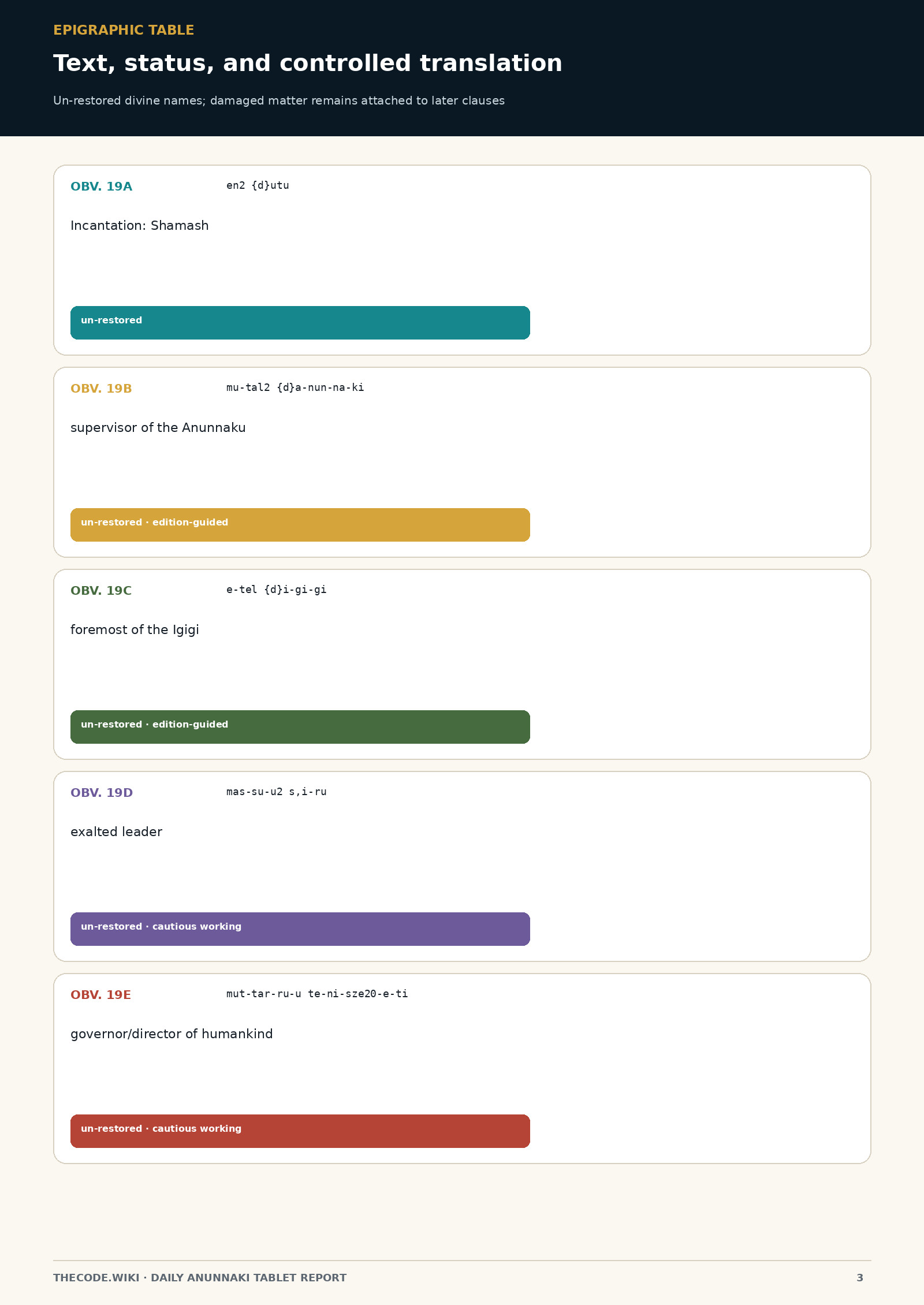
| Locus | Edition transliteration | Cautious sense | Status and visual limit |
|---|---|---|---|
| obv. 19a | en₂ {d}utu |
Incantation: O Shamash | Un-restored; exact-copy row visible; edition-guided. |
| obv. 19b | mu-tal₂ {d}a-nun-na-ki |
supervisor of the Anunnakū | Un-restored. Shamash is the title holder; Anunnakū is the complement. |
| obv. 19c | e-tel {d}i-gi-gi |
foremost of the Igīgū | Un-restored; separate ranked collective. |
| obv. 19d | mas-su-u₂ ṣīru |
exalted leader | Un-restored; cautious lexical rendering. |
| obv. 19e | muttarrû tēnišēti |
governor/director of humankind | Un-restored; predicate remains Shamash’s. |
Transliteration and translation
en₂ {d}utu mu-tal₂ {d}a-nun-na-ki e-tel {d}i-gi-gi mas-su-u₂ ṣīru mut-tar-ru-u te-ni-še-e-ti
Cautious working translation: “Incantation: O Shamash, supervisor of the Anunnakū, foremost of the Igīgū, exalted leader, governor of humankind.”
CDLI and BabMed publish the transliteration, while the English above is a cautious working translation. Mutallu is rendered here as “supervisor,” etellu as “foremost,” and muttarrû tēnišēti as “governor/director of humankind.” These titles form a praise sequence directed to Shamash. They do not make the Anunnakū the grammatical subject of supervising, governing, healing, judging, or performing the ritual.
The wider tablet: learned healing practice
BabMed describes BAM 4, 323 as an early Neo-Assyrian text containing incantations and medico-magical directions for illnesses caused by wandering ghosts. The artifact-specific text supports that description. Before line 19, instructions prescribe materials, fumigation, offerings, bindings, placement before Shamash, night observation, and repeated action. Lines 19–35 shift into a Shamash petition. Later sections resume procedures involving plants, oils, leather, figurines, washing, recitation, offerings, and timed ritual acts.
This genre matters. It is genuinely technical in the ancient sense: a professional tablet preserves a sequence of materials, timings, actions, divine addresses, and expected therapeutic outcomes. But the presence of technical procedure is not evidence that every named deity performs the procedure. The practitioner mixes, places, binds, washes, recites, and offers; the patient is treated; Shamash is invoked as judge and cosmic authority; the Anunnakū and Igīgū occur inside his ranked title.

Who does what?
Shamash: he is the addressed deity and title holder. Line 19 presents him as supervisor of the Anunnakū, foremost of the Igīgū, exalted leader, and governor of humankind. Lines 20–22 continue with judgment, unchanging command, ordering darkness, light for people, sunset, and sunrise.
The Anunnakū: they are a genitive complement of Shamash’s supervisory title. Their name is un-restored in this exact witness. They receive no operative medical verb in line 19.
The Igīgū: they are the second ranked collective, with Shamash described as foremost among them. This is valuable evidence that the text distinguishes divine groups instead of flattening them into one undifferentiated category.
The petitioner/patient: the first-person voice is afflicted and submits a case to Shamash. The patient is the target of prescriptions and therapeutic action.
The ritual specialist: imperative and procedural forms direct a human practitioner to prepare substances, position objects, make offerings, bind, wash, recite, and carry out timed steps. Those actions belong to the ritual workflow, not to the Anunnakū.
What the artifact supports
- Strong evidence for a ranked divine hierarchy in which Shamash is placed over the Anunnakū and foremost among the Igīgū.
- Strong evidence that explicit Anunnakū terminology could occur inside a professional scholarly and healing dossier.
- Moderate evidence for the broader corpus proposition that named divine offices framed ancient learned practice and judicial-therapeutic authority.
- A useful control showing that divine context, ritual expertise, and human technical action can coexist without sharing one grammatical actor.
What it does not support
The tablet does not describe the Anunnakū as extraterrestrials, physicians, laboratory workers, genetic engineers, spacecraft operators, miners, or users of advanced machinery. It does not say that they prepared medicines or performed the ritual. The healing procedures are human ritual practice; the divine collectives occur in Shamash’s title. Calling this “Anunnaki medical technology” would erase the grammar and the genre.

Corpus significance
P285405 advances the knowledge/procedure gap by adding a disciplined negative control. The corpus can now distinguish three layers on one exact artifact: divine rank, a professional therapeutic dossier, and human procedural agency. That is more useful than merely collecting another Anunnakū mention because it tests the mechanism by which modern claims often overreach—from “a divine group is named near ritual expertise” to “the divine group performed advanced technology.” This tablet supports the first proposition and contradicts the unwarranted leap to the second.
For the Sitchin hypothesis, the strongest defensible relevance is limited but real: Mesopotamian learned tradition remembered the Anunnakū as an organized divine collective embedded in a hierarchy and invoked within institutional knowledge practice. The source does not identify that collective as biological extraterrestrials or preserve recoverable alien technology.
Daily capability improvement: title-head versus procedural-actor firewall
Today’s reusable improvement records the title holder, divine complement, addressed judge, petitioner, practitioner, patient, and each operative procedure as separate fields before synthesis. Applied here: Shamash holds the supervisory title; the Anunnakū and Igīgū are ranked complements; the afflicted person petitions; human specialists execute the therapeutic sequence. This prevents a named divine group from inheriting nearby technical actions.

Primary records and reproducibility
- CDLI P285405 artifact record
- Exact CDLI photograph
- Exact numbered line art
- BabMed BAM 4, 323 transcription and dossier description
- eBL VAT.8242 identifier record
- CDLI publication record for BAM 4
Final evidence class: exact selected artifact photographed and inspected; exact numbered copy aligned to obverse 19; Anunnakū spelling un-restored; reading edition-guided. The photograph verifies identity and preservation, while CDLI/BabMed control sign values and translation.
Share this:

One considered email each week
TheCode Weekly Evidence Brief
Receive the week’s strongest tablet decode, source audit or research update, plus one carefully chosen archive read. Routine posts stay on the site; the Brief is the curated signal.
Free. Usually sent on Sunday. No daily post flood. Unsubscribe at any time. See what the Brief includes.


