
P281824: The Anunnaki Will Speak With You in an Assur Ritual
Exact-photo and line-art study of VAT 13653, where an Assur ritual says the Anunnaki will speak with a human addressee.

Ancient text and site reading
How to read this record
- Claim type
- Historical / textual + interpretive
- Evidence level
- Sources, translations, measurements, and symbolic reading where present
Use the evidence layer for sources and observations, and the interpretation layer for TheCode.Wiki synthesis.
CORE LOCUS · REVERSE 62–63
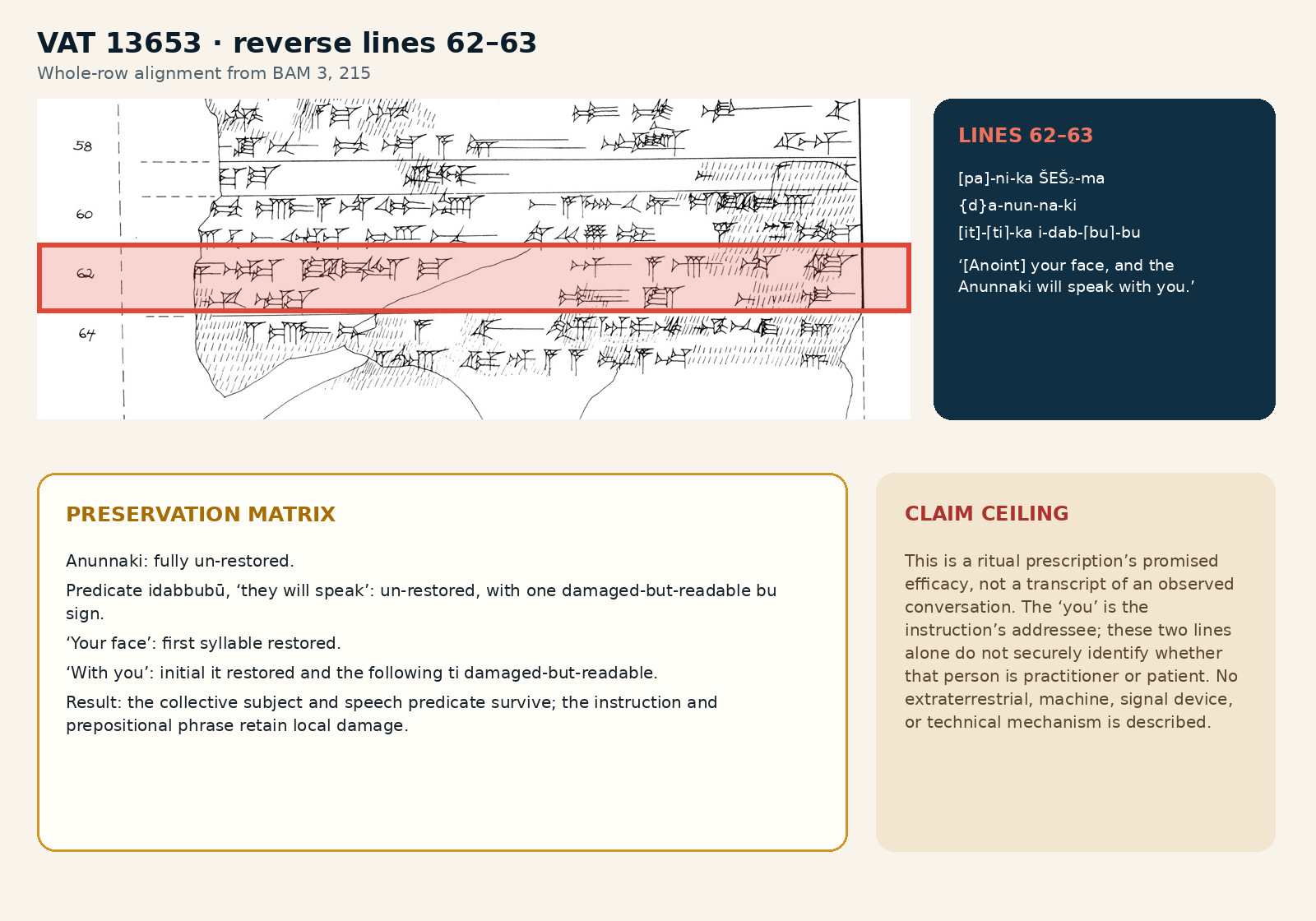
[pa]-ni-ka ŠEŠ₂-ma {d}a-nun-na-ki
[it]-⌈ti⌉-ka i-dab-⌈bu⌉-bu
Cautious working translation: “[Anoint] your face, and the Anunnaki will speak with you.”
Why this witness matters
Much Anunnaki discussion begins with modern claims and works backward. This report takes the opposite route: one identified object, one current scholarly text, one defensible image location, and one grammatical proposition. P281824 is a real clay tablet excavated at Assur, catalogued as VAT 13653 in Berlin’s Vorderasiatisches Museum, and published as BAM 3, no. 215. CDLI classifies it as a Neo-Assyrian Akkadian medical or scholarly text; it is also linked to the Corpus of Mesopotamian Anti-witchcraft Rituals as CMAwRo Q004191.
The corpus value is unusually direct. The Anunnaki are not merely a title, offering recipient, or background collective. They are the grammatical subject of idabbubū, “they will speak/talk,” in relation to a second-person human “you.” This advances the daily corpus’s communication and knowledge-interaction strand while still demanding strict limits: the clause promises ritual efficacy; it does not document a recorded encounter or name any mechanism.

Exact-object provenance and image-to-text alignment
The exact photograph and exact-object copy answer different questions. The photograph proves that the selected physical artifact is VAT 13653 and shows its preservation, edges, obverse, and reverse. The published copy visibly prints “215 VAT 13653” and gives continuous even-numbered line controls. On the reverse, markers 60, 62, and 64 make rows 62–63 defensibly locatable.
The annotation therefore marks a whole-row band, not individual signs. This distinction matters. The image establishes exact-object identity and row survival; BabMed and CDLI control the sign values, morphology, and line reading. The result is classified as exact-line-art visible and edition-guided, not as an independent photograph-only decipherment.

Published text and cautious working translation
The current BabMed record for BAM 3, 215 and the CDLI P281824 artifact record display a scholarly transliteration but no English translation. Accordingly, this report does not present its English sentence as a quotation from a published translation. It first preserves the source edition’s transliteration and then labels the English as a cautious working translation.
| Slot | Edition reading | Working sense | Status |
|---|---|---|---|
| Instruction | [pa]-ni-ka ŠEŠ₂-ma |
“[Anoint] your face, and …” | pa restored |
| Subject | {d}a-nun-na-ki |
“the Anunnaki” | fully un-restored |
| Relation | [it]-⌈ti⌉-ka |
“with you” | it restored; ti damaged-readable |
| Predicate | i-dab-⌈bu⌉-bu |
“they will speak/talk” | un-restored; one bu damaged-readable |
The core proposition is therefore narrower and stronger than a dramatic paraphrase: the exact witness preserves an un-restored Anunnaki collective as the subject of an un-restored plural speech predicate. Restoration affects parts of the instruction and the phrase “with you,” not the divine name or the verb that establishes speech agency.
The ritual context
The immediately preceding lines keep the claim grounded. Reverse 60–61 prescribe a preparation involving the anāmiru plant, water, cedar oil, mixing, a threefold recitation, and a calendrical instruction. Lines 62–63 then express what the treatment is expected to achieve. That sequence is crucial: it is procedural ritual language followed by a promised result.
This context supports a history-of-religion claim: Mesopotamian learned ritual could imagine a human entering a condition in which the Anunnaki would speak with that person. It does not prove that such a dialogue was independently witnessed. Nor do the two selected lines securely determine whether the second-person addressee is the ritual practitioner or the patient. The report therefore leaves that role unresolved instead of converting an ambiguous pronoun into a story.
Anuna and Anunnaki
Sumerian texts often write the collective as Anuna or Anunna; Akkadian sources use forms conventionally normalized as Anunnakū and popularly rendered “Anunnaki.” P281824 is an Akkadian Neo-Assyrian witness and writes the familiar syllabic sequence {d}a-nun-na-ki. The ancient corpus uses the group in multiple settings—assembly, underworld, hierarchy, ritual, and literary action—so the name should not be flattened into one modern definition.
Here the safest description is functional: the Anunnaki are treated as a coordinated divine collective capable of speaking within a prescribed ritual’s promised efficacy. The text does not provide biological, planetary, or technological identification.
Corpus relevance and the Sitchin test
Support: this witness adds direct collective agency to the corpus. The Anunnaki themselves govern the speech predicate, and the clause places that action in relation to a human “you.” It therefore matters for testing claims about organized non-human/divine authority, communication, and knowledge mediation.
Limits: the tablet does not identify extraterrestrials, Nibiru, spacecraft, a transmitter, radio, engineered telepathy, genetics, mining, laboratories, or advanced machinery. Nothing in the Akkadian wording specifies a technical mechanism. Treating “will speak with you” as a communication device would import modern machinery into a ritual statement that does not name one.
The result is neither dismissal nor sensationalism. It is a source-backed middle position: a genuine ancient witness attributes speech agency to the Anunnaki collective under ritual conditions, while the stronger ancient-astronaut mechanism remains unsupported by this object.
Daily decoding capability improvement
This run adds a speech-act preservation matrix. Future communication passages will track four elements separately: (1) ritual or narrative instruction, (2) divine collective subject, (3) human addressee or relational phrase, and (4) speech predicate/content. A secure subject and verb can support direct agency even when adjacent pronouns are restored; the human role and any proposed communication mechanism remain unclaimed unless the exact wording supplies them.
Sources
- CDLI P281824 artifact record — identity, metadata, transliteration, exact photograph, exact line art, references.
- eBL VAT.13653 fragment record — museum identity, BAM references, dimensions, excavation/archive controls.
- BabMed BAM 3, 215 — current line-numbered scholarly transliteration.
- CDLI exact photograph — exact selected physical artifact.
- CDLI exact line art — exact-object copy and reverse-line registration.
Download the full six-page evidence report:
P281824 / VAT 13653 — The Anunnaki Will Speak With You (PDF)
Share this:

One considered email each week
TheCode Weekly Evidence Brief
Receive the week’s strongest tablet decode, source audit or research update, plus one carefully chosen archive read. Routine posts stay on the site; the Brief is the curated signal.
Free. Usually sent on Sunday. No daily post flood. Unsubscribe at any time. See what the Brief includes.


