P283737: The Anuna Bless Sîn-iddinam at the New Year
Exact-line-art, edition-guided study of Sîn-iddinam A line 9: the Anuna, the great gods, bless the king within a New Year offering hymn.

Ancient text and site reading
How to read this record
- Claim type
- Historical / textual + interpretive
- Evidence level
- Sources, translations, measurements, and symbolic reading where present
Use the evidence layer for sources and observations, and the interpretation layer for TheCode.Wiki synthesis.
Daily Anunnaki Tablet Report · 15 September 2026
Result: BM 014016 preserves a line in which the Anuna are explicitly called “the great gods” and, according to the composite edition, bless or chant a prayer for King Sîn-iddinam. The divine subject is un-restored; the predicate is damaged on this witness, so this is an exact-line-art, edition-guided result—not independent pixel decoding.

Download the six-page illustrated PDF report
Why this tablet matters
P283737 is a real Old Babylonian literary tablet from Nippur, now catalogued as BM 014016. It is one witness to the praise poem conventionally called Sîn-iddinam A, identified by CDLI as composition Q000502/P481126 and by ETCSL as c.2.6.6.1. The primary copy was published as CT 42, item 45. ETCSL’s bibliography assigns lines 1–19 of the poem to this tablet.
The selected line advances a specific corpus gap: the Anuna are not merely listed or assembled; they perform a concrete act toward a named historical king. Yet the wording also imposes a useful limit. Sîn-iddinam handles cargo and offerings, Suen orders offerings, and Enlil fixes destiny. The Anuna’s own role is blessing or prayer. That actor separation is the center of this report.
The exact image-to-text alignment
| Evidence field | Result |
|---|---|
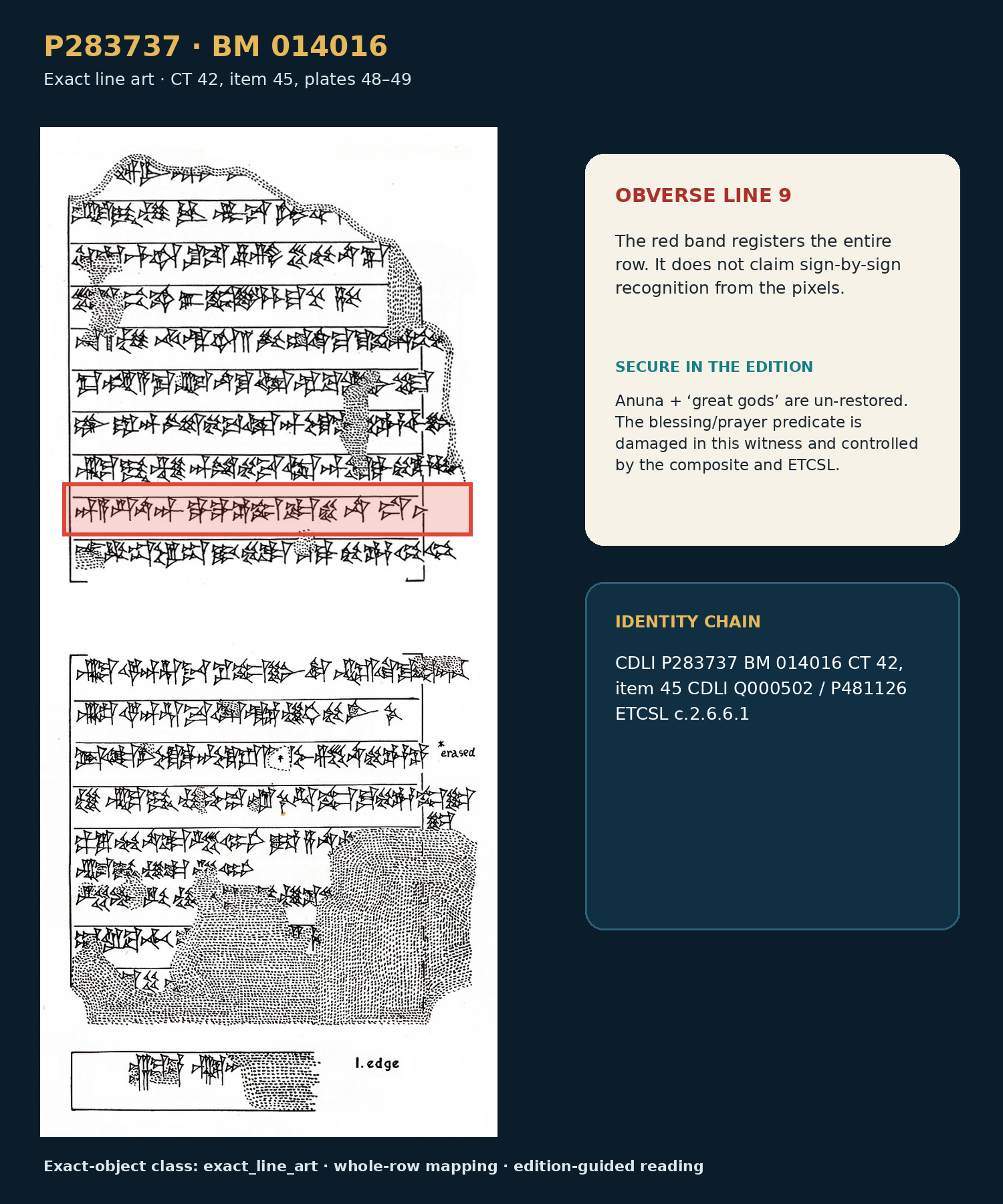
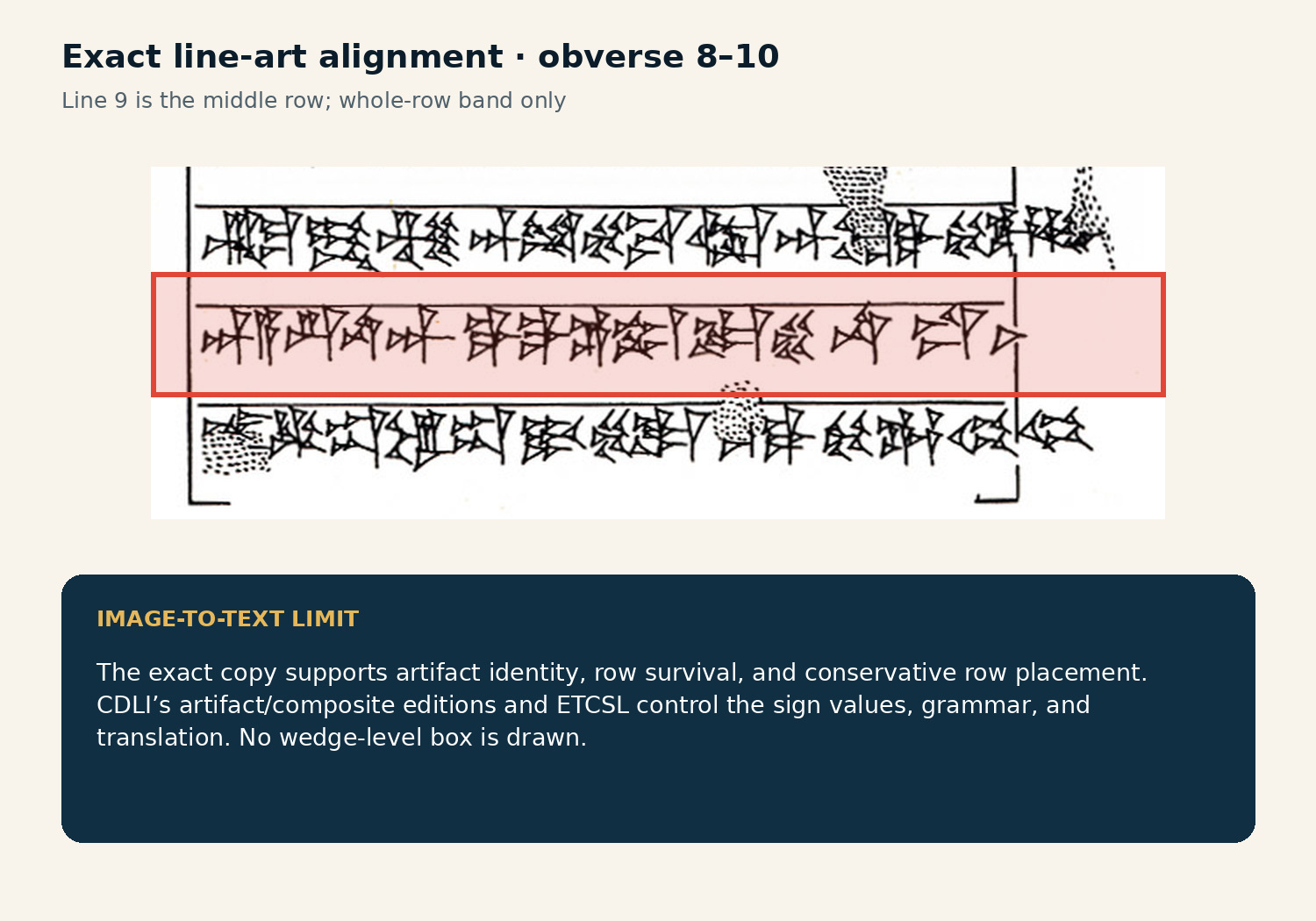
| Image location | P283737, obverse line 9; whole-row band between the printed 5 and 10 markers on CT 42 plate 48. |
| Edition transliteration | {d}a-nun-na dingir gal-gal-e-ne šudu₃ mu-na-šá₄-aš |
| Published translation | ETCSL: “The Anuna, the great gods, blessed him.” |
| Cautious working translation | “The Anuna, the great gods, chanted a prayer/blessing for him.” |
| Visible and un-restored | The exact copy preserves the row’s sign traces; the edition prints the Anuna name and “great gods” apposition without restoration brackets. |
| Damaged / composite-controlled | The predicate is imperfect on P283737. Composite P481126/Q000502 and ETCSL control its normalized form and translation. |
| Confidence and limit | High for the named subject and apposition; moderate and edition-guided for the action. No independent wedge-level decoding is claimed. |
Published translation and cautious reading
ETCSL renders the core sentence: “The Anuna, the great gods, blessed him.” The phrase {d}a-nun-na dingir gal-gal-e-ne transparently names the Anuna and identifies them as the great gods. The following verbal phrase is conventionally understood as prayer or blessing for the king. Because the exact witness is damaged there, the cautious working translation retains both “prayer” and “blessing” and labels the result edition-guided.
This distinction matters. The image is not decorative: it proves that the report uses the correct physical witness and that the relevant row survives. But it cannot legitimately upgrade a damaged predicate into a photographic reading. The scholarly composite supplies what the copy alone cannot.
What happens around line 9
In lines 5–8, Sîn-iddinam carries cargo to the Quay of Life at Ur and enters Suen’s house joyfully. Nanna is delighted and Ningal looks favorably on the king. Line 9 then brings in the Anuna, the great gods, who bless or pray for him. Line 10 returns to the king’s cultic duties: abundance, pure first fruits, and New Year offerings.
The next section widens the hierarchy. Suen orders offerings, while Enlil fixes a favorable destiny and long life. These are adjacent but grammatically distinct roles:
- Sîn-iddinam: transports cargo and perfects offerings.
- Nanna/Ningal: express delight and favor.
- The Anuna: bless or chant a prayer for the king.
- Suen: orders offerings.
- Enlil: fixes favorable destiny and long life.
No verb migrates from one actor to another merely because the lines are nearby.
Corpus relevance
This witness strengthens the corpus strand on kingship and divine legitimation. The Anuna act collectively toward a historical ruler, participating in a larger cultic order rather than functioning as vague background scenery. The text therefore supports coordinated divine approval and hierarchy.
It does not make the Anuna responsible for cargo transport, the mechanics of the offering system, or the fixing of destiny. Those predicates belong to the king, Suen, and Enlil. Nor does the tablet describe spacecraft, genetic engineering, mining, laboratories, machinery, or extraterrestrial visitors. The strongest honest conclusion is theological and political: the great gods validate royal and cultic order.
Exact-artifact provenance
The identity chain uses three matching references: CDLI P283737, British Museum number BM 014016, and CT 42 item 45. The CT 42 primary plate visibly labels “14016,” while CDLI binds that museum number to P283737 and composition Q000502. No publicly usable exact photograph was located in the current CDLI result, museum search, or primary publication path, so the workflow uses the exact line art expressly permitted when an exact photograph is unavailable.
Daily decoding capability improvement
This run adds a damaged-predicate actor gate for line-art witnesses. Before assigning an action to a named divine collective, the workflow now stores four fields separately: the un-restored subject, the predicate’s witness-specific damage state, the composite normalization, and the published translation. A whole-row visual may verify location and survival while the action remains edition-guided. This blocks both false pixel decoding and the transfer of neighboring verbs to the Anuna.
Sources
- CDLI P283737 artifact record
- CDLI P481126 / Q000502 composite record
- ETCSL c.2.6.6.1 translation: Sîn-iddinam A
- ETCSL witness bibliography
- CT 42 primary publication scan via ETANA
Evidence class: exact line art; whole-row location visible; reading and damaged predicate edition-guided. The report records support, limitations, and actor-specific contradictions rather than forcing an ancient-astronaut conclusion.
Share this:

One considered email each week
TheCode Weekly Evidence Brief
Receive the week’s strongest tablet decode, source audit or research update, plus one carefully chosen archive read. Routine posts stay on the site; the Brief is the curated signal.
Free. Usually sent on Sunday. No daily post flood. Unsubscribe at any time. See what the Brief includes.