Authority Within the Anuna: Exact Ur Fragment P346173 and the Title/Agent Question
Exact tablet P346173 preserves an un-restored authority title among the Anuna while proving that nearby kingship and craft language does not make the group technical agents.

Exact-witness authority audit
How to read this record
- Claim type
- Sumerian textual analysis
- Evidence level
- Current CDLI record, exact photograph and exact UET 6 line drawing for CDLI P346173 / UET 6, 0088 + 0538
- Status
- Exact-line-art visible; un-restored Anuna at obverse line 4 prime; edition-guided reading
An unnamed figure is described as authoritative among the Anuna. Broken nearby clauses do not make the Anuna collective agents of abundance, kingship, revival, Abzu work or craft.
An Old Babylonian fragment from Ur preserves an un-restored title describing an unnamed figure as authoritative among the Anuna. CDLI P346173 / UET 6, 0088 + 0538 adds a small but useful piece of evidence for differentiated rank inside the divine collective. It also supplies a strict negative control: nearby abundance, kingship, revival and Abzu-craft vocabulary cannot be transferred to the Anuna when the relevant subjects and clause links are broken.
Download the six-page illustrated source report (PDF)

The exact fragment and the question being tested
CDLI P346173 is an Old Babylonian Sumerian literary clay tablet written and excavated at Ur and now held in the British Museum. Its publication identifier is UET 6, 0088 + 0538. The current CDLI record does not assign it to a named literary composition, so this report does not invent one. It treats the physical witness and its fragmentary lines as the complete evidentiary unit.
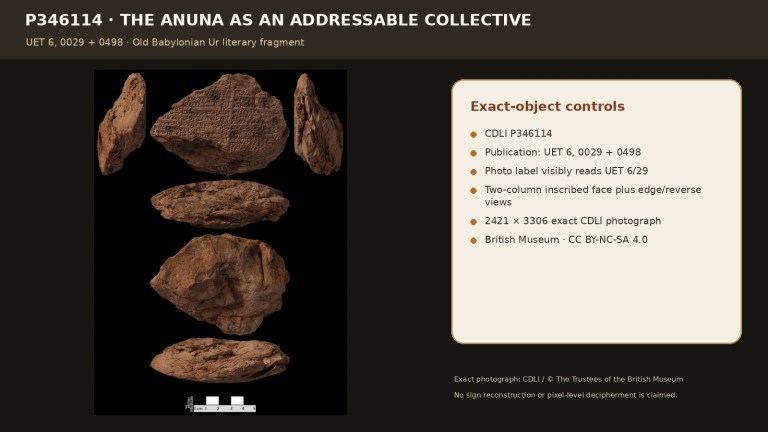
Two independent visual controls lock the source to the object. The current CDLI photograph is a 2886×8124 multi-view contact sheet; the selected fragment visibly carries the publication label UET 6/88. CDLI also serves an exact UET 6 line drawing that labels no. 88 and the 538 obverse/reverse pieces. Its printed line-5 and line-10 controls provide a defensible row map.
The hypothesis is narrow: does obverse line 4′ preserve differentiated authority inside the Anuna, and can any of the fragment’s nearby practical or royal motifs be assigned to that group? The first question can be answered positively and cautiously. The second must be answered negatively because the surrounding clauses are damaged and preserve different or unknown actors.
Obverse line 4′: an authoritative figure among the Anuna
The thesis-critical artifact line is:
[...] x mah dab nir-gal2 {d}a-nun-na-ke4-ne#
CDLI’s published witness translation is: “…, supreme and surpassing(?), authoritative one of the Anuna.” A cautious working translation is: “… exalted, pre-eminent—an authoritative figure among the Anuna.” The working version preserves the force of the title without pretending to recover the broken name.
The evidence split matters. The line opening and title-holder’s identity are lost. The sequence {d}a-nun-na-ke4-ne# is outside restoration brackets, but the final plural sign is marked damaged. Thus the secure proposition is not “the Anuna performed an action.” It is that the surviving title locates an unnamed authority figure in relation to the Anuna collective.
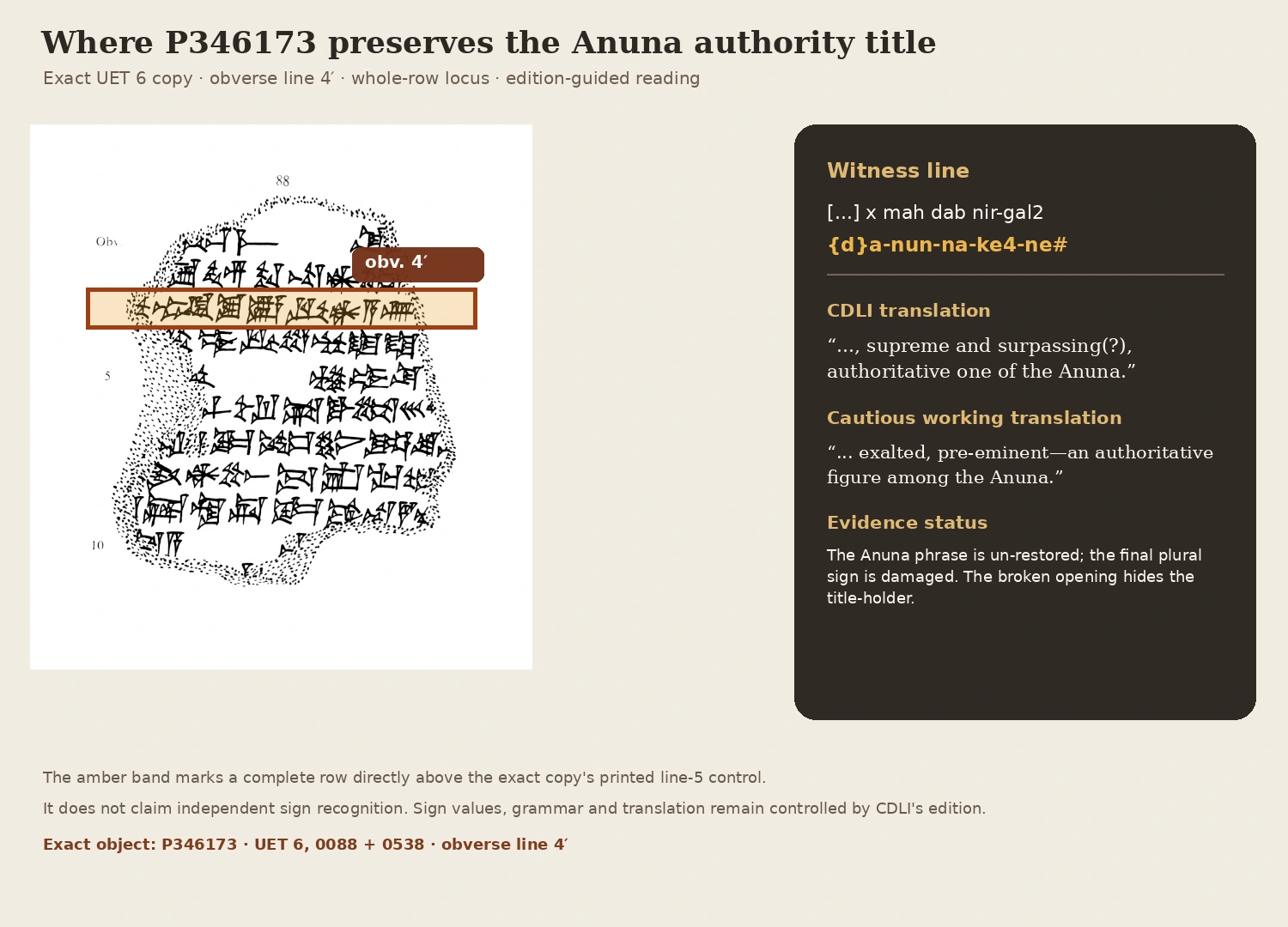
Image-to-text audit: exact, visible, damaged and edited
| Evidence layer | What is secure | Limit |
|---|---|---|
| Object identity | CDLI P346173 is catalogued as UET 6, 0088 + 0538; the exact photograph visibly carries UET 6/88. | The current record gives no separate British Museum museum number. |
| Exact photograph | The 2886×8124 image shows the joined witness’s obverse, reverse, edges, scale and publication labels. | The photograph establishes identity and preservation, not independent sign-by-sign reading. |
| Exact line art | The CDLI-served UET 6 copy depicts nos. 88 and 538 and prints line-5 and line-10 controls. | Line art is an edited scholarly copy and remains distinct from the photograph. |
| Line locus | Obverse line 4′ is the complete row directly above the printed line-5 control. | The annotation is a broad whole-row band, not a sign or word box. |
| Restoration status | The title core and Anuna phrase are outside restoration brackets. | The line opening and title-holder are broken; the final plural sign is damaged-readable. |
| Textual class | exact_line_art_or_squeeze_visible for the selected row; the exact photograph confirms the object and row survival. |
Transliteration, morphology and translation remain edition-controlled. |
| Agency | The line preserves a title linking an unnamed authority figure to the Anuna. | It preserves no finite Anuna collective action. |
This classification is stricter than saying “an exact photograph exists.” The photograph verifies the physical artifact. The exact copy registers the selected row. The edition supplies sign values and translation. Each layer performs a different job, and none is allowed to impersonate another.
The Title/Agent Firewall
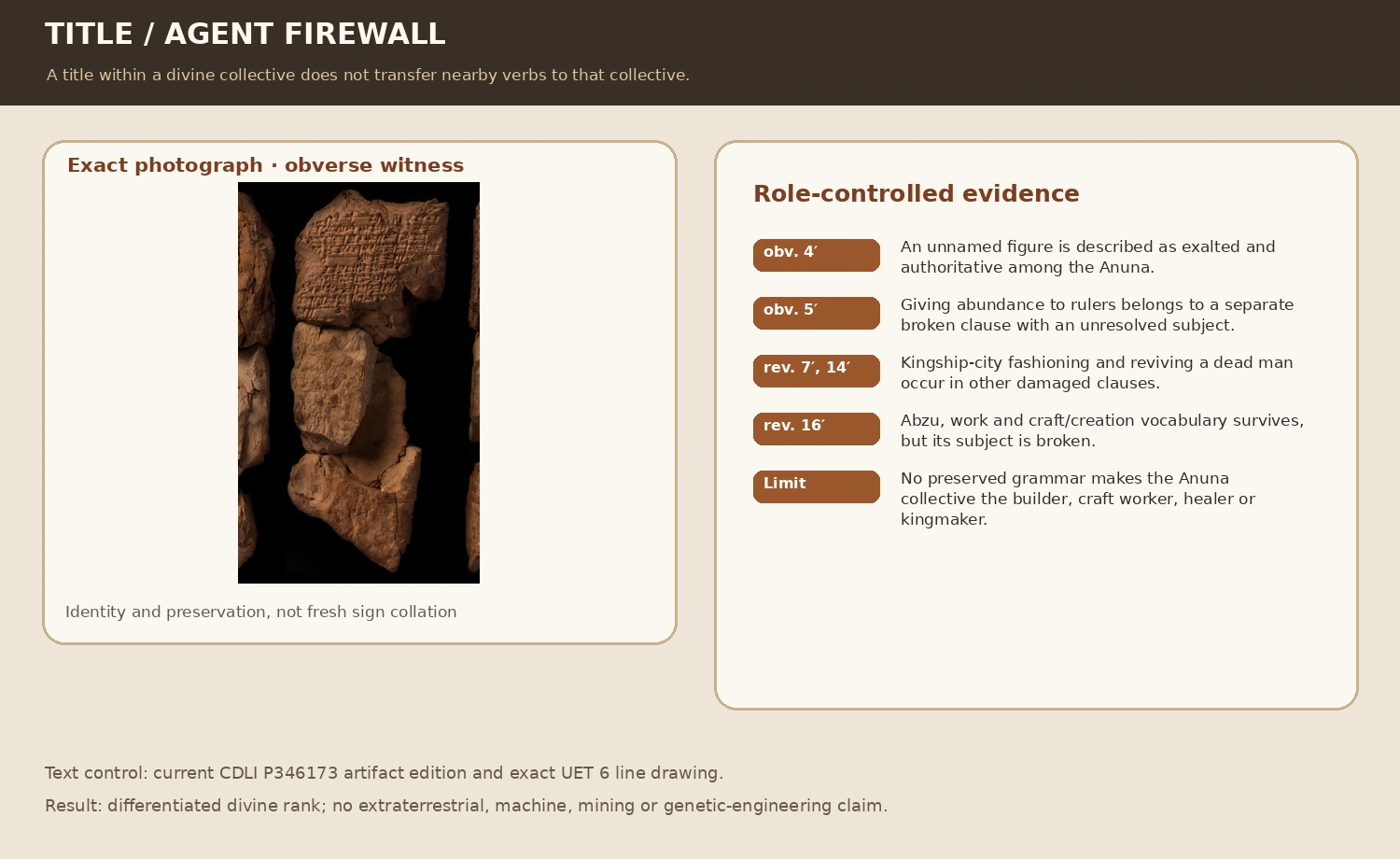
A title can establish rank without establishing an operative action. Here the Anuna phrase belongs to the description of an unnamed figure. It does not turn the collective itself into the subject of the fragment’s later or earlier verbs.
- Obverse 4′: an unnamed figure is described as exalted, pre-eminent or authoritative among the Anuna.
- Obverse 5′: a separate broken clause refers to giving abundance to rulers.
- Reverse 7′: another damaged clause mentions fashioning in the city of kingship.
- Reverse 14′: a fragmentary purpose clause mentions reviving a dead man.
- Reverse 16′: Abzu, work and craft or creation vocabulary survives with a broken subject.
- Hard limit: none of those actions may be assigned to the Anuna from proximity alone.
The exact positive claim is nevertheless significant: the fragment differentiates a particular authority figure in relation to the Anuna. That is evidence for a structured group with internal office or rank language, not an undifferentiated label for gods in general.
What the surrounding fragments do—and do not—show
Obverse 2′ may mention fashioning and surveying shrines, though the signs are uncertain. Obverse 5′ has abundance and rulers. The reverse contains a city-of-kingship expression, a damaged reference to listening to a command, the purpose “to revive the dead man,” and a line joining the Abzu with work and craftsmanship or creation. This motif cluster is attractive because it overlaps several proof gaps: authority, kingship, command, the Abzu and craft.
But the text is not a continuous, secure actor chain. Most openings and endings are missing. The named figure in line 4′ is unknown, and the Anuna occur only inside that figure’s title. The fragment therefore cannot establish that the Anuna surveyed shrines, gave abundance, fashioned kingship, revived anyone or performed Abzu craft. Those remain separate damaged propositions.
This is the difference between evidence-led interpretation and motif accumulation. A cluster of suggestive nouns can identify a promising dossier, but only preserved grammar can assign an action. The present artifact contributes authority and hierarchy evidence; it does not contribute direct Anuna craft, healing or technology agency.
What this adds to the Anunnaki evidence corpus
Text-supported: a real Old Babylonian Ur witness preserves the Sumerian divine-group name without restoration inside a title that places an unnamed, pre-eminent figure in relation to the Anuna. The exact object, exact copy and row map agree.
Corpus relevance: the entry strengthens the organized and differentiated divine-collective strand. The Anuna are not merely invoked as a vague mass; someone can be characterized by authority among them. That is compatible with hierarchy and office inside a divine institution.
Contradiction control: the same fragment demonstrates why authority language cannot be expanded into technical agency. Abzu, work, craft, kingship and revival occur nearby, but broken subjects prevent their assignment to the Anuna. A stronger future claim will need the group noun and the operative finite verb in the same preserved clause.
Unsupported: extraterrestrial identity, Nibiru, spacecraft, genetic engineering, biological intervention, mining, laboratories, advanced machinery and recoverable technology do not appear in the selected line. The object image is not independently deciphered sign by sign, and the broken title-holder must remain unknown.
The next best selection should therefore target an exact witness where Anuna or Anunnakū are both un-restored and the grammatical subject of a preserved verb involving command, making, allocating, measuring, movement, craft or institutional action.
A concrete decoding improvement: the Title/Agent Firewall
This run adds a reusable Title/Agent Firewall. Before converting a divine-group title into a claim about collective action, the workflow must record:
- the named or broken title-holder;
- the grammatical relation between that figure and the divine group;
- whether a finite operative verb survives in the same clause;
- the restoration and damage status of the group name and title;
- the clause boundaries separating nearby motifs;
- the exact image locus on the selected object;
- the proposition that remains after adjacent but unattached actions are removed.
Applied here, the result is clean: title-holder = broken; authority relation = preserved; Anuna phrase = un-restored with a damaged final plural sign; collective finite action = absent; nearby abundance, kingship, revival and craft clauses = separate and damaged. This prevents internal divine rank from becoming false technical agency.
Source trail and reproducibility
- CDLI P346173 artifact record — current object metadata, exact-witness transliteration and artifact-specific English rendering.
- CDLI exact photograph — 2886×8124 JPEG, SHA-256
c0939cefb086ae31e54609cc0f2ac84efb4b12b8f0b064dbe46397c0ee83a916. - CDLI exact UET 6 line drawing — 1185×1627 JPEG, SHA-256
9c6d190e90d9cbb5d170f67a0c4b42932b151a0f0a580867a0b81c165089cc47.
Method note: the report uses current CDLI evidence and exact visuals for P346173. The line drawing is used for whole-row registration; the photograph is used for object identity and preservation. No composite, parallel witness, synthetic tablet or reconstructed wedge supplies the thesis-critical Anuna phrase. The result is exact-line-art visible and edition-guided.
Share this:

One considered email each week
TheCode Weekly Evidence Brief
Receive the week’s strongest tablet decode, source audit or research update, plus one carefully chosen archive read. Routine posts stay on the site; the Brief is the curated signal.
Free. Usually sent on Sunday. No daily post flood. Unsubscribe at any time. See what the Brief includes.