Someone Spoke to the Anuna: Exact Ur Fragment P346114 and the Agency Question
Exact tablet P346114 preserves an un-restored address to the Anuna while proving that nearby temple and craft language does not make the group technical agents.

Exact-witness agency audit
How to read this record
- Claim type
- Sumerian textual analysis
- Evidence level
- Current CDLI record, exact photograph and exact UET 6 line drawing for CDLI P346114 / UET 6, 0029 + 0498
- Status
- Exact-line-art visible; un-restored Anuna at column II line 8 prime; edition-guided reading
The Anuna are recipients of speech. The broken fragment does not make them builders, material workers, killers or technical operators.
An Old Babylonian fragment from Ur preserves an un-restored address to the Anuna—but its grammar does not make them the agents of the brickwork, temple materials or death imagery that survive nearby. CDLI P346114 / UET 6, 0029 + 0498 gives us a useful negative control: a divine collective can be present and directly addressed without inheriting every action in a damaged literary sequence.
Download the six-page illustrated source report (PDF)
The exact fragment and the question being tested
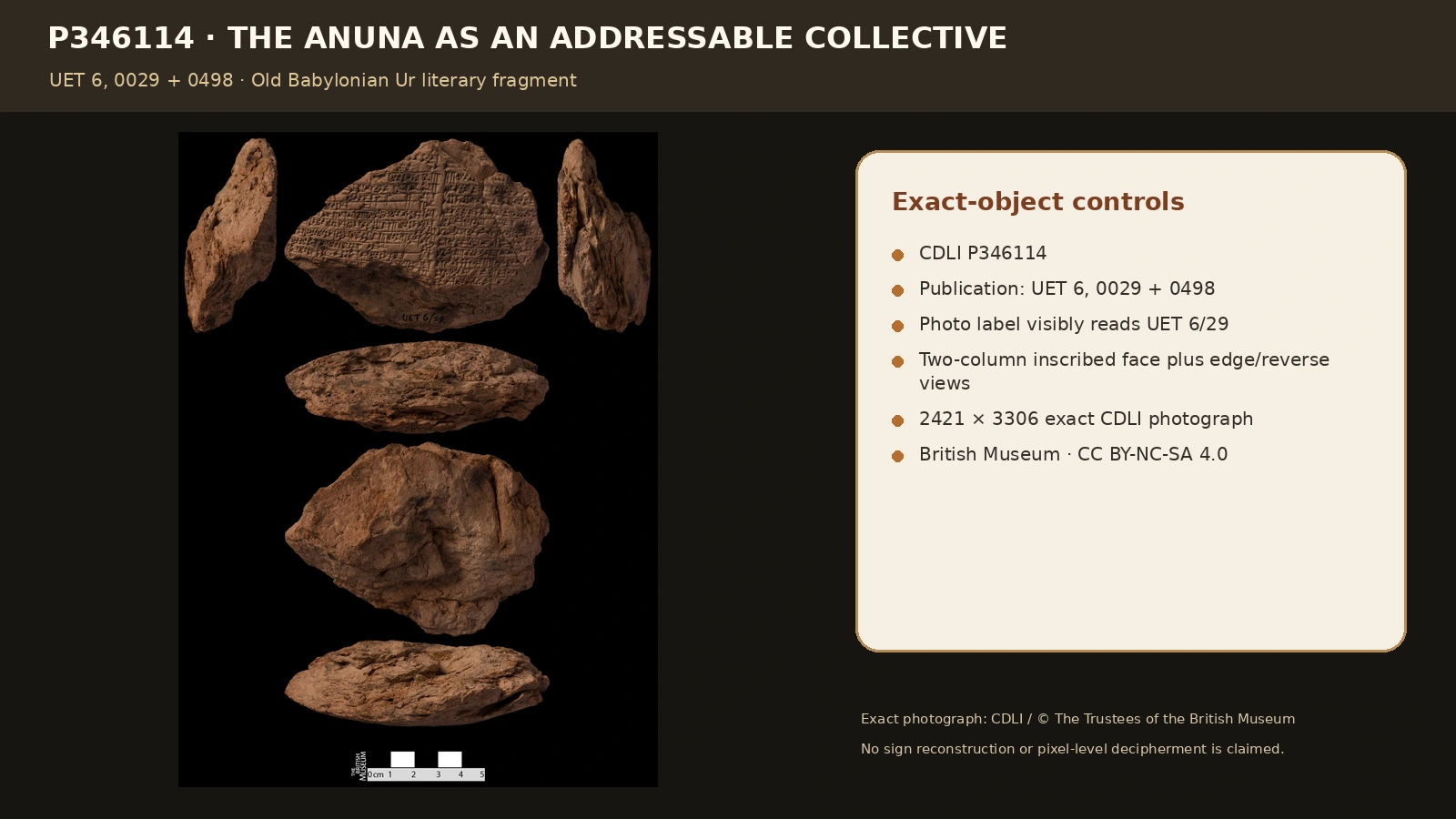
CDLI P346114 is an Old Babylonian Sumerian literary clay-tablet fragment excavated at Ur and held in the British Museum. Its publication identifier is UET 6, 0029 + 0498. The current CDLI record does not assign it to a named literary composition, so this report does not invent one. It treats the physical witness and its surviving clauses on their own terms.
The exact-object controls are unusually helpful. CDLI serves a 2421×3306 photograph showing the principal two-column inscribed face, additional edge and reverse views, scale and the visible label UET 6/29. It also serves an exact UET 6 line drawing that depicts the joined witness, labels the two columns and prints line-5 and line-10 controls. Together these sources establish identity and a defensible row map before interpretation begins.
The hypothesis is narrow: does the fragment make the Anuna agents of the nearby building and material language, or does its secure line name them only as recipients of speech? That distinction matters because extraordinary interpretations often migrate a divine name across broken clauses and silently attach unrelated verbs to it.
Column I: Enki, material and temple language
The first column is badly broken, but CDLI’s artifact edition preserves a recognizable cluster at lines 7′–13′. It mentions Enki, red clay or carnelian paste, an upper hinge, brickwork, a carnelian temple, trees and reeds. The current witness rendering includes:
7′ {d}en-ki#-ke4 im {na4}gug im-KU-e [...]8′ {gesz}nu-kusz2-u3 an-na {na4}kur-gi4 [...]9′ {d}en-ki-ke4 szeg12 im-ma-an-gub KA im#?-[...]10′ e2 {na4}gug a-a-gu10 ak hu-mu#-[...]11′ gesz hu-mu-ri-in-szub gesz hu-mu#-[...]12′ gi hu-mu-ri-in-szub gi# hu#-[...]
CDLI cautiously renders portions as Enki with red clay/carnelian paste, an upper hinge, Enki setting up brickwork, preparation of a carnelian temple, and the felling of trees and reeds. These are real surviving motifs, but the broken endings prevent a complete actor chain. Even before the Anuna line appears in the next column, it would be unsound to turn this fragment into a technical manual.
The physical text does support a temple-and-material setting. It does not support a machine, mine, laboratory or hidden engineering process. Nor does the mere proximity of the next column permit us to make the Anuna the grammatical subject of the surviving Enki and material clauses.
Column II line 8′: someone speaks to the Anuna
The thesis-critical line is column II 8′:
[...]-x {d}a-nun-na-ke4-ne gu3 mu-na-de2-e
CDLI’s published artifact translation is: “… was speaking out to the Anuna gods.” A cautious working translation is: “Someone spoke out to the Anuna gods.” The working version does not pretend to recover the broken speaker.
The evidence split is precise. The opening is lost and a trace immediately before the divine name is damaged. By contrast, {d}a-nun-na-ke4-ne, the speech expression and the finite verb are printed outside restoration brackets. The Anuna phrase includes the dative plural ending: in this clause the group is the recipient or addressee, not the preserved subject performing a technical action.

Image-to-text audit: exact, visible, damaged and edited
| Evidence layer | What is secure | Limit |
|---|---|---|
| Object identity | CDLI P346114 is catalogued as UET 6, 0029 + 0498; the exact photograph visibly carries UET 6/29. | The current record does not provide a separate British Museum museum number. |
| Exact photograph | The 2421×3306 image shows the two-column inscribed face, edges/reverse, scale and publication label. | The photograph establishes identity and preservation, not independent sign-by-sign reading. |
| Exact line art | The CDLI-served UET 6 copy depicts the joined witness and prints column and line-number controls. | Line art is an edited scholarly copy; it must be attributed and kept distinct from the photograph. |
| Line locus | Column II line 8′ is the row two lines above the printed line-10 control. | The annotation is a broad whole-row band, not a sign or word box. |
| Restoration status | The Anuna name, dative plural ending, speech noun and finite verb are outside restoration brackets. | The clause opening and the speaker’s identity are broken; the preceding trace is damaged-readable. |
| Textual class | exact_line_art_or_squeeze_visible for the selected row; the exact photograph confirms physical survival. |
Transliteration, morphology and translation remain edition-controlled. |
| Agency | The Anuna are the recipients of speech in the secure clause. | No preserved grammar makes them the builders, material workers, killers or technical operators. |
This classification is stricter than saying “an exact photograph exists.” The photograph verifies the artifact. The exact copy registers the selected row. The edition supplies sign values and grammar. Each layer does a different job, and none is allowed to impersonate another.
The recipient/agent firewall across the broken sequence
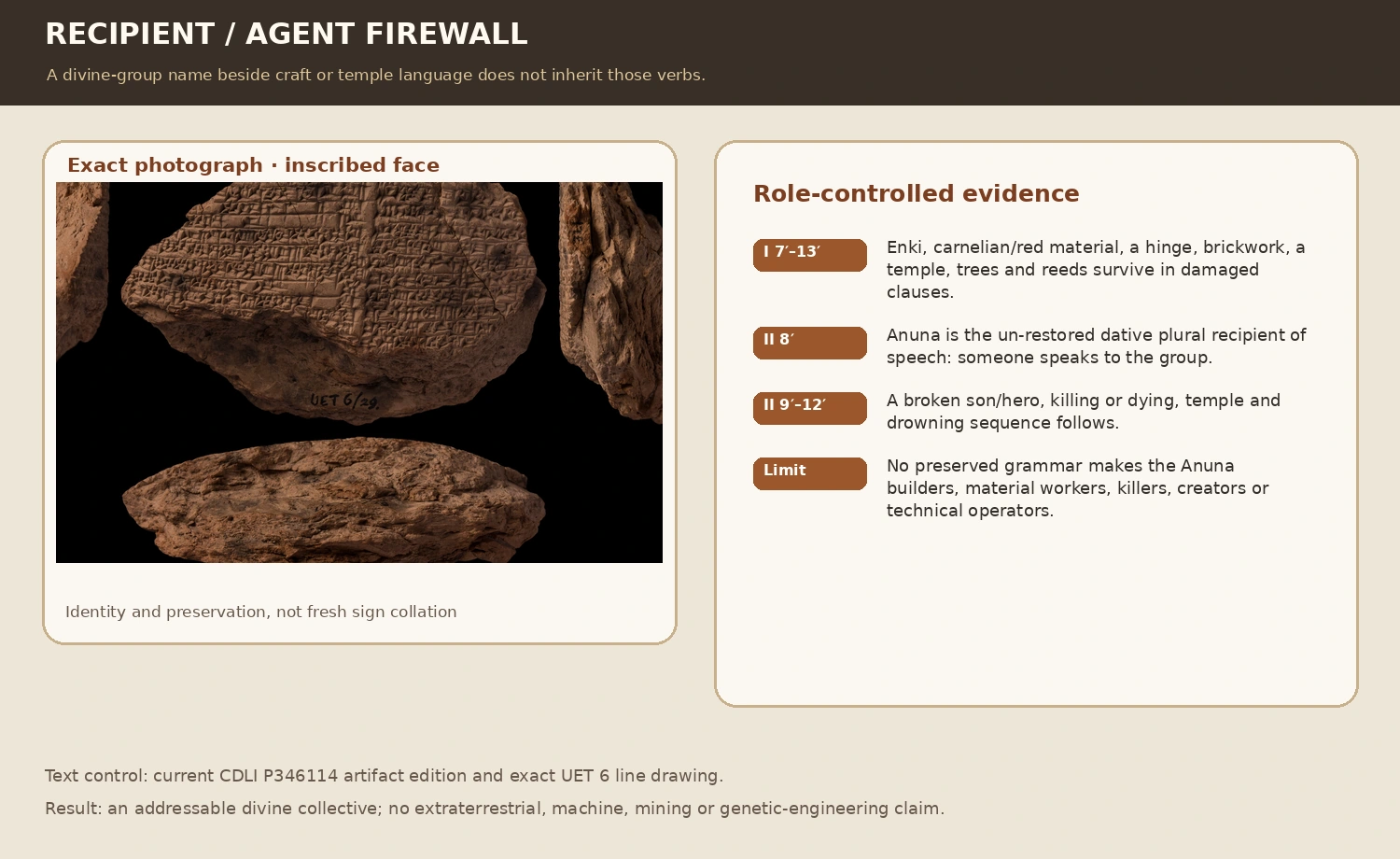
Column II 9′–12′ continues with damaged language about “my son,” a hero, killing or dying in a temple, and roiling or drowning like water or harvest. The sequence is evocative, but the fragment does not preserve a continuous narrative subject. It is therefore unsafe to claim that the Anuna kill the son, cause the drowning, construct the temple or manipulate the materials.
- Column I 7′–13′: Enki, carnelian or red material, hinge, brickwork, temple, trees and reeds survive in damaged clauses.
- Column II 8′: the Anuna are securely named as the group to whom someone speaks.
- Column II 9′–12′: a broken son/hero and death or drowning sequence follows, but its actor chain is incomplete.
- Hard limit: adjacency does not turn a recipient into the subject of earlier or later verbs.
The exact positive claim is modest but real: an Old Babylonian Ur literary fragment treats the Anuna as an addressable collective. That is consistent with an organized divine group rather than a vague abstraction. The source does not preserve their answer, decision or operative action.
What this adds to the Anunnaki evidence corpus
Text-supported: the physical witness preserves the Sumerian divine-group name without restoration and marks the group as plural recipients of speech. It places that address within a surviving temple-and-divine context, although the narrative links are broken.
Corpus relevance: this entry strengthens the organized-collective strand while refining the craft and technology question. A source can place the Anuna near Enki, brickwork, materials and a temple without assigning those operations to them. That distinction helps the corpus test stronger claims instead of accumulating suggestive proximity.
Contradiction control: the fragment cuts against a method that treats every Anuna-adjacent technical noun as evidence of Anuna engineering. The only secure role in the selected line is addressee. A valid future craft claim will need the group noun and an operative craft verb in the same preserved clause.
Unsupported: extraterrestrial identity, Nibiru, spacecraft, genetic engineering, biological intervention, mining, laboratories, advanced machinery and recoverable technology do not appear in the selected line. The image is not independently deciphered sign by sign, and the broken speaker must remain unknown.
This is useful negative evidence, not an empty result. It sharpens the selection rule for future tablets: prioritize exact witnesses where Anuna or Anunnakū coincide with a finite verb of command, making, measuring, moving, building or allocating—and where the same preserved grammar makes the divine group the subject.
A concrete decoding improvement: the Recipient/Agent Firewall
This run adds a reusable Recipient/Agent Firewall. Before connecting a divine group with nearby craft, movement, death or creation language, the workflow must record:
- the grammatical subject of the operative verb;
- the direct or dative recipient;
- the finite verb and whether it is restored or damaged;
- the clause boundary and any broken opening or ending;
- the exact visual locus on the selected object;
- the proposition that remains after all adjacent but unattached motifs are removed.
Applied here, the firewall yields a clean result: unknown speaker = broken; Anuna = un-restored plural addressee; speech predicate = un-restored; earlier craft/material actions = separate damaged clauses; later killing/drowning language = separate broken clauses. This prevents theological proximity from becoming false technical agency.
Source trail and reproducibility
- CDLI P346114 artifact record — current object metadata, exact-witness transliteration and artifact-specific English rendering.
- CDLI exact photograph — 2421×3306 JPEG, SHA-256
4c20f55c25f911727be45f931b84496c3604003a32ed1959bef8c7f350f05b27. - CDLI exact UET 6 line drawing — 1622×1048 JPEG, SHA-256
6bfac399194e74c38c5c9bb0dd2dccd9d24665d24dc2af7fc9f740b8b93ea40c.
Method note: the report uses only current CDLI evidence and exact visuals for P346114. The line drawing is used for whole-row registration; the photograph is used for object identity and preservation. No composite, parallel witness, synthetic tablet or reconstructed wedge supplies the thesis-critical Anuna phrase. The result is exact-line-art visible and edition-guided.
Share this:

One considered email each week
TheCode Weekly Evidence Brief
Receive the week’s strongest tablet decode, source audit or research update, plus one carefully chosen archive read. Routine posts stay on the site; the Brief is the curated signal.
Free. Usually sent on Sunday. No daily post flood. Unsubscribe at any time. See what the Brief includes.