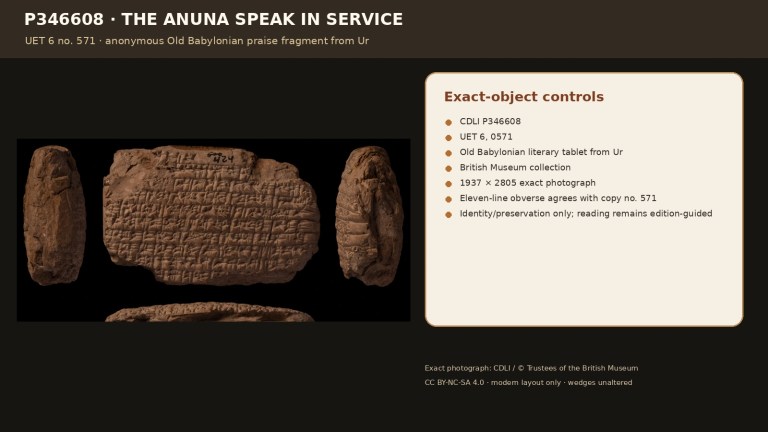
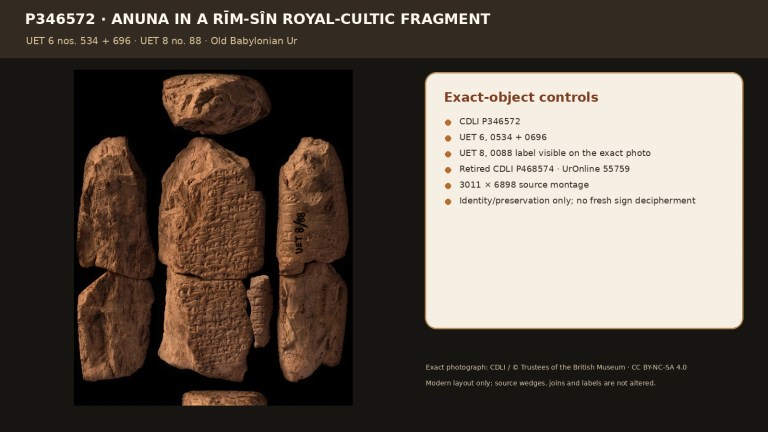
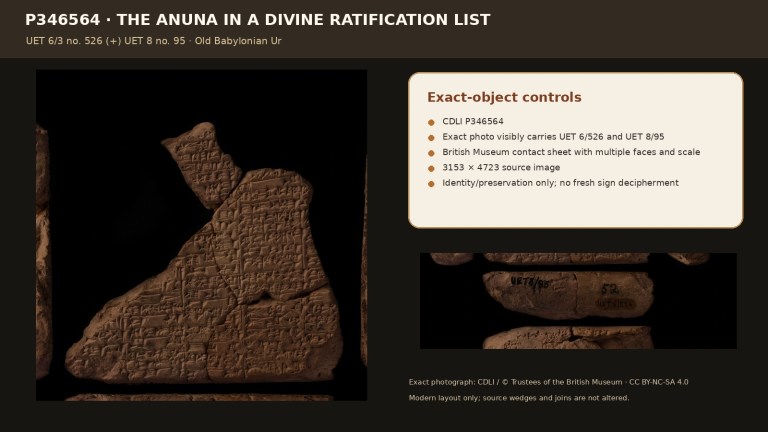
The Anuna Stand Before Enlil: Exact Tablet P464127 and the Labor Question
Exact tablet P464127 preserves un-restored Anuna in a deference scene before Enlil, clarifying that ritual service is not Anuna technical labor.
Exact-witness role audit
How to read this record
- Claim type
- Sumerian textual analysis
- Evidence level
- Fresh exact-object photograph of CDLI P464127, artifact-specific CDLI text, and current ETCSL 5.5.4 translation/transliteration controls
- Status
- Edition-guided; un-restored Anuna at obverse column I line 22
The passage supports divine hierarchy and deference before Enlil, not Anuna engineering or technical labor.
A newly examined exact tablet witness places the Anuna at a crucial boundary between human emergence and organized work—but the verb points to deference before Enlil, not to technical labor by the Anuna. CDLI P464127 / U 16900d / UET 6, 0026a preserves the thesis-critical name without restoration brackets. Its role in the sentence is direct; its sensational reinterpretation is not.
Download the six-page illustrated source report (PDF)
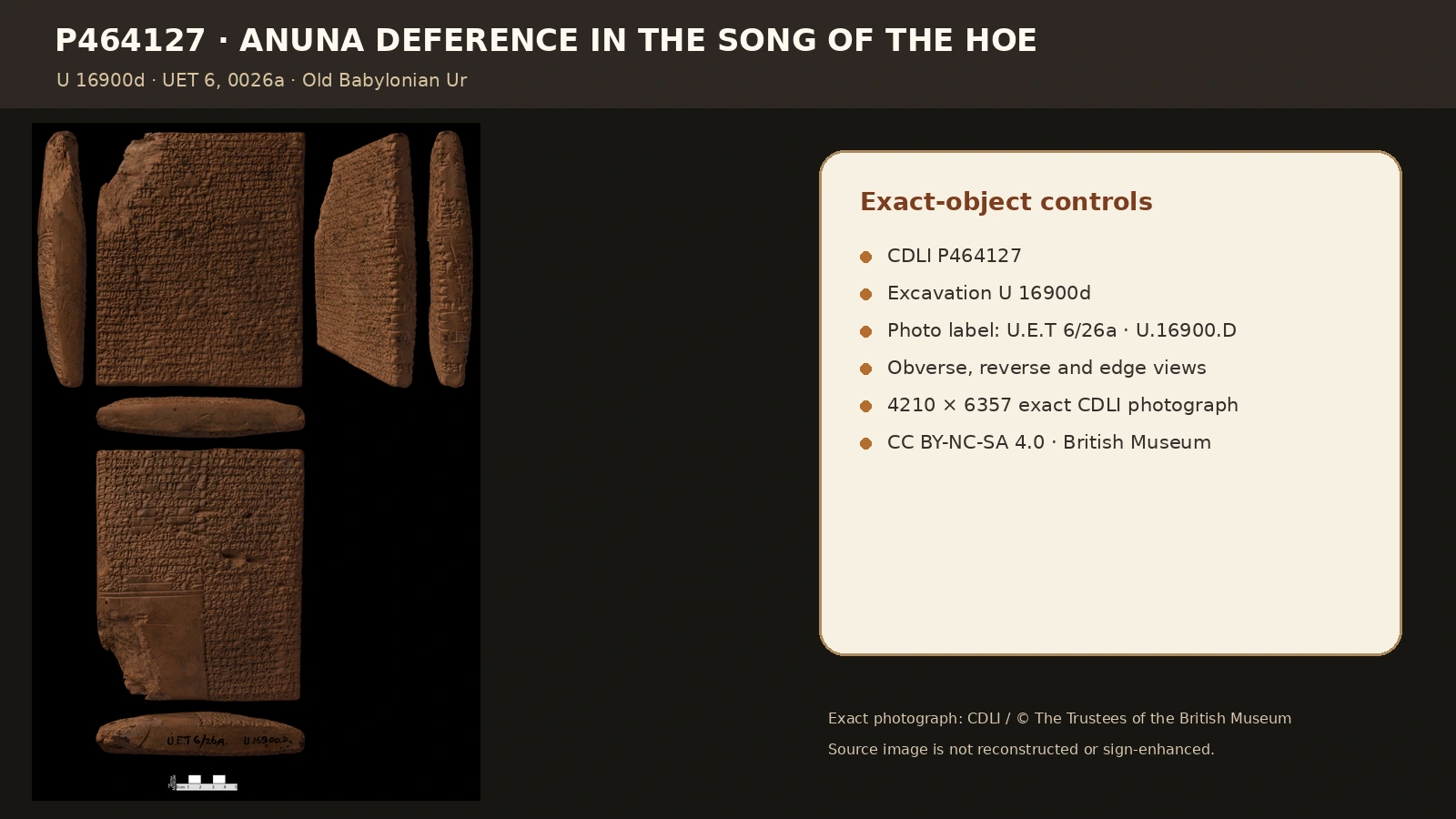
The exact tablet and the question being tested
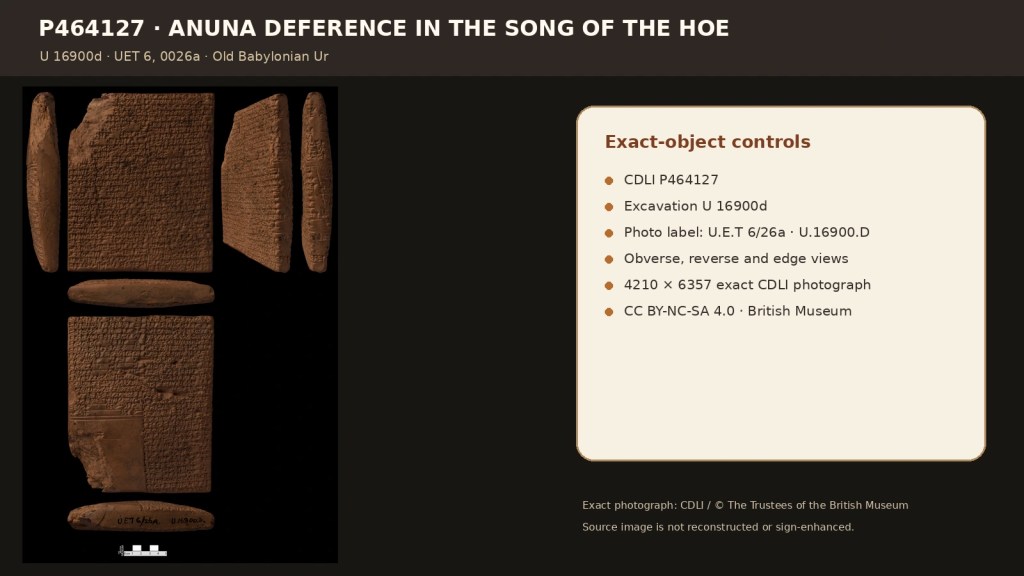
CDLI P464127 is an Old Babylonian Sumerian clay tablet from Ur, now associated with the British Museum collection. CDLI records the excavation number U 16900d, the publication reference UET 6, 0026a, and the composition assignment Q000778 / CDLI Literary 000778: The Song of the Hoe, ETCSL 5.5.4.
The exact photograph gives two independent identity controls beyond the P-number. Its lower edge is visibly labeled U.E.T 6/26a and U.16900.D. It also displays the obverse, reverse, side views and scale. That agreement makes the physical object secure before any translation is discussed.
This composition is not new to the corpus. A 2026 report studied another physical witness, P248356, for the larger chain from human formation to tools, records and divine service. P464127 is nevertheless a nonduplicate artifact. The present question is narrower and philologically useful: what does this exact witness say the Anuna are doing at obverse column I line 22, and can that action honestly be called labor?
Obverse I 19–25: artifact text and two published controls
The current CDLI artifact record presents P464127 obverse column I lines 19–25 as follows:
19 sag nam-lu2-lu7 u3-szub-ba am3-mi-ni-in-gar20 {d}en-lil2-sze3! kalam-ma ki mu-szi-in-dar-re21 sag-gig2-ga-ni-sze3 igi zi mu-szi-in-bar22 {d}a-nun-na mu-un-na-su8-su8-ge-esz23 szu-bi giri17-be2# mu-un-ne-gal224 {d}en-lil2 a-ra-zu-am3 mu-ni-in-hun-e-ne25 ug3 sag-gig2-ga-ni-sze3 {gesz}al mu-un-da-ab-be2-e-ne
CDLI’s artifact-specific English rendering translates line 22, “The Anuna served him.” The current ETCSL composite transliteration normalizes the reduplicated verbal base under gub, “to stand,” and the ETCSL published translation renders the sequence: “the Anuna gods stepped forward to him, and did obeisance to him.”
A cautious working translation should preserve both controls rather than pretending the difference does not exist: “The Anuna stepped/served before him in deference.” Line 23’s hand-to-nose submission gesture and line 24’s prayer before Enlil make ritual deference the safest contextual interpretation. “Service” here is not automatically construction, mining, tool operation or engineering.
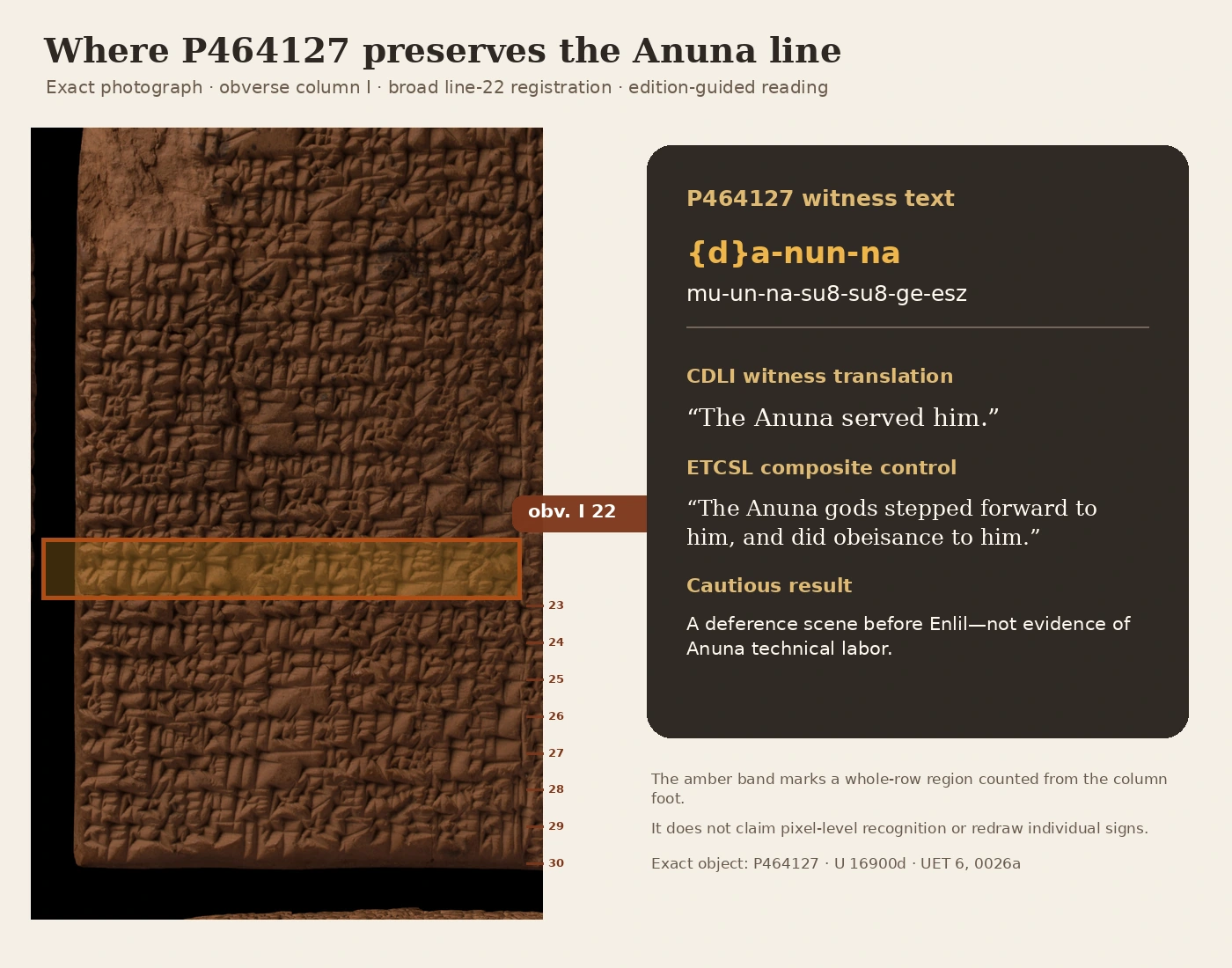
Image-to-text audit: visible, edited and limited
| Evidence layer | What is secure | Limit |
|---|---|---|
| Object identity | P464127, U 16900d and UET 6, 0026a agree between CDLI and the photographed edge labels. | The British Museum museum number is not supplied on the current CDLI record. |
| Exact visual | The 4210×6357 photograph shows obverse, reverse, edges, labels and scale. | The photograph is used under the stated CC BY-NC-SA 4.0 credit. |
| Line locus | Obverse column I contains thirty transcribed lines; line 22 is registered conservatively by counting upward from the column foot. | The broad band is a row-orientation guide, not a sign box. |
| Restoration status | CDLI prints {d}a-nun-na on artifact line 22 without brackets or damage markers. |
Adjacent line 23 contains a damaged-readable sign, and the verb’s normalization still depends on editions. |
| Textual class | photograph_visible for exact row survival and identity; the thesis-critical divine name is un-restored in the witness text. |
Sign values and translation are edition-controlled, not independently photo-decoded. |
| Agency | The Anuna are the grammatical subject of line 22; Enlil is the contextual superior in the prayer sequence. | The line does not assign the Anuna the later human provisioning or tool work. |
| Confidence | High for identity, witness attribution and un-restored Anuna; moderate for row registration and verb nuance. | “Served,” “stood before” and “did obeisance” must remain visibly compared. |
The role firewall: deference is not technical labor
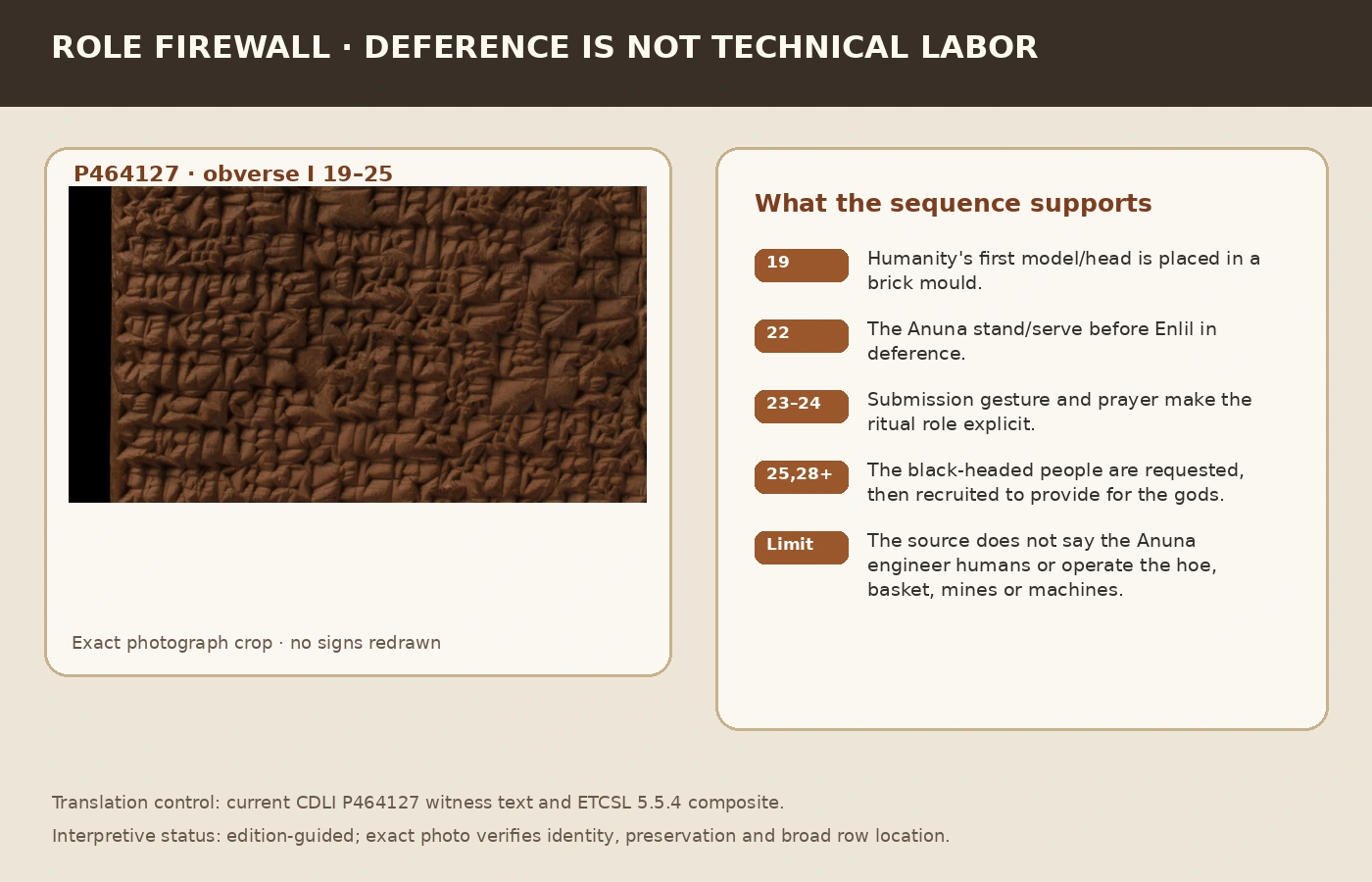
The surrounding composition is famous because it clusters language of human emergence, work assignments, the hoe and the earth-carrying basket. That makes grammatical discipline essential. A nearby labor motif does not make every named group the laboring subject.
- Lines 8–17: Enlil establishes duties, daily tasks and the hoe-and-basket work frame.
- Lines 18–19: the hoe is set to work where flesh comes forth, and the first model or head of humanity is placed in a brick mould.
- Lines 20–25: Enlil, the land and the black-headed people frame the Anuna’s act of standing/serving before him, followed by submission and prayer.
- Lines 28–34: people are recruited to provide for the gods; Enki praises the hoe; Nisaba receives responsibility for records; humans take up the holy hoes.
The exact role claim is therefore strong but modest: the Anuna participate as a deferential divine group before Enlil at the transition into the human-service sequence. The passage does not say that the Anuna manufacture the human body, operate a machine, wield the hoe, carry the basket or perform the later provisioning work.
Published translation versus cautious working translation
It is tempting to choose whichever English verb best fits a modern theory. That would be poor method. The artifact record’s “served him” and ETCSL’s “stepped forward … did obeisance” arise from related but not identical editorial presentations of the reduplicated Sumerian verb. Both point toward subordinate posture or service in context; neither licenses a technical-labor claim.
Published control 1, CDLI witness: “The Anuna served him.”
Published control 2, ETCSL composite: “Now the Anuna gods stepped forward to him, and did obeisance to him.”
Cautious working translation: “The Anuna stepped/served before him in deference.”
The working translation deliberately retains the uncertainty. The next lines are decisive controls: hands at noses/in submission, then prayer aimed at pacifying Enlil. In this bounded passage, the Anuna’s “service” is best understood as a hierarchical and ritual act. This is a philological result, not a weakening of the evidence; it tells us more precisely what kind of organized divine order the source supports.
What this adds to the human-origin and labor corpus
Text-supported: a new exact physical witness preserves the Anuna as a named collective and grammatical subject in a scene immediately adjacent to human emergence, duty, hoe, basket, prayer and later human provisioning. The name itself is not restored. Enlil occupies the superior position, and the Anuna enact deference.
Corpus relevance: the witness refines the labor strand by showing that “service” must be role-classified. Divine deference, divine work, human labor and tool operation are separate propositions. The organized-power-structure hypothesis gains a clearer internal hierarchy: the Anuna are not vague background gods, but neither are they automatically the engineers or laborers of every adjacent civilization motif.
Contradiction control: a simplistic reading might cite “The Anuna served him” as proof that the group performed physical labor. The prayer and submission context contradicts that move. The better conclusion is ritual subordination before Enlil, followed by a distinct transition to black-headed people providing for the gods.
Unsupported: extraterrestrial origin, Nibiru, spacecraft, genetic engineering, biological intervention, mining, laboratories, machinery and recoverable advanced technology do not appear in the selected lines. The brick mould and hoe are literary-cultural images in a Sumerian hymn; they are not descriptions of modern manufacturing equipment.
A concrete decoding improvement: the Service-Verb Role Firewall
This run adds a reusable control to the daily method: the Service-Verb Role Firewall. Whenever a translation uses “serve,” “stand before,” “work,” “carry” or “provide,” the workflow must record five separate fields before drawing a theory-level conclusion:
- the grammatical subject;
- the recipient or superior;
- the immediate gesture and ritual context;
- the separately named tool or work actor;
- the exact point where the text shifts from divine action to human duty.
Applied here, the firewall yields a clean map: Anuna = subject of deference; Enlil = contextual superior; hand-to-nose and prayer = ritual controls; humans = later provisioning actors; hoe and basket = work instruments in the wider sequence. This prevents a nearby labor motif from migrating across sentence boundaries into a false Anuna technology claim.
Source trail and reproducibility
- CDLI P464127 artifact record — current identifiers, exact-witness transliteration, artifact-specific English rendering, excavation number, composition assignment and license statement.
- CDLI exact photograph — 4210×6357 JPEG, SHA-256
2a043d43d5239f0ea38eb78baae5b0379772a970eb8a9d128a9647dc31ab473b. - ETCSL 5.5.4 transliteration — composite lineation, lexical markup and gub control for line 22.
- ETCSL 5.5.4 translation — published “stepped forward … did obeisance” rendering and wider lines 18–34 context.
Method note: every public visual derives from the selected exact photograph. The highlighted panel uses a broad row band only. The report distinguishes photograph-visible identity and row survival from edition-controlled sign values, morphology and translation. No synthetic tablet, reconstructed wedge or unrelated parallel image substitutes for P464127.
Share this:

One considered email each week
TheCode Weekly Evidence Brief
Receive the week’s strongest tablet decode, source audit or research update, plus one carefully chosen archive read. Routine posts stay on the site; the Brief is the curated signal.
Free. Usually sent on Sunday. No daily post flood. Unsubscribe at any time. See what the Brief includes.