
Sargon II’s Kition Stele: Anunnakū Authority Across the Western Sea
Exact-object report on Berlin VA 968 / ORACC Q006584: un-restored Anunnakū hierarchy meets Cyprus, Western Sea geography, material tribute, and monument production.

Ancient text and site reading
How to read this record
- Claim type
- Historical / textual + interpretive
- Evidence level
- Sources, translations, measurements, and symbolic reading where present
Use the evidence layer for sources and observations, and the interpretation layer for TheCode.Wiki synthesis.
Today’s exact selected artifact is Berlin VA 968, the monumental stone stele of Sargon II found at ancient Kition near modern Larnaca, Cyprus. It is edited as ORACC/RINAP Q006584, Sargon II 103. Its opening line places Aššur above the Igīgū and Anunnakū gods; later columns describe far-sea rulers, materials sent to Babylon, and the making and erection of the monument itself.

Why this witness advances the corpus
The corpus has already documented creation-for-labor, temple order, law, craft, kingship, Abzu imagery, and divine command. VA 968 advances a different proof gap: does un-restored Anunnakū language occur on the same exact object as explicit long-distance sea geography, political communication, named material movement, and monument production? Yes—but grammar and surface condition impose strict limits.
The opening Anunnakū clause is a divine hierarchy title. Human rulers send goods, and Sargon commissions the stele. This article therefore tests a civilization-network hypothesis without turning proximity into agency.
Exact-object identity and visual inspection
The current ORACC/RINAP catalogue identifies Q006584 as Sargon II 103, a Neo-Assyrian stele from Larnaka. RINAP 2 identifies the museum object as VA 968, gives dimensions of 209 × 68.5 × 32–33 cm, and describes its find near ancient Kition. The Staatliche Museen/Google Arts & Culture record independently gives inventory VA 00968, Kition provenance, basalt medium, and the Berlin collection.
Two exact photographs were downloaded and opened at original resolution: a 2552×4748 full view and a 4016×6016 inscription-side view. The full view shows Sargon II holding a mace and raising his right hand before eight deity symbols. The side view shows sharply preserved cuneiform rows. These photographs establish object identity and preservation; they do not automatically make the worn, relief-obscured opening line independently decipherable.
Thesis-critical line: column i 1
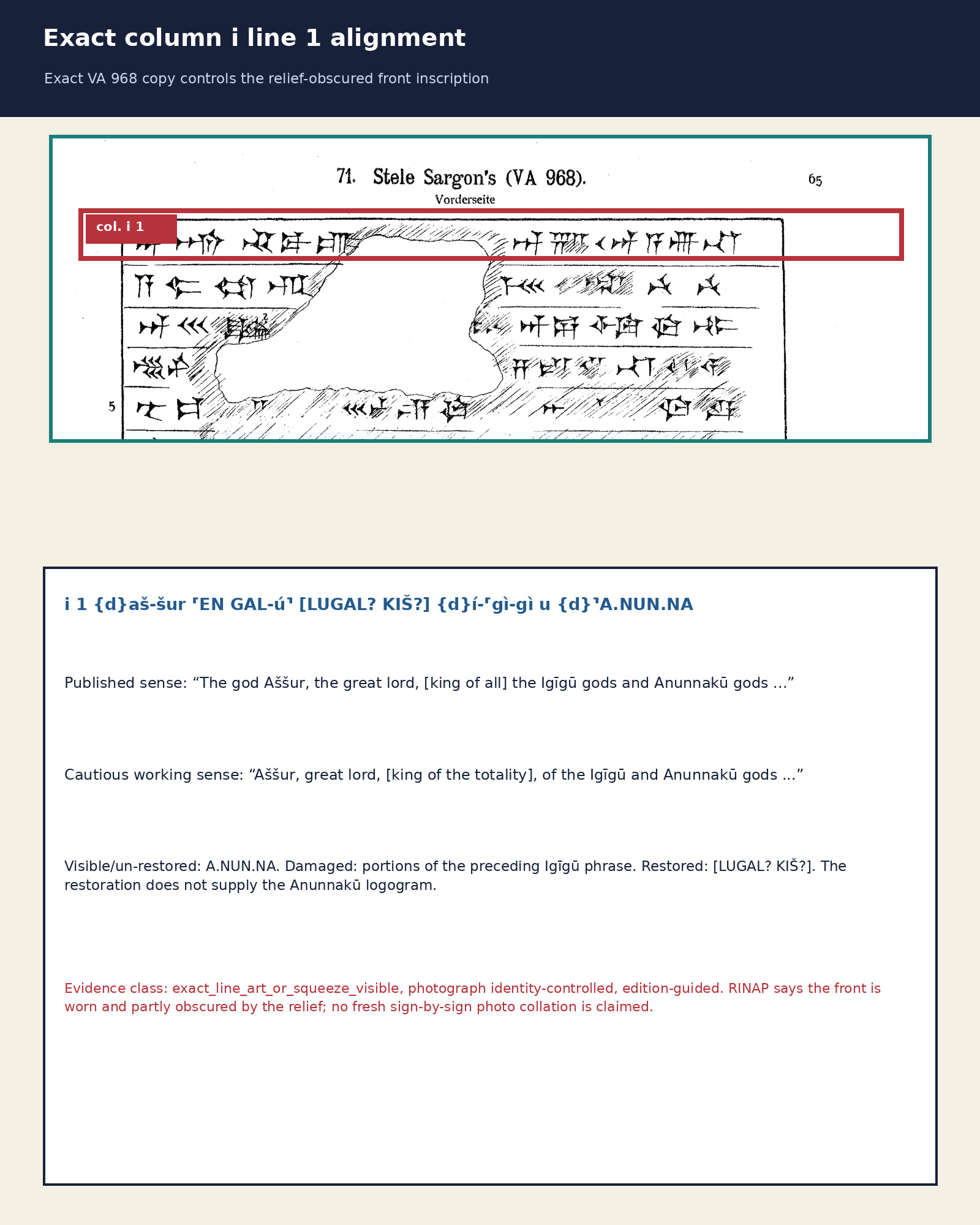
Edition transliteration: {d}aš-šur ⸢EN GAL-ú⸣ [LUGAL? KIŠ?] {d}í-⸢gì-gì u {d}⸣A.NUN.NA.
Published RINAP translation: “The god Aššur, the great lord, [king of all] the Igīgū gods and Anunnakū gods …”.
Cautious working translation: “Aššur, the great lord, [king of the totality], of the Igīgū and Anunnakū gods …”. The royal-title restoration [LUGAL? KIŠ?] is editorial. The writing A.NUN.NA is outside square brackets; it is not supplied by a parallel or composite reconstruction.
Image-to-text hard gate

This result is exact-line-art visible, exact-photograph identity-controlled, and edition-guided. RINAP explicitly notes that column i is badly worn and traces are obscured by the relief, sometimes requiring Ungnad’s exact-object copy. Accordingly, no isolated sign box is drawn on the photograph, and the much clearer side photograph is not falsely used as though it depicted the front opening row.
Line-by-line notes

Column i 1: divine hierarchy
Aššur is the grammatical center. The Anunnakū are one of the divine groups over whom his title extends. This supports an organized hierarchy but does not make the group the author or maker of the monument.
Column i 24–28: gods, kings, and order
The text calls the great gods managers of heaven and netherworld, associates their attack with conflict, and says they appoint rulers and place one land over another. This is relevant to divine decree and kingship, but it is a collective “great gods” clause—not an Anunnakū-only action.
Column iv 23–27: the Eastern Sea
The edition places Upēri, king of Dilmun, thirty leagues away in the Eastern Sea and says he sent a message of submission after hearing of Aššur, Nabû, and Marduk’s might. The passage is damaged and must remain edition-controlled.
Column iv 28–42: seven rulers across the Western Sea
Seven rulers of Yāʾ, a region of Adnana/Cyprus, are described as seven days distant in the Western Sea. They hear of Sargon’s deeds and bring gold, silver, ebony, boxwood, and the treasure of their land to Babylon. The text is royal ideology, but the geographical and material network is explicit.
Column iv 43–57: the stele itself
Sargon says he had a stele made, placed divine images and his royal image on it, wrote upon it, and had it erected. The exact restoration and location in iv 52–53 are disputed. A proposal linking the wording to “mines” is one of several rival readings and is excluded from the core claim.
Agency matrix: what the source actually assigns

Divine frame: Aššur is great lord above the Igīgū and Anunnakū. Diplomatic actors: named or numbered human rulers hear, respond, send, and submit. Material actors: human polities deliver gold, silver, woods, and treasure. Monument actor: Sargon commissions inscription and erection.
This structure supports an ancient conception in which divine hierarchy legitimates a wide political world. It does not say the Anunnakū sailed the seas, mined metals, transported goods, carved stone, or built the stele.
Conquest, contact, and caution
RINAP’s historical introduction warns that a direct Assyrian conquest or annexation of Cyprus cannot be accepted without serious reservations. Diplomatic gifts, ideological reach, and likely envoy contact are safer conclusions than military occupation. That caution matters: an evidence-led corpus should preserve the strong sea-network claim without inflating it into an unsupported conquest narrative.
What this means for the Anunnaki thesis
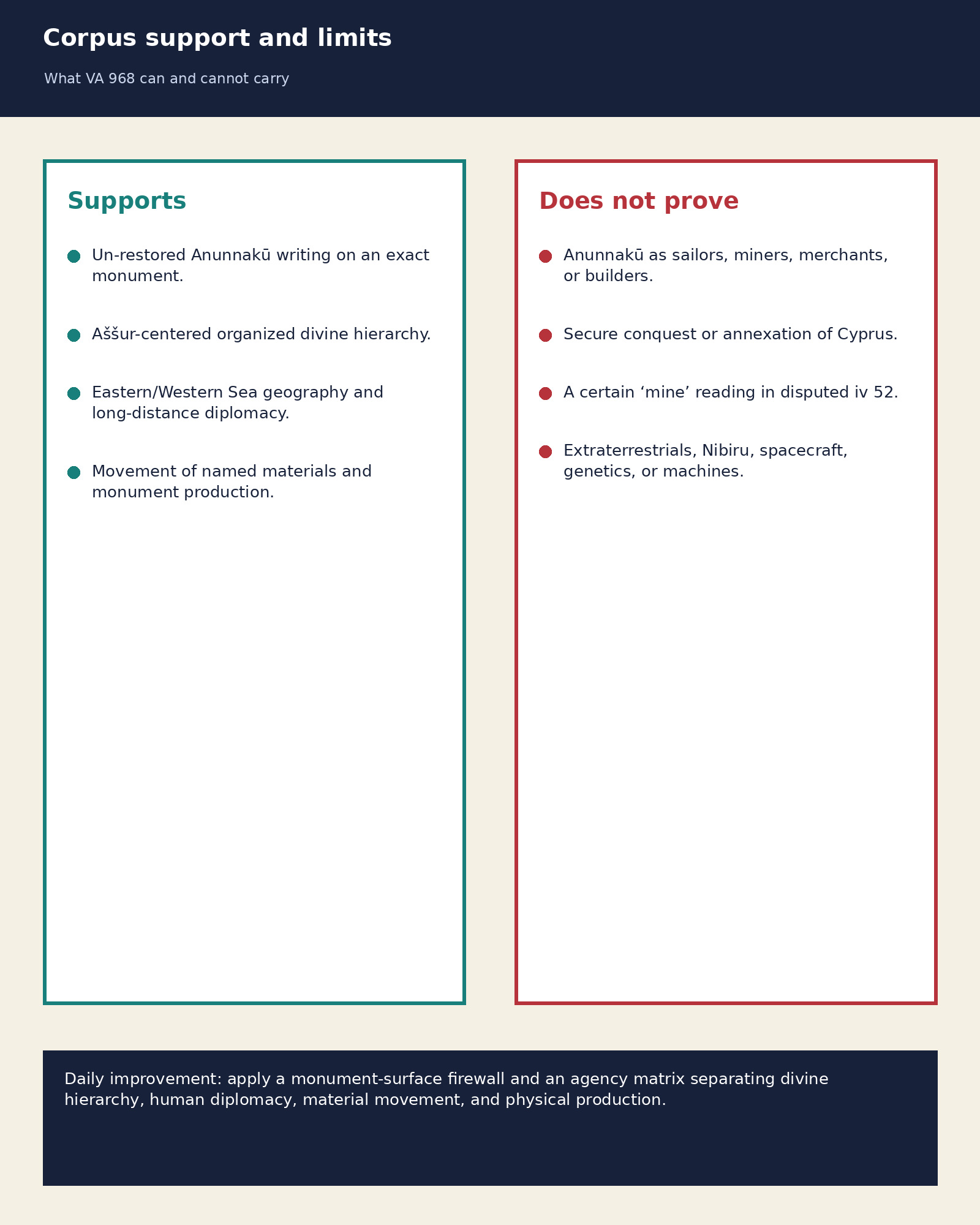
Support: the exact monument preserves an un-restored Anunnakū writing within an organized divine hierarchy; the same object encodes far-sea geography, royal communication, material transfers, and monument technology. This is meaningful evidence for divine-order ideology operating across a real civilization network.
Limits: no line calls the Anunnakū extraterrestrials or credits them with navigation, mining, commerce, craft, genetic engineering, spacecraft, Nibiru, or advanced machines. The material and monument clauses have human actors. The stronger ancient-astronaut claim remains unproven by this source.
Sources and image credit
- ORACC/RINAP Q006584, Sargon II 103 — current catalogue, transliteration, translation, and notes.
- RINAP 2 primary edition — pages 402–408.
- Ungnad, VAS 1 no. 71 — exact VA 968 line drawing.
- Staatliche Museen zu Berlin collection record — VA 00968.
- Exact overview photograph and exact inscription-side photograph, Osama Shukir Muhammed Amin, CC BY-SA 4.0.
Daily capability improvement: apply a monument-surface firewall: when relief obscures a front inscription, require an identifier-locked exact-object copy, classify the result as exact-line-art visible and edition-guided, and never transfer clearer wedges from another face. Add an agency matrix separating divine hierarchy, human diplomacy, material movement, and monument production.
Download the evidence report: Sargon II’s Kition Stele, Anunnakū authority, and Western Sea PDF report.
Share this:

One considered email each week
TheCode Weekly Evidence Brief
Receive the week’s strongest tablet decode, source audit or research update, plus one carefully chosen archive read. Routine posts stay on the site; the Brief is the curated signal.
Free. Usually sent on Sunday. No daily post flood. Unsubscribe at any time. See what the Brief includes.


