
STT 1, 9: The Anunnakū Take Up the Hoe and Build at Babylon
Exact-witness report on P338325: the Anunnakū take up the hoe, make bricks, and fashion cult daises in Enūma Eliš VI, with strict image and genre limits.

Ancient text and site reading
How to read this record
- Claim type
- Historical / textual + interpretive
- Evidence level
- Sources, translations, measurements, and symbolic reading where present
Use the evidence layer for sources and observations, and the interpretation layer for TheCode.Wiki synthesis.
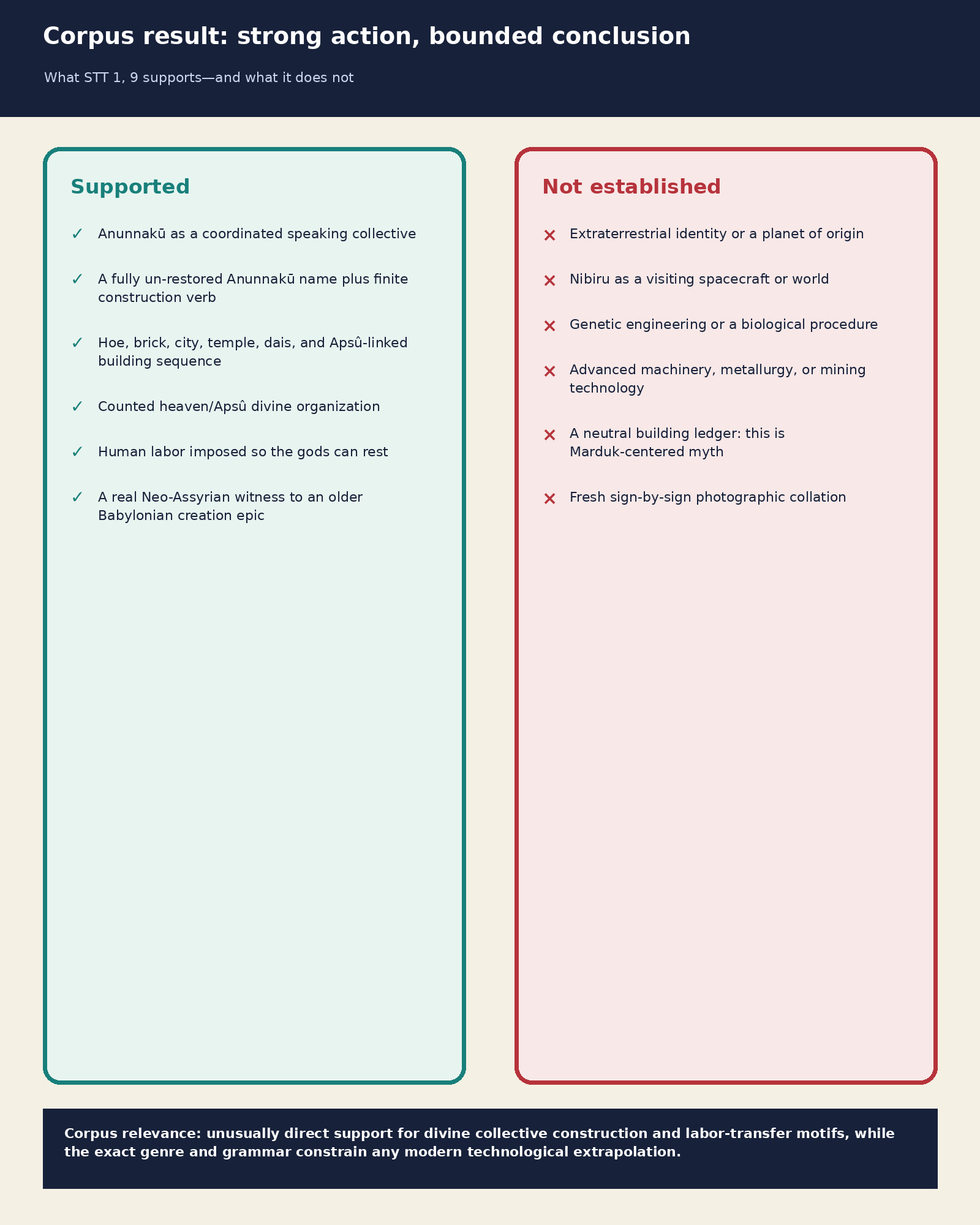
Main result: obverse 28′ preserves {d}A.NUN.NA.KI and the finite verb ibtašmū outside square brackets. That is stronger than mere proximity: the Anunnakū are grammatical actors in a construction clause. It is still Marduk-centered mythic theology, not a technical report and not evidence of spacecraft, genetics, or advanced machinery.

Why this exact witness matters
The earlier corpus entry surveyed Tablet VI across K.12000.B, VAT 9676, and BM 54855. Today’s advance is narrower and stricter: STT 1, 9 itself is mapped to the construction rows, and the image-to-text claim is limited to what its identifier-locked exact copy can support. CDLI P338325 identifies the tablet, Huzirina provenance, Neo-Assyrian date, SU 1952, 060 excavation number, and STT 1, 9 publication. ORACC CAMS/GKAB P338325 supplies the witness transcription and published English rendering. eBL SU-1952.60 independently repeats P338325 and STT 1, 9 and reports that no photograph is available.
CDLI currently lists the Anadolu Medeniyetleri Müzesi in Ankara, while eBL’s API labels the museum as Şanlıurfa Museum. The report does not silently reconcile that catalogue conflict. Identity rests on the shared excavation number, publication number, and P-number; current holding is reported as catalogue-disputed.

Image-to-text hard gate
The exact line art was opened at its original 825×3496 resolution. The obverse copy numbers the surviving register, allowing conservative whole-row placement at Tablet VI lines 59–60 (obverse 23′), 67–68 (obverse 28′), and 69 (obverse 29′). eBL’s manuscript apparatus independently maps SU-1952.60 to those line numbers. No word-level sign box is drawn. The classification is exact_line_art_or_squeeze_visible and edition-guided: the copy verifies row survival and damage/restoration status, while ORACC/eBL control sign values, word division, grammar, and translation.

Published translation and cautious working translation
Obverse 23′, published: “The Anunaku wielded the hoe. The first year they made bricks.” Working: “The Anunnakū took up the hoe; in the first year they formed its bricks.” The name and action are damaged-readable but not restored.
Obverse 28′, published: “After they had done the work of the Esaggil, all the Anunnaku created their own cult daises.” Working: “After the work on Esagil [had been done], the Anunnakū—all of them—fashioned their own cult daises.” The opening work verb is restored, so the exact-image core begins with the un-restored divine-group spelling and ends with the un-restored finite verb ibtašmū. Part of “all of them” is restored.
Obverse 29′, published: “The 300 Igigi of the heavens (and) the 600 of the Apsu all gathered.” This counted geography supplies context for the assembly, but the row does not itself spell Anunnakū. It must not be used as a substitute for the group-name rows.

What the construction chain actually says
After Marduk divides the divine stations, the Anunnakū speak as a group and offer to build. Marduk orders Babylon, molded brickwork, and a raised cult dais. The Anunnakū then take up the hoe and make bricks. The text continues through Esagil and the upper ziggurat of the Apsû before stating that all the Anunnakū fashioned their own cult daises. The sequence is unusually direct evidence for a divine collective as construction agents inside Babylonian myth.
The reverse summarizes the labor logic: Marduk created people and imposed the gods’ work on them so the gods could rest. This supports the corpus strand connecting human labor to organized divine order. It does not describe a biological procedure, and the damaged creation rows near the top of this witness are not promoted into independent image-decoded proof.

Corpus relevance and the Sitchin question
This witness supports a limited but important proposition: Mesopotamian tradition could portray the Anunnakū as an organized non-human/divine collective that deliberates and performs consequential building labor with hoes and bricks. It also links that activity to Babylon, Esagil, cult architecture, the Apsû, and a theology in which human beings bear divine work.
It does not identify the group as extraterrestrials, name Nibiru as their planet, describe spacecraft, encode genetic engineering, or preserve advanced technology. The tools are a hoe and brickmaking; the source is a learned creation epic copied centuries after its likely composition. The strongest conclusion is organized divine agency in a civilization-building myth, not a modern engineering dossier.
Sources and method
- CDLI P338325 / STT 1, 9 — exact artifact catalogue and line art.
- ORACC CAMS/GKAB P338325 — exact-witness transliteration and published translation.
- eBL SU-1952.60 — independent identifier, bibliography, and photo-availability control.
- eBL Enūma Eliš VI — current critical chapter context.
- ePSD2 summaries — lexical control for Sumerian Anuna/Anunak terminology.
Share this:

One considered email each week
TheCode Weekly Evidence Brief
Receive the week’s strongest tablet decode, source audit or research update, plus one carefully chosen archive read. Routine posts stay on the site; the Brief is the curated signal.
Free. Usually sent on Sunday. No daily post flood. Unsubscribe at any time. See what the Brief includes.


