
Enheduana’s Anuna Submit to Inanna: UET 6, 107A
Exact-object study of UET 6, 107A / P346192: the Anuna submit to Inanna and kiss the ground, while Enheduana’s legal petition remains a separate act.

Ancient text and site reading
How to read this record
- Claim type
- Historical / textual + interpretive
- Evidence level
- Sources, translations, measurements, and symbolic reading where present
Use the evidence layer for sources and observations, and the interpretation layer for TheCode.Wiki synthesis.
UET 6, 107A / U.7750 / CDLI P346192 is an exact Old Babylonian tablet witness from Ur to Q000623, Inanna B, better known as The Exaltation of Inanna. In reverse column i, the witness says that the Anuna submit to Inanna and kiss the ground for her. That is genuine, coordinated divine-group action on a photographed and copied artifact. Its historical meaning is hierarchy and ritual-political submission—not extraterrestrial technology, and not proof that the Anuna decided Enheduana’s legal case.

What this tablet is
- Physical witness: U.7750, published as UET 6, 107A.
- CDLI artifact: P346192, witness 009.
- Composition: Q000623, Inanna B / The Exaltation of Inanna.
- Date and place: Old Babylonian, excavated at Ur (Tell Muqayyar).
- Language and genre: Sumerian literary clay tablet.
- Collection: British Museum, London.
- Primary publication controls: UET 6, 107A; Hallo and van Dijk, The Exaltation of Inanna (1968), p. 37, as linked in CDLI’s current artifact record.
The current CDLI artifact HTML, JSON, exact photograph, exact line art, composite, and score were checked during this run. The photograph is a valid 1828×3200 JPEG and the copy a valid 1136×7602 JPEG. Both were opened at original resolution. The photograph visibly carries the publication marking U.E.T. 6/107A and excavation number U.7750; CDLI independently binds the object to P346192, Q000623, Ur, the British Museum, and the two primary publications. This convergence passes the exact-object identity gate.
The exact-witness Anuna stanza
P346192 artifact-specific CDLI edition; surface numbering and standard composition numbering shown together
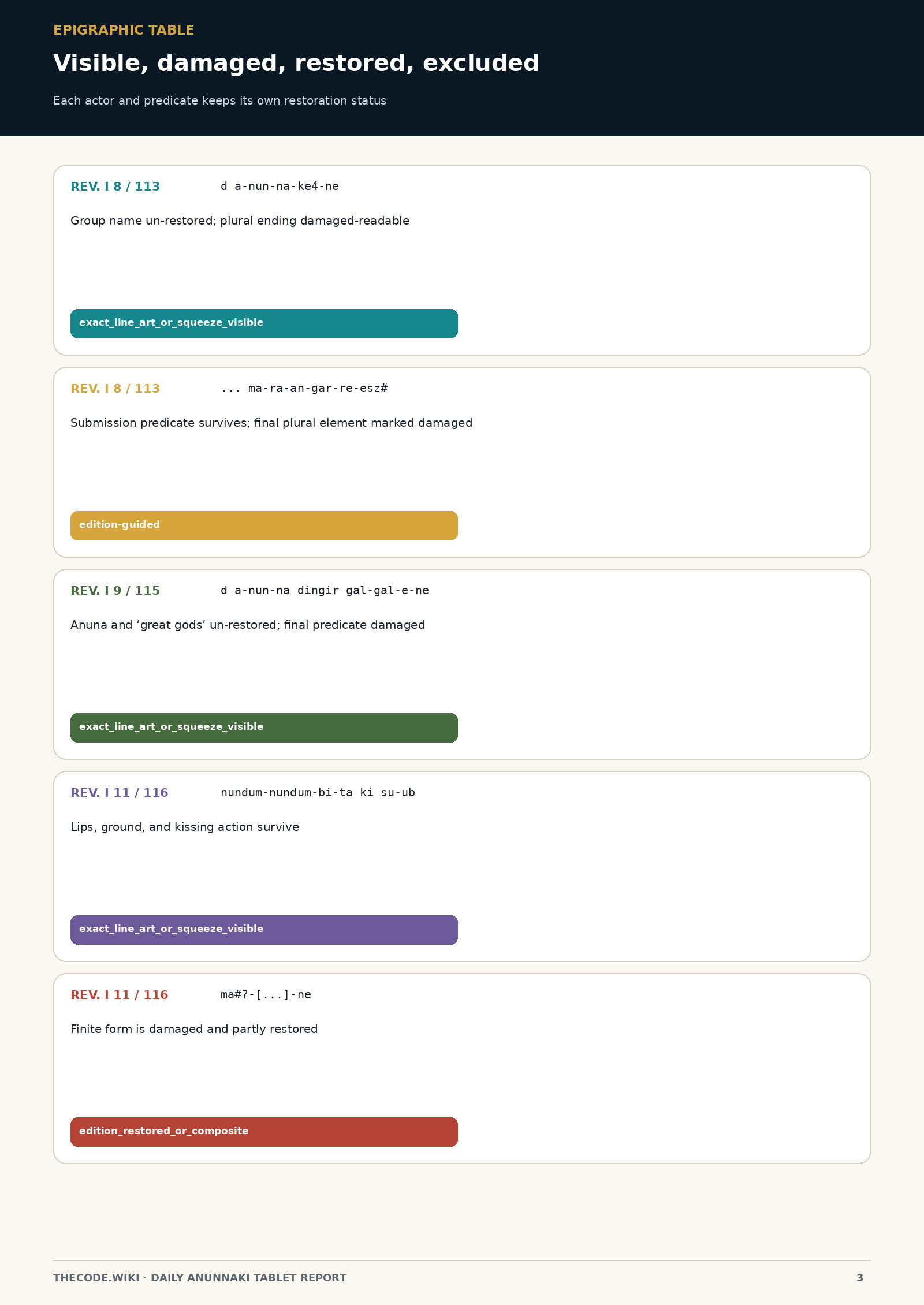
rev. i 8 / line 113: {d}a-nun-na-ke4-ne gux(GESZTIN) gesz ma-ra-an-gar-re-esz#rev. i 9 / line 115: {d}a-nun-na dingir gal-gal-e-ne e-ne ba-e-ne-diri#-garev. i 11 / line 116: {d}a-nun-na nundum-nundum-bi-ta ki su-ub ma#?-[...]-ne
Published CDLI translation: “The Anuna have submitted to you”; “How (you) have been superior to the Anuna, the great gods!”; and “The Anuna kiss the ground with their lips for you.”
Cautious working translation: “The Anuna gods yield before Inanna and perform ground-kissing submission for her.” This version keeps the minimum common sense of the passage without pretending that every damaged verbal element can be freshly read from the photograph. The Anuna names are un-restored. The plural ending in line 113 and the final predicate element in line 115 are damaged-readable; part of the finite form in line 116 is restored after damaged ma#?.

Image-to-text audit
| Locus | Edition evidence | Status | Exact visual claim |
|---|---|---|---|
| Rev. i 8 / 113 | {d}a-nun-na-ke4-ne | Group name un-restored | Exact numbered copy maps the row and cluster; photograph confirms object and row survival. |
| Rev. i 8 / 113 | ... ma-ra-an-gar-re-esz# | Submission predicate survives; plural ending damaged | Whole-row and copy-visible evidence; fine morphology remains edition-guided. |
| Rev. i 9 / 115 | {d}a-nun-na dingir gal-gal-e-ne | Anuna and “great gods” un-restored; final predicate damaged | The named collective and comparison survive on the exact witness. |
| Rev. i 11 / 116 | nundum-nundum-bi-ta ki su-ub | Lips, ground, and kissing action survive | The copy supports the locus; CDLI controls the linguistic analysis. |
| Rev. i 11 / 116 | ma#?-[...]-ne | Damaged and partly restored finite form | The missing portion is not claimed as photograph-visible. |
What submission means here
The passage belongs to Enheduana’s long first-person appeal to Inanna. The hymn magnifies Inanna’s terrifying and sovereign power, narrates Enheduana’s expulsion from her priestly office, asks divine powers to act against the rebel city and its ruler, and insists that the petitioner’s legal case remains unresolved. Against that setting, the Anuna stanza depicts the great gods as a coordinated body beneath Inanna: they submit, she surpasses them, and they kiss the ground.
That is stronger evidence for organized divine hierarchy than an isolated divine epithet. The collective is grammatically involved in plural actions. But the next distinction matters: response is not adjudication. Enheduana asks Inanna for a legal decision and says her case has not been finalized. The Anuna’s submission does not make them the court, the authors of the verdict, or the source of every adjacent curse.

Published translation versus working translation
- Published translation: CDLI’s artifact-specific English, quoted above, preserves the direct plural actions “submitted” and “kiss the ground.”
- Working translation: “yield” and “ground-kissing submission” summarize the minimum social gesture without overclaiming the damaged endings.
- Visible and unbracketed: the Anuna names; “great gods”; the lips/ground cluster; core predicate material.
- Damaged: the plural ending in line 113, the final predicate element in line 115, and
main line 116. - Restored: part of the finite form in line 116.
- Confidence: high for exact identity, locus, collective subject, and hierarchical response; moderate for independent fine-grained morphology.
Corpus relevance and the Sitchin test

Support: the exact witness directly presents the Anuna as an organized plural collective. Their coordinated submission and ground-kissing place them in a ranked divine order beneath Inanna. The wording belongs to a real Sumerian literary tradition, not a modern “Anunnaki tablet” invention.
Limit and contradiction: the same evidence narrows the claim. The Anuna are responders, not technical operators. The legal crisis centers on Enheduana’s appeal to Inanna; no surviving clause appoints the Anuna as judges. No creation, craft, measurement, transport, writing, engineering, kingship installation, or biological procedure is assigned to the group.
Sitchin relevance: this tablet supports the limited thesis that Mesopotamian theology described an internally ordered non-human/divine collective that could act together under a superior deity. It does not demonstrate extraterrestrial origin, Nibiru as a home planet, spacecraft, genetic engineering, gold mining, laboratories, machines, advanced technology, or a historical alien intervention.
A better decoding rule learned today

Today’s reusable improvement is a response-versus-adjudication firewall. For any legal or political prayer, record the petitioner, requested judge, named collective, collective response predicate, case/decree predicate, and restoration state independently. A group that bows, submits, or praises beside a lawsuit does not thereby become the court. Applied here, the Anuna’s direct actions are submission and ground-kissing; the unresolved legal decision belongs to Enheduana’s appeal to Inanna.
Sources
- CDLI P346192 — exact physical witness, artifact-specific transliteration and translation, exact photograph, exact line art, metadata, and bibliography.
- CDLI Q000623 — Inanna B composite and standard composition context.
- CDLI Q000623 score — current composite line numbering.
- CDLI exact photograph — the inspected P346192 / UET 6, 107A / U.7750 multi-view image.
- CDLI exact line art — the inspected numbered UET copy.
Evidence classification: exact_selected_artifact plus exact_line_art; exact_line_art_or_squeeze_visible for the mapped Anuna loci; overall reading edition-guided, with damaged and restored elements declared.
Share this:

One considered email each week
TheCode Weekly Evidence Brief
Receive the week’s strongest tablet decode, source audit or research update, plus one carefully chosen archive read. Routine posts stay on the site; the Brief is the curated signal.
Free. Usually sent on Sunday. No daily post flood. Unsubscribe at any time. See what the Brief includes.


