
CBS 13996: Enki, the me, and the Anuna Who Determine Fate
Exact-object study of CBS 13996 / P268989: Enki gives the me to the people, while the Anuna are lords who determine destiny.

Ancient text and site reading
How to read this record
- Claim type
- Historical / textual + interpretive
- Evidence level
- Sources, translations, measurements, and symbolic reading where present
Use the evidence layer for sources and observations, and the interpretation layer for TheCode.Wiki synthesis.
Daily Anunnaki Tablet Report — 11 September 2026 (Turkey time). Today’s object is Penn Museum tablet CBS 13996 / B13996, catalogued by the Cuneiform Digital Library Initiative as CDLI P268989. It is the sole listed witness to the royal inscription RIME 4.01.04.06, represented by composite CDLI P448291 / Q001950. The crucial passage distinguishes three kinds of agency: Enki possesses broad wisdom and gives the me to the people; the Anuna are named as lords who determine destiny; and Išme-Dagan remains the human king who performs the inscription’s fiscal, political, and dedicatory actions.

Result in one sentence: this tablet gives us a controlled bridge between the me and fate-setting, but it does so by preserving distinct divine offices—Enki gives the me, while the Anuna determine destiny—not by presenting a single undifferentiated “Anunnaki technology” narrative.
Download the six-page illustrated evidence report (PDF)
Why this tablet was selected
The daily corpus already contains many texts in which the Anuna appear as an assembly, witnesses, judges, mourners, or subordinate gods. P268989 adds a rarer conjunction. In reverse column 3, Enki’s wisdom and giving of the me immediately precede an apposition identifying the Anuna as fate-determining lords. Because P268989 is the sole listed witness for Q001950, the composite passage is not being projected across an unseen set of parallel tablets: the available edition maps to this one exact photographed object.
The selection also passes the duplicate gate. The artifact number P268989, museum numbers CBS 13996 and B13996, composition P448291 / Q001950, and designation RIME 4.01.04.06 were absent from the project ledger and evidence index before this run.
Object identity and provenance
- Museum number: CBS 13996; old number B13996
- CDLI artifact: P268989
- Composite/designation: P448291 / Q001950; RIME 4.01.04.06
- Period and place: Early Old Babylonian; excavated at Nippur
- Current collection: Penn Museum
- Visual used: current CDLI exact-object photograph, 3514 × 4869 pixels
Identity is supported independently by the CDLI P268989 artifact record and the Penn Museum catalog record. Both connect CBS 13996 / B13996 with P268989, Nippur, and Q001950. The exact CDLI photograph visibly includes “13996” on the object montage. The photograph establishes object identity and preservation; it does not, by itself, establish every sign value.
The image-to-text hard gate

The exact photograph clearly shows the tablet’s multi-view montage, breaks, preserved inscribed surfaces, and a narrow column on the lower reverse. It is adequate for exact-object identity and broad column survival. It is not an independently numbered copy and does not permit a responsible fresh sign-by-sign collation from this image alone. The following reading is therefore edition-guided: the photograph verifies the exact artifact and the relevant field’s survival, while the CDLI/RIME edition controls line labels and sign values.
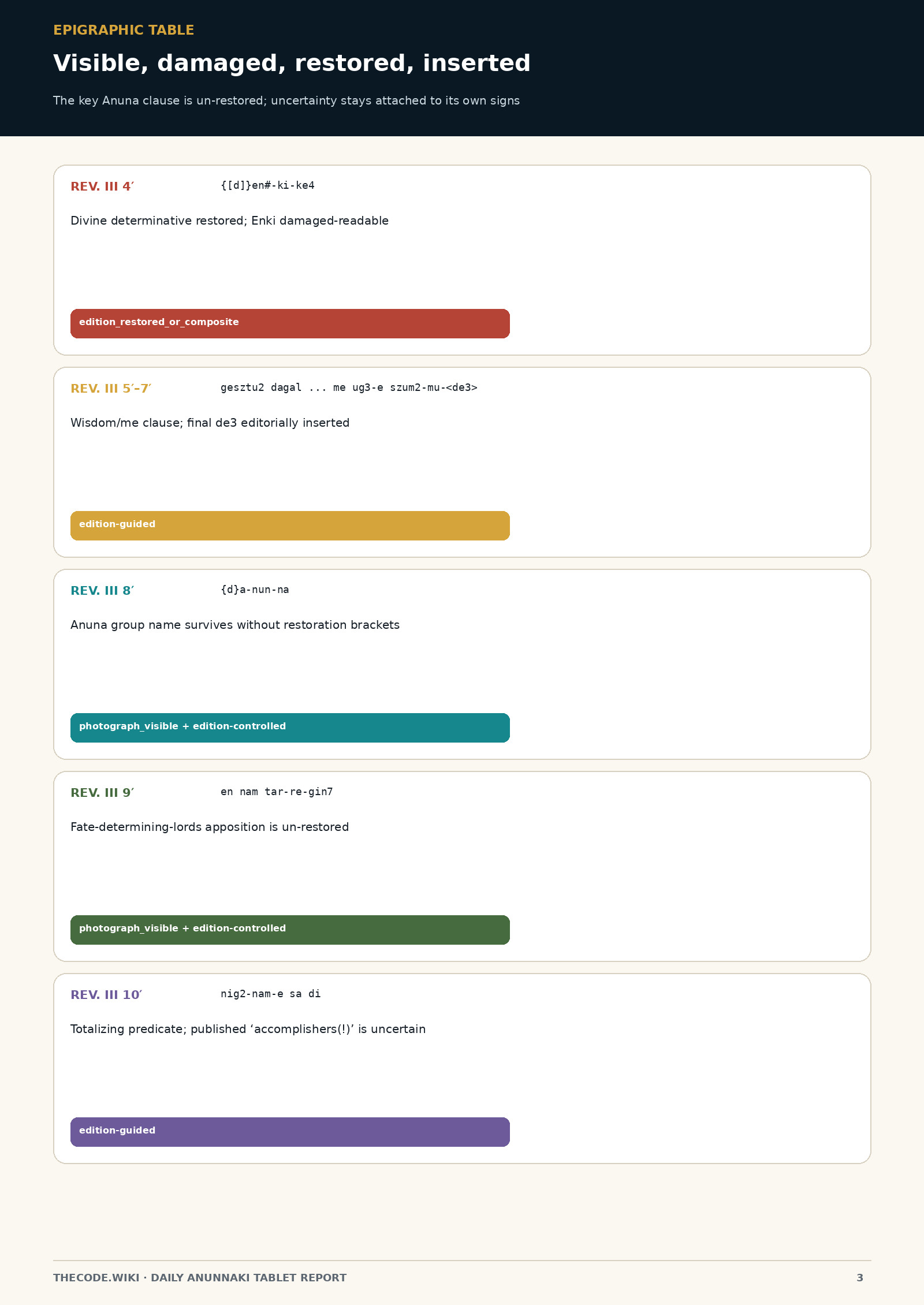
| Locus | Edition transliteration | Status | Exact visual claim |
|---|---|---|---|
| rev. iii 4′ | {[d]}en#-ki-ke4 |
The divine determinative is restored; Enki is damaged-readable. | The reverse-column field survives; the reading is edition-controlled. |
| rev. iii 5′–7′ | gesztu2 dagal / nig2-nam buru3-buru3-de3 / me ug3-e szum2-mu-<de3> |
Wisdom and me clause; final de3 is editorially inserted. |
No claim of independent sign decoding; exact object and column are photograph-visible. |
| rev. iii 8′ | {d}a-nun-na |
The Anuna group name is not restored in brackets. | Photograph-visible field plus artifact-specific edition; not a new collation. |
| rev. iii 9′ | en nam tar-re-gin7 |
The fate-determining-lords apposition is un-restored. | Same exact-object, edition-guided limitation. |
| rev. iii 10′ | nig2-nam-e sa di |
CDLI’s “accomplishers(!) of everything” carries an explicit uncertainty mark. | The uncertain interpretation is not promoted to a visually certain claim. |
Transliteration and published translation
The artifact-specific sequence in reverse column 3, lines 4′–10′ is:
{[d]}en#-ki-ke4
gesztu2 dagal
nig2-nam buru3-buru3-de3
me ug3-e szum2-mu-<de3>
{d}a-nun-na
en nam tar-re-gin7
nig2-nam-e sa di
CDLI’s published English describes Enki as one “that broad wisdom might penetrate everything” and as “the giver of the divine attributes to the people.” It then calls the Anuna gods “the lords who determine destiny” and, with an explicit editorial exclamation mark, “the accomplishers(!) of everything.” These quotations are kept distinct from the report’s working translation because the last phrase is uncertain and because the Enki line contains restoration and an editorial insertion.
Cautious working translation
Enki—so that broad wisdom may reach through everything, the one who gives the me to the people—and the Anuna, as lords who determine destiny, [with the following totalizing epithet left uncertain].
This wording preserves what is most secure without smoothing away the edition’s marks. The syntax forms a catalogue-like sequence of divine competencies. It does not warrant turning the Anuna into the grammatical giver of the me, and it does not warrant treating the uncertain final phrase as an unqualified description of omnipotence.
Who does what?

Enki: he is the wisdom-holder and giver of the me. His divine determinative is restored and his name is damaged-readable, so the state of the writing must remain attached to the claim.
The people: they are the beneficiaries of the me. Nothing in this clause says they are genetically created, engineered, or transformed.
The Anuna: they are identified as lords who determine destiny. The group name and fate-setting apposition are un-restored in the artifact-specific transliteration. The following totalizing predicate is less secure and must retain the edition’s question.
Išme-Dagan: the inscription’s human king is the political and dedicatory actor. Earlier lines describe relief from military service, tribute, and tithes and improvement of the land; later the king speaks and dedicates an object whose exact designation is broken or uncertain. These actions cannot be reassigned to Enki or the Anuna simply because all appear in the same composition.
What the passage supports
- A direct textual association between Enki, broad wisdom, and giving the me to people.
- A direct, un-restored naming of the Anuna immediately followed by their description as lords who determine destiny.
- A differentiated divine order in which competencies are allocated rather than flattened.
- A royal-literary setting in which divine praise and human governance are placed in relation without becoming identical kinds of agency.
What it does not support
The tablet does not identify the Anuna as extraterrestrials. It does not mention Nibiru as a planet, spacecraft, genetic engineering, laboratories, gold mining, mechanical devices, or advanced machinery. It does not say the Anuna give the me; that role belongs to Enki in this passage. It also does not say that Enki is one of the Anuna here. Those propositions would have to come from other evidence and cannot be imported into P268989.

Corpus significance
This witness fills a useful gap between two recurring strands in the corpus. One strand concerns Enki as a source of wisdom, order, and the me; another concerns the Anuna as a collective involved in destiny, judgment, or cosmic order. P268989 places these strands side by side without erasing their subjects. That makes it especially useful for testing claims that casually attribute every nearby divine action to “the Anunnaki.”
The evidence is strongest for the proposition “the Anuna are characterized as fate-determining lords.” It is also strong that Enki is the giver of the me to the people, subject to the explicitly recorded restoration and insertion. The broader inference that the sequence deliberately inventories separate divine offices is reasonable but interpretive, so it receives lower confidence than the individual grammatical roles.
Daily method improvement: adjacent-clause actor ledger
Today’s reusable improvement is an adjacent-clause actor ledger. For every compact divine catalogue, the workflow now records the wisdom holder, giver, beneficiary, fate-setting collective, uncertain predicate, human executor, and restoration state as separate fields before writing any synthesis. This prevents a named collective from inheriting an adjacent god’s verb or a king’s historical action. Applied here: Enki gives; the people receive; the Anuna determine destiny; Išme-Dagan governs and dedicates.

Primary records and reproducibility
- CDLI P268989 artifact record
- CDLI P448291 composite record
- CDLI Q001950 designation page
- CDLI exact-object photograph
- Penn Museum object 587477
Final evidence class: exact selected artifact photographed and inspected; broad reverse-column registration; artifact-specific edition; overall result edition-guided. The Anuna name and fate-setting phrase are un-restored in the edition, but the photograph is not claimed as an independent sign-by-sign decipherment.
Share this:

One considered email each week
TheCode Weekly Evidence Brief
Receive the week’s strongest tablet decode, source audit or research update, plus one carefully chosen archive read. Routine posts stay on the site; the Brief is the curated signal.
Free. Usually sent on Sunday. No daily post flood. Unsubscribe at any time. See what the Brief includes.


