
The Sultantepe Parallel: Anunnaku Bless Ea from Their Shrines
Exact-line-art study of STT 1, 67 / P338385: the complete Anunnaku name is un-restored as the group greets or blesses Ea from their shrines.

Ancient text and site reading
How to read this record
- Claim type
- Historical / textual + interpretive
- Evidence level
- Sources, translations, measurements, and symbolic reading where present
Use the evidence layer for sources and observations, and the interpretation layer for TheCode.Wiki synthesis.
Daily Anunnaki Tablet Report — 14 September 2026 (Turkey time). Today’s exact object is STT 1, 67, catalogued as CDLI P338385 and excavated as SU 1951, 060 at Huzirina, modern Sultantepe. This Neo-Assyrian Akkadian tablet preserves a lifted-hand prayer to Ea. Obverse line 10 says that the Anunnakū greet or bless Ea from their shrines.

Result in one sentence: P338385 gives the Anunnakū a genuine plural action and a distributed cult-place phrase, while the surrounding prayer assigns counsel and the “incantation of life” to Ea—not to the collective.
Download the six-page illustrated evidence report (PDF)
Why publish a second witness to this prayer?
The corpus already includes Iraq Museum tablet IM 067594 / CDLI P363581 / CTN 4, 167, which preserves the same Ea prayer from Kalhu. Reusing the composition is justified here because P338385 is a different physical artifact and materially improves the core clause: the Sultantepe witness preserves the complete written group name {d}A.NUN.NA.KE without square-bracket restoration. The earlier Kalhu witness restores NA inside that name.
This is therefore not a duplicate article. It is a named Sultantepe parallel and a restoration-delta study. The comparison asks a specific question: can a second exact witness strengthen the Anunnakū clause while preserving every editorial and grammatical limit? Here the answer is yes.
Object identity and provenance
- Primary designation: STT 1, 67
- CDLI artifact: P338385
- Excavation number: SU 1951, 060; normalized by eBL as SU-1951.60
- Period and place: Neo-Assyrian; Huzirina, modern Sultantepe
- Current collection: Anadolu Medeniyetleri Müzesi, Ankara
- Object: clay tablet, approximately 117 × 66 mm
- Exact visual: 463×1327 published line drawing; no current CDLI photograph is available
The CDLI P338385 record binds STT 1, 67, the excavation number, Huzirina, period, collection, dimensions, line art, primary publication, and external records. It links the artifact to eBL SU-1951.60 and to the artifact-specific ORACC CAMS/GKAB edition.
The exact-image and image-to-text gates

The original line-art file was downloaded from CDLI, validated as a nonempty JPEG, measured at 463×1327 pixels, hashed, and opened at original resolution. The copy labels obverse and reverse and prints the number 67. Its numbered row sequence makes obverse 10 defensibly locatable. Because no usable photograph exists, the provenance class is exact_line_art.
The textual evidence class is exact_line_art_or_squeeze_visible, with an edition-guided reading. The visual proves that the numbered row survives on this exact witness. It does not justify pretending that the report independently collated every wedge from a modest scan. ORACC’s artifact-specific edition controls the sign values, damaged-readable spans, the editorial insertion <ra>, Akkadian morphology, and the published translation.
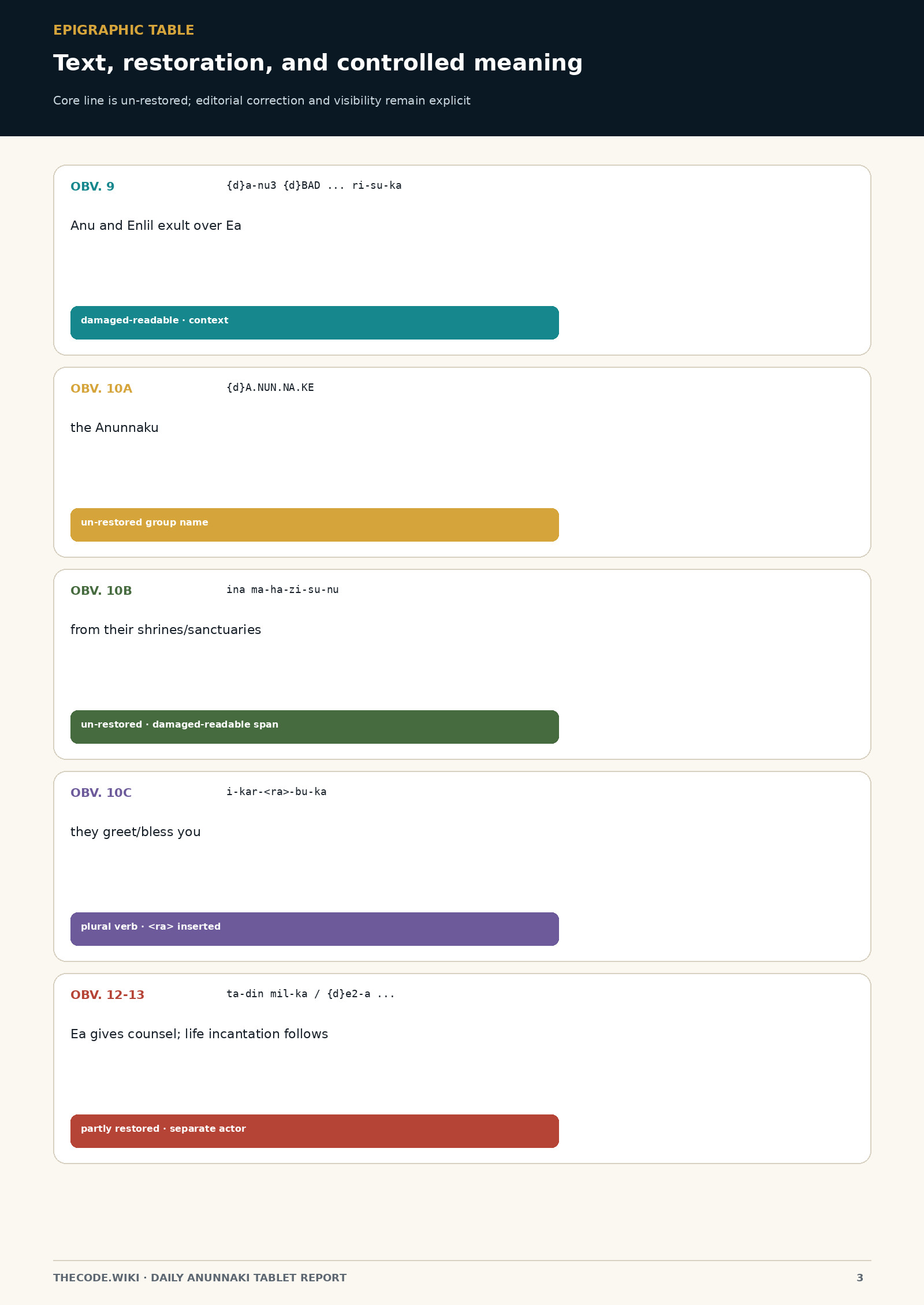
| Locus | Edition transliteration | Cautious sense | Status and limit |
|---|---|---|---|
| obv. 9 | {d}a-nu₃ {d}BAD ... ri-šu-ka |
Anu and Enlil exult over Ea | Damaged-readable context; not an Anunnakū predicate. |
| obv. 10a | {d}A.NUN.NA.KE |
the Anunnakū | Complete group name is un-restored in this witness. |
| obv. 10b | ina ma-ḫa-zi-⸢šu₂-nu⸣ |
from their shrines/sanctuaries | Outside square brackets; part damaged-readable. |
| obv. 10c | i-kar-⸢<ra>⸣-bu-ka |
they greet/bless you | Plural finite verb; <ra> is an editorial insertion. |
| obv. 12–13 | [ana] DINGIR-MEŠ ... ta-din mil-ka / [{d}]e₂-a ... |
Ea gives counsel; the life-incantation claim follows | Partly restored context and a separate grammatical actor. |
Published translation and cautious working translation
{d}A.NUN.NA.KE ina ma-ḫa-zi-⸢šu₂-nu i-kar⸣-<ra>-bu-⸢ka⸣
Published ORACC translation: “The Anunnaku greet you from their shrines.”
Cautious working translation: “The Anunnakū, from their sanctuaries, pronounce blessing to you.”
The working version does not replace the published rendering. It foregrounds the prayer-context range of Akkadian karābu, while retaining “greet” as ORACC’s translation. The third-person plural form makes the collective the clause’s actor. The second-person suffix points to Ea, the addressee praised throughout the prayer.
What changes between the Sultantepe and Kalhu witnesses?
P338385 / STT 1, 67: the group name {d}A.NUN.NA.KE is entirely outside square brackets. The location phrase and finite verb are likewise not reconstructed with square brackets, though portions are damaged-readable and the verb contains the editorial correction <ra>.
P363581 / CTN 4, 167: the parallel writes {d}A.⸢NUN⸣.[NA].⸢KE⸣ and restores part of maḫāzīšunu, while preserving the finite plural verb. That witness independently supports the same prayer line but has a weaker preservation state for the divine group’s complete spelling.
The restoration delta matters. A composite reading can conceal which witness preserves which signs. Comparing exact witnesses shows that the complete Anunnakū name is not merely reconstructed from the Kalhu tablet: it survives un-restored on the Sultantepe copy. At the same time, the comparison refuses the opposite mistake. P338385’s better group-name preservation does not erase the inserted syllable in the verb or turn an edition-guided row into a fresh sign-by-sign decipherment.

Who does what in the prayer?
Anu and Enlil: obverse 9 says they exult over Ea. They are subjects of their own clause.
The Anunnakū: obverse 10 makes them the plural subject of greeting or blessing Ea. The phrase “from their shrines” supplies a distributed cult-place setting. This is direct coordinated agency, not a passive list entry.
People of the land: obverse 11 says they praise Ea’s honored name. Human collective praise is a separate clause from the divine collective’s greeting.
Ea: obverse 12 says “you give counsel to the great gods,” and obverse 13 attributes an “incantation of life” to him. Those verbs and powers belong to Ea. The Anunnakū do not inherit them merely because their clause appears nearby.
The petitioner: later lines identify a human speaker and ask for release from unfavorable signs, heard speech, favorable pronouncement, health, and life. The prayer is an act of human ritual address.
What the artifact supports
- Strong evidence for an organized Anunnakū collective acting with a plural verb.
- Strong evidence that the group was conceived as present in multiple shrines or sanctuaries.
- Moderate evidence for Ea’s authority in relation to the group: they address him, while he gives counsel to the great gods in the following line.
- Strong witness-comparison value: P338385 preserves the complete group name un-restored where P363581 partly restores it.
What it does not support
The tablet does not describe extraterrestrials, spacecraft, genetics, laboratories, mining, advanced machinery, or Anunnakū medical technology. The verb is greeting or blessing, not creating humans, engineering devices, transporting cargo, or issuing a decree. Ea—not the Anunnakū—owns the adjacent counsel and life-incantation predicates. The exact line drawing verifies the physical witness and row map; it does not turn an edition-guided reading into independent pixel-level sign recognition.

Corpus significance
P338385 advances the Enki/Ea-authority and institutional-cult gaps in a bounded way. It supplies an exact second witness in which the Anunnakū collectively address Ea from their sanctuaries. The parallel comparison strengthens the name’s preservation while leaving the action modest: greeting or blessing. It also gives the corpus a useful anti-overreach control, because the text places the group immediately beside impressive claims about Ea’s counsel and life incantation without assigning those claims to the group.
For the Sitchin hypothesis, the strongest defensible relevance is that Mesopotamian learned tradition remembered an organized non-human/divine collective distributed across sanctuaries and acting coherently toward a senior deity. The witness does not establish that the collective was extraterrestrial or that the “incantation of life” encoded modern technology.
Daily capability improvement: restoration-delta witness matrix
Today’s reusable improvement compares exact parallels field by field: group-name signs, location phrase, finite verb, square-bracket restoration, damaged-readable signs, editorial insertions, and actor ownership. Applied here, P338385 upgrades the complete Anunnakū spelling; P363581 independently corroborates the clause; neither witness transfers Ea’s counsel or life-incantation predicate to the group.

Primary records and reproducibility
- CDLI P338385 artifact record
- Exact CDLI line art
- ORACC CAMS/GKAB P338385 edition and translation
- eBL SU-1951.60 identifier record
- ORACC AMGG Anunna terminology overview
- CDLI P363581 Kalhu parallel record
Final evidence class: exact_line_art and exact_line_art_or_squeeze_visible; the exact numbered copy aligns obverse 10, the complete Anunnakū spelling is un-restored in this witness, damaged-readable spans and the inserted <ra> remain explicit, and the translation is edition-guided.
Share this:

One considered email each week
TheCode Weekly Evidence Brief
Receive the week’s strongest tablet decode, source audit or research update, plus one carefully chosen archive read. Routine posts stay on the site; the Brief is the curated signal.
Free. Usually sent on Sunday. No daily post flood. Unsubscribe at any time. See what the Brief includes.


