
P334929: The Anunnaki Kneel in Marduk’s Council
Exact-photograph, edition-guided study of SAA 3, 2 obverse 26: the Igigi and Anunnaki are summoned and kneel before Marduk.

Ancient text and site reading
How to read this record
- Claim type
- Historical / textual + interpretive
- Evidence level
- Sources, translations, measurements, and symbolic reading where present
Use the evidence layer for sources and observations, and the interpretation layer for TheCode.Wiki synthesis.
Daily Anunnaki Tablet Report — 15 September 2026 (Turkey time). Today’s exact object is the joined British Museum tablet BM 099173+, catalogued as CDLI P334929 and published as SAA 3, 2, Assurbanipal’s Acrostic Hymn to Marduk and Zarpanitu. Its un-restored obverse line 26 summons the Igigi and Anunnaki and presents them kneeling before Marduk.

Result in one sentence: P334929 gives the Igigi and Anunnaki a secure collective posture inside a consultation scene, while Marduk remains the summoner, council focus, wisdom holder, judge, and praised king.
Download the six-page illustrated evidence report (PDF)
Why this tablet matters
The Anunnaki are often discussed as if every mention assigned them the spectacular action in the surrounding passage. This exact tablet permits a stricter test. It names the divine collectives and gives them a clear posture, but it also distinguishes the roles of Marduk, the engendering gods, the cult personnel, and the human royal speaker. That makes it useful for testing organized divine hierarchy without transferring unrelated verbs across grammatical actors.
The source is not a duplicate of an earlier corpus entry. P334929, BM 099173+, the join components, SAA 3, 2, and this council-response angle were checked against the ledger and evidence index before the exact photograph was downloaded.
Object identity and provenance
- CDLI artifact: P334929
- British Museum object: BM 099173+
- Join: K 07592 + K 08717 + DT 363 + 1904-10-09, 0205
- Edition: SAA 3, 2; primary publication ABRT 1, 29–31
- Title: Assurbanipal’s Acrostic Hymn to Marduk and Zarpanitu
- Period and place: Neo-Assyrian; Nineveh, ancient Kuyunjik
- Language and genre: Akkadian prayer/literary hymn
- Exact visual: current 3643×6030 CDLI/British Museum joined-object photograph
The CDLI P334929 record supplies the museum collection, complete join, period, provenance, genre, exact photograph, publications, and external records. The artifact-specific ORACC SAAo/SAA03 edition supplies the surface and line numbering, transliteration, English translation, title, and SAA designation. CDLI also links the museum object to British Museum W_K-7592.
The exact-image gate

The exact image was downloaded directly from CDLI, required to be a nonempty JPEG, measured, hashed, and opened at original resolution. The visible painted labels K.7592, K.8717, and DT.363 match three components in CDLI’s join record; P334929 and BM 099173+ provide two additional catalogue controls. This passes the provenance gate as exact_selected_artifact.
The photograph is not treated as a self-explanatory translation. It verifies the exact joined object, its obverse writing field, row survival, and identifiers. ORACC controls the identification of the group spellings, morphology, syntax, and English rendering.
The image-to-text gate

The textual evidence class is conservative whole-row photograph_visible, and the reading is edition-guided. This means the photograph independently supports the object, inscribed row zone, and preservation state, while the scholarly edition controls the signs and translation. It does not claim fresh pixel-level decipherment.
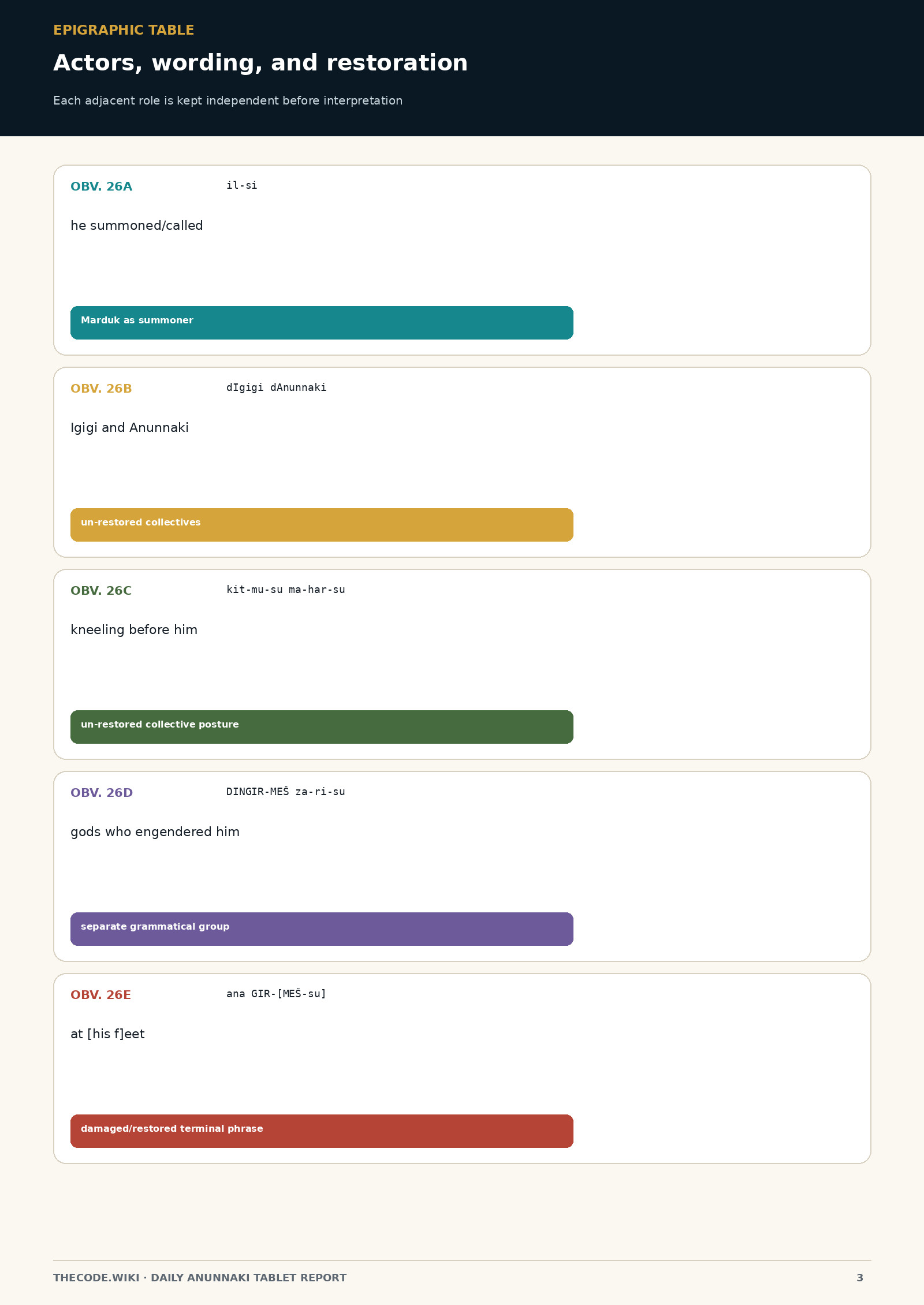
| Locus | Edition transliteration | Cautious sense | Status and limit |
|---|---|---|---|
| obv. 26a | il-si |
he summoned/called | Marduk is the summoner in the hymn’s discourse frame. |
| obv. 26b | {d}5.1.1 {d}600 |
the Igigi and the Anunnaki | Both group spellings are outside square brackets. |
| obv. 26c | kit-mu-su ma-ḫar-šu |
kneeling before him | Un-restored collective posture; edition-guided analysis. |
| obv. 26d | DINGIR-MEŠ za-ri-šu |
the gods who engendered him | A separate grammatical group with its own posture. |
| obv. 26e | a-na ⸢GÌR⸣-[MEŠ-šu] |
at [his f]eet | Terminal phrase is damaged/restored and excluded from the minimum claim. |
Published translation and cautious working translation
il-si {d}5.1.1 {d}600 kit-mu-su ma-ḫar-šu
Published ORACC translation: “He summoned the Igigi and the Anunnaki, they kneel before him, and the gods who begot him repose in silence at [his] f[eet].”
Cautious working translation: “He called the Igigi and the Anunnaki; they were kneeling before him, while the gods who engendered him rested silently at [his feet].”
The working rendering preserves the minimum grammatical distinction. Marduk calls; the two named collectives are presented kneeling; another group, “the gods who engendered him,” rests silently. The damaged/restored reference to feet is retained in brackets and is not needed to establish the collective posture.
What happens in the following lines?
Obverse 27: the edition continues with advice and lordly consultation, and restores part of the statement that attention is directed toward Marduk alone. This supplies the council setting, but restored attention language is not promoted into the core image-visible claim.
Obverse 28–29: offerings, incense, censers, musical instruments, praise of Esaggil’s builder, and Babylon’s rejoicing form a ritual and civic frame. These acts do not become Anunnaki craft or construction merely because they occur nearby.
Obverse 30: the Igigi and Anunnaki appear again among divine groups that submit to Marduk. This is valuable corroboration for collective response and hierarchy, but it remains a separate clause from obverse 26.
Who does what?
Marduk: he is the hymn’s addressee, summoner, council focus, bearer of wisdom and kingship, judge, releaser of subterranean water, giver of rain, and praised builder of Esaggil. These roles belong to Marduk.
Igigi and Anunnaki: they are summoned and presented kneeling in obverse 26. In obverse 30 they belong to the divine groups submitting to Marduk. These are real collective-response predicates.
Gods who engendered Marduk: the line distinguishes them as a separate group resting silently. Their description should not be flattened into the two summoned collectives without further evidence.
Human and cultic actors: the prayer belongs to learned royal and temple practice. Offerings, instruments, praise, manuscript production, and royal self-presentation remain human institutional actions.
What the artifact supports
- Strong evidence for the Anunnaki and Igigi as organized divine collectives summoned into a council scene.
- Strong evidence for coordinated hierarchy and response before Marduk.
- Moderate evidence for consultation context, because the following line contains partly restored attention language.
- Strong object-level evidence: exact photograph, catalogue join, visible component numbers, and artifact-specific edition converge.
What it does not support
The tablet does not describe extraterrestrials, Nibiru, spacecraft, genetics, laboratories, mining, or advanced machinery. It does not make the Anunnaki authors of Marduk’s wisdom, decrees, judgment, rain, subterranean water, construction, or kingship. Kneeling and submission are response predicates, not evidence of technical procedure. The exact photograph verifies the artifact and row survival; the reading remains edition-guided.

Corpus significance
P334929 advances the divine-assembly, consultation, hierarchy, and collective-response strands. It is especially useful because the Anunnaki are not merely in a deity’s title or a nominal list: the group appears inside a scene of summons, posture, and consultation. At the same time, it does not close the corpus’s harder gap—a photographed witness where an un-restored Anuna/Anunnaki subject performs a concrete creation, craft, measurement, transport, knowledge, or decree verb.
For the Sitchin hypothesis, the strongest defensible relevance is that Mesopotamian learned tradition represented the Anunnaki as an organized non-human/divine collective inside a ranked council. That is compatible with one limited component of the broad hypothesis. This text does not identify the collective as extraterrestrial and does not supply modern technological content.
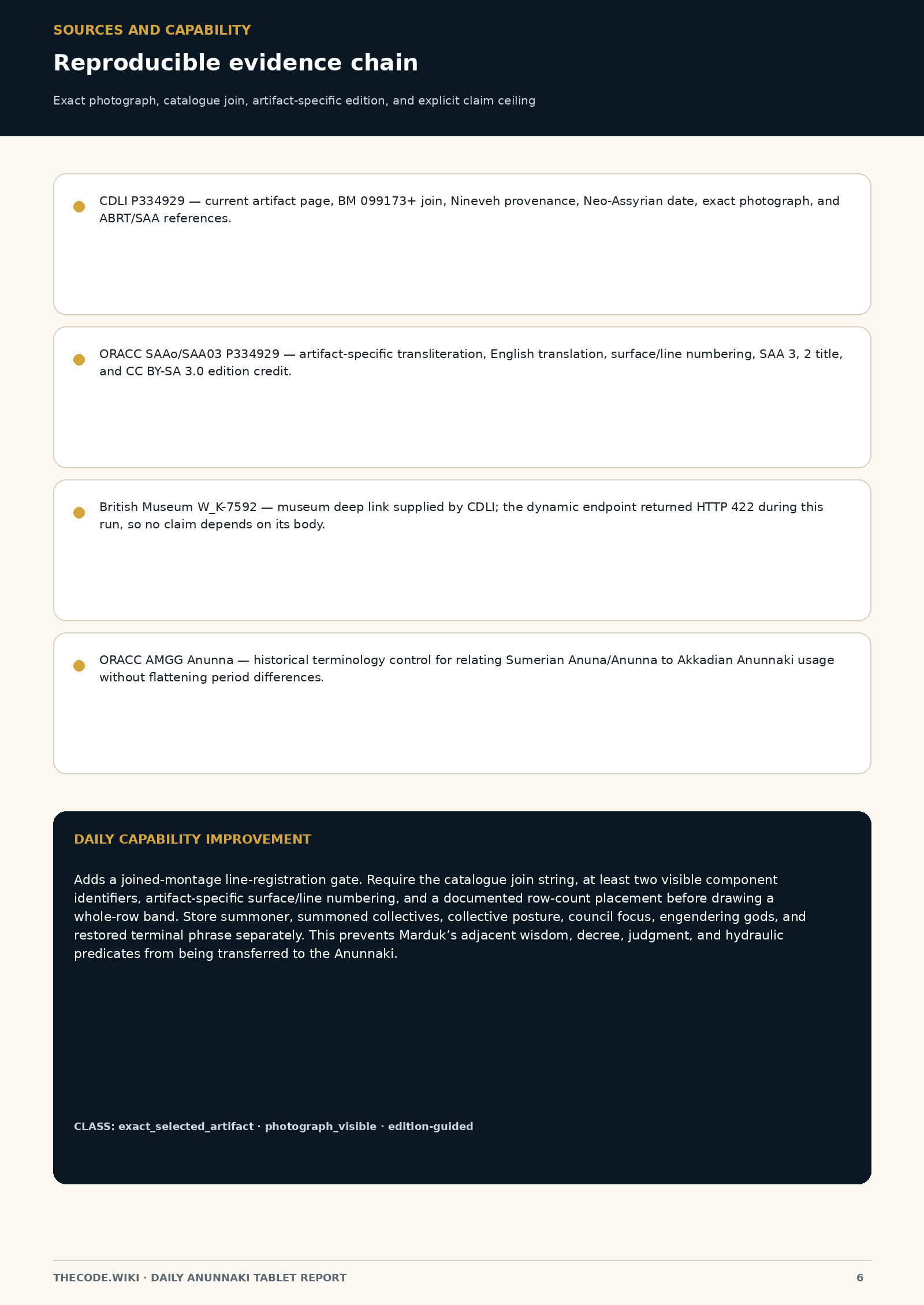
Daily capability improvement: joined-montage line registration
Today’s reusable improvement requires four controls before drawing a whole-row band on a multi-fragment photograph: the catalogue join string, at least two visible painted component identifiers, artifact-specific surface/line numbering, and a documented row-count placement. The actor ledger also stores summoner, summoned collectives, collective posture, council focus, engendering gods, and restored terminal phrase separately. This prevents Marduk’s adjacent wisdom, decree, judgment, and hydraulic predicates from migrating to the Anunnaki.
Primary records and reproducibility
- CDLI P334929 artifact record
- Exact CDLI/British Museum photograph
- ORACC SAAo/SAA03 P334929 edition and translation
- British Museum W_K-7592 record
- ORACC AMGG Anunna terminology overview
Final evidence class: exact_selected_artifact and conservative whole-row photograph_visible; the group names and kneeling phrase are un-restored, the terminal feet phrase is damaged/restored, and signs, grammar, and translation remain edition-guided.
Share this:

One considered email each week
TheCode Weekly Evidence Brief
Receive the week’s strongest tablet decode, source audit or research update, plus one carefully chosen archive read. Routine posts stay on the site; the Brief is the curated signal.
Free. Usually sent on Sunday. No daily post flood. Unsubscribe at any time. See what the Brief includes.


